Monday, August 4, 2008

Total solar eclipse observed well from Asia, sea and air

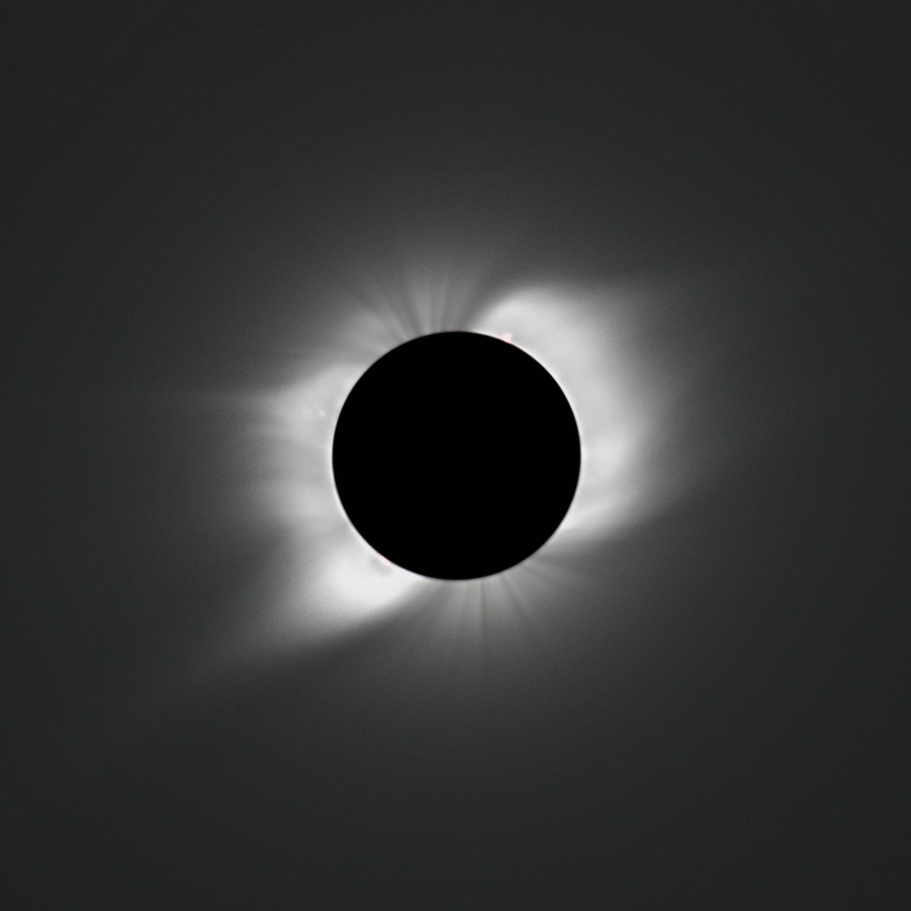
As with the previous total solar eclipse in 2006 the view was clear along much of the track of totality during the TSE of 1 August 2008 - from places in the Arctic sea (with dismal weather stats) through Russia, Mongolia and China where the eclipse was even visible a few degrees above horizon in its central region. And there were even two eclipse flights, originating in Germany and Canada.

Three days later the web is full with early impressions and detailled reports - and it became clear that the corona's shape had been predicted very well several days ahead, as a comparision with a first composite by Lüthen (explained here) shows.

There are now picture galleries by SpaceWeather, S&T, LA Times, Welt, Chicago Tribune, Tagesschau and even the Huffington Post - and radioastronomical amateur observations of the partial phase. Individual links follow, sorted by region along the track.General coverage of the eclipse (covering its impact in several places) was provided by Sky & Tel., LA Times, MSNBC, BBC, CNN, AP, IB Times, Bild (with Reuters video, also here), Sat1, N24 (with other video), T-Online, DPA, News and in this video. And there was even an unusual view from space, explained here.

Monday, July 21, 2008

First total eclipse of the Sun in over two years top event of August

Yours truly will go to China today for two weeks to intercept the phenomenon from the headline in Xinjiang and it is not clear (yet) whether continuing to update this blog will be possible on the road. Thus the sky highlights of August 2008 come to you already today.
  • Aug. 1: Total Eclipse of the Sun in Greenland, Canada, Russia and China - there's more info here and esp. here while webcasts are/will be linked here and here and there are already blogs of folks going to Mongolia and Siberia.

  • Aug. 2: Very young Moon 4° from Venus; evening apparition of the latter get's going.

  • Aug. 5: Venus near Regulus just after sunset.

  • Aug. 12, around noonn UTC: Maximum of the Perseids (waxing Moon setting after midnight).

  • Aug. 13: Venus just 0.2° from Saturn (telescope required).

  • Aug. 15: Neptune in opposition at 7.8 mag. in Cap.

  • Aug. 16/17: Partial lunar eclipse, max. phase 81%
In other news the apparent survival of the Little Red Spot in Jupiter's clouds can be seen in images from July 18, July 17 and July 15 (lower-res views from that date here and here); a much-quoted Hubble press release on its demise was premature. More challenging Jovian sights? How about Amalthea with 80 cm?

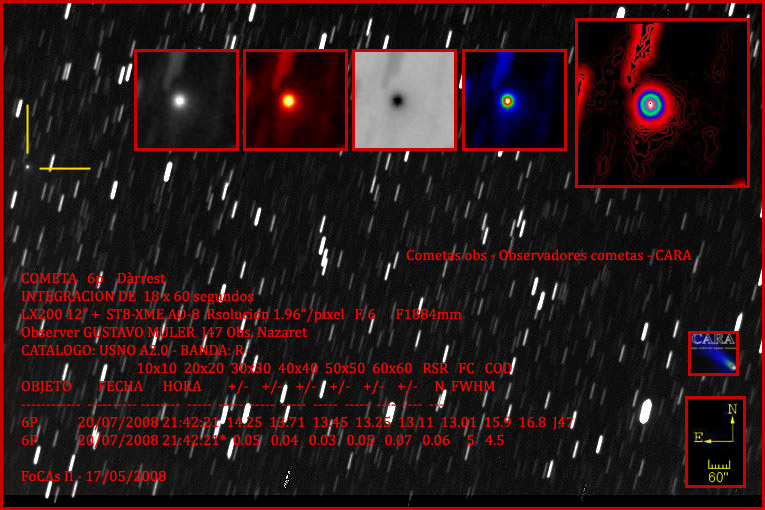
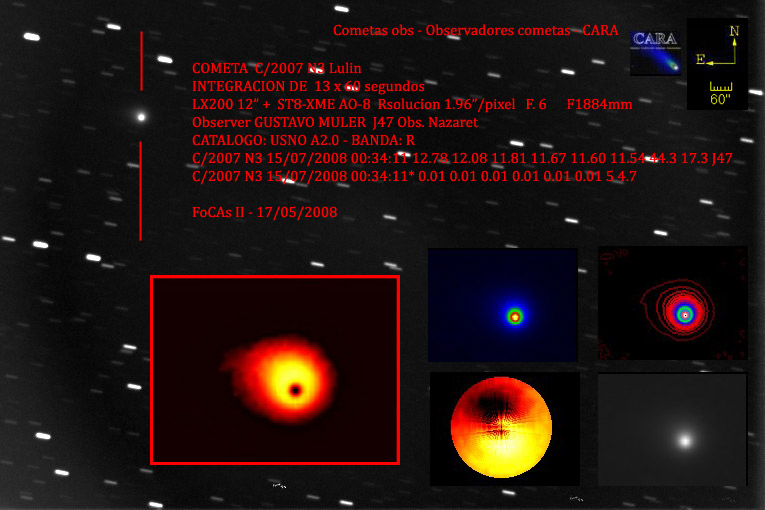
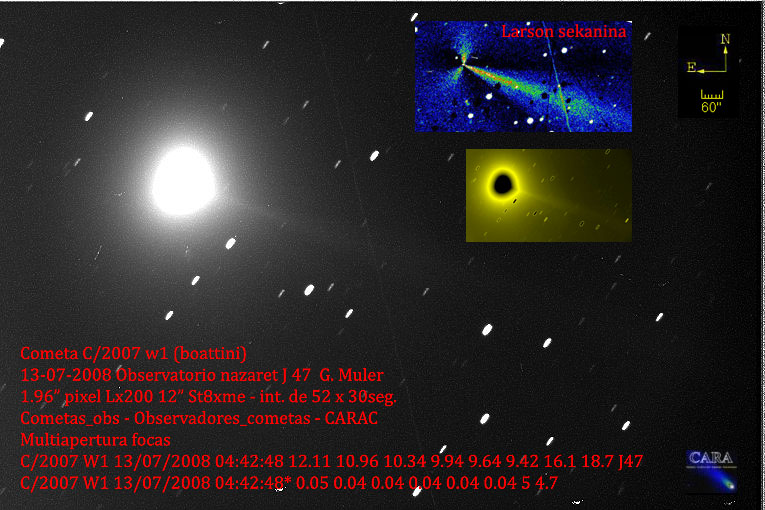
• The light curve of Boattini is going down; also pics of d'Arrest, Lulin and Chury. • A paper on next year's Epsilon Aur campaign and how to contribute with small equipment. • How a newspaper covered a green flash, and NLCs over Iran. • The Moon transits Earth as seen by EPOXI. And an ISS movie of July 14.

Tuesday, July 15, 2008

2005 FY9 becomes 4th dwarf planet, named Makemake

The official list of dwarf planets now has four entries: Kuiperoid 2005 FY9 alias (136472) alias Makemake - see here for pronounciation issues with this Polynesian word - joins Ceres, Pluto and Eris and is also the 3rd official plutoid. Its naming decision seems to have been relatively uncontroversial while the third big Kuiperoid announced in 2005 still has to wait because there's a lingering question of priority over 2003 EL61. Which is also not exactly spherical but shaped like a football due to its fast rotation, a fact that might even threaten its future classification as a dwarf planet, despite its size. (This incidentally calls into question the "hydrostatic equilibrium" demand as a key criterion for both planets and dwarf planets: Even beyond a diameter of 1000 km a body can still be very un-spherical.)

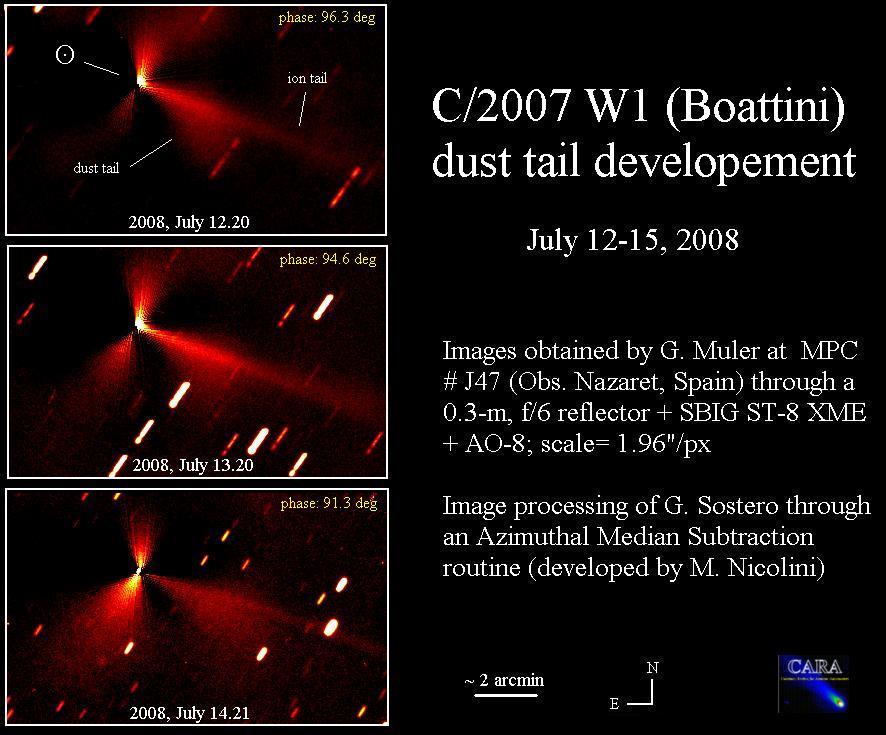
In other news NASA's Wayne Hale recalls a solar flare scare on the ISS in 2006. • There is a new candidate for the brightest star in the Galaxy. • And to look at: a movie clip of 2008 BT18 near Earth, heavy image processing of comet Boattini, apparently revealing a dust tail next to the ion tail, and hi-res images of the ISS from 14 July and 13 July showing well the new Columbus and Kibo modules.

Monday, July 14, 2008

Binary asteroid - main body ~600 meters - to come within 2.3 million km today

A binary asteroid discovered last winter, 2008 BT18, will approach Earth to within 0.1509 AU or 2.26 million kilometers later today (closest approach is around 14:00 UTC): nothing to worry about but a fine opportunity for intense radar imaging a few days ago. Visual observers have a harder time: Yesterday the phase angle was around 150°, with the asteroid very close to the Sun in Mon and CMa, now its moving away from the Sun's glare but rushing South. Today it moves through Lep and Col, in a few days it'll be at -50° declination. The brightness, at least, should stay rather constant around 13th mag. as more and more of its bright side is facing Earth.

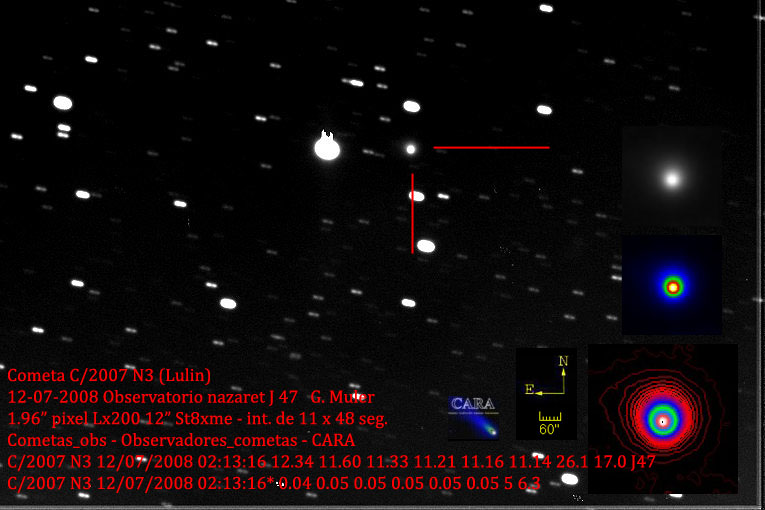
In other news we have images of the big Boattini of July 13 and July 12, little Boattini of July 11 and Lulin of July 12 and July 11. • The developments around the Great Red Spot on Jupiter can be tracked in image collections of July 13 (the Little Red Spot seems back!), July 12, July 10, July 8 and July 7 (no images of the right area were archived for July 9 and 11). • Finally a nicely edited video of the total solar eclipse of 2003 from an airplane, with many soundbites ...

Saturday, July 12, 2008

Phoenix color panorama (pretty) complete - thanks to an amateur

As usual these days - with raw images from (NASA) space missions being distributed in near-real time - it was an amateur who has created the first complete panorama around the Phoenix lander in color; there are still some minor flaws, but now you know where "we" stand. • In other planetary news Jupiter images of July 11 and July 10 show only remnants of the Little Red Spot which may have been severely damaged after all when it 'collided' with the other two red storms. • Also wide-angle views of the Mars/Saturn conjunction from July 10 in Austria and earlier in Australia plus from July 9, earlier pics and the view of July 5 with a fire in California.

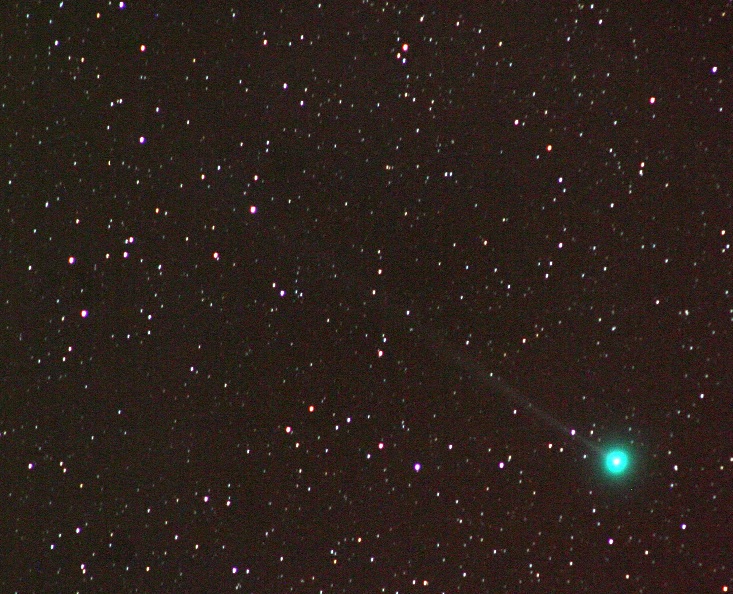
In other solar system news comet C/2007 W1 (Boattini) is back - though very low - for Northern observers who caught it well on July 11 (more and a wide-field view plus a visual report). • The Moon has been imaged with extreme libration, exposing the North Polar Region. • And there is no reason yet to worry about the long solar minimum.

Tuesday, July 8, 2008

Three storms on Jupiter converged, seem to have survived each

When a third, tiny "red spot" appeared in Jupiter's clouds this spring (mentioned here and in the Cosmic Mirror's header), it was clear from the windspeed pattern that the three would meet soon: What would that do to the smaller storms? As several hi-res amateur images collected by SpaceWeather show, the newest red one seems to have made it through inbetween the GRS and the Oval BA aka. Red Spot Junior. More images in the coming days will show whether it is 'unharmed'; meanwhile here are more and more and more images of the quadruple conjunction hailed in the last posting.

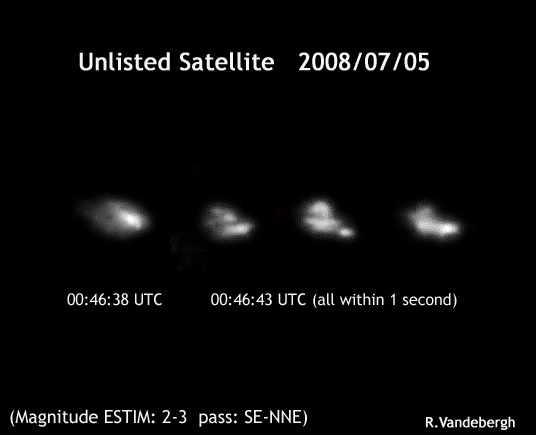
In other news the coma of one comet Boattini (W1) looks strage while the other Boattini (J1) is also elongated while Lulin is fainter again. • A newspaper covers the fun in chasing eclipses while • others take resolved images of mysterious satellites that are not listed officially yet pretty bright ...

Monday, July 7, 2008

2 planets, one moon, one star: rare quartet seen in evening skies

In the Americas this show is still ahead, in Europe, Africa, Asia & Oz it's history: On the evening on July 6, the crescent Moon joined the planets Saturn and Mars - lined up with the bright star Regulus - for a nice celestial trio: Here are pictures taken by this blogger and others in Germany a few hours ago, while in Australia the view had been quite different, and two nights ago there was no Moon. • Meanwhile Jupiter is near opposition and has been imaged frequently, e.g. on July 6, July 3 (with Callisto and its shadow on the disk), July 1 (with Io and its shadow on the disk) and June 28. • And observations of Venus 1999 to 2006 appear in a report for the BAA.

In other news here are amazing hi-res images of the Sun (no spots, just granulation details) • and of comets Lulin (more) and Boattini (light curve). • An NLC animation of 2 July is contained in this story; these super-high clouds have been quite active recently, even at 48° latitude. • Finally, do you believe that this is an image of M 57 in broad daylight? A heated debate is going on right now ...

Tuesday, July 1, 2008

Planets/Regulus line-up, Jupiter opposition visual highlights in July

Already low in the evening skies for Northerners, a line-up of Saturn, Mars & Regulus and various closest approaches of the three objects promise to be the main visual sky event, followed by Jupiter's opposition:
  • July 1: Mars 0.7° from Regulus
  • July 6: Moon passes Mars & Saturn
  • July 9: Jupiter in opposition (there have been great views from down under and even possible details on Ganymede imaged)
  • July 11: Mars 0.6° from Saturn
  • July 12: Venus greatest brilliance in evening sky
The current trio of bright dots may actually have been responsible for several UFO reports like this in which the visibility lasted long ...

In other news there are indications that comet Lulin may be taking off: It's now at 10.6 mag. and could put on a nice show next February. Also • a picture of Boattini from June 28, • a dramatic prominence animation and • Mike Brown setting ground rules for debating "what's a planet" ...

Saturday, June 28, 2008

1500th SOHO comet found - satellite most prolific comet hunter ever

The ESA/NASA SOHO spacecraft has just - on June 25 - discovered its 1500th comet with its LASCO coronagraph, making it more successful than all other comet discoverers throughout history put together. Not bad for a spacecraft that was designed as a solar physics mission. Of course, LASCO itself does not make the detections; that task falls to an open group of highly-skilled volunteers who scan the data as soon as it is downloaded to Earth. Once SOHO transmits to Earth, the data can be on the Internet and ready for analysis within 15 minutes; enthusiasts from all over the world then look at each individual image for a tiny moving speck that could be a comet. For direct viewing, meanwhile, Boattini is returning to Northern skies.

In other news an amateur may or may not have detected Pluto's moon Charon with an 80-cm reflector (also M. Brown on classifications and a video of the recent occultation). • Jupiter from Germany and Puerto Rico, Mars in daytime and a preview of Mars meeting Saturn. • What a low solar max would mean for space debris, how an asteroid got named John, and NLCs on June 26 - they are surging now. • Dark sky status for Cherry Springs. • Pictures of a weird rocket body. • The strange "Deep ILmpact" web tv event (about a fictional impact in Germany) is coming today. • And here's to the KBA at 5 years (with yours truly featured on page 41)!

Sunday, June 22, 2008

Aussie amateur records Pluto occult a star!

A few hours ago Dave Gault in Australia took this nice light curve of dwarf planet Pluto occulting a star of 12th magnitude in Sgr, using a 10" Newton and a WAT-120N video camera: The star was gone for 113 seconds. This occultation had been deemed very important for scientific studies of the Pluto system.

In other news Venus is the evening 'star' again, having been recovered in Munich's dusky skies yesterday. • Despite its low elevation in Germany, detail-rich Jupiter images have been obtained this morning (more, more) as well as on June 21, June 20 and June 19. • And here's a moderately entertaining/scary chart of famous NEOs and how close they came/will come to Earth ...

Saturday, June 21, 2008

Just some pretty - or unusual - pictures ...

There was no true "Breaking News" event this week, but some pretty amazing celestial pictures taken by amateur astronomers have been published in recent days, worth a post after all:Incidentally a fine Omega effect had been seen during a partially eclipsed Sunrise in 2006, also yours truly - an inferior mirage in action. (Later I also found out where this appearance of the Sun had first been compared to an Etruscan vase: It was in Jules Verne's novel Le Rayon Vert, during the final "showdown" - on page 287 of this German translation.) Atmospheric optics is cool - but beware of faulty interpretations ...

In other news it has been determined that a recently discovered comet was very close to Jupiter in 2005, while another one came too close to the Sun on June 16. • More image processing of the June 14 Jupiter shown in the last post and another one from June 19. • And this blog has learned about an unsuccessful attempt to catch the Venus occultation by the Sun in Tasmania; here is a digital version of the newspaper article announcing the plan.