Solar observers are celebrating a small sunspot from the new cycle that has just appeared - after so many months of low activity even this minute visitor is welcome. But is the current solar minimum really longer than any in recent memory? Indeed it is, an important analysis by Peter Meadows in The Astronomer (45 [Aug. 2008] 99-100) recently showed, but there have been much longer minima in the past centuries. He defines the length of the minimum as the interval when the 13-month average of the international sunspot number falls below 20: These periods have ranged from just one year in 1965 to 8 years in the early 19th century.
The smoothed number fell below 20 in January 2006, and thus the current minimum will last at least 2.5 and perhaps 3.5 years. In any case it is the longest since the one from 1931-35, confirming the suspicions of an unusually long one - on the timescale of a human life, that is. Meadows also finds a moderate correlation between minimum duration and the height of the next peak: expect a moderate one with a maximum smoothed number of 110 to 120. According to Ulysses data, by the way, the solar wind is at a 50-year low: NASA will hold a telecon about that finding later today.
In other news here is an idea about Jupiter's Red Spot Junior color change: "an upward and inward diffusion of either a coloured compound or a coating vapour that may interact later with high energy solar photons." • Comet 29P is in outburst, having risen from 14 to 11.5 mag. • There was an impressive fireball over SoCal on Sep. 19. • A minor planet passed close to Uranus, looking like another moon. • Some images (more, more, more and more) of the Moon vs. the Pleiades on Sep. 20 as seen from Europe. • And image processing seems to reveal blue Earth reflected by the ISS ...
Tuesday, September 23, 2008


Friday, September 19, 2008
Record distance for gamma ray burst: redshift 6.7!
GROND, the Gamma-Ray Burst Optical Near-IR Detector sitting behind an old 2.2-meter telescope in Chile, on September 13 has found the most distant gamma-ray burst ever detected. Alerted by the Swift satellite, the unique instrument taking images in 7 different colors obtained a rough redshift only minutes later, which was confirmed 1½ hours later with the Very Large Telescope. At a redshift of 6.7 GRB 080913 occurred less than 825 million years after the Universe began, and the star that popped off this shot seen across the cosmos died when the Universe was less than one-seventh its present age. The most distant GRB before had a redshift of 6.3 and was was 70 million light years closer to us. • And another astrophysics record of some importance: the least luminous galaxy is the dwarf Segue 1, full of dark matter.
In other news a sensational new image composite of the 1 August TSE has been released by M. Druckmüller, showing coronal streamers for 20 solar radii and many stars, including the Beehive cluster, in the background. • Tonight the Moon once more occults the Pleiades, in Europe only on Saturday morning. • The evening planets as seen from Oz in mid-September.
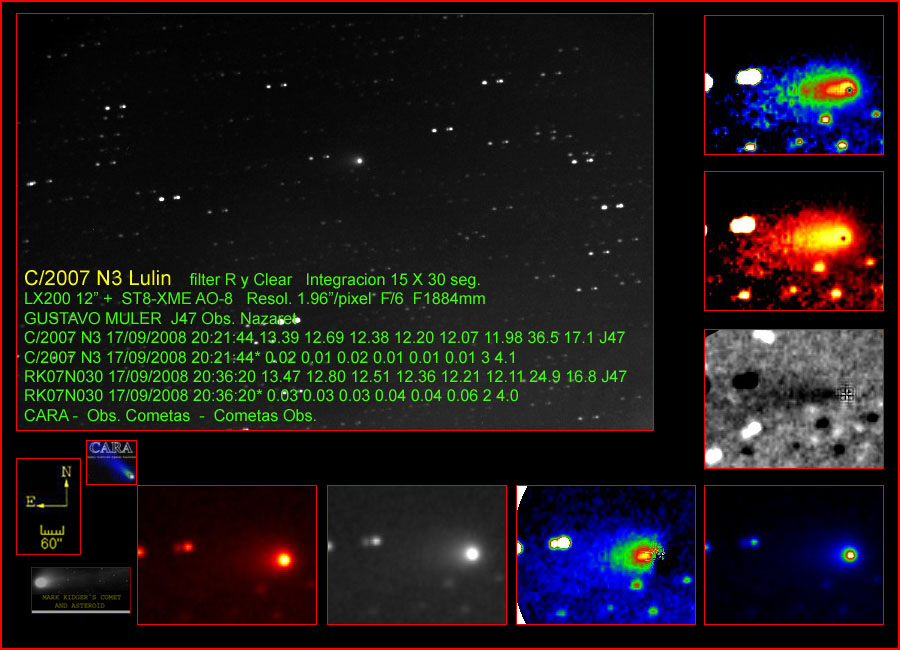
• Comet Lulin on the 17th - and new page on all comets in the sky right now and how easy or hard they are. (This and this catalog are excellent additions.) • Two bright sun dogs today. • A political article on light pollution as an overlooked environmental problem. • The ISS transiting the Moon and in much detail. • And ... it's alive: ISEE 3 alias ICE, the first spacecraft to visit a comet. Which was in 1985, already in an extended mission!
In other news a sensational new image composite of the 1 August TSE has been released by M. Druckmüller, showing coronal streamers for 20 solar radii and many stars, including the Beehive cluster, in the background. • Tonight the Moon once more occults the Pleiades, in Europe only on Saturday morning. • The evening planets as seen from Oz in mid-September.
• Comet Lulin on the 17th - and new page on all comets in the sky right now and how easy or hard they are. (This and this catalog are excellent additions.) • Two bright sun dogs today. • A political article on light pollution as an overlooked environmental problem. • The ISS transiting the Moon and in much detail. • And ... it's alive: ISEE 3 alias ICE, the first spacecraft to visit a comet. Which was in 1985, already in an extended mission!
Wednesday, September 17, 2008
Now all five dwarf planets have real names!
Amidst unresolved issues regarding the circumstances of its discovery, the big and weird Kuiper Belt Object 2003 EL61 has been named Haumea and is now listed as the 5th dwarf planet, joining Pluto, Eris and Makemake in the Kuiper Belt and Ceres in the main belt of asteroids; no further immediate candidates for ascension into this category of solar system bodies introduced only in 2006 are known. The two satellites of Haumea are now called Hi'iaka and Namaka. While the IAU refrains from saying anything about the discoverer(s) of Haumea, the USGS in its list locates the discovery telescope in Spain (where it was imaged but not recognized in 2003) yet also names no people. Mike Brown, who hit upon the same body in 2004, realized that it was something important and is generally credited with the discovery, meanwhile in great detail reiterates his claim of being the rightful owner of this dwarf planet. And indeed the IAU used his 2006 proposal for the name.
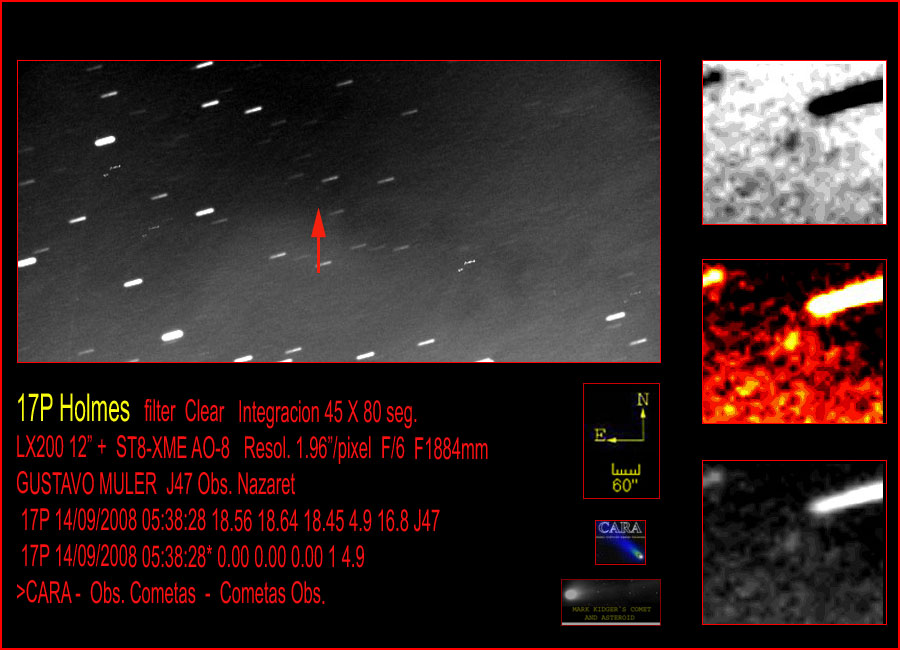
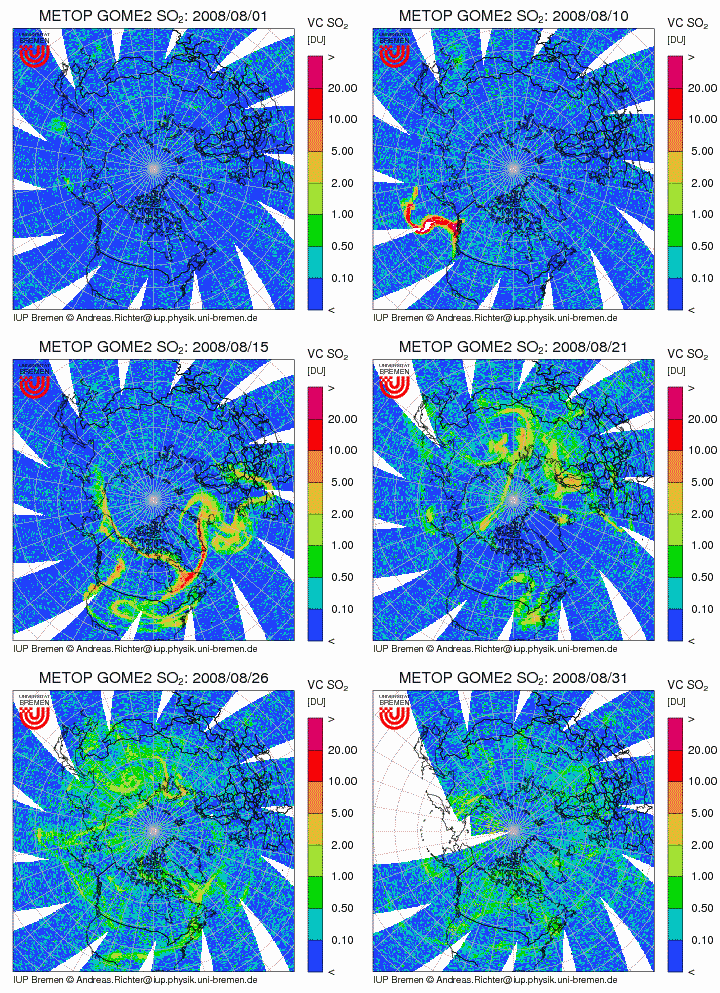
In other news this image may be the first one of comet P17/Holmes after its conjunction with the Sun, though it shows only the very core of the coma. • An interesting animation based on Metop data shows how the Kasatochi aerosols swept around the globe - so these weird post-sunset colors imaged by yours truly from Eastern Germany on Aug. 19 could already have been caused by them (which also goes for more German sunset views from that day, this August view from Colorado or another German view of Aug. 30). • Australian views of the evening planets on Sep. 13 and Sep. 1. • Another story on the September Perseids outburst. • New insights into the 19th century eruption of Eta Carinae. • And a view of overlapping galaxies from Hubble - where NICMOS is down and only the WFPC2 working now among the main instruments.
In other news this image may be the first one of comet P17/Holmes after its conjunction with the Sun, though it shows only the very core of the coma. • An interesting animation based on Metop data shows how the Kasatochi aerosols swept around the globe - so these weird post-sunset colors imaged by yours truly from Eastern Germany on Aug. 19 could already have been caused by them (which also goes for more German sunset views from that day, this August view from Colorado or another German view of Aug. 30). • Australian views of the evening planets on Sep. 13 and Sep. 1. • Another story on the September Perseids outburst. • New insights into the 19th century eruption of Eta Carinae. • And a view of overlapping galaxies from Hubble - where NICMOS is down and only the WFPC2 working now among the main instruments.

Wednesday, September 10, 2008
Surprise outburst of bright "September Perseids" recorded
As reported first by SpaceWeather, on Sept. 9th a surprising flurry of bright fireballs lit up the skies of North America. The SENTINEL all-sky camera picked up 25 bright meteors in a shower that began at 6:20 UTC and lasted approximately 4 hours. Most appear to have a radiant near Perseus, making this probably an outburst of the September Perseids: these meteors come from an unknown comet and typically produce no more than a handful of dim meteors per hour when the shower peaks on Sept. 8th and 9th; this is the first time they have been caught bursting in this fashion. Most of the meteors recorded by the NASA camera were magnitude -2 or brighter, i.e., as bright as Jupiter or Venus, something a visual observer confirms while others could get more pictures and were able to calculate a radiant. The CBET #1501 also notes detections of outburst by several Radio Forward Meteor Scatter observers in Europe: So this surprise event was well covered - and reminds us that one should always watch the skies ...
In other news there were so many observations of the "naked-eye GRB" that a detailled understanding seems possible as reported at a NASA telecon today. • The volcanic twighlights over Europe are gone but could be back. • Did the HST image an exoplanet in a disk that even Keck couldn't see? • What we've learned (sofar) about asteroid Steins - and how to pronounce its name. • And finally some unusual solar sailing by MESSENGER as it nears its 2nd Mercury encounter.
In other news there were so many observations of the "naked-eye GRB" that a detailled understanding seems possible as reported at a NASA telecon today. • The volcanic twighlights over Europe are gone but could be back. • Did the HST image an exoplanet in a disk that even Keck couldn't see? • What we've learned (sofar) about asteroid Steins - and how to pronounce its name. • And finally some unusual solar sailing by MESSENGER as it nears its 2nd Mercury encounter.
Sunday, September 7, 2008
All the images taken by Venus Express' quasi-visual camera ...
... VMC have finally, after long delays, started to appear in ESA's public archive which is a huge FTP directory system. To make the images - so far only the UV channel is available, for the first 300 orbits - easier to access the Planetary Society has prepared pages full of thumbnails behind which the original data files wait, in a rather special ".IMG" format (for which free conversion software exists, however). These images could be called the 'ground truth' (although the dark features are caused by still mysterious chemical compounds in the high atmosphere) for groundbased pictures - like those obtained by amateur astronomers which fill archives in Japan or by ESA which has early seen their value and encourages uploading.
Already last year a poster and handout highlighting the high state of the art of amateur planetary imaging surprised many professionals at a conference - the successor of which, by the way, will take place later this month in Münster, Germany. With, for the first time, oral contributions by amateur astronomers, filling a complete session. Fellow amateur astronomers as well as teachers can attend the conference at a drastically reduced fee, by the way, and registration isn't necessary either: just show up in Münster!
In other news there exists another VMC - on Mars Express and back in operation now - which currently delivers the only full disk view of Mars, and amateurs are invited to get the most out of these images. • Jupiter images of late August: from the 30th, the 27th (more) and the 23rd - the latter from Namibia. • Meet the Boattinis: W1 on Sep. 2 and J1 on Sep. 1/2. • Some prominences in early September. • And finally a really weird demonstration that epicycles can do everything if you've got enough of them ...
Already last year a poster and handout highlighting the high state of the art of amateur planetary imaging surprised many professionals at a conference - the successor of which, by the way, will take place later this month in Münster, Germany. With, for the first time, oral contributions by amateur astronomers, filling a complete session. Fellow amateur astronomers as well as teachers can attend the conference at a drastically reduced fee, by the way, and registration isn't necessary either: just show up in Münster!

In other news there exists another VMC - on Mars Express and back in operation now - which currently delivers the only full disk view of Mars, and amateurs are invited to get the most out of these images. • Jupiter images of late August: from the 30th, the 27th (more) and the 23rd - the latter from Namibia. • Meet the Boattinis: W1 on Sep. 2 and J1 on Sep. 1/2. • Some prominences in early September. • And finally a really weird demonstration that epicycles can do everything if you've got enough of them ...
Saturday, September 6, 2008
Diamond shape, 23+ craters, strange crater chain: asteroid Steins now a world
The first images and other data from Rosetta's first asteroid flyby - the first nominal science phase of the long mission - have just been presented at a news conference at the control center: A sequence of images from the wide angle channel of the OSIRIS camera unveils a diamond-shaped body of 5.9 x 4 km with 23 craters on the side seen that are larger than 200 meters. The two biggest craters are 2 km each: The impacts that caused them must have fractured the whole body. The shape of which had been predicted very well from previous ground- and space-based photometry, but the geometrical albedo of 35±5 % is lower than expected, the body thus a bit larger.
A major mystery has already emerged: There is a crater chain (catena) of 7 craters, something seen only on our Moon and icy outer planet satellites so far. The mechanism that caused it (secondary cratering or an impact of a swarm of bodies) is pretty unclear. There is some regolith on Steins as indicated by shallow, degraded craters that seem to be filled up by some degree (so the cratering history is complex), and the overall color of Steins is grey. A lot more data from several instruments will be downlinked in the coming days, so a fuller understanding of yet another small solar system body will emerge soon from Europe's first visit to an asteroid. Already a few VIRTIS spectra are in - and data from the GIADA dust detector: no impacts at all, as expected for a flyby in 800 km distance. Which missed the target by less than 2 km.
A major mystery has already emerged: There is a crater chain (catena) of 7 craters, something seen only on our Moon and icy outer planet satellites so far. The mechanism that caused it (secondary cratering or an impact of a swarm of bodies) is pretty unclear. There is some regolith on Steins as indicated by shallow, degraded craters that seem to be filled up by some degree (so the cratering history is complex), and the overall color of Steins is grey. A lot more data from several instruments will be downlinked in the coming days, so a fuller understanding of yet another small solar system body will emerge soon from Europe's first visit to an asteroid. Already a few VIRTIS spectra are in - and data from the GIADA dust detector: no impacts at all, as expected for a flyby in 800 km distance. Which missed the target by less than 2 km.
Friday, September 5, 2008
Remote volcano causes unusual sunset colors
The phenomenon has been noted in the past week or so in several continents: An eruption by the volcano Kasatochi in Alaska on August 7 has thrown particles high enough into the atmosphere to cause unusual sunset light effects. These have been amply documented on SpaceWeather today and earlier, still earlier and even earlier, with more reports on sites in Germany and the Netherlands. • A bit higher in the atmosphere the Perseids of 2008 reached a surprisingly high max. ZHR of 110-120: Impressive composite pictures are here (larger and with 35 mm instead of 20 mm focal length), movies here, a fine individual Perseid here and many more pics here. Perseids were also observed impacting on the Moon. • There are also a video meteor summary for July, a daylight fireball in AZ and a potential megacryometeor fall in Jordan discussed here and here (in Arabic). • And again at the edge of space we have NLCs seen from the ISS and bright ISS trash seen from Earth.
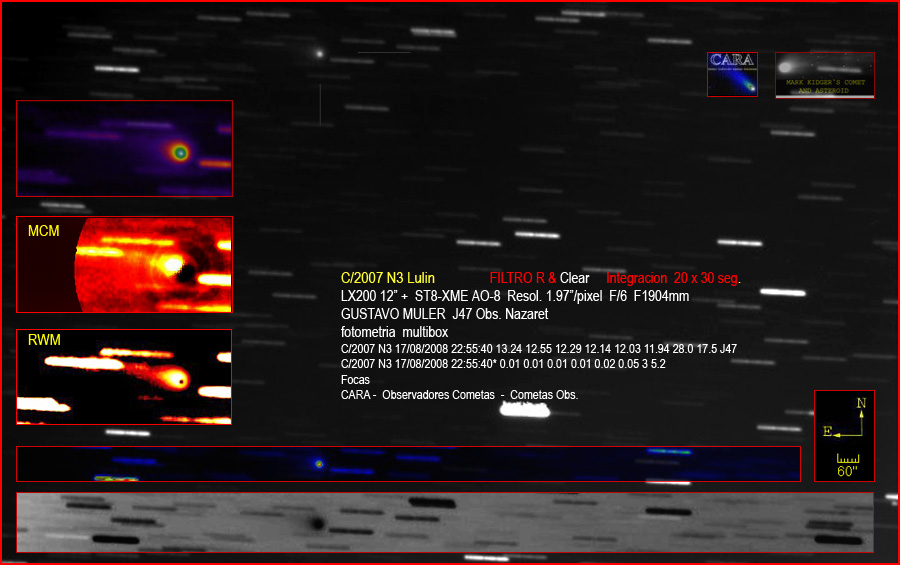
In (lots of) other news the first comet discovery by a Swiss amateur astronomer is being hailed (as is a recovery by an Austrian amateur). • We have nice images of C/2007 W1 (Boattini) of Aug. 16 and Aug. 14, marvel about the strange light curve of C/2008 A1 (McNaught) and an outburst of 6P/d'Arrest seen here on Aug. 27 and Aug. 24, still have hope in C/2007 N3 (Lulin), seen on Aug. 17, have a movie of 51P, see 67P and 47P as a pair and C/2005 L3 (McNaught) next to a supernova. • In and beyond the Kuiper Belt two strange bodies have been found, one with an extremely elongated orbit, the other one orbiting backwards.
• The continuing low activity of the Sun is raising eyebrows, but August was not spot-free: A small one had briefly shown up without getting an AR number though. • In amateur astronomy we have a long portrait of an enthusiast from Oz's Gold Coast, a story on light pollution in the NYT Business(!) section and a helpful name resolver tool. • On the practical fron one can worry about leap seconds and celebrate the roll-out of Atlantis which will head to the HST (with Oct. 10 as the new target launch date) as well as the LSST main mirror blank that its creators call "perfect".
• In science a surprising minimum mass for dwarf galaxies has been found, our planetary system may be unusual after all (though this is only a simulation) - and new data confirm the "hockey stick" rise in global temperature: This planet is warmer than it should be. • Finally it may be noted that a strange attempt to reverse the new nomenclature of the solar system didn't generate the desired media impact and was instead seen as a failure, simply boring and way too emotional, for whatever reason. It simply does't depend on what to call it to make a small body fascinating. And if you like it big, how about the largest solar system on Earth, with the planets to scale?
In (lots of) other news the first comet discovery by a Swiss amateur astronomer is being hailed (as is a recovery by an Austrian amateur). • We have nice images of C/2007 W1 (Boattini) of Aug. 16 and Aug. 14, marvel about the strange light curve of C/2008 A1 (McNaught) and an outburst of 6P/d'Arrest seen here on Aug. 27 and Aug. 24, still have hope in C/2007 N3 (Lulin), seen on Aug. 17, have a movie of 51P, see 67P and 47P as a pair and C/2005 L3 (McNaught) next to a supernova. • In and beyond the Kuiper Belt two strange bodies have been found, one with an extremely elongated orbit, the other one orbiting backwards.




• The continuing low activity of the Sun is raising eyebrows, but August was not spot-free: A small one had briefly shown up without getting an AR number though. • In amateur astronomy we have a long portrait of an enthusiast from Oz's Gold Coast, a story on light pollution in the NYT Business(!) section and a helpful name resolver tool. • On the practical fron one can worry about leap seconds and celebrate the roll-out of Atlantis which will head to the HST (with Oct. 10 as the new target launch date) as well as the LSST main mirror blank that its creators call "perfect".
• In science a surprising minimum mass for dwarf galaxies has been found, our planetary system may be unusual after all (though this is only a simulation) - and new data confirm the "hockey stick" rise in global temperature: This planet is warmer than it should be. • Finally it may be noted that a strange attempt to reverse the new nomenclature of the solar system didn't generate the desired media impact and was instead seen as a failure, simply boring and way too emotional, for whatever reason. It simply does't depend on what to call it to make a small body fascinating. And if you like it big, how about the largest solar system on Earth, with the planets to scale?
Asteroid visit by Rosetta - today! - and ATV deorbit highlights of September 2008
After August brought us two or three eclipses, September 2008 isn't that rich in natural celestial extravaganzas - so we produce them ourselves when Rosetta flies by asteroid (2867) Steins today at 18:58 UTC. Downlink of images and other data will take a few hours, so it gets really interesting only tomorrow. Also this month the ATV will become a huge man-made meteor - which some plan to observe from the air.
- Sep. 6, 10:00-11:00 UTC news conference - streamed on the web - on the outcome of the Steins encounter which ESA already is blogging about quite frantically.
- Sep. 12: Venus 0.4° from Mars; may be a telescopic daytime target.
- Sep. 13: Uranus in opposition at mag. 5.7.
- Sep. 19: Venus, Mars and Mercury form a 4° triangle; may be visible telescopically in daytime in Europe, for more Southern regions see below.
- Sep. 20: Another Plejades occultation by the Moon (in the wee hours for Europe).
- Sep. 27: Waning crescent Moon visits Saturn - the morning visibility of the latter (with rings at a shallow angle) begins.
- Sep. 29: Controlled deorbiting of the ATV over the Pacific Ocean - the reentry will be observed from two airplanes for scientific reasons.
Wrapping up the TSE of 2008 - and two other eclipses since
Many initial reports about the surprisingly well observed total solar eclipse of 1 August 2008 have already been summarized after 3 days and another week, and the most detailled view of the corona has been hailed - here's a third collection of links to reports and pictures from around the world, beginning at an even earlier point than the other two:
The partial lunar eclipse two weeks later was also observed widely in several continents - and used for some experiments. For example by compositing the segment of the umbra that swept over the Moon its size could be measured; these composites were popular with this deep partial eclipse are rarely before as images here, here, here (also here and annotated) and here show. Others tried High Dynamic Range imaging (here, here and here) or observed stellar occultations or nearby Neptune (more) during the eclipse which was webcast from many places. Yet more nice pictures of the event are here, here, here, here, here, here, here, here, here, here, here and here. The Chinese lunar orbiter, by the way, was not harmed by the event. Want still more recent "eclipses"? The Moon in the Plejades cluster another week later can be seen here (yours truly - no tripod ...), here and here.
- From the soil of Canada the eclipse could be seen, as a dramatic picture (from Alert) in this story as well as this picture (from Somerset Island) demonstrate.
- From an icebreaker in the Arctic comes this report.
- The polar flight out of Germany is featured in this report and this story, plus a widely read German news story.
- Many more reports and pictures from (low) Russia are here (another "Druckmüllerization"), here (striking contacts composite), here, here, here (very hi-res) and here.
- From the Russian Altai (close to Mongolia) comes this image, taken here, while other sites were cloudy, as these pictures from another expedition nearby show.
- From Mongolia come reports of successes from here, here, here, here and here. And Science magazine, of all places, has a long & dramatic story, incl. a narrated slide show ...
- From China's Xinjiang province we have a more complete picture report by yours truly (and also a new trip report in German), a study of the sky polarization (plus much more from the same trip) and a view from the edge of the zone of totality with extended Baily's beads.
- From China's Gansu province many more results and reports have been published here and here (with a nice flash spectrum) and here and here and here and here and here (cool foreground) and here.
- Finally from Xian with a very low Sun comes this report, with the eclipse here. So, as in 2006, totality has been seen from the ground along almost its complete track!
The partial lunar eclipse two weeks later was also observed widely in several continents - and used for some experiments. For example by compositing the segment of the umbra that swept over the Moon its size could be measured; these composites were popular with this deep partial eclipse are rarely before as images here, here, here (also here and annotated) and here show. Others tried High Dynamic Range imaging (here, here and here) or observed stellar occultations or nearby Neptune (more) during the eclipse which was webcast from many places. Yet more nice pictures of the event are here, here, here, here, here, here, here, here, here, here, here and here. The Chinese lunar orbiter, by the way, was not harmed by the event. Want still more recent "eclipses"? The Moon in the Plejades cluster another week later can be seen here (yours truly - no tripod ...), here and here.


Tuesday, August 26, 2008
Druckmüllerized corona of 1 August published!
The first two results from a long-running project by Czech mathematician (and amateur astronomer) Miloslav Druckmüller regarding the total solar eclipse of 2008 - that the last two posts dealt with - have been published today! This particular kind of image processing which Miloslav (and his daughter!) developped from first principles of signal analysis is widely regarded as bringing out all the structure that the eye can see in the corona and more in just one image in which the extremely high dynamic range of the solar atmosphere is eliminated and fine - but real - structure enhanced mightily. One of the images shows the corona in all its glory with enormous detail and background stars down to 11th mag., the other presents the true colors of the corona with highly amplified saturation. More results (based on images obtained in Mongolia) will appear here in the future, and observers in other locations have also contributed data so that subtle changes in the corona over many minutes may have been documented. Another large collection of links to reports from the 2008 TSE - and the PLE two weeks later; this is how yours truly and numerous others saw it - will follow.
Monday, August 11, 2008
Lots more exotic views and images of the 2008 total solar eclipse ...
... have come in over the past seven days, so here's a new collection of links, as big as the initial one. The most unusual view is certainly this video from the edge of the totality zone, shot near Hami in China. We also have new corona composites here and here and a video of the Moon shadow from GEO orbit.
In other news the Perseids peak tomorrow, making the coming night and the one from Aug. 12/13 the best to watch - after midnight, when the Moon has set. It's not quite clear what to expect: The CBAT Electronic Telegram No. 1464 contains some inconclusive thoughts about Swift-Tuttle's dust trail form 1479 which may - or may not - cause some action at 5:30 UTC on Aug. 12 and other possible rate enhancements. So: Watch the skies - or the visual data quicklook where the rate is already going up steadily. No part of the Perseids was a nice New Mexico fireball of Aug. 4, by the way.
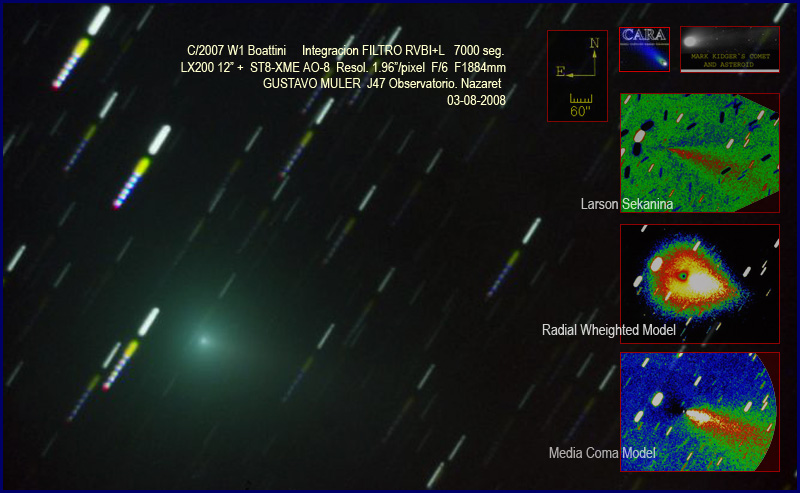
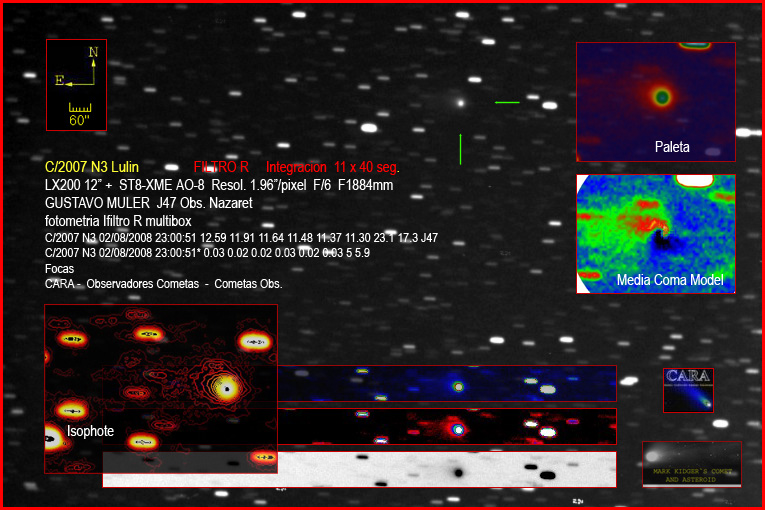
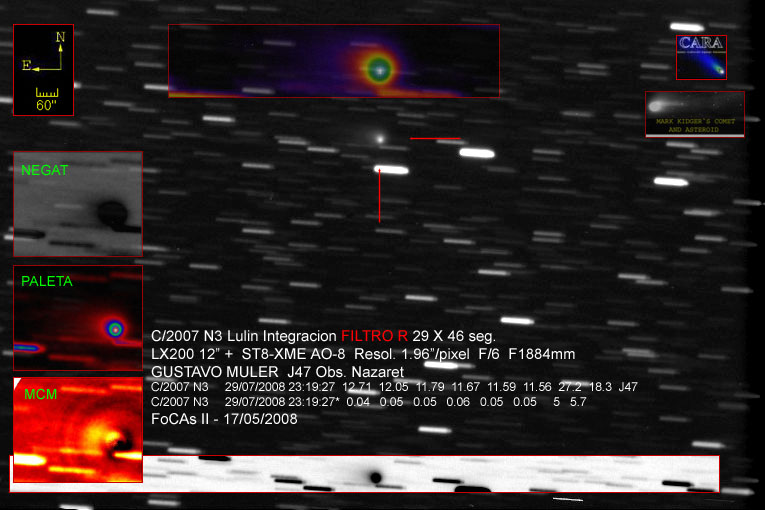
• Comet-wise there are Boattini images of Aug. 10, Aug. 3 and Aug. 2, Lulin images of Aug. 2 (animation), July 29 and July 24 and D'Arrest images of Aug. 3 and July 25. • There is a call for observations of Eta Carinae which has started a new spectroscopic event which returns every 5½ years - a piece of evidence for a binary system.
• The famous Hanny's Voorwerp story, all over the news, has now even produced Yale and Oxford Press Releases - rarely do amateur astronomical chance discoveries have such an impact on pro astrophysics. • There are more ISS images of July 30, 27, 25 and 24 (more), Stardust@Home hasn't found an interstellar particle yet, and the HST celebrates 100,000 orbits.
- Several more airplanes had views of totality than reported initially, e.g. a chartered one over Norway (parts one and two) or one from the Norwegian AirForce, while it was also seen from an airliner cockpit over Russia. From the Canadian charter flight here is the 'official' version of an already famous video as well as a report. And from the German polar flight we have another video, part 2 of a slide show, coverage by N24 and reports (more and more).
- From ships in the Arctic Sea only one more report has become available.
- From Russia there are a U.S. TV report and slide show, a video from Novosibirsk with several cameras (discussed here), another one and one from Akademgorodok, an animation of 2nd contact, widefield and close-up pictures, a composite of the contacts and numerous reports (more, more, more [more, more, more, more], more, more, more and more).
- From Mongolia there are videos (another one) and pictures.
- From China we have lots of material from several sites including one N' of Barkol where a dazzling QTVR hyper-image had its origin (a full-dome experience on your PC ...) and
- the "main" camp at Weizixia with pictures, a report, videos from people who ran away in search of a cloud hole and those who stayed put (while the hole came to them) and more exquisite pictures (more, more, more, more, more and more).
- Here are pictures from Yiwu downtown, a timelapse sequence and a video from between Yiwu and Hami.
- And from Gansu we have reports (more, more and more), another video and pictures (more).
- the "main" camp at Weizixia with pictures, a report, videos from people who ran away in search of a cloud hole and those who stayed put (while the hole came to them) and more exquisite pictures (more, more, more, more, more and more).


In other news the Perseids peak tomorrow, making the coming night and the one from Aug. 12/13 the best to watch - after midnight, when the Moon has set. It's not quite clear what to expect: The CBAT Electronic Telegram No. 1464 contains some inconclusive thoughts about Swift-Tuttle's dust trail form 1479 which may - or may not - cause some action at 5:30 UTC on Aug. 12 and other possible rate enhancements. So: Watch the skies - or the visual data quicklook where the rate is already going up steadily. No part of the Perseids was a nice New Mexico fireball of Aug. 4, by the way.
• Comet-wise there are Boattini images of Aug. 10, Aug. 3 and Aug. 2, Lulin images of Aug. 2 (animation), July 29 and July 24 and D'Arrest images of Aug. 3 and July 25. • There is a call for observations of Eta Carinae which has started a new spectroscopic event which returns every 5½ years - a piece of evidence for a binary system.


• The famous Hanny's Voorwerp story, all over the news, has now even produced Yale and Oxford Press Releases - rarely do amateur astronomical chance discoveries have such an impact on pro astrophysics. • There are more ISS images of July 30, 27, 25 and 24 (more), Stardust@Home hasn't found an interstellar particle yet, and the HST celebrates 100,000 orbits.

Subscribe to:
Posts (Atom)