Sunday, June 17, 2012

A dip in the vast pool of Transit of Venus results on the web

Will there ever be a master list with links to all reports, pictures and videos on the World Wide Web about the Transit of Venus of 2012? After frantically covering all hot material coming in until the end of June 7 in this long live-blog, here's (some of) the stuff that was found - or has found me - in following ten days! • The weather in the various observing regions is nicely summarized here. • Some early scientific results include hi-res images of the aureole which my team obtained in Greece (more and cited here) as well as other photographers (more, more, more, more and more) - a series of drawings. A wonderful demonstration of the parallax over 14,000 km (more). And observations by ALMA, Hinode (more), Venus Express and various NSO telescope plus what was planned.

Full reports and picture sequences come from Peenemünde, Fehmarn (more), Usedom, Travemünde, Norddeich, Lausitz, Erzgebirge, Unstrut, Bavaria, Brandenburg, Bad Lippspringe, Lichterfeld-Schacksdorf, Bielefeld and Munich in Germany, Austria (more, more, more, more, more and more), Greece (more, more, more and more), Italy (more and more), Denmark (more), Norway (more), Sweden (more, more, more and a slideshow; Venus only at 5:06), Finland, Hungary, Russia, Abu Dhabi, Chennai (pics), SPACE activities (pics and more), Delhi, Kutch and Bangalore in India, China, Bali (more and more), Australia (more, more, more, more and more), Timor Leste, Rapa Nui (more), Hawaii (more, Canada) and the states of California (more, more, more, more, more and more), Oregon, Wisconsin, Texas, Alabama, New Jersey and New York (more) of the U.S.

Picture collections of the transit have also turned up here (incl. particularly scenic Baltic sunrises), here, here, here, here, here, here, here, here, here, here, here and here while interesing • pictures are here, here, here, here, here, here, here, here, here, here, here, here, here, here, here and here. • Videos showing a working pinhole camera (good to know for future eclipses), the Mount Wilson webcast (in pt. 5 an interesting aureole interview; background) and from Svalbard, Bora Bora, Amrum, Waikiki, Hyderabad (43 mins) and Sydney, plus clips from a movie project and a wild animated cartoon of Le Gentil's problems ... • Stories about the transit are here, here, here, here, here, here, here, here, here, here, here, here, here and here (from someone who just didn't get it). • Finally TV reports from Austria,Russia, Hawaii, NBC (earlier) and ZDF - and a long Indian preview talk.

Imaging Venus veeery close to the Sun before and after the transit was a popular sport: successes from June 9 (more and more), June 8 (more), June 7 (more), June 5, June 4 (earlier; more, more, more, more, more, more, more and more), June 3 (more), June 2 and June 1 (with Mercury; more); more pictures are linked from the various Rhodes pages. • Pictures of the partial lunar eclipse just before the transit are linked from this Rhodes report and can also be found here, here, here, here, here, here, here, here and here, with stories here and here and many videos here. • And yet more images, videos and reports from the May annular eclipse have appeared here (just amazing), here (Lytro ...), here (weird balloon thing), here, here, here, here and here.

Once more a big sunspot crossed the disk: views of June 16 (AR 1504 in detail), June 15 (more), June 14 (movie until June 14, with flares, more, more and more), June 13 (more), a movie til June 12 and prominences on June 4, plus science on ultrafine corona loops and Fermi flare observations (more). • Amazing fresh Keck IR pictures of Neptune and Uranus, Saturn on May 28, Jupiter's smallest moon (more) and the planet and the Moon today and Mars on May 25.

The big NEA 2012 LZ1 - preview (more, more, more and more) - came moderately close to Earth: video clips, pictures and reports here, here, here, here, here, here, here, here, here, here, here, here, here and here. Plus studies on NEA 2011 AG5 (deemed mostly harmless), 2008 TC3 & its meteorites and general risk communication - and comet Garradd on June 9, meteorite science in Canada and more Dryas claims (uncritical report and mammoth complications).

Elsewhere in the Universe the APASS is delivering photometry of 40+ million bright stars. • Nova Sco 2012 discovery (more and more) and amateur spectroscopy. • Amateur-discovered planetary nebulae (more). • The noctilucent clouds are already going strong: some observations from the nights June 16/17, June 14/15 (more), June 13/14 (more and more, also from Scandinavia and Canada), June 10, June 4 and June 2. • There has also been some aurora activity, this morning (more and more) and on June 11 (more). • And finally a total recall from Meade ...

Friday, June 1, 2012

First the annular eclipse, now a partial lunar one - and then the Transit of Venus!

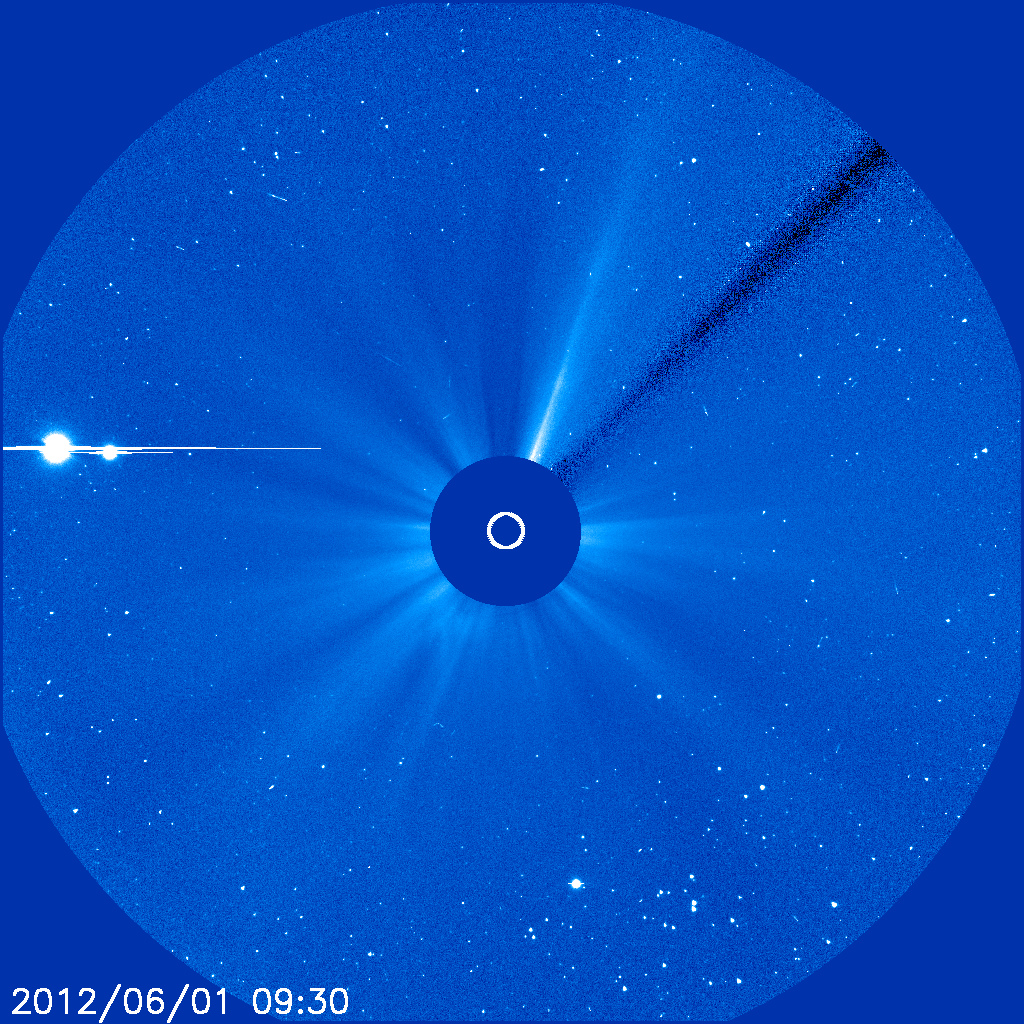
We are in a 17-day interval of an unusual massing of rare celestial events, culminating in the rarest of all, the last Transit of Venus until 2117 on June 5/6: numerous links about it can be found in this still growing collection, some videos here and various science plans here. It is preceded by a partial lunar eclipse on June 4 that coincides with another big Moon (appearing as big as the one in early May; see below) - more details here and esp. here. And right now on June 1 there is a conjunction of Venus and Mercury, obviously - 4 days before the solar transit of the former - very close to the Sun and dangerous to observe, but it can be done. And here they are, in the same FOV, a few hours ago (and a bit earlier), with Venus as a crescent and Mercury fully lit! And both planets are already in the LASCO C3 FOV as well. For other lesser June sky events - including a mediocre Mercury evening apparition following the Venus conjunction - see here and here.

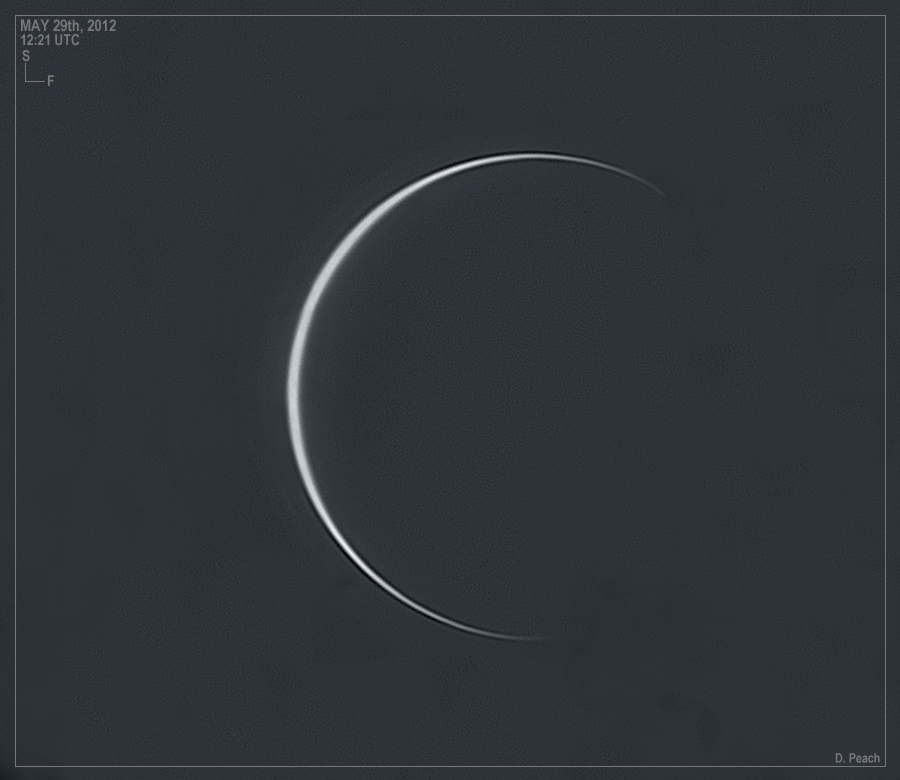
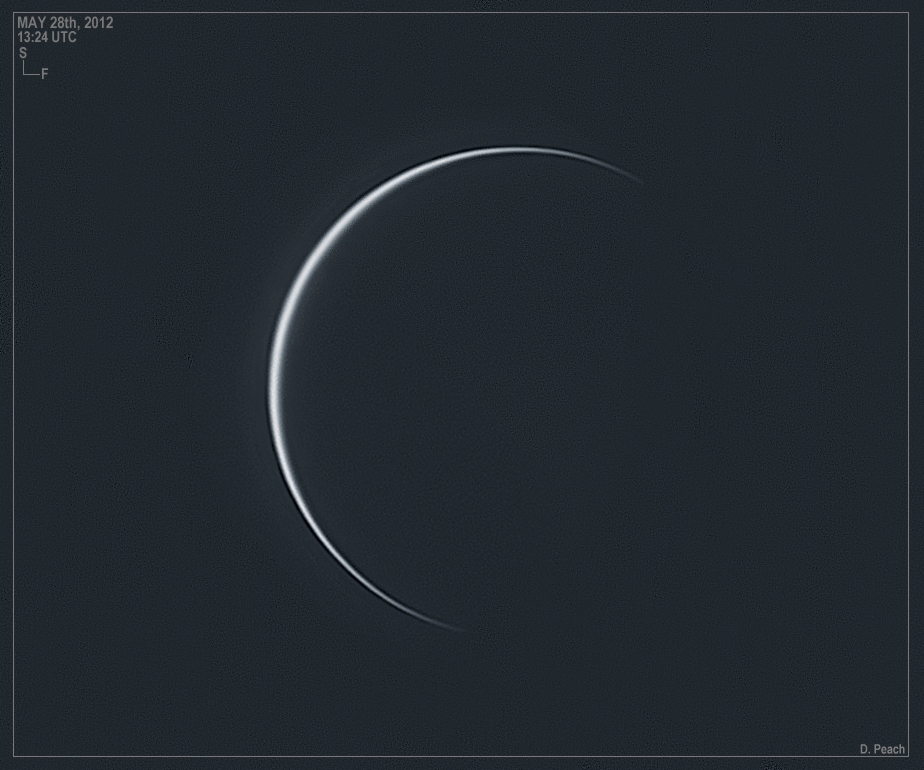
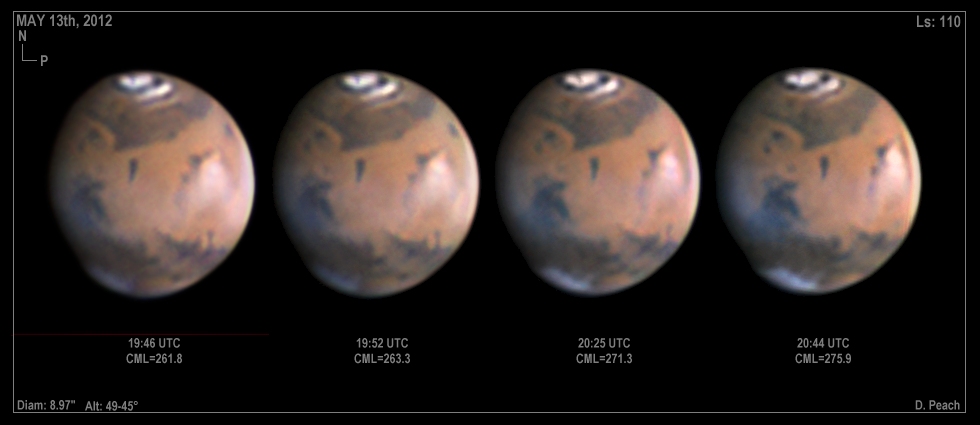
Venus as an ultra-thin and huge crescent was the sky show in the final weeks of May: tons of pictures, the changes January to May and selected views of May 30 (also cusp extensions; more and more, an Indian video, the changes May 26 ... 30 and again), May 29 (more and more), May 28 (more, more, more and more plus scenic), May 27 (more, more and more), May 26 (more, more, more and more), May 25, May 24 (also with the Moon), May 23 (more, more, with the Moon, more and more), May 22 (with links; more, more and more), May 21 (more), May 20, May 19, May 18, May 17 (more), May 15 (also veery long but no ashen light; more), May 14, May 12 (more) and May 10 with simple means. Also how not to film Venus, new amateur Venus cartography at 1 µm. • And Mars on May 13, May 6, April 4 and April 1, Saturn on May 23 (more) and May 13 and Jupiter & Mercury close to the Sun on May 22 and May 21.

The annular solar eclipse of May 21/20 had opened the 'hot' 2 1/2 weeks in the sky: Lots of pictures and links can be found in this live-blog and this page. There are reports from Hong Kong (pictures), Japan (more), California, Nevada (H-Alpha), Utah (more & more), Arizona (more, more and more), New Mexico (more) and Texas (more and more) and reports here and here. Interesting videos comes from an island off Taiwan, Japan, California (great Baily's Beads from 4:00! Also H-Alpha and nearby), Nevada (timelapse), Arizona (with Beads; more and a partial sunset) and New Mexico (Beads at 3rd contact; the same), plus another partial sunset and a sunset ring! Further picture & story collections are here, here, here, here and here.

More selected pictures from Norway (yes, they got a shallow partial - at night!), China (with chromosphere & inner corona; more and another chromosphere from there), Japan (with Beads), California (montage), Nevada (good Beads; also clouds), Monument Valley (more, more and more) and Arizona (at the edge, more in the stream; more, more, Beads at the edge and people in the foreground), also low chromosphere (more), a Texas sunset, a setting crescent and more Beads (more). From space the antumbra as seen by the LRO (more), Michibiki, Terra and the ISS (video; more space eclipses) - and the view from a balloon; there was also radio astronomical interest. Finally the confession on how a famous picture fake was made - that was distributed for real ("I was taken with a lens of three months salary! No proposal ... who cares?"; see also here and here).

The big full moon of early May - see here for angular size comparisions - was also widely observed two weeks earlier, even from the ISS. Further reports, pictures and collections here, here, here, here, here, here, here, here, here, here, here, here, here, here, here, here, here, here, here, here, here, here, here, here, here, here, here, here, here and here - and here's a list of big full moons over many years. • A video of a grazing occultation of a star by the Moon.

A big sunspot group crossed the solar disk in mid-May as documented in German postings on two German blogs # one, two, three, four, five, six and seven. Also the full disk May 21 ... 30 animated (more), an unusual effect by an M flare (more and more), prominences on May 19, May 17, May 15 & other dates and May 5, satellite use for serious space weather assessment (not like here ...), tales of the Carrington Event, corona mysteries, auroral processes studied and a Canadian aurora on May 20.

The long Garradd comet show is coming to an end after many months: pictures of May 16, May 15 and May 11. • Meanwhile interest is rising in comet PANSTARRS: an update and pictures of May 21, May 20 and May 18 (wide-angle). Also a little Holmes outburst and news about P/2012 K3, 2011 KP36, P/2005 N3, C/2012 K5 and P/1994 X1.

In other small bodies news a Lyrid imaged from the ISS (more and more plus a related timelapse), while the imaging balloon was also found. • There is finally a little video of the April 22 bolide (more) while the meteorite search continues (more, earlier) - and meteorites fell in India, too (pictures). • A close visit by tiny 2012 KT42, ESA crowdsources NEAs, a new story about 2012DA14 is fishy (dito, dito and the real risk), WISE improves the PHA statistics (more, more, more, more and more), the Yarkowsky effect was measured in a NEA (more, more, more and more) and there is new speculation about the Tunguska impactor (more, more, more and more).

In other news the supernova 2012cg has flattened out at 12 mag.: more reports here and here. • Also a SN early warning system, problems for Boles, the SN hunter, a Nova in Oph (more, a spectrum and several recent novae) and reviews of CVs and R CrB. • A sprite & a meteor: some connection? • The NLC season is just beginning, a paper on the earliest NLC reports and aurora fun. • A video with TWAN winners (more). • And finally Tiangong vs. the Sun, geostationary satellites in motion, a crazy rocket launch trail and an old UFO case finally solved.

Saturday, May 5, 2012

EXTRA: Why you should look at tonight's full moon - and find out for yourself how "super" it really is!

Here we go again: When a full moon in the spring of 2011 coincided with perigee it was hyped as a "supermoon" (using a term introduced by an astrologer), connected with natural disasters (absolute nonsense) - and then widely debunked as a total non-event: no normal person would be able to notice that this moon was closer to Earth than others throughout the year. In time I pointed out on this blog that this claim was also wrong and a pity because it would discourage people from actually finding out for themselves what's going on in the sky.

For this blogger had found out by chance that the ellipticity of the lunar orbit is actually pretty obvious to the naked eye, with perigee full moons easily recognized as such without being told about their closeness beforehand. In the following year I even made a little sport out of guessing the distance of full moons without knowing the numbers, and it worked quite well. To do this properly the Moon has to be reasonably high in the sky and away from distracting foreground objects: the 'moon illusion' must not be allowed to play a role. Just take in the unobstructed sight (and look how much surface detail of the maria one can actually see with the unaided eye, while you're at it).

Tonight we are facing another perigee moon - and wouldn't you believe it, the debunkers in their zeal to kill the 'supermoon' idea repeat the claim that the eye can't see anything without a ruler: NASA does it, also Sky & Telescope does it, many normally reputable astronomy blogs do it. This AP video tops them all by even completely mixing up the perigee effect and the moon illusion in its first minute - yikes! I can only encourage everyone to have a look tonight: of course you're biased now but try to memorize the appearance of the full moon and recall that when viewing more distant ones later in the year (the one in June will still look exactly the same, so don't despair if it's cloudy tonite)! More stories with varying degrees of flawed-ness (and occasional nice numbers and plots) here, here, here, here, here, here, here, hier and hier.

Monday, April 30, 2012

Solar satellite "filmed" complete Nova Sgr 2012 outburst with high cadence!

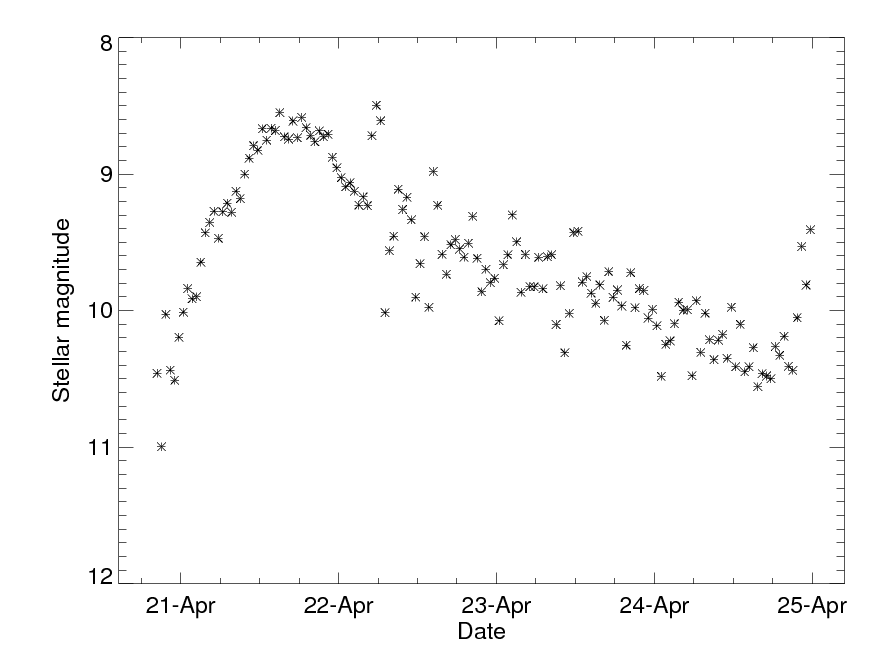
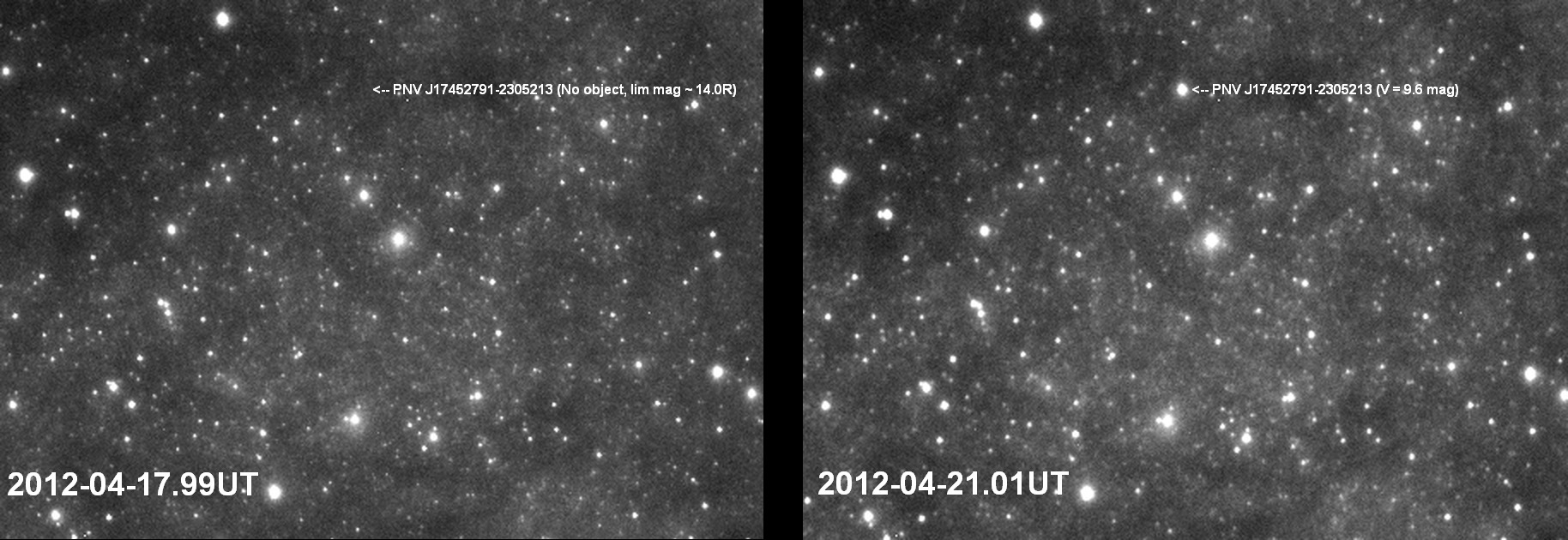
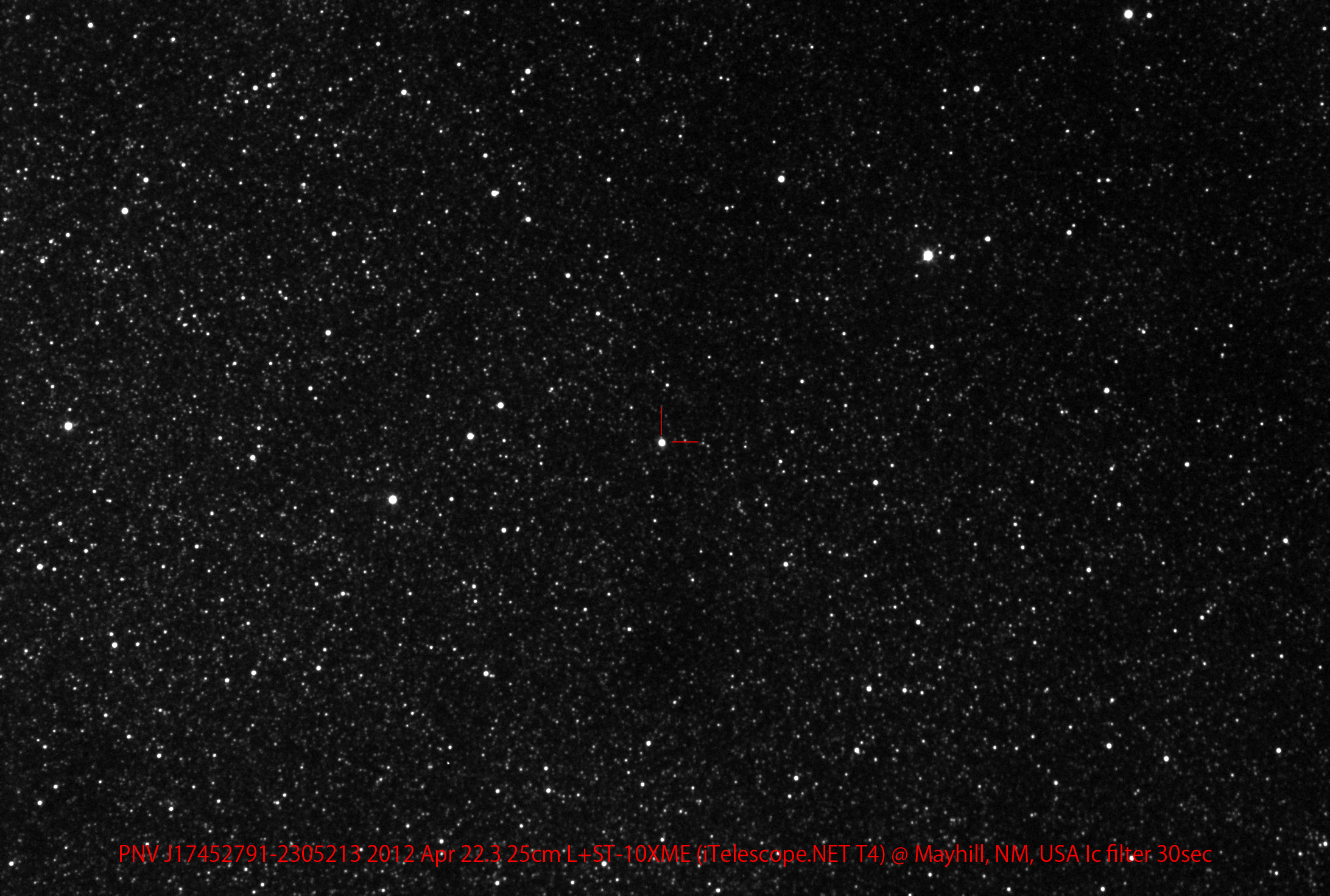
This could be a first in nova research: When Nova Sagittarii 2012 alias PNV J17452791-2305213 erupted on April 21, the satellite STEREO B had the field firmly in its view, and from the inadventend high-cadence photometry an impressive lightcurve has been generated, showing the complete peak! Whether such a record is unprecedented isn't clear yet. The nova reached 8.8 mag. briefly; since the nova has faded a lot: discovery pictures here and here, early spectra here and here (strong H-Alpha) and reports here and here. • Also blazar OJ 287 is flaring and in a high optical state, though not brighter than 13.5 mag.

On the Sun a prominence & CME on April 22, a prominence and sunspot details on April 21, a prominence on April 17 and a famous prominence (more) on April 16. • The SDO has been in orbit for 2 years, generating lots of pretty pictures. • An EGU press conference on space weather forecasting (abstracts links and COMESEP's home), ISWI and another doom story, picked up here and here. • Hinode sees a pole asymmetry. • Camilla visited the stratosphere (not 'space'), generating publicity for NASA like here, here (7:10-42), here, here and even here.

The aurora was quite active around April 24 as images from Sweden, northern Germany, northwestern Ireland (more and more, a video [alt.]), Northern Ireland and Canada (video) show; more collections here and here. • Also a celebrated aurora timelapse from Norway, more here - and auroral ballooning (more) in Alaska (video). • Also a sky mystery that could be a venting satellite, a story on amateur spysat hunters, and the sad death of Dale Ireland (also here and here) - whose automatic weather timelapse algorithm keeps running ...

Minor bodies in the news: Comet Garradd on April 18, April 17 and April 16, plus Faulkes observations of the Rosetta target. • Trans-Neptunian star occultations til 2015. • Yet more evidence against the Dryas impact and the impact history of the Earth. • The Target Asteroids! project explained here, here, here and here, plus a study on capturing a NEO. • A great bolide over the U.S., dropping meteorites in old gold rush country, a Brazilian bolide and the usual Lyrids.

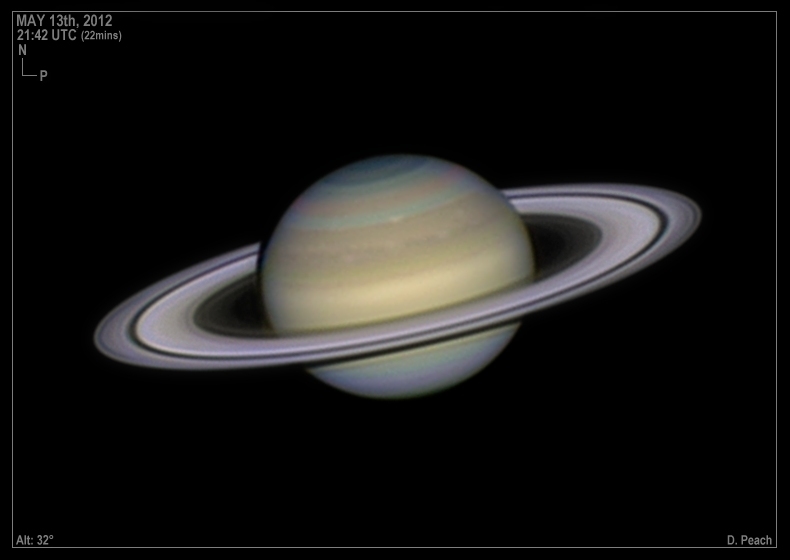
Planets now well placed - a long-term calculation of altitudes for Germany - are Saturn (April 21 [dito and dito], April 12 [dito] and near opposition pictures), Mars (on April 19, April 16, April 7 and March 29/30) and Venus: a deeep picture in the Pleiades and with the Moon - and Obama. • Being so bright and well-placed - and thus also the sky highlight of early May - Venus also caused various UFO alerts, notably on German TV (covered also here, here, here and here) or here. While Venus looks like this right now (or like this in the near IR), it's prone to video artefacts. • And talking about a misunderstood Venus, its role in a famous aircraft incident in Jan. 2011 is less clear than in all the news coverage e.g. here, here, here, here, here or here as reading the actual investigation report shows. • Finally Mercury & the Moon on April 19 from Oz.

Sunday, April 15, 2012

Big KBO Quaoar to occult pretty bright star - probably for Africa

It was the 3rd big Kuiper Belt Object discovered, after Varuna and Ixion - and on the morning of April 17 (50,000) Quaoar will occult an 11-mag. star: Such occultations by outer solar system bodies have often led to new insights. Previous hopes that the track might cut through Europe have faded with recent astrometry: Now it looks like that the zone where occultation by Quaoar as well as its moon Weywot can be observed had slipped south into central Africa. • For the first time aurora on Uranus has been imaged from great distance, namely with Hubble. • Saturn is in opposition: pictures of April 14 and April 12 - and for tonight at 1:30 UTC (April 16) a webcast is planned. • Meanwhile Jupiter has 'lost' several moons that didn't exist in the first place, of course.

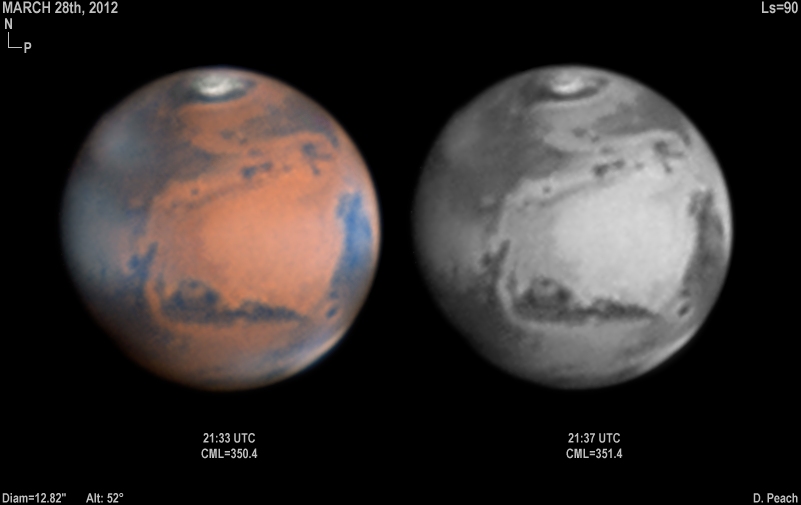
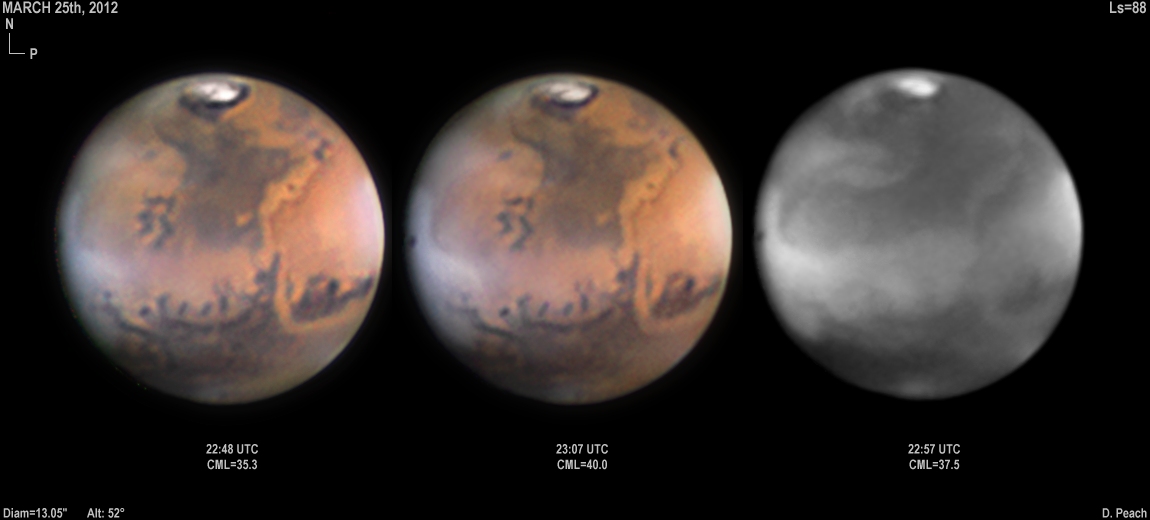
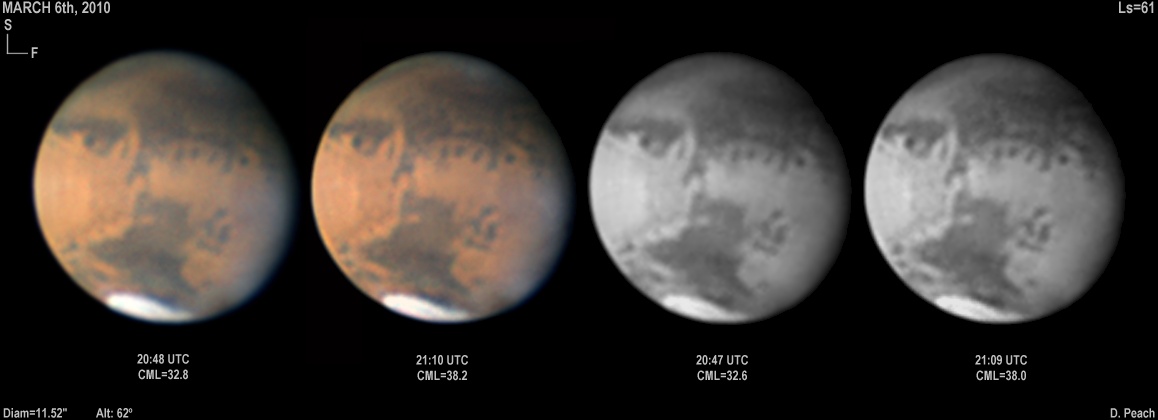
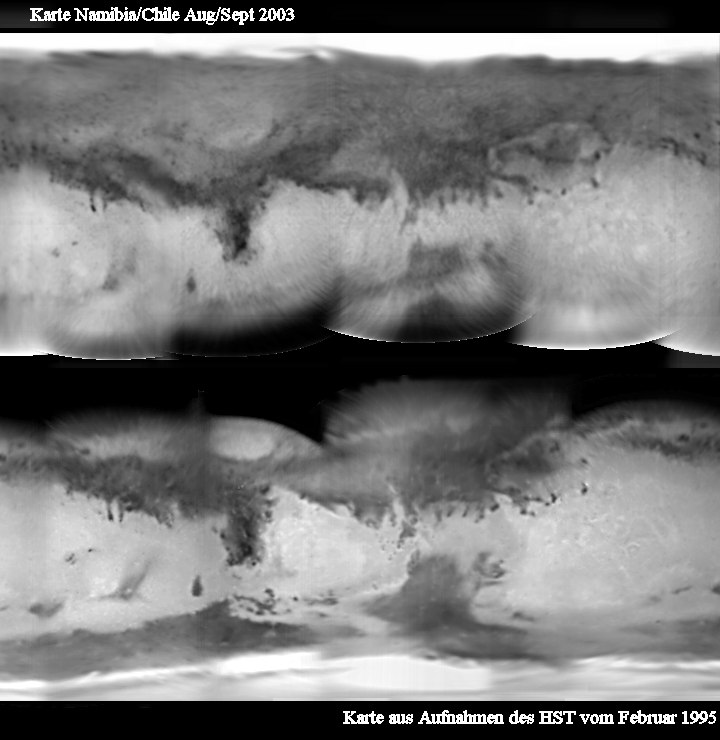
The apparition of Mars is already fading, with the disk shrinking: images of April 14, April 8, April 1 (more), March 30, March 28 (another terminator cloud; also a better animation of March 20 and another and another March 28 picture), March 27 and March 25, plus a February to April montage. It has now turned out that the bright spot in Mare Acidalium mentioned last time was also seen in 2010 as well as 2008 & 10 - but not in 1995, the last opposition with similar geometry as the current one. • The passage of Venus near the Pleiades was imaged a lot: collections of April 2 ... 4 and March 31 ... April 3 - and a view from 1972, 5 'grand cycles' earlier. • Meanwhile the separation of Venus & Jupiter is large again, but there are conjunctions about annually, with a particularly close one in August 2016.

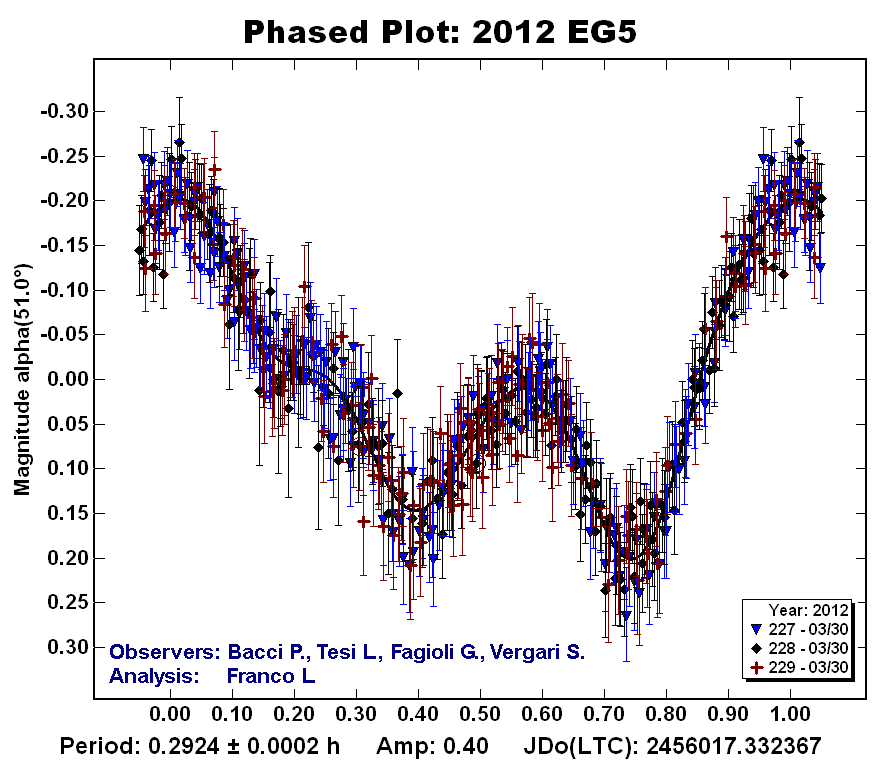
Near Earth Asteroid 2012 EG5 was observed widely during its April 1 Earth visit: a lightcurve, a picture and early analysis of taxonomy and spin rate - but no radar detection in spite of a well-determined orbit. • A long story on 2011 AG5 and why it's so hard to nail its orbit. • Comet Garradd on April 11: It's now in the 'paws' of UMa and was also observed by Swift, while 2011 FR143 has a cometary nature and P/2005 YJ126 (Catalina) has been recovered. • More on the Norwegian meteorite crash, a bolide in Texas on April 2 (which was real but the video was not), a multistation analysis of a Dutch bolide on March 27 and a German bolide on March 17. • Oh, and there was no Younger Dryas impact, period.

On the - rather inactive - Sun (the space wx April 4 ... 10) a fine limb eruption on April 15 from AR 1442 (more views & analysis and more), AR 1459 near the limb and another SDO 'tornado' on April 10/11. • From solar science corona cells (more), solar shape measurement by rolling SDO, joint IBEX/TWINS observations of a solar storm and alleged solar cycle weather effects. • The Arctic aurora season in ending quickly now (more and more): some parting shots from Scotland, the UK and Norway (more) - plus a fine 45-min documentary from German TV on aurora hunting in Scandinavia, describing various methods to go after it!

Finally the NASA space observatory data center has been named for Senator B. Mikulski which is well deserved as she fought hard for Hubble and the JWST - but it's merely a joke that a supernova was also named for her (as also claimed here and here). "No, supernovae are not named officially, only designated," the IAU's Central Bureau for Astronomical Telegrams has assured this blog: "This is evidently just a cute joke..." • And to close a wide view of the zodiacal light and assorted phenomena, glorious images of contrails (tons of them) with light effects and turbulence effects - and a timelapse movie of geostationary satellites ... with the Alps in the foreground!

Saturday, March 31, 2012

Lot of cloud action on Mars thrills observers (with sufficient resolution)

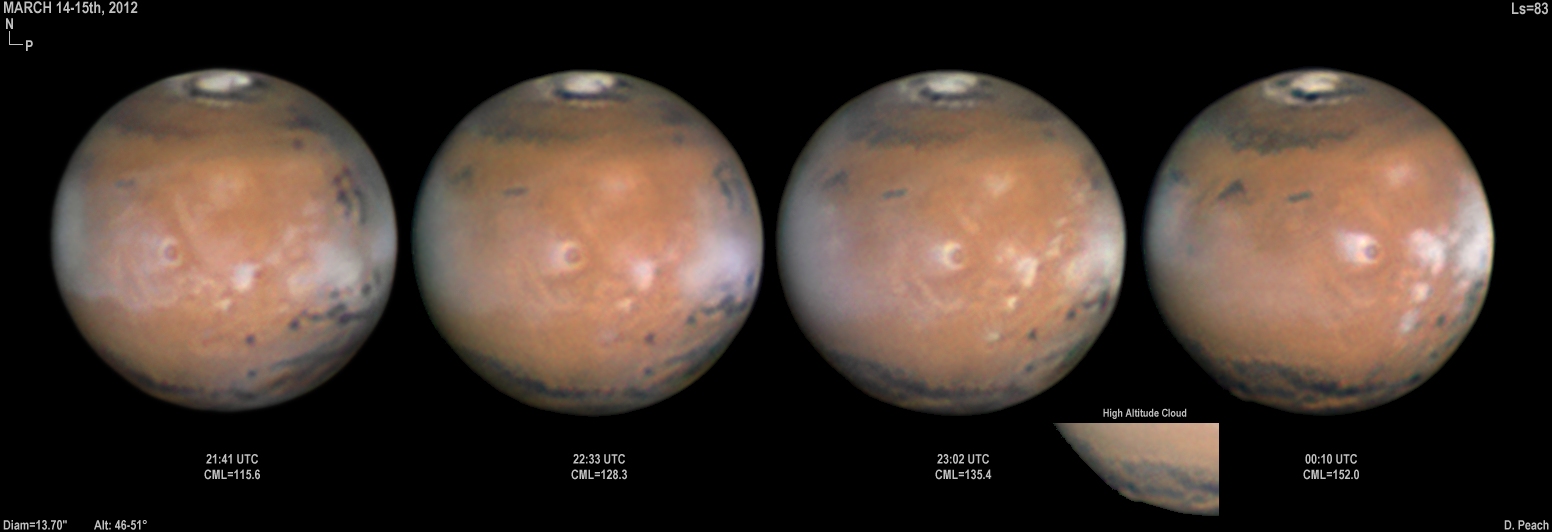
A bright, high cloud at the terminator that a few lucky observers caught and that got even professional planetologists excited, a bright splotch on the big dark Mare Acidalium and numerous other clouds have been sighted on Mars in recent weeks - if your equipment's resolution was good enough for seeing detail on the tiny disk. The terminator cloud was observed e.g. several times by Wayne Jaeschke (see e.g. this, this and this report) and is covered here, here, here (proposed explanation; earlier), here and here.

The Acidalium spot can be seen on many images, including some of those from March 28, March 25 (more), March 24 (more, more), March 22 (more), March 21 (more), March 19 (more), March 18, March 16 (more, more), March 15, March 14-15, March 14 and March 11-12. • The Venus/Jupiter conjunction is over (as a picture from this evening clearly shows): help yourself to many more pictures of March 24 to 28 and March 13 to 25 when they were closer and the Moon nearby, too.

In the world of comets the new and unusual SWAN Kreutz comet didn't survive the solar passage: STEREO, SOHO C2 (more and more) and LASCO C3 imagery, coverage here, here (earlier), here and here and a possible ground-based detection on March 10. Plus how comets fare near the Sun (interview; earlier). • Comet Garradd's ion tail is coming and going: pictures of March 28, March 25, March 22, March 17, March 15 (more), March 13 and March 4. • Comet PanSTARRS is on track for a possible nice show in 2013. • Comets Gibbs & Lemmon (Gibbs again) and space weathering on Wild 2. • How the Halley meteoroid streams evolve under the influence of Jupiter (interview) and simulating the 2009 impact on Jupiter. • Another close asteroid fly-by by 2012 EG5 tomorrow (more) while Earth visitor (in 2013) 2012 DA14 got less interesting (related rant).

Nice recent aurora images from March 20 (off Norway), March 18 (Canada), March 16 (plus 17 plus 20 off Norway), March 15 (USA, Norway, Germany [table, pictures, picture], the UK [more, more, more] and from a plane over the UK [more]), March 12 (Australia), March 11 (off Norway; more) and earlier in Norway and Alaska and here and there. Plus aurora science, a 2010 storm observed, space wx forecasting, SABER & storms (more), GIC modelling, possible space wx trends and weird claims re. health FX. • AR 1429 is back but largely gone though something was seen at the edge - during the 1st disk transit a lot more was there, including an M flare on March 13. • Also sunquakes after flares, the SDO seeing coronal cavities, a SDO movie of a "solar tornado" - and the solar diameter from a Mercury transit!

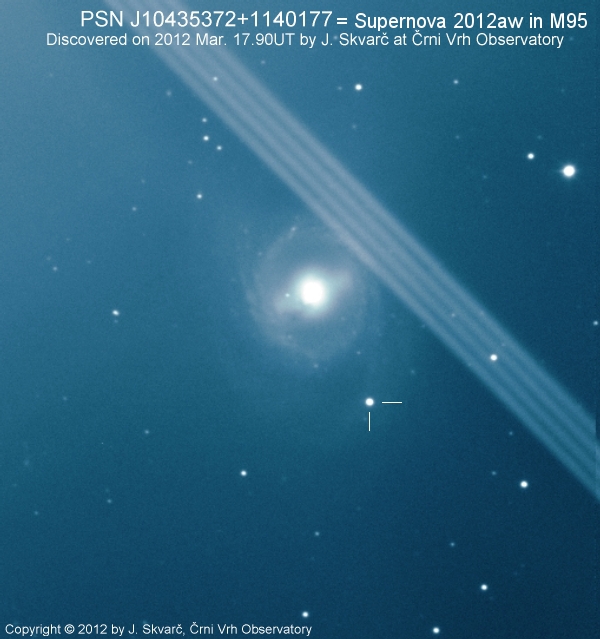
Elsewhere in the Universe SN 2012aw in M 95 (announcement, March 17 and 16 discovery images, a video about the early story and mehr, more, mehr, more, mehr, more, more, mehr, more, more, more, more, more, more, more, more, more, more and more) and SN 2012au in NGC 4790 (more, more, more and more). • NASA making 'chemtrails' for science of the thermosphere (timelapse sequence and another one). • Why spring came early. • And April won't bring much predictable, except for Venus in the Pleiades in the early days of the month (a March 28 view), the opposition of Saturn on April 15 and some Lyrid meteors later in the month.