Sunday, November 30, 2008

"Triple conjunction" just 24 hours away: the highlight of the final month

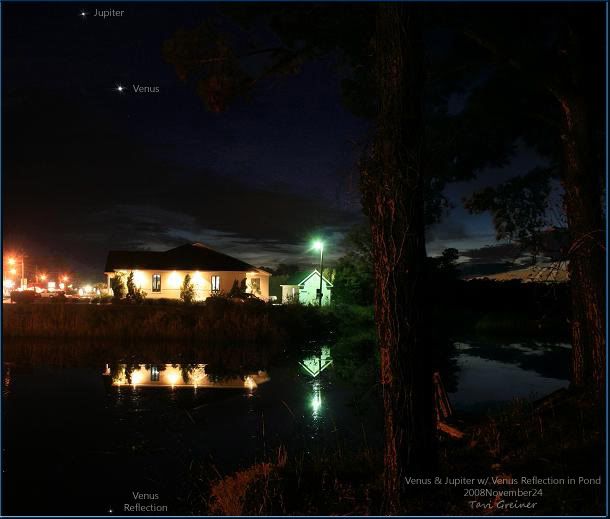
First Jupiter and Venus crept closer towards each other and since yesterday the crescent Moon is joining the picture: going backwards in time, selected views from Germany, various locations and Australia on Nov. 30, the U.S., Germany, various places, Germany again and Australia on Nov. 29, various sites on Nov. 28, Germany, Austria and Australia on Nov. 27, the U.S. on Nov. 24 and Austria on Nov. 23 - celestial mechanics in action! And the best is to come tomorrow.So much for the predictable highlights of Dec. 2008.

In other news the first meteorites that fell after the well-documented Canadian bolide of Nov. 20 have been found and celebrated widely (see here and here and here and here and here and here for coverage and pictures). • Another Canadian bolide - and a rumbling sound in Wales. • According to at least one theorist the Leonids in 2009 could reach a ZHR of 500, i.e. 5 times the typical Perseids. Others haven't confirmed that yet. • Comet Borrelly with a long tail on Nov. 30. • Sometimes here true live images of comets can be seen.

• There is a possible nova in Carina with 7th mag. • And finally the toolbag lost during the 1st EVA of STS-126 has not only been filmed near Eta Psc (which made the videographer kind of famous), it has also been sighted visually, sometimes at 6.5 mag., sometimes even naked-eye, leading the ISS by several minutes already. Predictions are easy to get, and even public events have been proposed - while parodies of the incident abound ...

Monday, November 24, 2008

Major Canadian bolide on Nov. 20 documented by several videos!

A dazzling meteor on the evening of Nov. 20 was "widely seen over a wide portion of the Canadian prairies, resulting not only in hundreds of eye-witness reports [like these] but some wonderful videos" like this one (also here), this and this one - and one shows that "the object broke into pieces. Some may have survived the explosion and have fallen to Earth where, with luck, searchers will find them as charred, blackened rocks sitting on the snow in a farmer’s field. The search is now on, first in narrowing down the fall area, followed by the field work, interviewing eyewitnesses, finding those who saw it fly overhead, and those who may have heard it. Then the real work begins — tramping winter fields looking for dark rocks that don’t belong."

According to early analysis, "the object that entered the atmosphere had a mass of from 1 to 10 tonnes, likely as big as a chair to a desk in size. It fragmented in the large explosion everyone witnessed but reports suggest hundreds of meteorites could be on the ground, in an area near the Alberta-Saskatchewan border north of Provost and Macklin (110°W 52.6°N). At peak brightness, the fireball reached about magnitude -20 — that's 600 times brighter than the Full Moon." Such a thing leaves ample trails on the web: Spaceget and SpaceWeather, e.g., link to the videos, Astroengine has stills, TransientSky, ScienceBlogs, BadAstronomy, UniverseToday, NASA Watch and ROG report as do CBC, MSNBC and SPIEGEL.

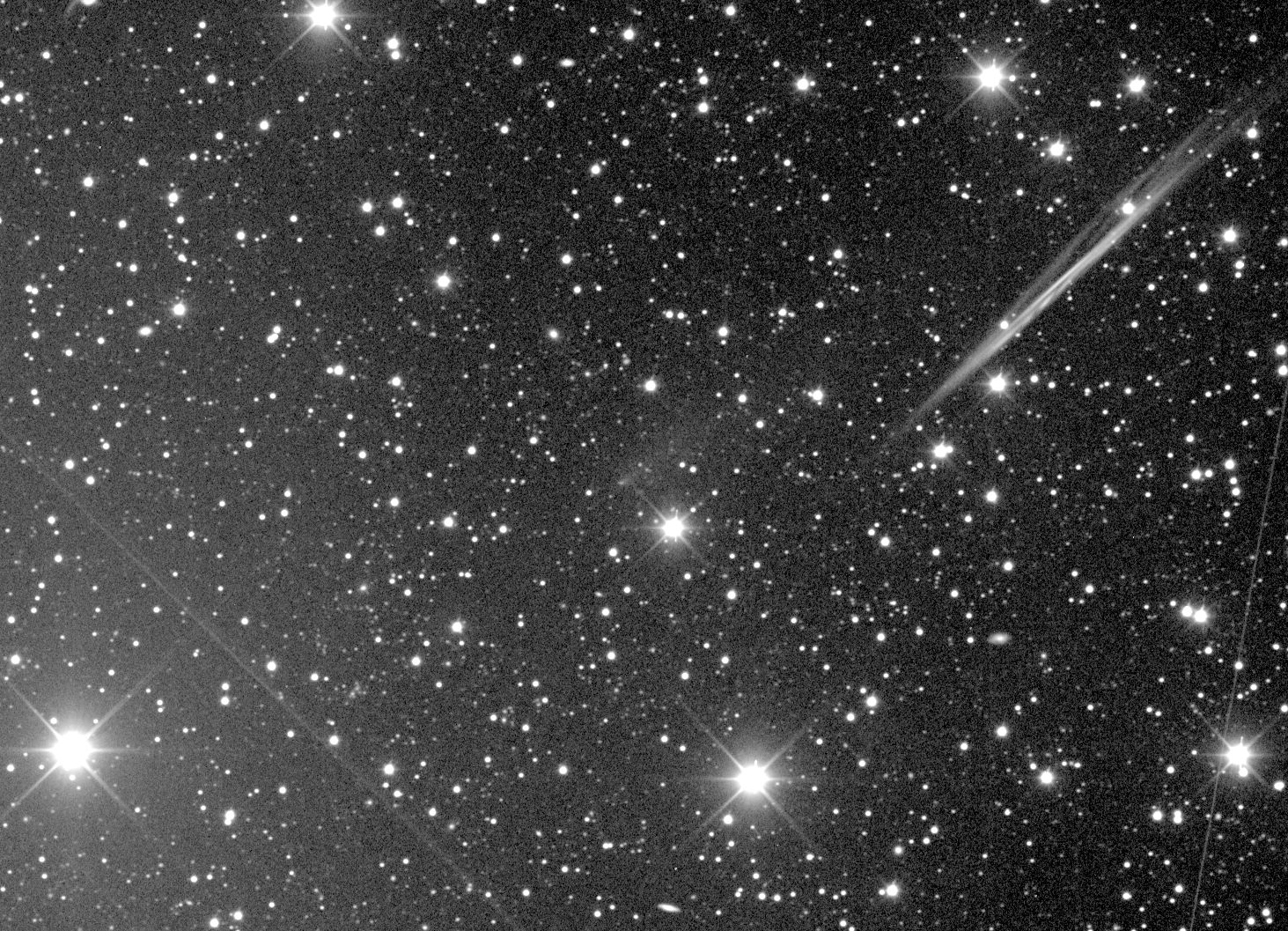
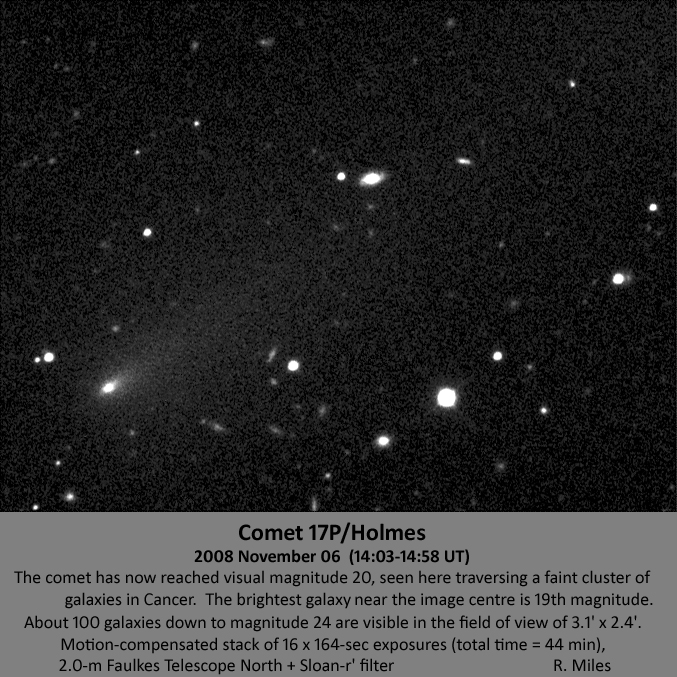
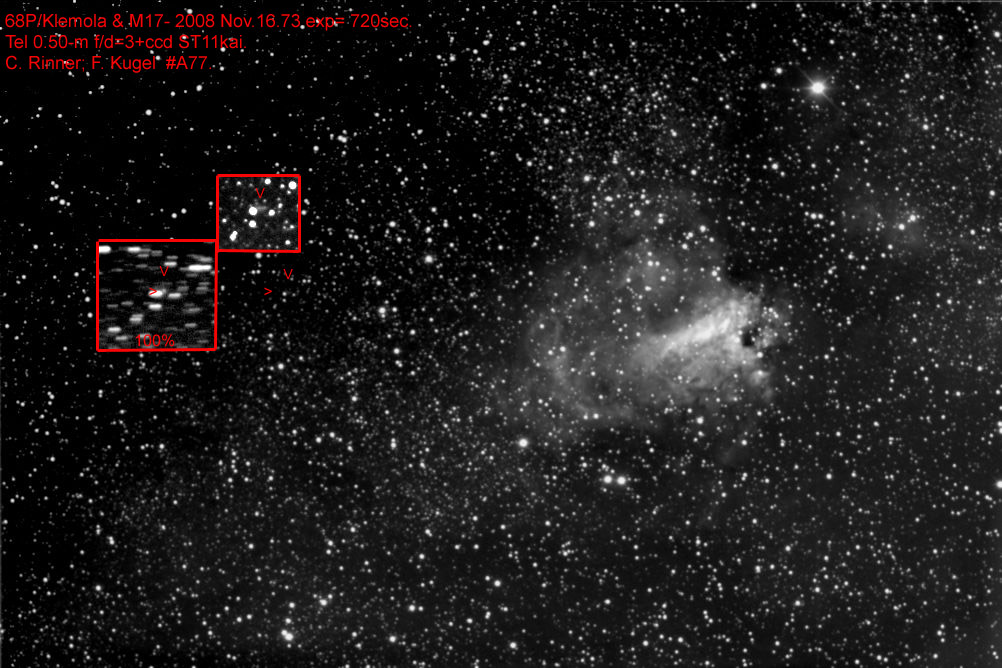
The Leonids of 2008 did produce one major peak with a ZHR approaching 100 but not two as was also predicted for these meteors (always good for a headline). Here and here are some images, here, here and here reports. • Many comets on Nov. 22, 17P/Holmes on Nov. 23 and Nov. 6 and 68P/Klemola at Messier 17. • Various links about a stellar occultation by TNO Varuna on Dec. 7, a very rare event: Other than by Pluto no stellar occultation has ever been recorded by a Kuiper Belt Object.

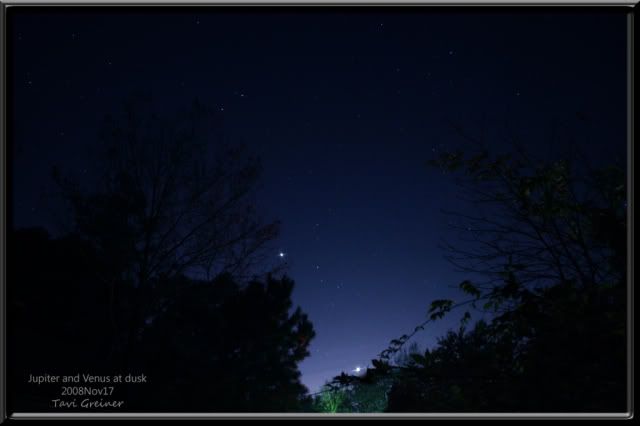
The full Moon at/in front of Messier 45 on Nov. 13, also seen here and here and here - and its waning crescent on Nov. 23. Venus and Jupiter are approaching each other, one week before a tight conjunction also involving the Moon. Views from Nov. 23 (more), Nov. 20 and Nov. 17, plus the view from down under and daily previews. • Rhea's shadow on Saturn. • The aurora from a plane. • A collection of corona images.

And finally some good news out of the bad: The San Fernando Observatory - which this blogger visited last year - survived the big fire of Sylmar (at the Northern periphery of Los Angeles). "The observatory is fine, although we did have fire in the surrounding shrubbery," CSUN's Angie Cookson told this blog on Nov. 17: "None of the buildings sustained damage and we just have to deal with cleaning up ash and soot. The fires have been (and continue to be) just devastating. Driving from home this morning and looking at the burned areas, I was amazed that more homes weren't lost. The firemen truly do an incredible job."

Thursday, November 13, 2008

This evening: the full moon occults the Pleiades

The Pleiades occultation tonight will be tough to observe because the Moon is full and its glare will outshine the stars of the cluster. • The occultation of Neptune a week ago seems to have been lost to clouds, at least in the U.K.

In other news Activity region #1008 remains on the solar disk - here's yet another attempt to forecast future activity. • A new meteor monitoring system with two video cameras + fisheye lenses + automated software is now active. shower analysis. • Meanwhile questions have arisen whether the 2008 Taurids were really exceptional: Visual observations do not confirm more fireballs than usual, video data may support the idea. • Comet McNaught on Nov. 9 and on Nov. 3 at Messier 10, plus Cardinal animations. • A long review of the apparent fate of comet Boethin.

• Possible changes on Eris are making some headlines. • Right after the next total solar eclipse in Shanghai next July there will be a comet conference (followed immediately by another one in Rio in August). Here are yet another story on the last TSE (and eclipse observations from the air in general) and related links. • A review of current - and mostly free - planetarium software (which I wouldn't call "virtual telescopes"). • And a 30 minute TV feature on light pollution.

Sunday, November 9, 2008

Taurid fireballs - few but bright - may confirm "swarm year" prediction

A couple of dramatic photos - see also here and here - and visual reports seem to document an anomalously high number of Taurid fireballs in recent days (and the shower is not over yet). In a scientific paper in 1993 Table III identified 2008 - like 2005 - as one of several possible "swarm years" for these meteors, when the Earth encounters heavier particles from comet Encke. Analysis of the ample data recorded in 2008 will help testing the model. • Remember the first predicted bolide a month ago? The fireball in the sky when asteroid 2008 TC3 met its fate was imaged directly only from satellites - but now a website of the SETI institute shows pictures of the smoke trail the meteor left in the atmosphere where it was lit up by the rising Sun. There is now also a rather detailled analysis of the whole case of 2008 TC3.

In less fiery news Canadian comet Cardinal is visiting some galaxies while 29P (here on the 8th) continues fading away. • Saturn with its rings nearly from the edge, and the Moon, Jupiter & Venus, both on Nov. 6 (morning and evening, resp.). • There were 5 minor sunspot groups in October: Does this mean that solar activity will rise now? • A call for high-quality photometry of P Cyg. • Possibly the deepest UV picture ever - 40 hours integration in the U band - is making headlines everywhere. • A particularly strange sunset mirage effect, and lingering Kasatochi sky colors 12 weeks after the volcano blew. • What it's like to use robotic telescopes. • The IYA podcasting project is proceeding.

• And finally, the "German Stonehenge", the horizon observatory on Halde Hoheward in the Ruhr Area, has been inaugurated on Nov.8 as many pictures here and here document. The astronomy of millennia past demonstrated on a huge, lonely artificial mesa - a unique way to engage (hopefully) the public in fundamental questions of science. The two big arcs (which strongly reminded this blogger, when visiting the construction site, of a certain machine in the movie "Contact" :-) represent the celestial equator and the meridian while numerous precision sighting instruments are also incorporated.

Tuesday, November 4, 2008

Evening of Nov. 6: grazing occultation of Neptune for U.K., Norway

"Early in the evening of 6 November, observers in the north and west of the UK will have an opportunity (weather permitting) to observe an occultation of Neptune, while those in the south and east will see the planet close to the southern limb of the Moon," advises a Special Electronic News Bulletin of the Society for Popular Astronomy today: "The most interesting place to be is on the graze line, which crosses the country from SW to NE, from north Cornwall and north Devon, via south Wales, Stoke on Trent, Barnsley and York to Whitby on the North Sea coast. In the graze zone you may expect to see the planet dim and blink out several times as it is successively hidden and then reappears behind mountains on the Moon's dark southern limb. After leaving England, the graze line continues towards the NE following the coastline of Norway."

The SPA has "produced a map showing the graze line crossing the country [i.e. the U.K.], and another showing the position of the m(v) +7.9 planet in relation to the gibbous waxing Moon's dark limb at the time. [...] Approximate times (UT) of the grazing event for various UK places on the line are as follows [...]: Lizard Point 18:44, Barnstaple 18:46, Lynmouth 18:48, St Brides (S. Wales coast) 18:49, Brecon 18:50, Stoke on Trent 18:51, Barnsley 18:52, York 18:53, Whitby 18:54. The altitude and azimuth of the event are about 22 and 183 degrees respectively, and the Moon's age is 8.8 days. The next UK lunar occultation of Neptune is not until 2016 June 25 at around 23:55 UT." A website from Austria provides further information on the rare event, including an interactive map.

In other news the motions of Venus, Jupiter and the Moon in the evening sky have been amply documented on Nov. 3 (dito), Nov. 2 (dito), Nov. 1, Oct. 31 (from Kansas) and Oct. 30 (from Fla.). • Farther away some changes on Uranus, as compared to 2007. • Comet McNaught is currently close to globular cluster Messier 10, making for nice pictures and stories (In Czech) as well as some confusion (that was cleared up almost instantaneously). Also 29P on Nov. 4 and a nice - though not current - 17P animation. • Amateur astronomers at the Chabot Space & Science Center in California are using one of their telescopes for asteroid follow-up observations which are as important as new discoveries.

• A fat but late Orionid from Oct. 31. • A heavy peace of the ISS jettisoned some time ago has reentered over a remote ocean, and thus its demise remained unobserved. • Atmospheric gravity waves can be studied via the airglow, and the moving patterns have been imaged by amateurs in 2007 and again now. • A stunning view of the Milky Way while even the military hates light pollution which is actually going down in New York City somewhat. • A simple online planetarium, an online tutorial of the night sky - and an illustrated observing report from high in the Alps from the Edelweißspitze.

Friday, October 31, 2008

Few highlights in November - thus the border days count as well

Today and in the following days there are some nice nice line-ups of planets and the Moon in the evening sky, but two of the November highlights, yet another Pleijades occultation and the Leonid meteors, are largely drowned in Moonlight. So, to spice up the list a little bit, Oct. 31 and Dec. 1 are included as well.
  • Oct. 31: Another close encounter with Enceladus for Cassini; the team is again blogging about the experience.

  • Nov. 6: The (first-quarter) Moon only 0.2° from Neptune in the evening (at least as seen from Germany).

  • Nov. 8: Orbit insertion for Chandrayaan 1 after a complicated trajectory to the Moon.

  • Nov. 13: The full Moon occults the Pleijades for Europe - that will be tough to watch, even with binoculars.

  • Nov. 17 (at 1:32 or 0:22 UTC) and perhaps also Nov. 18 (at 21:38 UTC): Two possibilities or just one for 100 Leonid meteors per hour and perhaps even more - but the waning gibbous Moon will interfere heavily.

  • Dec. 1: The Moon occults Venus, for Europe in the late early evening. And Jupiter will be just 2° away.
In other news a fireball as bright as the full Moon was imaged on Oct. 29 over Colorado and has been seen widely (more and more reports). • There is also talk about a moderately fresh impact crater in Alberta, CA. • There will be mutual events of Namaka and Haumea for several more years, thanks to the other moon of the dwarf planet. • Here are comet C/2008 A1 on Oct. 18 and 29P on Oct. 27. • A quickly varying white dwarf, HL Tau 76. • One can watch aurorae on the web - and still Kasatochi stuff in the atmosphere.

• Italian amateur astronomers have imaged Pluto's moon Charon with a 14" telescope. • A really long exposure with a pinhole camera. • The last tracked fragment of "blown-up" satellite USA 193 has reentered on Oct. 9. • There are new features for the World Wide Telescope. • A cool tool lets you rotate the closest stars. • And the activity of the Sun - which was particularly wild 5 years ago and is sometimes connecting with the Earth via FTEs - may be influencing the streamflow of S. America's Parana river, however that might work ...

Sunday, October 26, 2008

Food for thought: weather statistics for the two 2010 solar eclipses out

They are probably the most eagerly awaited websites for the international eclipse chasing (and catching!) community: the detailled weather statitics and analyses Canadian meteorologist Jay Anderson prepares for all upcoming total and annular solar eclipses. Many a tour or expedition has been planned on the basis of these data and graphs - and it won't be different for 2010 when two intriguing eclipses will pass over the Indian and Pacific Oceans, the longest annular one until 3043 and a pretty long total one mainly hitting tiny remote islands. For ASE 2010 the wx stats along the track are stunning, with a deep minimum of cloudiness hardly ever seen in such graphs ... in Birma/Burma/Myanmar which promises up to 95% chances for clear skies! Now they claim to be prepared for visitors, others disagree, and the debate whether to go there has been going on for decades. Runners-up weatherwise (with 80% hope for clear skies) are SW China - and the coast of Kenya, touristically well advanced. For the TSE 2010 it's roughly 50:50 in the Cook Islands, French Polynesia and Easter Island, with Polynesia somewhat ahead at 55% clear skies (but hardly any solid ground, only remote atolls); South America - at sunset - has prospects far worse.

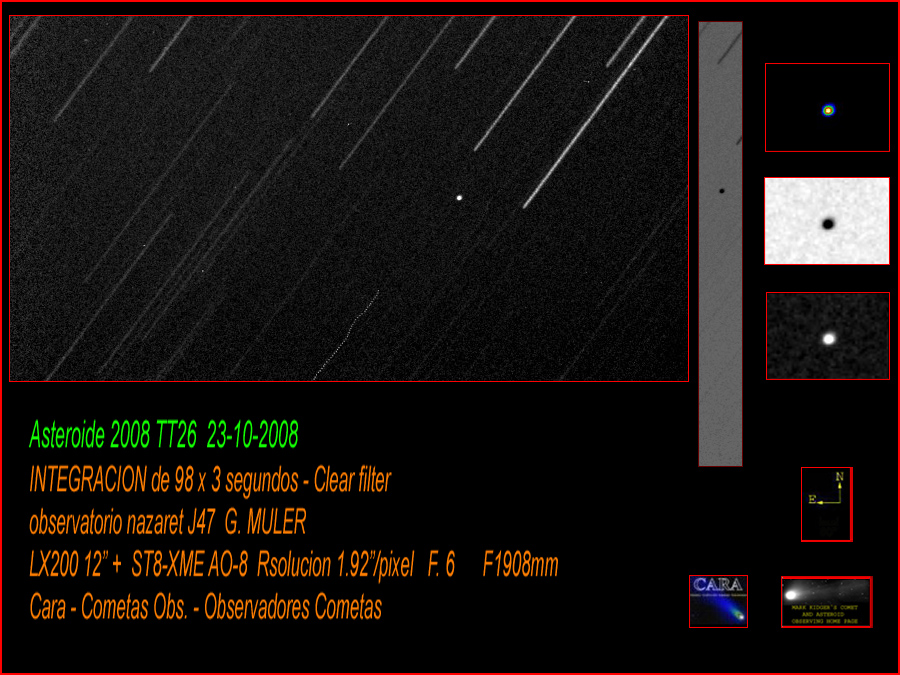
In other news it took a while for the Orionids profile to stabilize; now a peak of these meteors around midnight Oct. 20 with a ZHR just below 40 seems likely. How the Orionids fared night after night can be seen in reports of Oct. 20, Oct. 21, Oct. 22, Oct. 23, Oct. 24, Oct. 25 and Oct. 26. • Videos of a Canadian fireball are being hailed as rare. • There is a nice resource on 2008 TC3 and its impact, esp. an analysis of the astrometric effort and an attempt on periodicities in the lightcurve. Elsewhere TC3's discoverer speaks on what it all means. • There is an unusual list of all potentially hazardous asteroids - for all terrestrial planets. • Following TC3 there were more close calls, e.g. by 2008 US. • And 2008 TT26 came within 3.5 lunar distances: a preview, another and more pictures - and a very periodic light curve with a 7 hr period. • Oh, and there apparently another megacryometeor incident, making headlines.

• It's now one year since comet Holmes brightened dramatically - yet checking the technical literature, there has shockingly little science come out of this breathtaking sky event (which was easily visible to the naked eye), including only about 3 attempts to understand what happened. • Meanwhile the current outburst of 29P is winding down. • Plus Rosetta-target 67P on Oct. 21 and Oct. 20. • Amateur astronomers played a role in recovering XMM-Newton after comm trouble. • NASA explains how the ATV reentry was observed. • A paper describes MCAO hi-res NIR imaging of Jupiter. • A Spanish press release with nice galaxy images comes with a detailled explanation of the image processing. • And light pollution recently got a lot of press (here is the Nat'l Geographic package) - and has become a topic even in Hong Kong.

Monday, October 20, 2008

Orionids perform well, despite Moon interference

European reports from the night Oct. 19/20 speak of a fine performance of the Orionid meteors in spite of lunar interference this year. The meteor rate already exceeds 40/hour (under assumed perfect viewing conditions), and the peak is expected only in the coming night. • Meanwhile a new analysis of the Leonids predicts a max. rate of 150 this year. • A detailled interview (ca. 10 min. MP3) on the Jodrell Bank meteor system, with more background here. • A few more details of the 2008 TC3 bolide observations by a secret satellite - and also more on the indirect webcam observation: Reference observations near fullmoon show nothing, so the airburst must have been much brighter, even from 700+ km away!

In other news a dwarf nova is in outburst for the 1st time since 1997, but only at 12 mag. • A supernova extinction record: 16 magnitudes! • The physics of the Deep Impact impact are still mysterious. • The discovery of comet Cardinal in Canada - which doesn't look like much - is spawning a press release ("only the second Canadian discovery of a comet, using a Canadian telescope, in nearly a decade") and news and blog coverage in the country. • Comet Tuttle is binary. • And the HST has observed Pallas, an asteroid of which one hears little.

• A big prominence was seen on the Sun where STEREO imaged another one on Sep. 29. • Analysis of a flash spectrum obtained during the Aug. 1 eclipse - about which some 40 pages appear in TOTALITY! #8. • The German parliament held a hearing on light pollution with mixed responses. • Unusual radio images of our Moon can be seen here (under "ALMA Project News" as Fig. 5) - for comparision, the Moon at many other wavelengths. • Metals have been detected in NLCs, a possible clue to their formation. • And one should go to Canada for the best aurora views.

Monday, October 13, 2008

"McNeil's Nebula" shining in old glory again!

Already on Sep. 1, The Astronomer Electronic Circular #2478 had reported an "apparent brightening of V1647 Ori and its associated (McNeil's) nebula to mag about 16.7 on an unfiltered CCD image taken on Aug. 26.789 UT with a 0.60-m f/5.7 reflector," while "neither the variable star nor the associated nebula were visible" in January with a limiting mag. of 17.5. Now a picture of Oct. 12 shows the famous nebula practically as bright as in 2004 during its famous appearance out if nowhere (and discovery by an amateur astronomer). Observations followed in many wavelengths and a lot of papers were written e.g. about the bright state and the subsequent fading - now more can be learned about the eruptive variable star V1647 Orionis behind the show.

In other news a new bipolar active region on the Sun (#1005) on Oct. 12 - and 21 hi-res pictures of the Sun at various wavelengths. • New Keck pictures of Uranus and its clouds and rings, yielding clues to that planet's seasons. • Comet 29P on Oct. 12 and Oct. 10 and 51P on Oct. 12 and Oct. 10.

• The webcam images of the predicted bolide are back, together with some geometry. • We are still learning about the deep impact made by Deep Impact - and we will make the next one (on the Moon) next summer or fall with LCROSS.

• A planets conference at Cornell is being archived well. • Taking the fight against light pollution to parliament in Germany. • And remarkable pics of a plane in front of the Moon ...

Friday, October 10, 2008

Another "lost" comet recovered after over 100 years!

"Nearly a month ago two Japanese amateur astronomers re-discovered Comet Giacobini which had been lost for 111 years [see the 2nd paragraph here]. Now this weekend comes word that an object found by professional astronomer Andrea Boattini of the Catalina Sky Survey is also a re-discovery of a long-lost comet," reports Carl Hergenrother: "After Boattini’s find was officially announced, Maik Meyer of Limburg, Germany suggested that this comet was actually the same as a comet last seen on 1892 Dec 8." So it's now comet P/2008 T3 (Barnard-Boattini) though it will become 206P/Barnard-Boattini in a few weeks. The original discovery was a milestone in the history of astronomy as it constitutes the first one using photography.

In other news more images of comet 29P in outburst of Oct. 9, Oct. 8 (more, more) and Oct. 7, also comet 51P on Oct. 6. • More details of the MeteoSat bolide observations have become available. • The solar corona during the TSEs of 1994 and 2008 was extremely similar (an interesting observation, given the strange changes in the solar wind since). • Another report from the Herzberg star pary. • From Oct. 11 to 15 many talks from the DPS Meeting, a major planetary sciences conference, can be followed online. • And this blog has now also Twitter channel ...

Wednesday, October 8, 2008

QUICK UPDATE: More detections of the predicted bolide - from space and by webcam

There is now a Meteosat image of the airburst over Sudan which "was visible in all 12 of the satellite's spectral channels, covering wavelengths from 0.5 to 14 microns" - and a webcam in Egypt showed how the ground was illuminated by the fairly distant explosion low on the horizon. (A website with screenshots is currently down.) Plus there is a cryptic notice by JPL about direct observations of the airburst that may refer to data from an early warning satellite (those are regularly detecting such bursts but rarely are the actual measurements shown).

The case of 2008 TC3 is now being analyzed widely: What if this had been a bigger body which would have impacted the ground? This blog has already learned of a plan to set up an "official" website where the whole world can be watching how the impact probability ellipse on Earth will shrink and move as more astrometry comes in (and the response by observers this time has been huge). More video clips in sunlight are here, here and here: Some show a variation in brightness that may reveal the state of rotation of 2008 TC3 just hours before its demise.