Yesterday the big Automated Transfer Vehicle approached the ISS in a first of two dress rehearsals to within 3.5 km; later that evening the pair - with the ATV leading the ISS - was photographed and filmed over Europe (another picture and more). From the ISS the ATV was also seen during the demonstration. The day before the two had been flying much farther apart as two movies show. Here are the plans for another demonstration tomorrow (when the ATV will come to within 11 meters of the ISS around 16:45 UTC; the go-ahead came minutes ago) and docking on Thursday at 14:41 UTC. You can follow the action via an ESA blog and see where the ATV and ISS are right now. Weather permitting there are one or two nicely lit overflights for Europe every evening in the coming days as Heavens Above tells us.
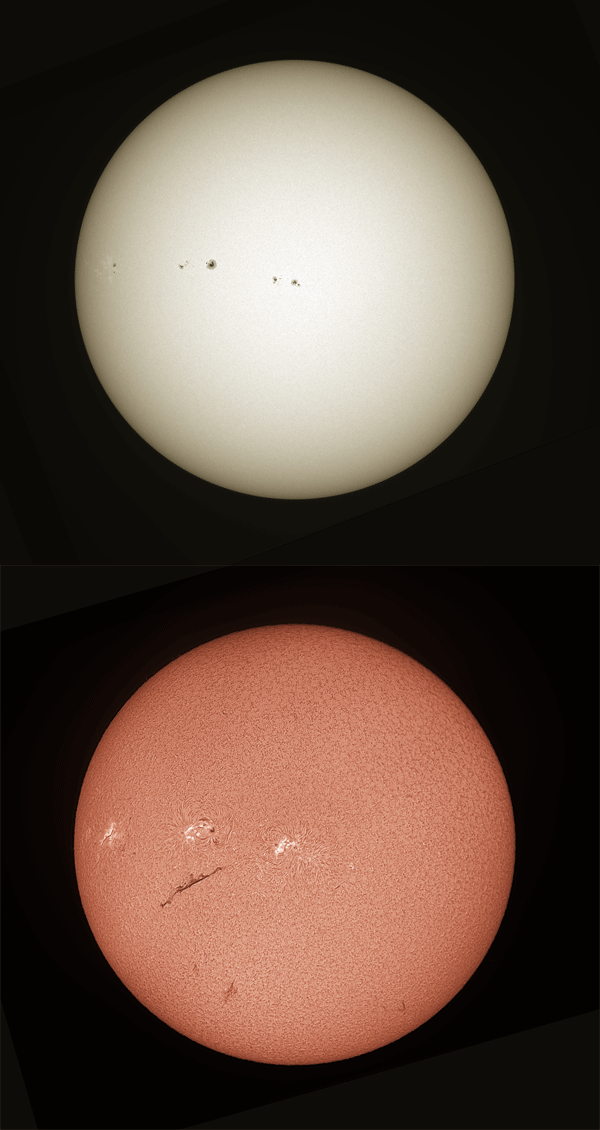
In other news two satellite fuel tanks apparently survived reentry and were found in recent days, one in Australia and one in Brazil. • The three sunspot groups from the old cycle are now near the middle of the disk: a white light and an H-Alpha view (another one) of March 29 and a white light/H-Alpha blinking image and a calcium view of March 28. • An old impact crater may have been found in the U.K. • Yesterday's Earth Hour was followed in some places and could even inspire some stargazing - and caused controversy in Oz. • And here is an unusual panorama of a halo.
Sunday, March 30, 2008



Friday, March 28, 2008
12 mag. supernova in Sculptor galaxy NGC 7793!
Finally a (compared to most other discoveries) pretty bright supernova that medium-sized amateur telescopes should show well: In the spiral galaxy NGC 7793, located at -32° declination in the constellation Sculptor, a supernova of 12th magnitude has been discovered on March 25. SN 2008bk is located approximately 2.3 arcminutes north of the nucleus of NGC 7793, a bright flocculent spiral galaxy of type Scd.
In other news there are now three sunspot groups on the disk, all from the old cycle: White-light images of Mar. 27 (attn.: wrong AR numbers) and Mar. 25 show the three activity regions well as do H-Alpha images of Mar. 26 and Mar. 25. • There are also impressive aurora pictures taken 'from above' during the last shuttle mission. • The Google-discovered Aussie impact crater is making more news. • And the reentry of the ATV (which hasn't even docked to the ISS yet) will be a subject of scientific study ...
In other news there are now three sunspot groups on the disk, all from the old cycle: White-light images of Mar. 27 (attn.: wrong AR numbers) and Mar. 25 show the three activity regions well as do H-Alpha images of Mar. 26 and Mar. 25. • There are also impressive aurora pictures taken 'from above' during the last shuttle mission. • The Google-discovered Aussie impact crater is making more news. • And the reentry of the ATV (which hasn't even docked to the ISS yet) will be a subject of scientific study ...


Tuesday, March 25, 2008
Comet Holmes still naked eye; meets Chen-Gao
Exactly 5 months after its outburst the famous comet was still "was faintly, fleetingly visible with the naked eye on 2:15 UT March 24 under transparent skies (mag. 6.5 stars visible)," reports one Bob: "The comet appeared as a uniform smudge approximately 1/2 degree across. 10x50 binoculars showed a dim puff that was 1 1/4 degrees across". Tomorrow and the day after Holmes will be visited by Chen-Gao which will approach it to within 1° and may actually be seen in front of the coma - interesting especially for astrophotographers. While Holmes has been estimated at 5th mag recently, Chen-Gao is at 9th - and will be occulted by the Moon in April for East Asia, another photo challenge.
In other news three papers in the mail today deal with the extraordinary "naked-eye GRB" (42 pages, only 5 days after the event!), the demise of a bizarre 'discovery' in spiral galaxy statistics (already discussed by the Galaxy Zoo and Bad Astronomy blogs in January - an interesting cautionary tale) and the statistics of exoplanet discoveries at Keck: One can extrapolate "17-20% of stars having gas giant planets within 20 AU".
• Here's an unexpected March 24 Mars with details, caught in daytime. • The two sunspot groups are still growing and also nice in H-Alpha. • Finally the new "Bond" is currently shooting on Cerro Paranal: The producers liked the futuristic residential complex of the European Southern Observatory's main site. Only that "Residencia" and the airstrip will be used as locations, the actual telescopes or their buildings will not be involved - in contrast to another movie years ago ...
In other news three papers in the mail today deal with the extraordinary "naked-eye GRB" (42 pages, only 5 days after the event!), the demise of a bizarre 'discovery' in spiral galaxy statistics (already discussed by the Galaxy Zoo and Bad Astronomy blogs in January - an interesting cautionary tale) and the statistics of exoplanet discoveries at Keck: One can extrapolate "17-20% of stars having gas giant planets within 20 AU".
• Here's an unexpected March 24 Mars with details, caught in daytime. • The two sunspot groups are still growing and also nice in H-Alpha. • Finally the new "Bond" is currently shooting on Cerro Paranal: The producers liked the futuristic residential complex of the European Southern Observatory's main site. Only that "Residencia" and the airstrip will be used as locations, the actual telescopes or their buildings will not be involved - in contrast to another movie years ago ...



Monday, March 24, 2008
Finally some notable sunspots to be seen
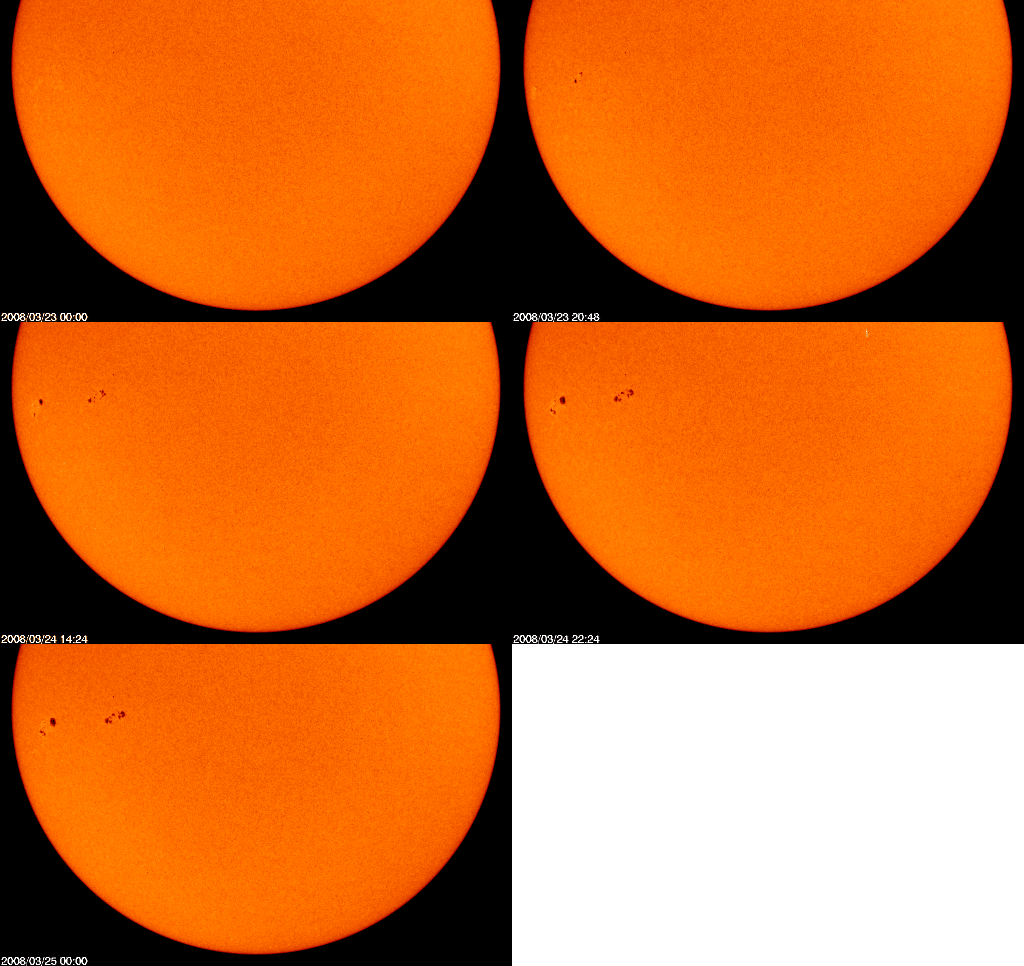
Two groups with several small spots each are now on the white-light Sun, AR 10987 and 10988. There is also some prominence activity now. Fortunately observing both phenomena - with proper techniques! - is free, in contrast to the 2009 Total Solar Eclipse in Japan where some well-placed small islands will charge an "entrance fee" of 300,000 yen or EUR 2000, just for the permission to come ashore ...
In other news here are detailled optical light curves of the March 19 GRB from Polish and Russian astronomers. • Once again actual data show no cosmic ray climate effects, a dubious topic that comes up all the time. • A nice Moon halo was seen at Easter. • And USA 193 reacted differently to the rocket attack than expected.
In other news here are detailled optical light curves of the March 19 GRB from Polish and Russian astronomers. • Once again actual data show no cosmic ray climate effects, a dubious topic that comes up all the time. • A nice Moon halo was seen at Easter. • And USA 193 reacted differently to the rocket attack than expected.

Saturday, March 22, 2008
Rare event tonight: asteroid and its moon to occult star in Europe!
"Another important occultation will occur in the next Saturday to Sunday night near 2:30 UT (i.e. on Easter morning)," advises J.Lecacheux on the PLANOCCULT mailing list: "The shadows of the big asteroid 22 Kalliope and of Linus, its 30 km satellite, will cross Near Orient and Europe diagonally, separated by 1094 km. Detecting Linus by occultation can provide a very accurate astrometric position, ten times better than the VLT or Keck Airy resolution, thus very useful to improve the satellite orbit. Only one previous successful occultation is known for Linus : when the Japanese observers caught both asteroid and satellite from the region of Tokyo on 2006 Nov.07. It allowed us to revise down the diameter of Linus from 38 to 30 km."
Here are more maps of Kalliope's path. According to Lecacheux, the 40 km path of Linus "will fly over Syria, w.Turkey, n.Grece or s.Bulgaria, all the states of former Yugoslavia, n.e.Italy or s.Austria, Switzerland or s.Germany, n.e.France or Belgium, and finally s.England and Ireland. Assuming 50 km as '1 sigma' accuracy of the Linus ephemeris relative to Kalliope, the probability of positive occultation should be 15 % for any observer staying at the middle of the Linus track [...]. For example this probability should be 7.5 % from Brussels, Bern or Paris." The path of Kalliope, 255 km wide, will be centered 500±180 km "SSW from the Linus centre line. It will cover a part of Jordania and almost whole Israel, s.Greece (Crete and Peloponnese), a part of s.Italy, and finally a large strip running across the south and west of France."
Lecacheux is a bit pessimistic, though, in his circular from yesterday, noting two circumstances that "will keep the situation far from idyllic. 1/ The bad weather now expected from many regions; 2/ The faint drop predicted, only 0.16 magnitude. The observation itself will be quite easy, even with modest telescopes and despite lunar vicinity, as the combined magnitude of the target (asteroid + star) will be V~10.7." Analyzing the measurements will be diffucult, though, and Lecacheux has an "advice: recording a two minutes dark sequence (with the telescope covered) just after the occultation, then subtracting at processing stage to every video image the so obtained 'mean dark pattern', will boost by a factor ~2 the SNR of a Watec 902x camera. This is an efficient way of improvement."
In other news Arthur C. Clarke has been laid to rest in Sri Lanka today. • More results from Hinode have been published, • auroral activity may be up a bit due to the season, • and the last Hubble Servicing Mission may face delay because there aren't enough external tanks ready. • Readers should also be aware of repeated misleading meteor 'recommendations' from one (otherwise o.k.) website.
• The particularly early Easter Sunday this year (in the western world, that is) should make us all ponder the complex rules that actually contradict astronomy one year in ten! German readers find more here or here - fortunately there are able online calculators available that obey to all the church math. • And if that's all too much, here's a celestial Easter Bunny ...
Here are more maps of Kalliope's path. According to Lecacheux, the 40 km path of Linus "will fly over Syria, w.Turkey, n.Grece or s.Bulgaria, all the states of former Yugoslavia, n.e.Italy or s.Austria, Switzerland or s.Germany, n.e.France or Belgium, and finally s.England and Ireland. Assuming 50 km as '1 sigma' accuracy of the Linus ephemeris relative to Kalliope, the probability of positive occultation should be 15 % for any observer staying at the middle of the Linus track [...]. For example this probability should be 7.5 % from Brussels, Bern or Paris." The path of Kalliope, 255 km wide, will be centered 500±180 km "SSW from the Linus centre line. It will cover a part of Jordania and almost whole Israel, s.Greece (Crete and Peloponnese), a part of s.Italy, and finally a large strip running across the south and west of France."
Lecacheux is a bit pessimistic, though, in his circular from yesterday, noting two circumstances that "will keep the situation far from idyllic. 1/ The bad weather now expected from many regions; 2/ The faint drop predicted, only 0.16 magnitude. The observation itself will be quite easy, even with modest telescopes and despite lunar vicinity, as the combined magnitude of the target (asteroid + star) will be V~10.7." Analyzing the measurements will be diffucult, though, and Lecacheux has an "advice: recording a two minutes dark sequence (with the telescope covered) just after the occultation, then subtracting at processing stage to every video image the so obtained 'mean dark pattern', will boost by a factor ~2 the SNR of a Watec 902x camera. This is an efficient way of improvement."
In other news Arthur C. Clarke has been laid to rest in Sri Lanka today. • More results from Hinode have been published, • auroral activity may be up a bit due to the season, • and the last Hubble Servicing Mission may face delay because there aren't enough external tanks ready. • Readers should also be aware of repeated misleading meteor 'recommendations' from one (otherwise o.k.) website.
• The particularly early Easter Sunday this year (in the western world, that is) should make us all ponder the complex rules that actually contradict astronomy one year in ten! German readers find more here or here - fortunately there are able online calculators available that obey to all the church math. • And if that's all too much, here's a celestial Easter Bunny ...
Friday, March 21, 2008
"Naked-eye Gamma Ray Burst" becomes mainstream knowledge
1 1/2 days after the event NASA has finally reacted with a Press Release to its satellite's success: "NASA Satellite Detects Record Gamma Ray Burst Explosion Halfway Across Universe". The story stresses that "the Very Large Telescope in Chile and the Hobby-Eberly Telescope in Texas measured the burst's redshift at 0.94. [...] A redshift of 0.94 translates into a distance of 7.5 billion light years, meaning the explosion took place 7.5 billion years ago, a time when the universe was less than half its current age and Earth had yet to form. This is more than halfway across the visible universe."
Records, records: "No other known object or type of explosion could be seen by the naked eye at such an immense distance," and "GRB 080319B's optical afterglow was 2.5 million times more luminous than the most luminous supernova ever recorded, making it the most intrinsically bright object ever observed by humans in the universe." Observing reports are still streaming in, though the afterglow - imaged at 19th mag. later on the 19th by Finnish amateurs - of the remarkable GRB has now dropped to below 20th mag.
Records, records: "No other known object or type of explosion could be seen by the naked eye at such an immense distance," and "GRB 080319B's optical afterglow was 2.5 million times more luminous than the most luminous supernova ever recorded, making it the most intrinsically bright object ever observed by humans in the universe." Observing reports are still streaming in, though the afterglow - imaged at 19th mag. later on the 19th by Finnish amateurs - of the remarkable GRB has now dropped to below 20th mag.
Thursday, March 20, 2008
So who did mention geostationary telecom sats first?
Arthur C. Clarke will be buried - in a strictly secular ceremony - on Saturday, and few of the uncountable obituaries fail to mention that he 'predicted' or even 'invented' the idea of geostationary satellites for telecommunications, like the one launched last night. Even Eutelsat is celebrating him as the Father of the Geostationary Orbit, but this is not the case: The all-knowing Wikipedia tells us that the "idea of a geosynchronous satellite for communication purposes was first published in 1928 by Herman Potočnik" alias Hermann Noordung, and that Clarke role was that of a popularizer of the concept. In his famous Oct. 1945 Wireless World paper Clarke indeed quoted Noordung and others - and a recent study showed that the special role of the geostationary orbit was pointed out even in the 19th century. Clarke struggled in vain to set the record straight during his lifetime, now it may be even harder ...
Meanwhile many more obituaries and tributes to Arthur C. Clarke have come in, e.g. from an Indian SF author, in a Sri Lankan editorial or an Indian Leader or in the LA and NY Times' or Physics World. Details about his last interview, a growing collection of tributes and the strange travels of some Clarke DNA are there, a 1977 article on a rare U.S. visit has been re-published, and we even learned how to hold a moment of silence in cyberspace ... The fascination of space lives on, of course, and if it comes in the form the recovered video tapes from the STS-123 SRBs: The best 'action' starts at 2:08, 4:35, 5:35, 7:40 and 10:05!
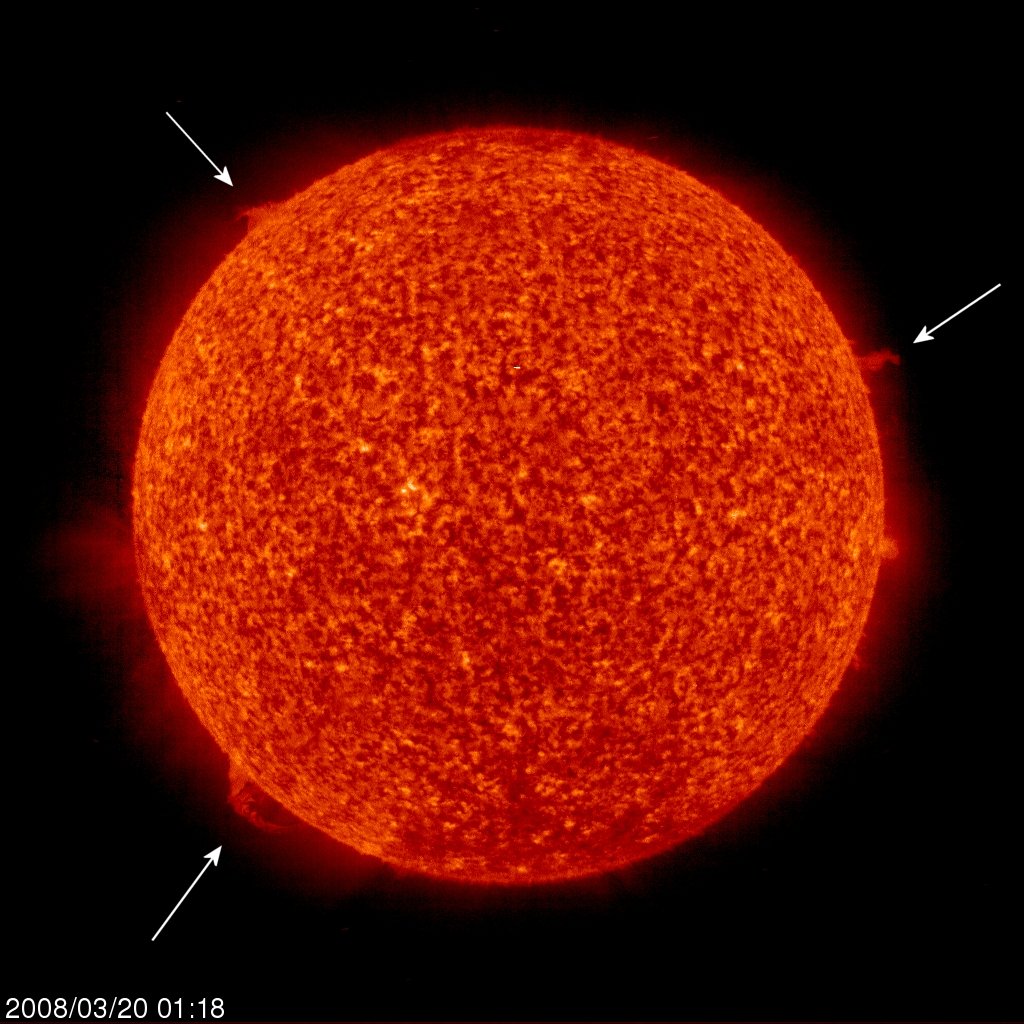
In other news a real unknown impact crater seems to have been discovered via Google Earth. • The MIT has students hunt asteroids via remote observing at the IRTF. • The NASA Eclipse Website has moved to a new URL and older ones will vanish; you find here e.g. all Eclipse Bulletins or info on the next TSE. • There has been no NOAA update on the coming 24th solar cycle for 11 months now, because these predictions are hard near the current minimum, but predictions by a single researcher now see a steep rise in sunspots beginning later this year. • Meanwhile be happy with three prominences seen today.
Meanwhile many more obituaries and tributes to Arthur C. Clarke have come in, e.g. from an Indian SF author, in a Sri Lankan editorial or an Indian Leader or in the LA and NY Times' or Physics World. Details about his last interview, a growing collection of tributes and the strange travels of some Clarke DNA are there, a 1977 article on a rare U.S. visit has been re-published, and we even learned how to hold a moment of silence in cyberspace ... The fascination of space lives on, of course, and if it comes in the form the recovered video tapes from the STS-123 SRBs: The best 'action' starts at 2:08, 4:35, 5:35, 7:40 and 10:05!
In other news a real unknown impact crater seems to have been discovered via Google Earth. • The MIT has students hunt asteroids via remote observing at the IRTF. • The NASA Eclipse Website has moved to a new URL and older ones will vanish; you find here e.g. all Eclipse Bulletins or info on the next TSE. • There has been no NOAA update on the coming 24th solar cycle for 11 months now, because these predictions are hard near the current minimum, but predictions by a single researcher now see a steep rise in sunspots beginning later this year. • Meanwhile be happy with three prominences seen today.
Wednesday, March 19, 2008
Gamma Ray Burst might have been visible naked-eye this morning
Probably nobody looked at the right spot at the right time - but when GRB 080319B erupted this morning at 6:13 UTC, it would have been visible as a star of at least magnitude 5.8 for a few seconds at 14h 31m 40.7s +36° 18' 14.7" (2000.0)! According to THE ASTRONOMER Electronic Circular No 2432 a camera "located at Las Campanas Observatory imaged the region of GRB 080319b before, during and after the GRB with 10s exposures (IR-cut filter only)." Nothing was visible from 6:12:33 to 6:12:43 UTC down to 12th mag., but from 6:12:47 - 6:12:57 UTC a 10 mag. "star" was seen which from 6:13:01 - 6:13:11 UTC had risen to a maximum brightness of about 6th mag. Now a call is out whether someone by chance photographed this sky field at the right time - and observers with larger telescopes are encouraged to take deep exposures even now.
In other news the death of Arthur C. Clarke has brought out numerous items of interest on the web such as the last ever interview he gave (transcript), a statement by NASA, a BBC piece with videos, an NPR piece with a radio feature, and obituaries galore from everywhere around the world, e.g. from the Planetary Society, the New York, Los Angeles and London Times', the Washington Post, ABC, the Guardian, CNN, the BBC, CBC and Space.com. And in the blogosphere responses came e.g. from SpaceRef, SpaceWeather, Wired, AstroProf, Planetary Soc., Nature, SpaceWriter, Voltage Gate, New Scientist, Univ. Today, Centauri Dreams, Cocktail Party Physics and NASA Watch.
• Meanwhile, the storm on Saturn seems to be fading, the 2009 ring plane crossing is approaching, and it has been decided that we now have an Encke Gap - and not Division - in Saturn's rings. • Here's a DIY Deimos. • And March 29 features both an (international) Earth Hour in which cities should turn off their lights for one hour at 8 p.m. local time and the start of the (U.S.) Nat'l Dark-Sky Week, as the International Dark-Sky Association reminds us. Light pollution has become a big media topic now.
In other news the death of Arthur C. Clarke has brought out numerous items of interest on the web such as the last ever interview he gave (transcript), a statement by NASA, a BBC piece with videos, an NPR piece with a radio feature, and obituaries galore from everywhere around the world, e.g. from the Planetary Society, the New York, Los Angeles and London Times', the Washington Post, ABC, the Guardian, CNN, the BBC, CBC and Space.com. And in the blogosphere responses came e.g. from SpaceRef, SpaceWeather, Wired, AstroProf, Planetary Soc., Nature, SpaceWriter, Voltage Gate, New Scientist, Univ. Today, Centauri Dreams, Cocktail Party Physics and NASA Watch.
• Meanwhile, the storm on Saturn seems to be fading, the 2009 ring plane crossing is approaching, and it has been decided that we now have an Encke Gap - and not Division - in Saturn's rings. • Here's a DIY Deimos. • And March 29 features both an (international) Earth Hour in which cities should turn off their lights for one hour at 8 p.m. local time and the start of the (U.S.) Nat'l Dark-Sky Week, as the International Dark-Sky Association reminds us. Light pollution has become a big media topic now.
Tuesday, March 18, 2008
STOP PRESS: Arthur C. Clarke dead at 90
Deeply saddened this blogger has just learned moments ago that A.C. Clarke has died in Sri Lanka at the age of 90. Links to more detailled obituaries will follow.
State of the art of meteor astronomy evident at German conference
As every year the - already 27th - AKM-Seminar, this time in Freital near Dresden, gave a great overview about the state of the art of meteor observation and analysis: This is one of the fields of astronomy where the level of amateur work is not much different anymore from what the (few) professionals in the field do.
In other news the Moon and Saturn will meet tomorrow, a Saturn animation clearly shows its elusive rotation pattern, and even with 8" but modern electronic cameras amazing Saturn images are possible today.
Another impact on the Moon has been videographed, this time from Maryland, astonishing lunar images with cell phone cameras, just held behind a telescope eyepiece, are possible - and you can bring out color on the Moon (that normally just looks yellowish) with clever image processing!
- This is particularly evident in the IMO Video Meteor Network to which now 20+ cameras contribute (15+ of them every clear night) and which netted 75,070 meteors in 2007 - the annual yield has been climbing linearly for years now. The 330,000 meteors in the data base will be analyzed for known and unknown meteor streams again this summer by sophisticated (and extremely CPU-intensive!) software: While visual observations still form the traditional base of our knowledge of meteoroid clouds moving through the solar system and being intercepted by Earth, the never-tiring video cameras add more and more insights. And mysteries: This March 6 and 9, the two meteors were recorded travelling in close proximity at the same time, something never seen before in 100,000s of cases ...
- While meteor stream modelling has greatly advanced in the past ten years, thanks to the Leonid storms, there are still surprises happening (so one should be observing at every opportunity): For example in 2006 and again in 2007 the Orionids were more active than usual, with Zenithal Hourly Rates in the 60s instead of 20-25. This has since been explained by a 6:1 resonance with Jupiter of the meteoroids which not only explains enhanced Orionid activity in 1936, 2006 and 2007 but also predicts high rates of these bright meteors in 2008 as well as 2009 and 2010. Unfortunately the 2008 Orionids will suffer from moonlight as will the Geminids: The Perseids - with an expected ZHR of 110 - will be the only major shower this year free of lunar interference.
- When major fireballs light up the sky anywhere over Europe Thomas Grau will travel there, interview eye (and ear!) witnesses and go on a hunt for meteorites if a strewnfield is deemed likely and its location has been calculated. The results from extensive witness 'interrogation' can at times be more precise than using imagery from fireball camera networks, says Grau, who reported on three recent cases.
- The famous 1 March 2008 fireball had at first been suspected to have dropped small meteorites near (or even into) Lake Constance - simply because many early eyewitness reports had come from that area. But further reports have now made it clear that any meteorites would have fallen in central Switzerland instead where going after them will be tough. The characteristics of the fireball could also mean, though, that no solid matter reached the ground at all.
- Similarly confusing were the first reports about a fireball in France on 25 January 2008, 15 minutes after sunset. A cloud in the sky remained and was photographed, but because of wind drift its use for determining the trajectory was limited. Fireball sighting vectors from reliable witnesses, however, meet near one location, in the vicinity of Montpellier - and several mentioned strange "red and blue flames" trailing the fireball. No meteorites yet either.
- The last major success happened in Spain after a daylight fireball on 10 May 2007 which was accompanied by loud noises and shaking ground like during an earthquake. Although only 5 really good witnesses could be located, from their sightings and acoustical recollections a search zone could be located - and soon five small meteorites were found (among tons of meteowrongs in olive plantations). A further search by Grau yielded 10 more, and overall 100+ meteorites have been found in a 7 x 3 km zone, with together 800 grams - and they are eucrites, i.e. most likely splinters of asteroid Vesta.
- The famous 1 March 2008 fireball had at first been suspected to have dropped small meteorites near (or even into) Lake Constance - simply because many early eyewitness reports had come from that area. But further reports have now made it clear that any meteorites would have fallen in central Switzerland instead where going after them will be tough. The characteristics of the fireball could also mean, though, that no solid matter reached the ground at all.
In other news the Moon and Saturn will meet tomorrow, a Saturn animation clearly shows its elusive rotation pattern, and even with 8" but modern electronic cameras amazing Saturn images are possible today.
Another impact on the Moon has been videographed, this time from Maryland, astonishing lunar images with cell phone cameras, just held behind a telescope eyepiece, are possible - and you can bring out color on the Moon (that normally just looks yellowish) with clever image processing!
Sunday, March 16, 2008
Google's Sky service now also on the web - no extra software!
The planetarium/visualization software released last year is no longer necessary to bring the sky to your computer: a website is offering the same, with highly zoomable real images from sky surveys. It works just like Google Maps and is pretty fast and smooth.
In other news it is noteworthy that many Cassini images from the Enceladus flyby have stars in the background as the Saturn moon was in the shadow! The flyby was not as smooth as it first seemed, with a key dust instrument failing at a bad time. • Here's an unusual paper about micrometeorite impacts into space telescopes of the grazing kind - which are pretty common.
• Clips from a live TV report from 1979 from the last total solar eclipse in the U.S. are available, 10 minutes in total (fine picture and sound quality)! And there are thoughts about observing solar eclipses from the Moon which has been done only once and in poor quality. • The light curve of Halley's comet at all timescales has been analyzed in Russia. • And there are speculations about another real planet in our solar system ...
In other news it is noteworthy that many Cassini images from the Enceladus flyby have stars in the background as the Saturn moon was in the shadow! The flyby was not as smooth as it first seemed, with a key dust instrument failing at a bad time. • Here's an unusual paper about micrometeorite impacts into space telescopes of the grazing kind - which are pretty common.
• Clips from a live TV report from 1979 from the last total solar eclipse in the U.S. are available, 10 minutes in total (fine picture and sound quality)! And there are thoughts about observing solar eclipses from the Moon which has been done only once and in poor quality. • The light curve of Halley's comet at all timescales has been analyzed in Russia. • And there are speculations about another real planet in our solar system ...
Subscribe to:
Posts (Atom)