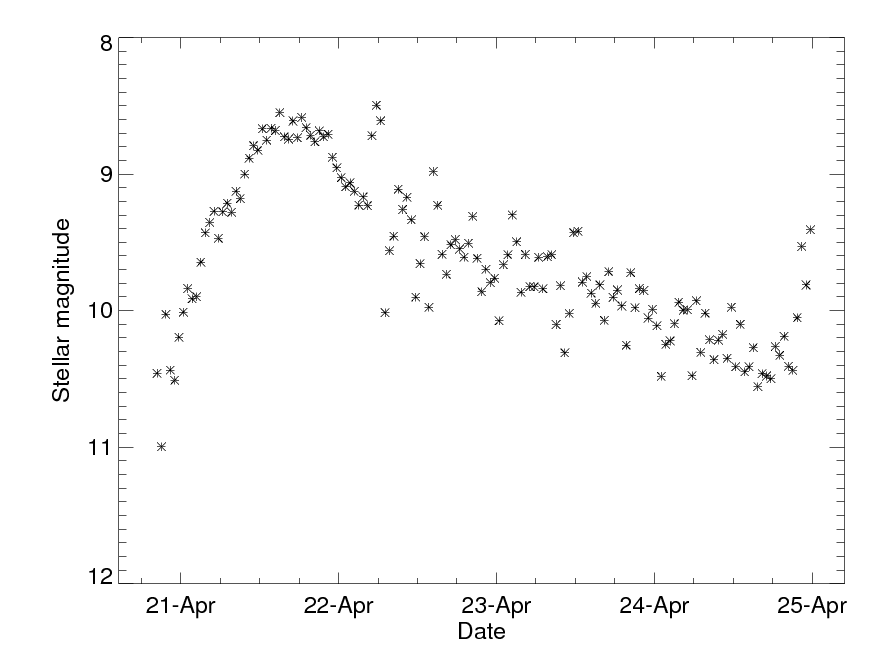
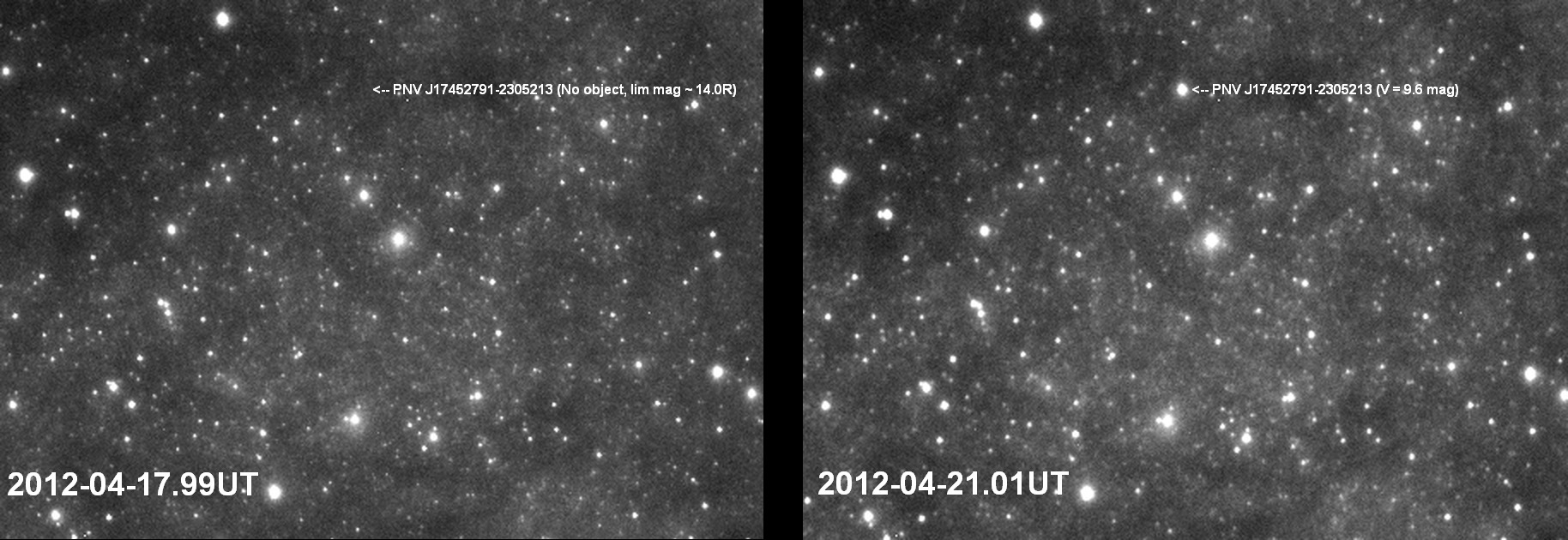
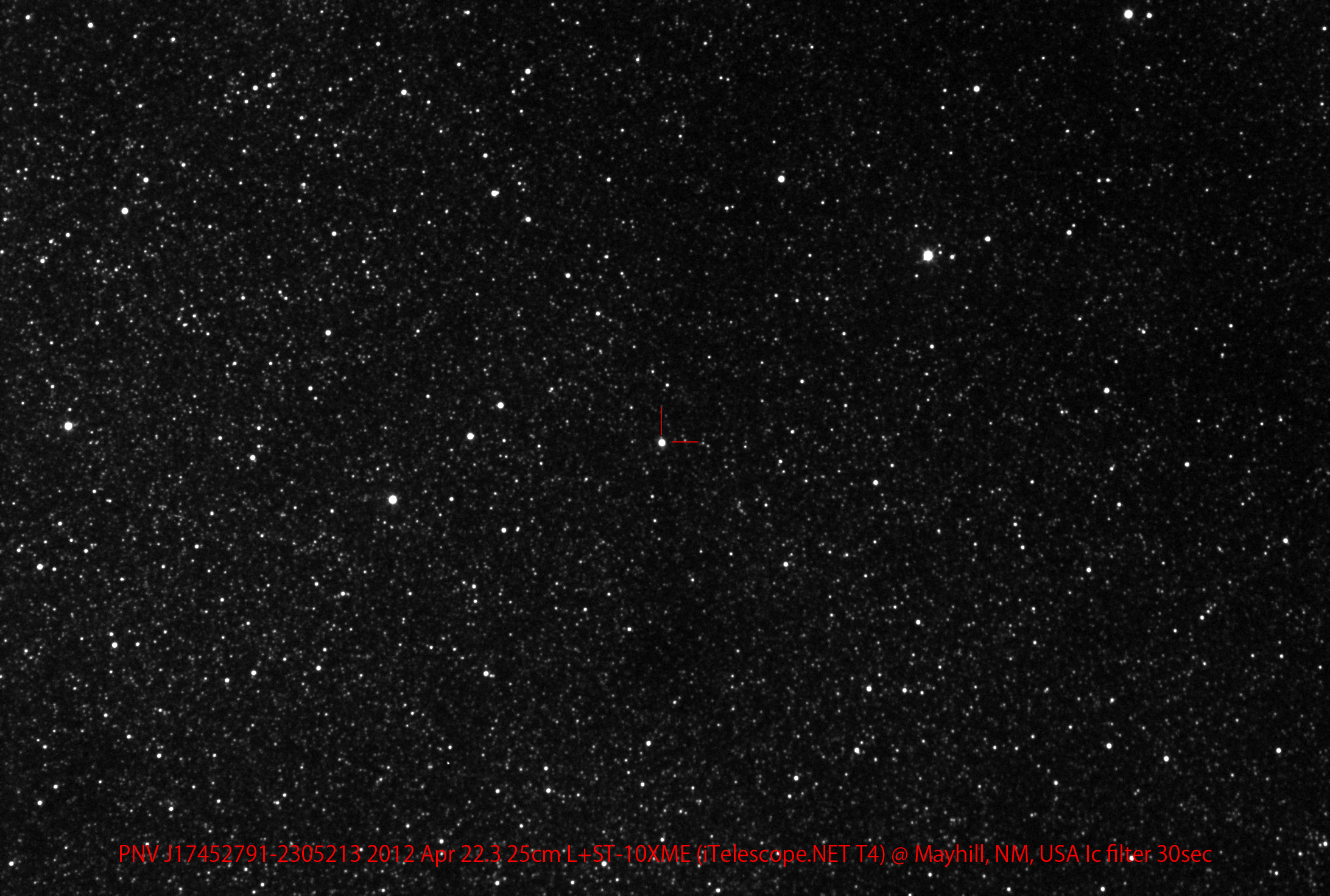
This could be a first in nova research: When Nova Sagittarii 2012 alias PNV J17452791-2305213 erupted on April 21, the satellite STEREO B had the field firmly in its view, and from the inadventend high-cadence photometry an impressive lightcurve has been generated, showing the complete peak! Whether such a record is unprecedented isn't clear yet. The nova reached 8.8 mag. briefly; since the nova has faded a lot: discovery pictures here and here, early spectra here and here (strong H-Alpha) and reports here and here. • Also blazar OJ 287 is flaring and in a high optical state, though not brighter than 13.5 mag.
On the Sun a prominence & CME on April 22, a prominence and sunspot details on April 21, a prominence on April 17 and a famous prominence (more) on April 16. • The SDO has been in orbit for 2 years, generating lots of pretty pictures. • An EGU press conference on space weather forecasting (abstracts links and COMESEP's home), ISWI and another doom story, picked up here and here. • Hinode sees a pole asymmetry. • Camilla visited the stratosphere (not 'space'), generating publicity for NASA like here, here (7:10-42), here, here and even here.
The aurora was quite active around April 24 as images from Sweden, northern Germany, northwestern Ireland (more and more, a video [alt.]), Northern Ireland and Canada (video) show; more collections here and here. • Also a celebrated aurora timelapse from Norway, more here - and auroral ballooning (more) in Alaska (video). • Also a sky mystery that could be a venting satellite, a story on amateur spysat hunters, and the sad death of Dale Ireland (also here and here) - whose automatic weather timelapse algorithm keeps running ...
Minor bodies in the news: Comet Garradd on April 18, April 17 and April 16, plus Faulkes observations of the Rosetta target. • Trans-Neptunian star occultations til 2015. • Yet more evidence against the Dryas impact and the impact history of the Earth. • The Target Asteroids! project explained here, here, here and here, plus a study on capturing a NEO. • A great bolide over the U.S., dropping meteorites in old gold rush country, a Brazilian bolide and the usual Lyrids.
Planets now well placed - a long-term calculation of altitudes for Germany - are Saturn (April 21 [dito and dito], April 12 [dito] and near opposition pictures), Mars (on April 19, April 16, April 7 and March 29/30) and Venus: a deeep picture in the Pleiades and with the Moon - and Obama. • Being so bright and well-placed - and thus also the sky highlight of early May - Venus also caused various UFO alerts, notably on German TV (covered also here, here, here and here) or here. While Venus looks like this right now (or like this in the near IR), it's prone to video artefacts. • And talking about a misunderstood Venus, its role in a famous aircraft incident in Jan. 2011 is less clear than in all the news coverage e.g. here, here, here, here, here or here as reading the actual investigation report shows. • Finally Mercury & the Moon on April 19 from Oz.
Monday, April 30, 2012



Sunday, April 15, 2012
Big KBO Quaoar to occult pretty bright star - probably for Africa
It was the 3rd big Kuiper Belt Object discovered, after Varuna and Ixion - and on the morning of April 17 (50,000) Quaoar will occult an 11-mag. star: Such occultations by outer solar system bodies have often led to new insights. Previous hopes that the track might cut through Europe have faded with recent astrometry: Now it looks like that the zone where occultation by Quaoar as well as its moon Weywot can be observed had slipped south into central Africa. • For the first time aurora on Uranus has been imaged from great distance, namely with Hubble. • Saturn is in opposition: pictures of April 14 and April 12 - and for tonight at 1:30 UTC (April 16) a webcast is planned. • Meanwhile Jupiter has 'lost' several moons that didn't exist in the first place, of course.
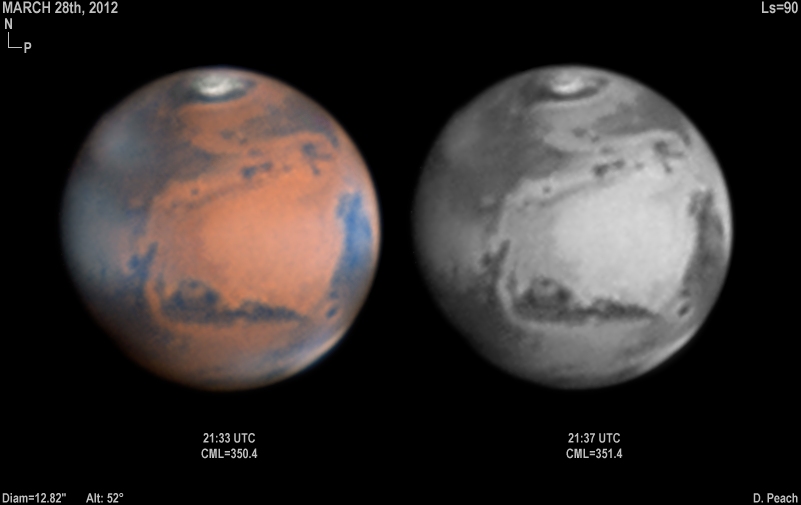
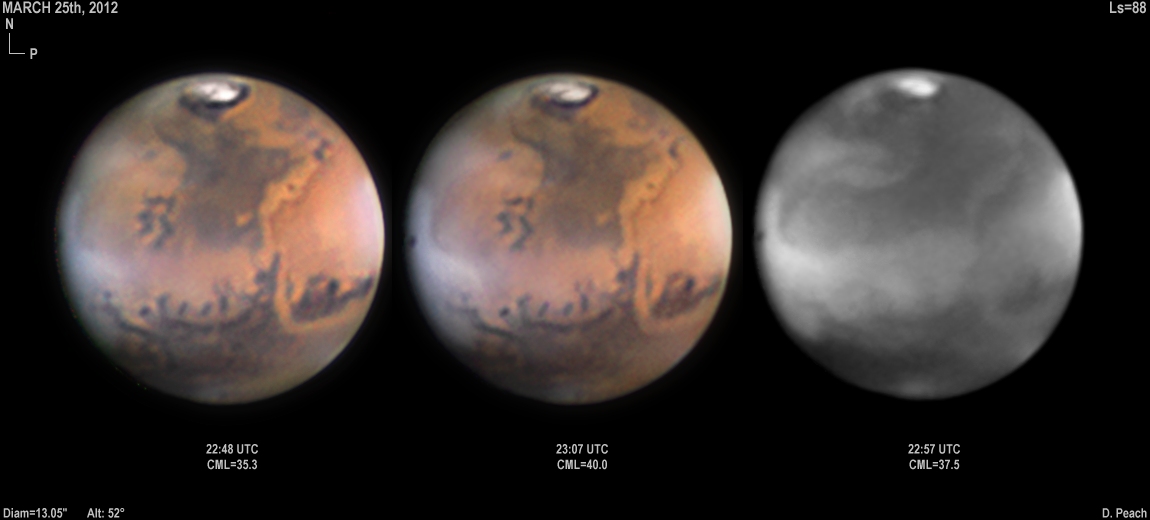
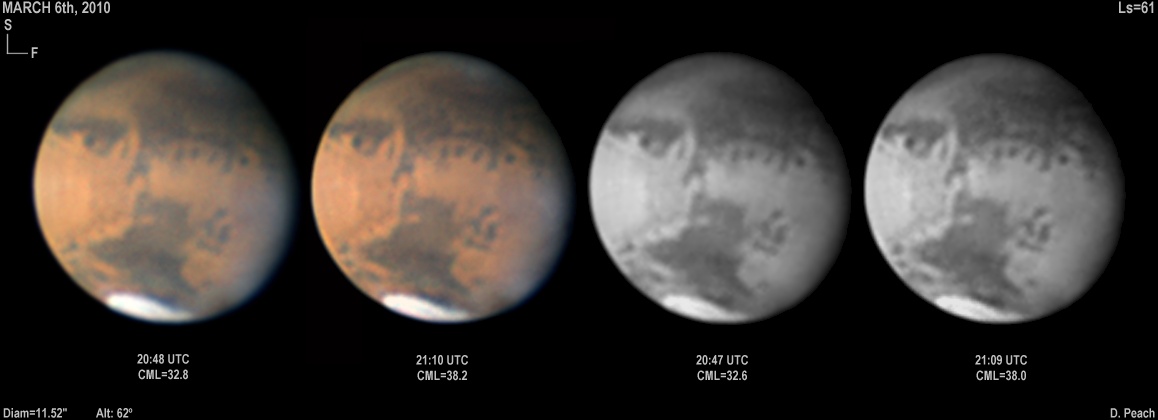
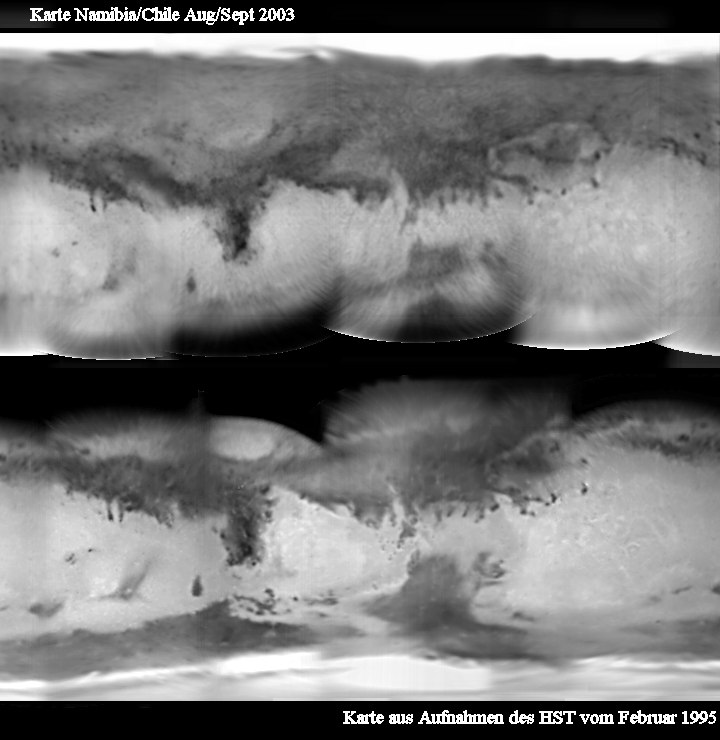
The apparition of Mars is already fading, with the disk shrinking: images of April 14, April 8, April 1 (more), March 30, March 28 (another terminator cloud; also a better animation of March 20 and another and another March 28 picture), March 27 and March 25, plus a February to April montage. It has now turned out that the bright spot in Mare Acidalium mentioned last time was also seen in 2010 as well as 2008 & 10 - but not in 1995, the last opposition with similar geometry as the current one. • The passage of Venus near the Pleiades was imaged a lot: collections of April 2 ... 4 and March 31 ... April 3 - and a view from 1972, 5 'grand cycles' earlier. • Meanwhile the separation of Venus & Jupiter is large again, but there are conjunctions about annually, with a particularly close one in August 2016.
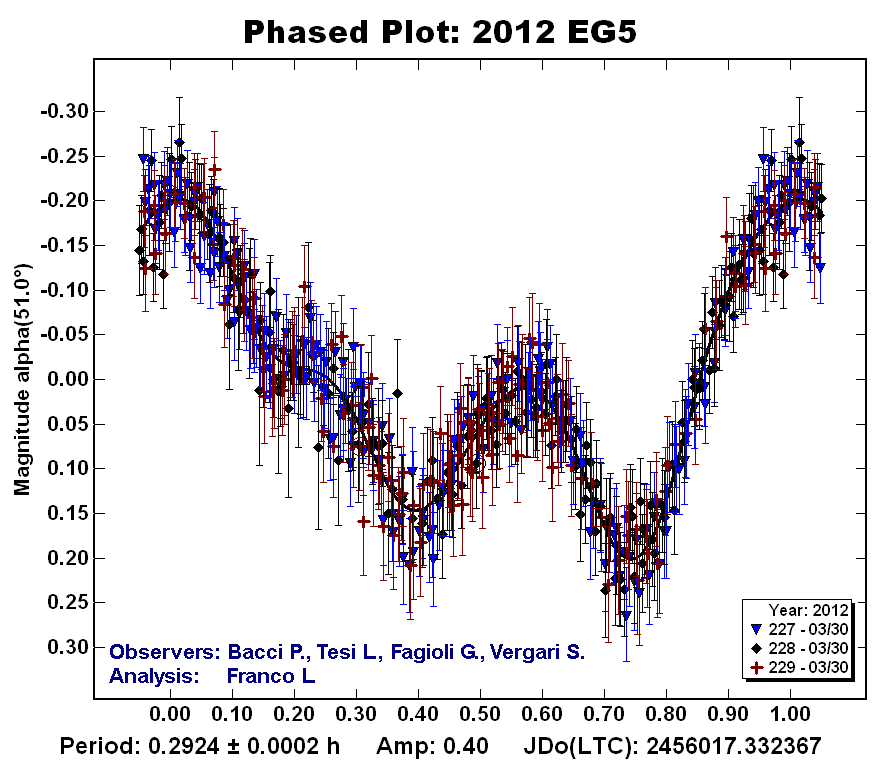
Near Earth Asteroid 2012 EG5 was observed widely during its April 1 Earth visit: a lightcurve, a picture and early analysis of taxonomy and spin rate - but no radar detection in spite of a well-determined orbit. • A long story on 2011 AG5 and why it's so hard to nail its orbit. • Comet Garradd on April 11: It's now in the 'paws' of UMa and was also observed by Swift, while 2011 FR143 has a cometary nature and P/2005 YJ126 (Catalina) has been recovered. • More on the Norwegian meteorite crash, a bolide in Texas on April 2 (which was real but the video was not), a multistation analysis of a Dutch bolide on March 27 and a German bolide on March 17. • Oh, and there was no Younger Dryas impact, period.
On the - rather inactive - Sun (the space wx April 4 ... 10) a fine limb eruption on April 15 from AR 1442 (more views & analysis and more), AR 1459 near the limb and another SDO 'tornado' on April 10/11. • From solar science corona cells (more), solar shape measurement by rolling SDO, joint IBEX/TWINS observations of a solar storm and alleged solar cycle weather effects. • The Arctic aurora season in ending quickly now (more and more): some parting shots from Scotland, the UK and Norway (more) - plus a fine 45-min documentary from German TV on aurora hunting in Scandinavia, describing various methods to go after it!
Finally the NASA space observatory data center has been named for Senator B. Mikulski which is well deserved as she fought hard for Hubble and the JWST - but it's merely a joke that a supernova was also named for her (as also claimed here and here). "No, supernovae are not named officially, only designated," the IAU's Central Bureau for Astronomical Telegrams has assured this blog: "This is evidently just a cute joke..." • And to close a wide view of the zodiacal light and assorted phenomena, glorious images of contrails (tons of them) with light effects and turbulence effects - and a timelapse movie of geostationary satellites ... with the Alps in the foreground!
_Occult.jpg)
The apparition of Mars is already fading, with the disk shrinking: images of April 14, April 8, April 1 (more), March 30, March 28 (another terminator cloud; also a better animation of March 20 and another and another March 28 picture), March 27 and March 25, plus a February to April montage. It has now turned out that the bright spot in Mare Acidalium mentioned last time was also seen in 2010 as well as 2008 & 10 - but not in 1995, the last opposition with similar geometry as the current one. • The passage of Venus near the Pleiades was imaged a lot: collections of April 2 ... 4 and March 31 ... April 3 - and a view from 1972, 5 'grand cycles' earlier. • Meanwhile the separation of Venus & Jupiter is large again, but there are conjunctions about annually, with a particularly close one in August 2016.




Near Earth Asteroid 2012 EG5 was observed widely during its April 1 Earth visit: a lightcurve, a picture and early analysis of taxonomy and spin rate - but no radar detection in spite of a well-determined orbit. • A long story on 2011 AG5 and why it's so hard to nail its orbit. • Comet Garradd on April 11: It's now in the 'paws' of UMa and was also observed by Swift, while 2011 FR143 has a cometary nature and P/2005 YJ126 (Catalina) has been recovered. • More on the Norwegian meteorite crash, a bolide in Texas on April 2 (which was real but the video was not), a multistation analysis of a Dutch bolide on March 27 and a German bolide on March 17. • Oh, and there was no Younger Dryas impact, period.
On the - rather inactive - Sun (the space wx April 4 ... 10) a fine limb eruption on April 15 from AR 1442 (more views & analysis and more), AR 1459 near the limb and another SDO 'tornado' on April 10/11. • From solar science corona cells (more), solar shape measurement by rolling SDO, joint IBEX/TWINS observations of a solar storm and alleged solar cycle weather effects. • The Arctic aurora season in ending quickly now (more and more): some parting shots from Scotland, the UK and Norway (more) - plus a fine 45-min documentary from German TV on aurora hunting in Scandinavia, describing various methods to go after it!
Finally the NASA space observatory data center has been named for Senator B. Mikulski which is well deserved as she fought hard for Hubble and the JWST - but it's merely a joke that a supernova was also named for her (as also claimed here and here). "No, supernovae are not named officially, only designated," the IAU's Central Bureau for Astronomical Telegrams has assured this blog: "This is evidently just a cute joke..." • And to close a wide view of the zodiacal light and assorted phenomena, glorious images of contrails (tons of them) with light effects and turbulence effects - and a timelapse movie of geostationary satellites ... with the Alps in the foreground!
Saturday, March 31, 2012
Lot of cloud action on Mars thrills observers (with sufficient resolution)
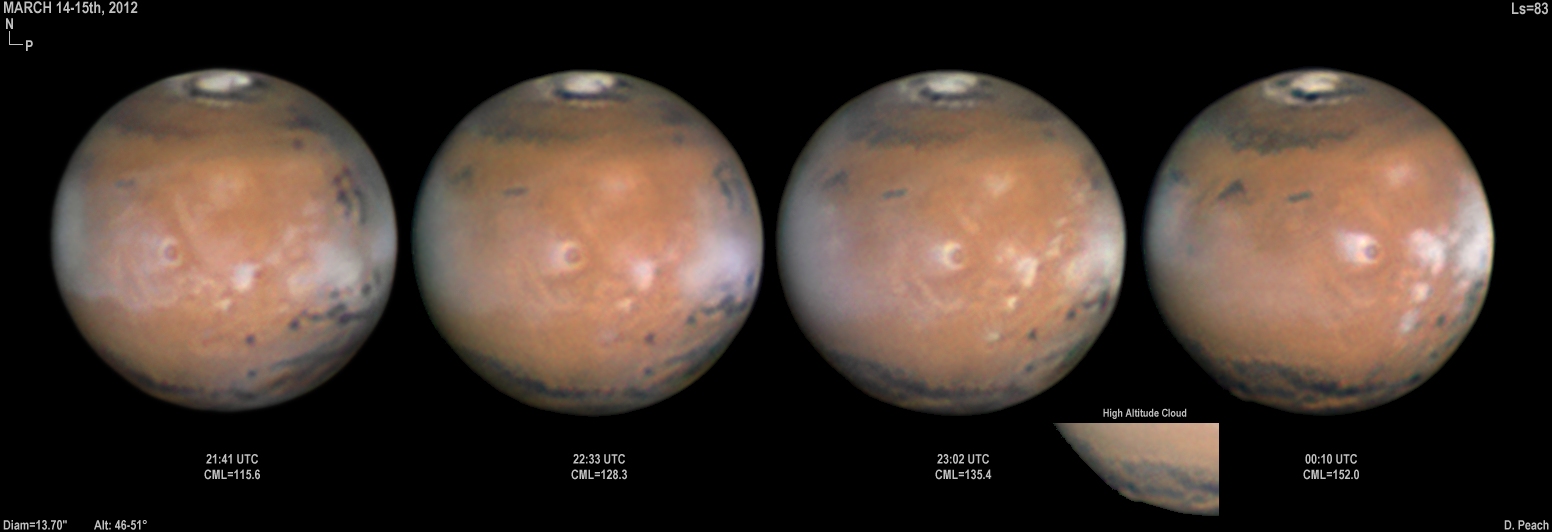
A bright, high cloud at the terminator that a few lucky observers caught and that got even professional planetologists excited, a bright splotch on the big dark Mare Acidalium and numerous other clouds have been sighted on Mars in recent weeks - if your equipment's resolution was good enough for seeing detail on the tiny disk. The terminator cloud was observed e.g. several times by Wayne Jaeschke (see e.g. this, this and this report) and is covered here, here, here (proposed explanation; earlier), here and here.
The Acidalium spot can be seen on many images, including some of those from March 28, March 25 (more), March 24 (more, more), March 22 (more), March 21 (more), March 19 (more), March 18, March 16 (more, more), March 15, March 14-15, March 14 and March 11-12. • The Venus/Jupiter conjunction is over (as a picture from this evening clearly shows): help yourself to many more pictures of March 24 to 28 and March 13 to 25 when they were closer and the Moon nearby, too.
In the world of comets the new and unusual SWAN Kreutz comet didn't survive the solar passage: STEREO, SOHO C2 (more and more) and LASCO C3 imagery, coverage here, here (earlier), here and here and a possible ground-based detection on March 10. Plus how comets fare near the Sun (interview; earlier). • Comet Garradd's ion tail is coming and going: pictures of March 28, March 25, March 22, March 17, March 15 (more), March 13 and March 4. • Comet PanSTARRS is on track for a possible nice show in 2013. • Comets Gibbs & Lemmon (Gibbs again) and space weathering on Wild 2. • How the Halley meteoroid streams evolve under the influence of Jupiter (interview) and simulating the 2009 impact on Jupiter. • Another close asteroid fly-by by 2012 EG5 tomorrow (more) while Earth visitor (in 2013) 2012 DA14 got less interesting (related rant).
Nice recent aurora images from March 20 (off Norway), March 18 (Canada), March 16 (plus 17 plus 20 off Norway), March 15 (USA, Norway, Germany [table, pictures, picture], the UK [more, more, more] and from a plane over the UK [more]), March 12 (Australia), March 11 (off Norway; more) and earlier in Norway and Alaska and here and there. Plus aurora science, a 2010 storm observed, space wx forecasting, SABER & storms (more), GIC modelling, possible space wx trends and weird claims re. health FX. • AR 1429 is back but largely gone though something was seen at the edge - during the 1st disk transit a lot more was there, including an M flare on March 13. • Also sunquakes after flares, the SDO seeing coronal cavities, a SDO movie of a "solar tornado" - and the solar diameter from a Mercury transit!
Elsewhere in the Universe SN 2012aw in M 95 (announcement, March 17 and 16 discovery images, a video about the early story and mehr, more, mehr, more, mehr, more, more, mehr, more, more, more, more, more, more, more, more, more, more and more) and SN 2012au in NGC 4790 (more, more, more and more). • NASA making 'chemtrails' for science of the thermosphere (timelapse sequence and another one). • Why spring came early. • And April won't bring much predictable, except for Venus in the Pleiades in the early days of the month (a March 28 view), the opposition of Saturn on April 15 and some Lyrid meteors later in the month.
The Acidalium spot can be seen on many images, including some of those from March 28, March 25 (more), March 24 (more, more), March 22 (more), March 21 (more), March 19 (more), March 18, March 16 (more, more), March 15, March 14-15, March 14 and March 11-12. • The Venus/Jupiter conjunction is over (as a picture from this evening clearly shows): help yourself to many more pictures of March 24 to 28 and March 13 to 25 when they were closer and the Moon nearby, too.


In the world of comets the new and unusual SWAN Kreutz comet didn't survive the solar passage: STEREO, SOHO C2 (more and more) and LASCO C3 imagery, coverage here, here (earlier), here and here and a possible ground-based detection on March 10. Plus how comets fare near the Sun (interview; earlier). • Comet Garradd's ion tail is coming and going: pictures of March 28, March 25, March 22, March 17, March 15 (more), March 13 and March 4. • Comet PanSTARRS is on track for a possible nice show in 2013. • Comets Gibbs & Lemmon (Gibbs again) and space weathering on Wild 2. • How the Halley meteoroid streams evolve under the influence of Jupiter (interview) and simulating the 2009 impact on Jupiter. • Another close asteroid fly-by by 2012 EG5 tomorrow (more) while Earth visitor (in 2013) 2012 DA14 got less interesting (related rant).

Nice recent aurora images from March 20 (off Norway), March 18 (Canada), March 16 (plus 17 plus 20 off Norway), March 15 (USA, Norway, Germany [table, pictures, picture], the UK [more, more, more] and from a plane over the UK [more]), March 12 (Australia), March 11 (off Norway; more) and earlier in Norway and Alaska and here and there. Plus aurora science, a 2010 storm observed, space wx forecasting, SABER & storms (more), GIC modelling, possible space wx trends and weird claims re. health FX. • AR 1429 is back but largely gone though something was seen at the edge - during the 1st disk transit a lot more was there, including an M flare on March 13. • Also sunquakes after flares, the SDO seeing coronal cavities, a SDO movie of a "solar tornado" - and the solar diameter from a Mercury transit!


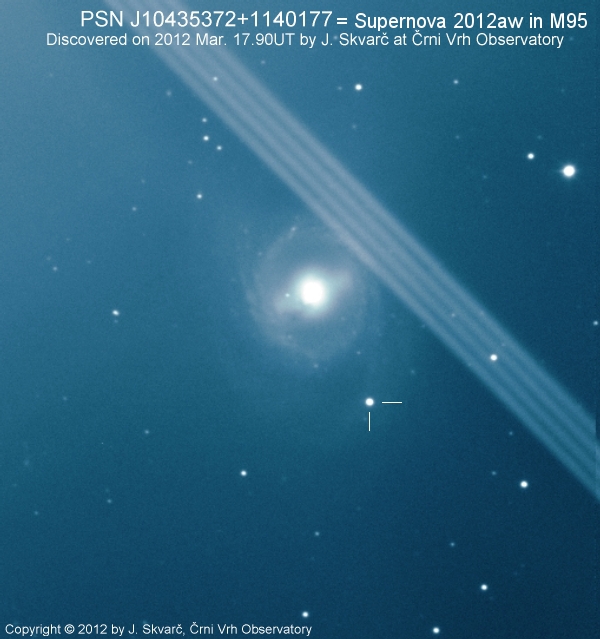
Elsewhere in the Universe SN 2012aw in M 95 (announcement, March 17 and 16 discovery images, a video about the early story and mehr, more, mehr, more, mehr, more, more, mehr, more, more, more, more, more, more, more, more, more, more and more) and SN 2012au in NGC 4790 (more, more, more and more). • NASA making 'chemtrails' for science of the thermosphere (timelapse sequence and another one). • Why spring came early. • And April won't bring much predictable, except for Venus in the Pleiades in the early days of the month (a March 28 view), the opposition of Saturn on April 15 and some Lyrid meteors later in the month.

Tuesday, March 13, 2012
Planet conjunction of the year now - and another 'Lovejoy' approaching?
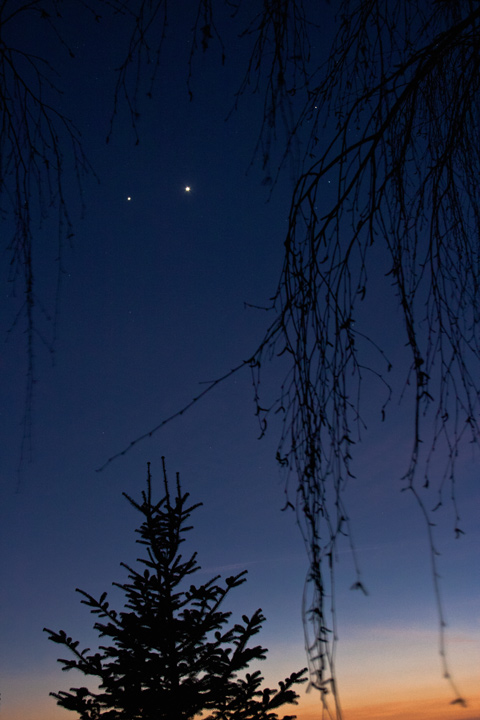
The moderately close (3°) conjunction of Venus & Jupiter in the evening sky can't have escaped anyone's attention by now, given the number of advance reports like here (more), here, here, here, here, here, hier, hier and hier: views - sometimes with Mercury - of March 12 from Germany (more, from this page), Romania and Australia, March 11 from a plane, the Canary Islands, France, Germany, the U.K. (also with aurora; more), India and the Philippines, March 10 from the U.S. (more), the U.K. (more), Austria and Australia, March 9 from the U.S. (more) and India, March 8 from India, March 7 from the U.S., March 6 from Germany (more), March 5 from Ireland, the U.K. and Australia, March 4 from the U.K. (also Mercury & Uranus close-up; more), March 3 from Austria, March 2 from the U.K., March 1 from Australia and late February from various places. Also close-ups of Venus on March 10 (morphed cloud animation!) and March 1 (plus planned observations for the ToV), a movie from Jupiter drawings and Mars - in opposition on March 10 (many clouds; more), March 6 and Feb. 29 (also individual colors; more & more)
A strange comet is approaching the Sun: it was discovered in SWAN images and could be 'another Lovejoy'. For further developments see this live-blog; Lovejoy himself couldn't find it, by the way, nor anyone else. Also Garradd on March 10 with a disconnection event (more March Garrads under the SWAN link). • There are now over a million meteors in the IMO video database! • A bolide impressed Britain: more links and a call for data. Also a possible Georgia dropper: images. • A meteorite hit a house in Norway (more), and the Dryas impact claim is back. • Asteroid (68) Leto crosses the Pleiades in mid-March, the Catalina Sky Survey gets $$, NASA counters scare stories about 2011 AG5 (see also here, here, here, here, here and here ...), from the other non-impactor 2012 DA14 - also debunked by the MPC - some clone animations and a fun animation, and a proposal to tamper with Apophis - please ...
There was a lot of action on the Sun as reported - with tons of links - in March 7, March 9 and March 11 postings. Auroral consequences stayed moderate, though, except at high latitudes such as Australia and Canada on March 12 or Scotland and Finland on March 11. Also a nice eruptive prominence & CME at the limb, the AR 1429 responsible for everything and new ISS aurora views. • Finally a new Eps Aur paper clarifying the dust disk (background), a new Nova Car 2012, an interview with T. Legault, ISS imager (part 2), a Moon non-illusion (it can really be bigger; more), amateur astronomers in Texas flashing the ISS (more and more) and night views from the ISS.


A strange comet is approaching the Sun: it was discovered in SWAN images and could be 'another Lovejoy'. For further developments see this live-blog; Lovejoy himself couldn't find it, by the way, nor anyone else. Also Garradd on March 10 with a disconnection event (more March Garrads under the SWAN link). • There are now over a million meteors in the IMO video database! • A bolide impressed Britain: more links and a call for data. Also a possible Georgia dropper: images. • A meteorite hit a house in Norway (more), and the Dryas impact claim is back. • Asteroid (68) Leto crosses the Pleiades in mid-March, the Catalina Sky Survey gets $$, NASA counters scare stories about 2011 AG5 (see also here, here, here, here, here and here ...), from the other non-impactor 2012 DA14 - also debunked by the MPC - some clone animations and a fun animation, and a proposal to tamper with Apophis - please ...
There was a lot of action on the Sun as reported - with tons of links - in March 7, March 9 and March 11 postings. Auroral consequences stayed moderate, though, except at high latitudes such as Australia and Canada on March 12 or Scotland and Finland on March 11. Also a nice eruptive prominence & CME at the limb, the AR 1429 responsible for everything and new ISS aurora views. • Finally a new Eps Aur paper clarifying the dust disk (background), a new Nova Car 2012, an interview with T. Legault, ISS imager (part 2), a Moon non-illusion (it can really be bigger; more), amateur astronomers in Texas flashing the ISS (more and more) and night views from the ISS.
Wednesday, February 29, 2012
Mysterious solar system object 2012 DR30: period ~50,000 years, inclination 75°, perihelion 14 AU
You know that something important has been discovered in the solar system when Mike Brown is tweeting every few minutes about it - which yesterday was the case with 2012 DR30: the originally pubished orbit from Feb. 26 (at first revised slightly only) had a semimajor axis of 160 AU, corresponding to a period of ~2000 years, but Brown has heard that the semimajor axis could be 1400 AU which would mean a periode of roughly 50,000 years. This is based on an arc from Jan. 3 til Feb. 28: If true, the eccentricity would be 0.99 (instead of 0.91), since the perihelion distance is only 14 AU - 2012 DR is about as close as it gets to Sun & Earth now. But why wasn't it found earlier? The body - with an absolute magnitude of 7.2 roughly 200 km in diameter shines at 18th magnitude now, easily caught by several amateur astronomers who found it to be star-like without a coma. Yet the high-inclination orbit with i~75° (diagram), the huge eccentricity and perhaps a sudden turn-on would surely speak for a cometary nature. Observations with big telescopes are now called for to find out. Incidentally there is another asteroid on a comet-like orbit, but the elements of 2011 YU75 are not nearly as extreme.
In other small bodies news comet Lovejoy on Feb. 22/23 was a tail without a comet while on Feb. 21 it had looked pretty normal - most observers have lost it now because of the low surface brightness. • Comet Holmes - the one with the big outburst in 2007 - has been imaged at 21 mag. on Feb. 24. • Comet Garradd still sports three tails as seen in pictures from Feb. 28, Feb. 27, Feb. 26 (more), Feb. 22, Feb. 21 (with a disconnection event), Feb. 20 (more) and Feb. 19 (more); also a collage spanning many months showing the changing tail geometry - which some don't get (see comment 8!) what others then copy ...
Among the planets Mars is approaching opposition on March 3rd - and despite it being about as far away from Earth as possible, some nice pictures have been obtained, e.g. on Feb. 26, Feb. 25, Feb. 20, Feb. 19 and other dates. • There was a nice constellation of the Moon, Venus & Jupiter on Feb. 24-26 (also on Feb. 27; more and more pics - and the Moon only 18 hours old on Feb. 22 and Jupiter on Feb. 10/11). • A NEO of radar interest in 2013 is 2012 DA14, of which more observations are needed - dito for 2011 AG5 which has a small impact probability of 1:625 in 2040 (causing unnecessarily alarmist headlines here, here and hier - bored of Apophis, eh?). • And why were there so many fireballs in February, all unrelated?
The Sun was partially eclipsed by the Moon but only for the SDO on Feb. 21 - also an animation of the May ASE. • There were 5 eruptions on the Sun in rapid sequence but no low-latitude auroral comsequences. • The temporary loss on an amateur dish receiving STEREO quick data (see also here and here) was mildly worrying, this blog has confirmed. • Feb. 19 aurora over Ireland, a rocket launch during an aurora, the Jan. 22 aurora from the Shetlands (from this site), ISS aurora video also featuring a nightly impactcrater and an astronaut-endorsed older ISS aurora video with 3D-like effect. • A timelapse video from Paranal and how it was made, a crazy sunrise (also discussed here) and universal scales interactively animated. • The highlights of March include the Mars opposition, the evening apparition of Mercury and the close approach of Venus & Jupiter on March 13.
In other small bodies news comet Lovejoy on Feb. 22/23 was a tail without a comet while on Feb. 21 it had looked pretty normal - most observers have lost it now because of the low surface brightness. • Comet Holmes - the one with the big outburst in 2007 - has been imaged at 21 mag. on Feb. 24. • Comet Garradd still sports three tails as seen in pictures from Feb. 28, Feb. 27, Feb. 26 (more), Feb. 22, Feb. 21 (with a disconnection event), Feb. 20 (more) and Feb. 19 (more); also a collage spanning many months showing the changing tail geometry - which some don't get (see comment 8!) what others then copy ...


Among the planets Mars is approaching opposition on March 3rd - and despite it being about as far away from Earth as possible, some nice pictures have been obtained, e.g. on Feb. 26, Feb. 25, Feb. 20, Feb. 19 and other dates. • There was a nice constellation of the Moon, Venus & Jupiter on Feb. 24-26 (also on Feb. 27; more and more pics - and the Moon only 18 hours old on Feb. 22 and Jupiter on Feb. 10/11). • A NEO of radar interest in 2013 is 2012 DA14, of which more observations are needed - dito for 2011 AG5 which has a small impact probability of 1:625 in 2040 (causing unnecessarily alarmist headlines here, here and hier - bored of Apophis, eh?). • And why were there so many fireballs in February, all unrelated?


The Sun was partially eclipsed by the Moon but only for the SDO on Feb. 21 - also an animation of the May ASE. • There were 5 eruptions on the Sun in rapid sequence but no low-latitude auroral comsequences. • The temporary loss on an amateur dish receiving STEREO quick data (see also here and here) was mildly worrying, this blog has confirmed. • Feb. 19 aurora over Ireland, a rocket launch during an aurora, the Jan. 22 aurora from the Shetlands (from this site), ISS aurora video also featuring a nightly impactcrater and an astronaut-endorsed older ISS aurora video with 3D-like effect. • A timelapse video from Paranal and how it was made, a crazy sunrise (also discussed here) and universal scales interactively animated. • The highlights of March include the Mars opposition, the evening apparition of Mercury and the close approach of Venus & Jupiter on March 13.
Friday, February 17, 2012
Comets make news: Garradd's weird tails, more amateur discoveries - and Lovejoy heads north
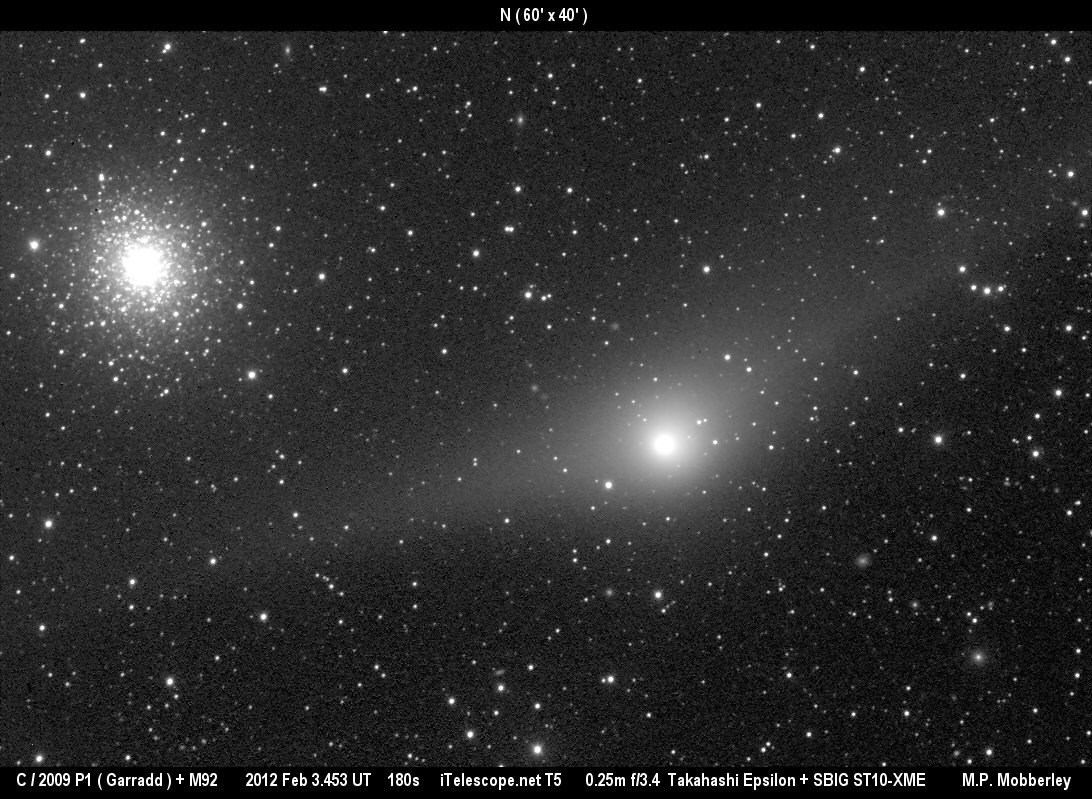
Well, nerd news rather, as none of the interesting comets making headlines in speciality media are bright enough for general (or even general amateur astronomical) interest - not even C/2009 P1 (Garradd) which is now at its best and even circumpolar for Northerners. With three tails, a regular dust and plasma tail in one and a dust anti-tail in the opposite direction, but only 6.5 mag. The highlight so far was certainly the close passage to Messier 92, and astrophotographers were hard to stop: selected pictures of Feb. 14, Feb. 12 (more, more), Feb. 4, Feb. 3 (also an APOD; more, more, more, more, more, more, more, more, more, more and more), Feb. 2 (more, more, highly processed, more and more), Feb. 1 (b/w) and Jan. 31 - and a paper on Garradd's chemistry.
In other comet news there were several amateur discoveries, C/2012 B3 (La Sagra) (more), C/2012 CH17 (MOSS) and C/2012 C2 (Bruenjes): the discoverer's report about the 3rd comet and pictures here, here, here, here, here and here. • Other recent comet discoveries were C/2012 C1 (McNaught), P/2011 VJ5 (Lemmon) and P/2012 C3 (PanSTARRS); also the recovery of P/2003 T12 (SOHO). • Finally comet Lovejoy is heading north again, with a deep picture of Feb. 12 from Oz showing a 7° tail in Lepus - observers on the N hemisphere could now get lucky, too; though the comet has nothing of its former beauty of Dec. 2011 left.
Several bolides made headlines in the U.S.: in Texas on Feb. 1 (further analysis here, here, here, here and here), Virginia & al. on Feb. 3 and Feb. 13 in the Carolinas (TV clips, more, more, more and a joke ...). • Also the NASA fireball network, and one of the fresh Mars meteorites has come to the U.K.. • During its close approach to Earth (433) Eros 'passed' some satellites; more pictures here and here and coverage here, here, here, here and here (funny lede). • Also a Kalliope mutual events campaign, detailled NEA discovery stats, the discovery of 2012 BX34 and the NEOShield study (mehr).
Elsewhere in the solar system the unique binary KBO 2007 TY430, the orbits of big KBOs, southern KBOs and a great 5-minute talk on where Pluto fits into the solar system. • Mars pictures of Feb. 7, Feb. 4 ... 7, Feb. 4 and Feb. 1, two new small satellites of Jupiter and Venus, Jupiter & the Moon in the coming days. • Regarding the Sun a paper on the latitude dependence of the maximum duration of a total solar eclipse, observations by CRATER of the recent flares, X flares vs. time over solar cylces, 10 years of RHESSI flare monitoring and insights on flare physics, the solar B field, H2 in sunspots, the solar climate role (minimal) and storm risks.
Elsewhere in the Universe a 1923 nova in M 31 erupts again (more) and a big conference poster on the Eps Aur campaign. • Stories on the U.S. Naval Obs. and the leap second indecision - section 3.4 of the Dec. 2011 R.A.S. Council Meeting Minutes is also interesting here as apparently U.K. hope was lost at that time (later the leap second won and the U.K. was credited for that). • Finally a surprise aurora Feb. 14 in Minn. and Alaska, a TV feature on aurora chasers in the U.K., an aurora video from Oz (Jan. 22; still) and more space timelapse movies here, here and here (the latter from the ISS and w/aurora).




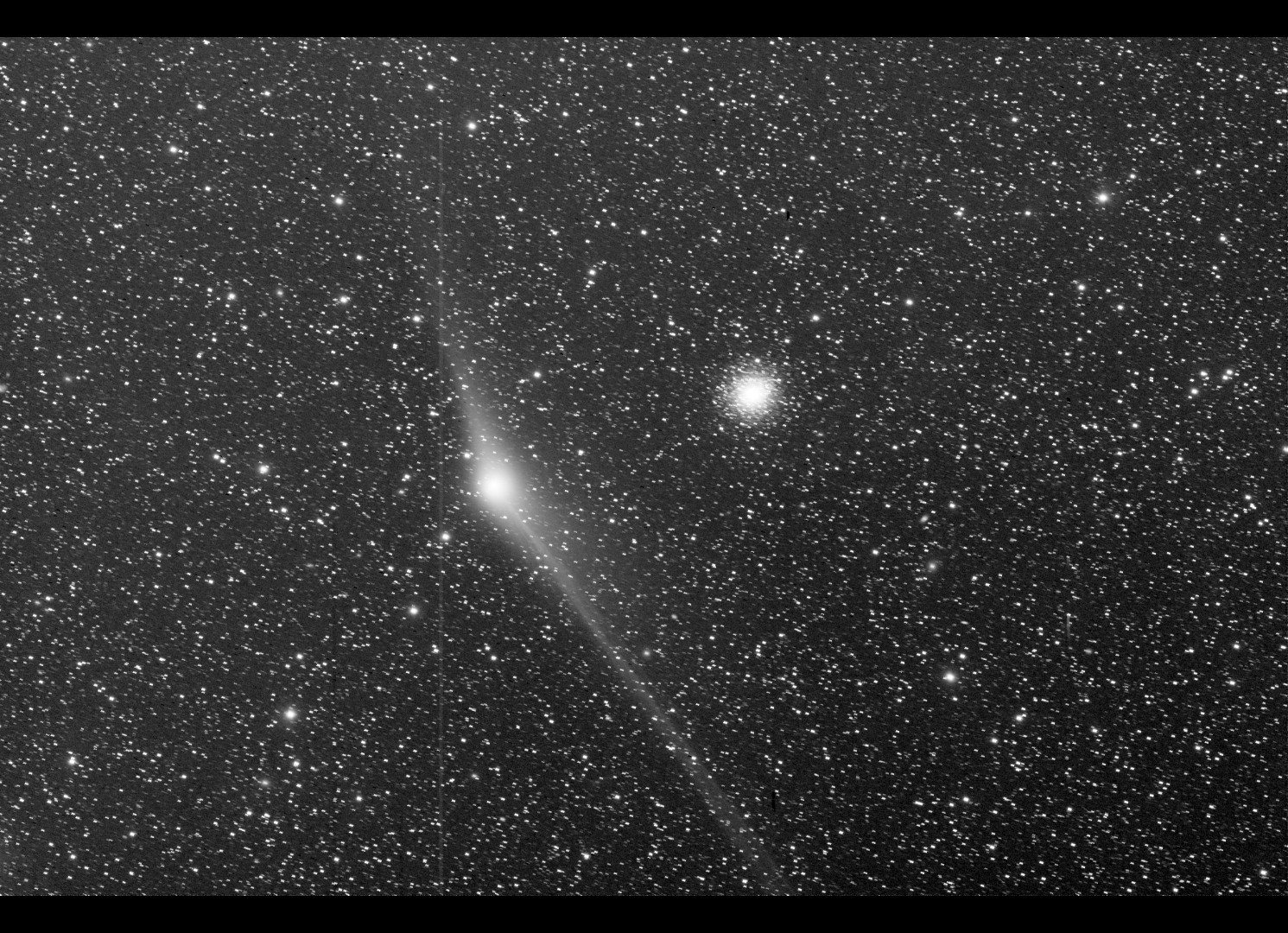


In other comet news there were several amateur discoveries, C/2012 B3 (La Sagra) (more), C/2012 CH17 (MOSS) and C/2012 C2 (Bruenjes): the discoverer's report about the 3rd comet and pictures here, here, here, here, here and here. • Other recent comet discoveries were C/2012 C1 (McNaught), P/2011 VJ5 (Lemmon) and P/2012 C3 (PanSTARRS); also the recovery of P/2003 T12 (SOHO). • Finally comet Lovejoy is heading north again, with a deep picture of Feb. 12 from Oz showing a 7° tail in Lepus - observers on the N hemisphere could now get lucky, too; though the comet has nothing of its former beauty of Dec. 2011 left.


Several bolides made headlines in the U.S.: in Texas on Feb. 1 (further analysis here, here, here, here and here), Virginia & al. on Feb. 3 and Feb. 13 in the Carolinas (TV clips, more, more, more and a joke ...). • Also the NASA fireball network, and one of the fresh Mars meteorites has come to the U.K.. • During its close approach to Earth (433) Eros 'passed' some satellites; more pictures here and here and coverage here, here, here, here and here (funny lede). • Also a Kalliope mutual events campaign, detailled NEA discovery stats, the discovery of 2012 BX34 and the NEOShield study (mehr).
Elsewhere in the solar system the unique binary KBO 2007 TY430, the orbits of big KBOs, southern KBOs and a great 5-minute talk on where Pluto fits into the solar system. • Mars pictures of Feb. 7, Feb. 4 ... 7, Feb. 4 and Feb. 1, two new small satellites of Jupiter and Venus, Jupiter & the Moon in the coming days. • Regarding the Sun a paper on the latitude dependence of the maximum duration of a total solar eclipse, observations by CRATER of the recent flares, X flares vs. time over solar cylces, 10 years of RHESSI flare monitoring and insights on flare physics, the solar B field, H2 in sunspots, the solar climate role (minimal) and storm risks.
Elsewhere in the Universe a 1923 nova in M 31 erupts again (more) and a big conference poster on the Eps Aur campaign. • Stories on the U.S. Naval Obs. and the leap second indecision - section 3.4 of the Dec. 2011 R.A.S. Council Meeting Minutes is also interesting here as apparently U.K. hope was lost at that time (later the leap second won and the U.K. was credited for that). • Finally a surprise aurora Feb. 14 in Minn. and Alaska, a TV feature on aurora chasers in the U.K., an aurora video from Oz (Jan. 22; still) and more space timelapse movies here, here and here (the latter from the ISS and w/aurora).
Tuesday, January 31, 2012
Series of solar flares excites high latitudes, leaves others in the dark
Several flares and coronal mass ejections between Jan. 19 (see last time graf 2) and 27 caused a lot of excitement and managed to enhance auroral activity at high latitudes but left observers farther away - e.g. in central Europe - waiting in vain. While on Jan. 22 at least the northern British Isles got a nice show, on Jan. 24 - covered in great detail by this live-blog with maaany links - the action remained restricted to around the regular auroral oval. The proton storm the latter CME caused was the strongest since 2003, but the - aurora-relevant - geomagnetic storm never exceeded a meager G1: This made the high-latitude aurora a bit more intense perhaps but it is practically always present, as most news coverage - as confused as ever - failed to point out. Here are links about an X flare on Jan. 27 (video, coverage, more, more and more) and C flares an Jan. 26, all ineffective. Earlier why the M9 flare on Jan. 23 and its CME didn't "work" for lower latitudes, selected high latitude pictures here (from a Hurtigruten ship), here, here, here, here, here, here, here, here and here, videos here, here and here and coverage here, here, here, here, here, here and hier.
Finally the effects of the Jan. 19 flare on Jan. 22 were mostly covered in the live-blog; here are a nice picture, Norwegian videos of Jan. 22 and Jan. 21-23 - and documentation of auroral theft (the original pictured had been linked to twice in the blog) ... More solar-terrestrial links: new efforts in forecasting, an interview on space weather effects, a guide for aurora in Germany, solar wind predictions, the Kp value plotted for Jan. 22-24 (and during a real storm), the lack of solar cycle effects on climate demonstrated during the past minimum, the apparent non-role of the Sun in the Little Ice Age (blame it on volcanos; more and mehr), sunspot physics details, near-Earth electron escape and high solar activity removing space junk from orbit. • Elsewhere in the solar system Uranus has crossed the celestial equator for good and stays north for 42 years now. • Jupiter on Jan. 26 and Jan. 25, Jupiter, Moon & Venus on Jan. 29 (deep; Finland at 62.5°N) and Jan. 27 (video; Slovakia at 48.5°N) and Mars on Jan. 28 (more) and Jan. 17.
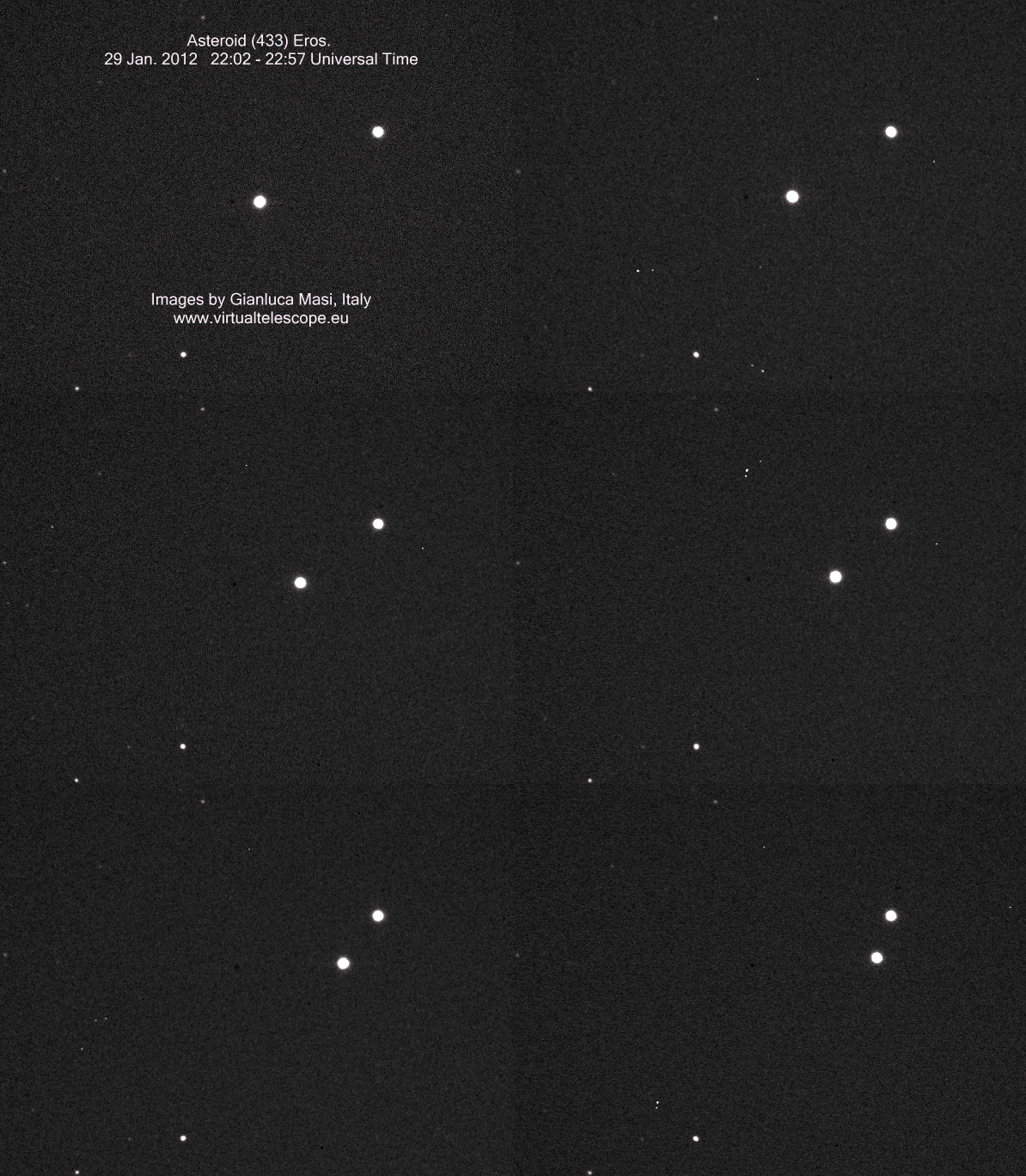
Minor planet Eros is in perigee today, the closest in decades! The parallax campaign is in full swing, with the object quick in the sky, also seen in this video and trail image of Jan. 29 - and it's changing its brightness quite a bit as the strange body rotates. • The tiny NEO 2012 BX34 came to within 60,000 km of the Earth's surface: pictures and animations here, here, here and here and stories here, here, here and here. • Plus the physics of lunar impact flashes, an Al Jazeera clip on meteorite searching in Oman - great science on TV at an unexpected place! - and a mini-paper on the Shiva crater candidate.
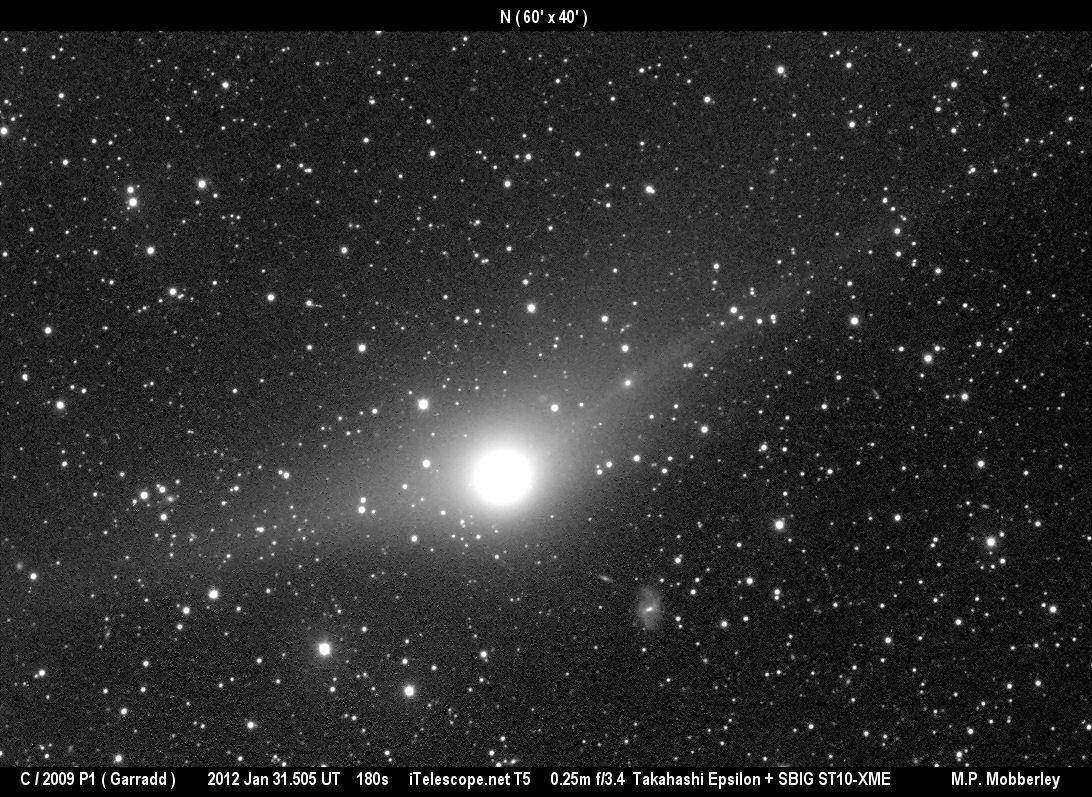
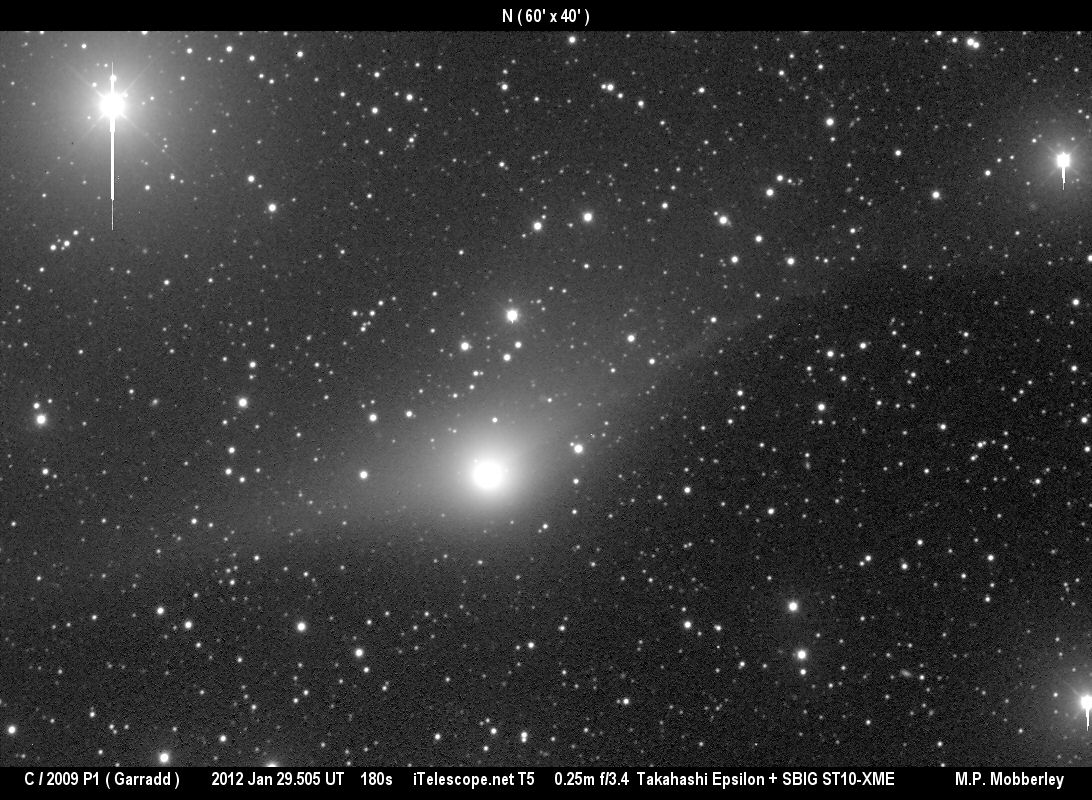
In the world of comets the weird story of the "shy comet" P/2003 T12 (SOHO) recovered by STEREO now. • Images of comet Garradd of Jan. 31 (just hours ago; more), Jan. 30, Jan. 29 (dito), Jan. 26, Jan. 22 (dito) and Jan. 21. • Comet Lovejoy - here's a great picture collection! - is still there, with an exceedingly faint tail: pictures of Jan. 30 and Jan. 28 - plus a very tough sighting from New Mexico, also mentioned here. • Another article on the comet near the Sun last July.
Sky highlights to be expected in February include the possibility to see all 5 bright planets in one night as Mercury begins its best evening apparition of 2012 in mid-month. There will also be a close Venus-Uranus conjunction on Feb. 9, and a star occultation by Quaoar on Feb. 17. • Finally a story on an amateur SN hunt (20 observers, 200+ successes), another analemma success, observations of a rocket fuel dump and a Yosemite timelapse movie with some astronomy from 2:20-3:20.
Finally the effects of the Jan. 19 flare on Jan. 22 were mostly covered in the live-blog; here are a nice picture, Norwegian videos of Jan. 22 and Jan. 21-23 - and documentation of auroral theft (the original pictured had been linked to twice in the blog) ... More solar-terrestrial links: new efforts in forecasting, an interview on space weather effects, a guide for aurora in Germany, solar wind predictions, the Kp value plotted for Jan. 22-24 (and during a real storm), the lack of solar cycle effects on climate demonstrated during the past minimum, the apparent non-role of the Sun in the Little Ice Age (blame it on volcanos; more and mehr), sunspot physics details, near-Earth electron escape and high solar activity removing space junk from orbit. • Elsewhere in the solar system Uranus has crossed the celestial equator for good and stays north for 42 years now. • Jupiter on Jan. 26 and Jan. 25, Jupiter, Moon & Venus on Jan. 29 (deep; Finland at 62.5°N) and Jan. 27 (video; Slovakia at 48.5°N) and Mars on Jan. 28 (more) and Jan. 17.


Minor planet Eros is in perigee today, the closest in decades! The parallax campaign is in full swing, with the object quick in the sky, also seen in this video and trail image of Jan. 29 - and it's changing its brightness quite a bit as the strange body rotates. • The tiny NEO 2012 BX34 came to within 60,000 km of the Earth's surface: pictures and animations here, here, here and here and stories here, here, here and here. • Plus the physics of lunar impact flashes, an Al Jazeera clip on meteorite searching in Oman - great science on TV at an unexpected place! - and a mini-paper on the Shiva crater candidate.

In the world of comets the weird story of the "shy comet" P/2003 T12 (SOHO) recovered by STEREO now. • Images of comet Garradd of Jan. 31 (just hours ago; more), Jan. 30, Jan. 29 (dito), Jan. 26, Jan. 22 (dito) and Jan. 21. • Comet Lovejoy - here's a great picture collection! - is still there, with an exceedingly faint tail: pictures of Jan. 30 and Jan. 28 - plus a very tough sighting from New Mexico, also mentioned here. • Another article on the comet near the Sun last July.


Sky highlights to be expected in February include the possibility to see all 5 bright planets in one night as Mercury begins its best evening apparition of 2012 in mid-month. There will also be a close Venus-Uranus conjunction on Feb. 9, and a star occultation by Quaoar on Feb. 17. • Finally a story on an amateur SN hunt (20 observers, 200+ successes), another analemma success, observations of a rocket fuel dump and a Yosemite timelapse movie with some astronomy from 2:20-3:20.
Friday, January 20, 2012
Decision on leap second postponed - world time & Earth rotation remain linked (for now)
A panel of the International Telecommunication Union - which these days feels responsible for defining time, something astronomers used to do - has postponed a decision to abandon the leap second for another three years as no clear majority was evident: see reports here, here, here, here, here, here, here and hier for further details, context and opinons as well as a nice Al Jazeera news clip and reports before the non-decision here, here, here and here. Perhaps the 3 years gained will now be used for an open debate involving society (and astronomers, please!) as a whole? How the differing opinions of the ITU members came to be is hard to fathom; in the U.S. the State Department was in charge, for example, and in Germany the Bundesnetzagentur. Who asked whom for input prior to the 2012 gathering is also difficult to access, e.g. the members of the American Astronomical Society were not asked for their opinion while the IAU somehow felt it had the authority to support abandoning the leap second (according to documents this blog obtained; sorry, no links). Anyway, it didn't happen, and Earth rotation and Universal Time Coordinated remain linked for the time being, with the next leap second due this June 30 anyway.
The biggest news elsewhere in the Universe is a 13 mag. supernova in NGC 3239 in Leo, SN 2012A, which is also discussed here, here, here and here. • The Catalina Real-Time Transient Survey is making headlines with its many discoveries of variable things in the sky; also more insights about and one amateur's light curve of Epsilon Aurigae's last eclipse. • On the Sun an M flare that may have terrestrial FX tomorrow (or perhaps not so much), a Jan. 2 prominence movie and magnetic measurements. • Jupiter on Jan. 15 (more), Jan. 4 (movie!), Jan. 2 (with moons & Moon) and in Nov. 2011 and Mars on Jan. 16, Jan. 15 (more), Jan. 11, Jan. 9, earlier and still earlier, plus a cool 'trailer' for the Transit of Venus.
Comet Lovejoy is still around but the tail of the - formerly 'great' - comet has faded extremely: pictures of Jan. 20, Jan. 19, Jan. 18, Jan. 18+16, Jan. 16, Jan. 15 (with a 43° tail), Jan. 14 (stark processing; at LMC; dito), Jan. 13 (over the LMC), Jan. 12 (dito), Jan. 7, Jan. 6 (dito), Jan. 5 (dito, dito), Jan. 4, Jan. 3 (dito, dito), Jan. 2 (dito, dito), Dec. 31, Dec. 29 and Dec. 28 (the latter two from the ISS), a movie covering 6 days, picture collections here, here, here, here, here, here and here, a visual report from Jan. 2, coverage of Jan. 3 (dito, dito) and early speculations (related video - and a counterview). • Also the July 2011 case of comet observed being destroyed in the sun has been analyzed: press releases here and here, corollary thoughts and coverage here, here and here.
In other comet news comet C/2010 G2 (Hill) is in outburst: pictures of Jan. 12, Jan. 10, Jan. 5, Jan. 3 and Jan. 2, plus the comet in STEREO images and during an earlier outburst. • Comet Garradd on Jan. 16, Jan. 5 and Jan. 4, Arend-Rigaux among galaxies on Jan. 19, comet C/2012 A2 (LINEAR) and many comets with Faulkes. • A reminder about the Eros Parallax Campaign beginning Jan. 28 (more and more) and detections of Eros by yours truly with a simple camera on a tripod with long and even short focal length. • Also a detection of Apophis with a 60 cm scope (not affecting the impact risk - very low anyway - much), an 'Orwellian' retraction of an asteroid and papers on asteroid activity and rotation. • A rare fall of Mars meteorites last year in Marocco is now confirmed (more, more, more, more and more) - and wine aged with a meteorite is making headlines ...
In other news the Quadrantids 2012 didn't perform that well (with a maximum ZHR of only ~80) but were nice for photographers: composite images here, here, here and here, a comparision DSLR vs. video, a video clip and picture collections here, here and here. • How to photograph the ISS crossing the Moon (more) and utter BS about the X-mas Soyuz stage reentry - sigh ... • A call for amateur radio observations (of meteors in Earth's atmosphere) in support of the LADEE mission to the Moon. • And finally another astrophotography contest and a new astrophotography blog - featuring many pictures taken from Bonn, Germany. High contrast & vivid colors despite the urban location of the 50-cm telescope employed!
The biggest news elsewhere in the Universe is a 13 mag. supernova in NGC 3239 in Leo, SN 2012A, which is also discussed here, here, here and here. • The Catalina Real-Time Transient Survey is making headlines with its many discoveries of variable things in the sky; also more insights about and one amateur's light curve of Epsilon Aurigae's last eclipse. • On the Sun an M flare that may have terrestrial FX tomorrow (or perhaps not so much), a Jan. 2 prominence movie and magnetic measurements. • Jupiter on Jan. 15 (more), Jan. 4 (movie!), Jan. 2 (with moons & Moon) and in Nov. 2011 and Mars on Jan. 16, Jan. 15 (more), Jan. 11, Jan. 9, earlier and still earlier, plus a cool 'trailer' for the Transit of Venus.


Comet Lovejoy is still around but the tail of the - formerly 'great' - comet has faded extremely: pictures of Jan. 20, Jan. 19, Jan. 18, Jan. 18+16, Jan. 16, Jan. 15 (with a 43° tail), Jan. 14 (stark processing; at LMC; dito), Jan. 13 (over the LMC), Jan. 12 (dito), Jan. 7, Jan. 6 (dito), Jan. 5 (dito, dito), Jan. 4, Jan. 3 (dito, dito), Jan. 2 (dito, dito), Dec. 31, Dec. 29 and Dec. 28 (the latter two from the ISS), a movie covering 6 days, picture collections here, here, here, here, here, here and here, a visual report from Jan. 2, coverage of Jan. 3 (dito, dito) and early speculations (related video - and a counterview). • Also the July 2011 case of comet observed being destroyed in the sun has been analyzed: press releases here and here, corollary thoughts and coverage here, here and here.


In other comet news comet C/2010 G2 (Hill) is in outburst: pictures of Jan. 12, Jan. 10, Jan. 5, Jan. 3 and Jan. 2, plus the comet in STEREO images and during an earlier outburst. • Comet Garradd on Jan. 16, Jan. 5 and Jan. 4, Arend-Rigaux among galaxies on Jan. 19, comet C/2012 A2 (LINEAR) and many comets with Faulkes. • A reminder about the Eros Parallax Campaign beginning Jan. 28 (more and more) and detections of Eros by yours truly with a simple camera on a tripod with long and even short focal length. • Also a detection of Apophis with a 60 cm scope (not affecting the impact risk - very low anyway - much), an 'Orwellian' retraction of an asteroid and papers on asteroid activity and rotation. • A rare fall of Mars meteorites last year in Marocco is now confirmed (more, more, more, more and more) - and wine aged with a meteorite is making headlines ...


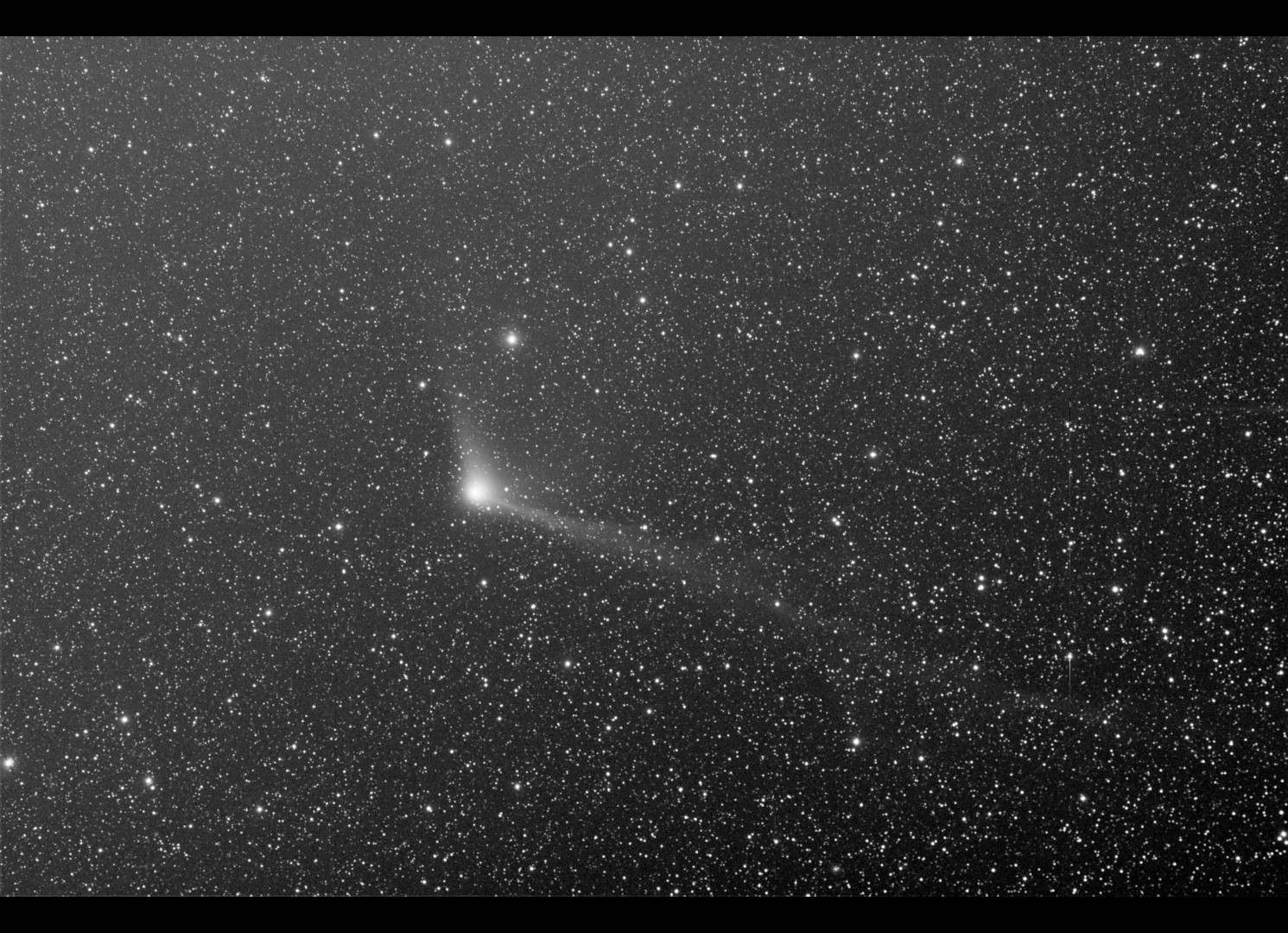
In other news the Quadrantids 2012 didn't perform that well (with a maximum ZHR of only ~80) but were nice for photographers: composite images here, here, here and here, a comparision DSLR vs. video, a video clip and picture collections here, here and here. • How to photograph the ISS crossing the Moon (more) and utter BS about the X-mas Soyuz stage reentry - sigh ... • A call for amateur radio observations (of meteors in Earth's atmosphere) in support of the LADEE mission to the Moon. • And finally another astrophotography contest and a new astrophotography blog - featuring many pictures taken from Bonn, Germany. High contrast & vivid colors despite the urban location of the 50-cm telescope employed!
Sunday, January 1, 2012
Lovejoy's tail still dozens of degrees long but surface brightness way down
Only under the best conditions is the long narrow tail of comet Lovejoy - still stretching for almost 40° - easily visible in the sky, elsewhere it isn't even a naked-eye object anymore: This Great Comet is only a shadow of its former self. Still photographs (exposed for several minutes) continue to show an amazing object, and the fading tail might get even longer by mid-January, though some image enhancement techniques will be necessary to bring its full length out. Some picture collections by Tabur, Garradd, Gerry, Mattiazzo and Hao (more, more, details) from Australia, pictures from Argentina and an undated one.
Selected views of Jan. 1 (more, more and more), Dec. 31 (more and more), Dec. 30 (more, more, more and more in weird projection), Dec. 29 (more), Dec. 28 (more, more, more, more and more), Dec. 27 (more, more, more, more, more, details, more, more, more, more, more, more, a rise video and an ISS view, alt.), Dec. 26 (more and Dec. 21 ... 26), Dec. 25, Dec. 23 and Dec. 22 (in an all-sky video). Also visual reports from Jan. 1 (still 39° tail), Dec. 31 (no longer naked-eye), Dec. 30 (earlier) and Dec. 27 - and coverage of Jan. 1, Dec. 31, Dec. 29, Dec. 28 (dito), Dec. 27 (down; dito, dito) and and Dec. 26. • There are also two new Boattini comets, P/2011 Y2 and C/2011 Y3.
Heavenly highlights in January 2012 - see also hier & hier - include an asteroid transit in front of Betelgeuze (with the star's disk x10 larger than the asteroid; can that be observed?) on Jan. 2, the Quadrantids peaking on Jan. 4 (more & more) and a rare Earth approach of asteroid Eros on Jan. 31: This has led to a call to capture its parallax as a reenactment of a famous technique to measure the AU; concrete details are still being planned. • For the full year 2012 some highlights, what the planets and meteors have in store and what will be occulted by the Moon and minor planets; also a list of planet occultations by the Moon in 2012 and beyond. • Finally a helpful website about the state of space weather, some results from the Eps Aur event - and a FAQ, story (more, more & more), another video, TV coverage and all kinds of stuff (later, still later) about the Dec. 24 Soyuz upper stage reentry over Europe.
Selected views of Jan. 1 (more, more and more), Dec. 31 (more and more), Dec. 30 (more, more, more and more in weird projection), Dec. 29 (more), Dec. 28 (more, more, more, more and more), Dec. 27 (more, more, more, more, more, details, more, more, more, more, more, more, a rise video and an ISS view, alt.), Dec. 26 (more and Dec. 21 ... 26), Dec. 25, Dec. 23 and Dec. 22 (in an all-sky video). Also visual reports from Jan. 1 (still 39° tail), Dec. 31 (no longer naked-eye), Dec. 30 (earlier) and Dec. 27 - and coverage of Jan. 1, Dec. 31, Dec. 29, Dec. 28 (dito), Dec. 27 (down; dito, dito) and and Dec. 26. • There are also two new Boattini comets, P/2011 Y2 and C/2011 Y3.


Heavenly highlights in January 2012 - see also hier & hier - include an asteroid transit in front of Betelgeuze (with the star's disk x10 larger than the asteroid; can that be observed?) on Jan. 2, the Quadrantids peaking on Jan. 4 (more & more) and a rare Earth approach of asteroid Eros on Jan. 31: This has led to a call to capture its parallax as a reenactment of a famous technique to measure the AU; concrete details are still being planned. • For the full year 2012 some highlights, what the planets and meteors have in store and what will be occulted by the Moon and minor planets; also a list of planet occultations by the Moon in 2012 and beyond. • Finally a helpful website about the state of space weather, some results from the Eps Aur event - and a FAQ, story (more, more & more), another video, TV coverage and all kinds of stuff (later, still later) about the Dec. 24 Soyuz upper stage reentry over Europe.
Subscribe to:
Posts (Atom)