According to the latest calculation with JPL's Horizons ephemeris machine it will be Monday, June 27, at precisely 17:00 UTC ± a few minutes when asteroid 2011 MD - with a diameter of a dozen meters or two, i.e. roughly house-sized - will pass closest to Earth: It will then be only 0.0001247 AU = 18,665 km from the planet's center or about 12,280 km from its surface. As the all-time list of closest approaches shows, this is by no means a record: at least three asteroids that got provisional numbers came even closer - and another one was discovered and then hit us (2008 TC3 of course). Our newest visitor will reach its closest Earth approach point in extreme southern latitudes (in fact over the southern Atlantic Ocean).
The incoming trajectory leg - some helpful animations from different points of view! - passes several thousand kilometers outside the geosynchronous ring of satellites and the outgoing leg passes well inside the ring. One would expect an object of this size - 5 to 20 meters, depending on the albedo - to come this close to Earth about every 6 years on average: a little video shows it moving in the sky this morning. There had been initial speculation that 2011 MD might be old space junk, but this seems practically excluded today. Some coverage here, here (earlier), here and here - and we have already an early contender for the most stupid headline: 5 to 20 meters diameter = "giant asteroid" ... :-)
In other planetary system news we have new data about and a fuzzy pic of centaur Echeclus in outburst, new Afrho data - what that means - from Elenin and an info page about PANSTARRS; there is still some confusion regarding its orbit. • A big bolide in TX & OK on June 20, and yours truly gets quoted re. the Draconids 2011 outlook. • An occultation of a star by Pluto was observed with SOFIA - central flash included - and from the ground, and there will be another one shortly. • A great amateur pic of Mercury showing e.g. the Caloris basin and a montage of Saturn's motion near Porrima.
From the total lunar eclipse 10 days ago report of successful observations with the LRO's DIVINER instrument, another gallery of amateur pictures (more, more and more collections; much more), a German review of what happened, a timelapse video and more selected reports and pictures from the Philippines (more), Nepal (more), India (more and more reports and more, more, more and more pictures), South Africa (a precise lightcurve!), Namibia, Greece (with thunderstorm; alt.; more, Hungary, Ireland, Spain, Austria (unusual timelapse movie; more, more, more, more, more, more, more, more, more, more, more, more and more pics & stories) and Germany (Donauwörth, Garching, Munich, Ulm and Stuttgart), plus a serious and a funny and another weird story on the TLE.
Elsewhere in the Universe a lightbridge in AR 1236 on the Sun where spots were published 400 years ago, a flare & CME on June 20 (video; it was again w/o Earth effects), how Chandra coped with the June 7 flare and yet another (alt.) and another space wx scare story. • The SN 2011dh in M 51 - now at ~12.3 mag. - on June 23 vs. 4 blinking and paired, a June 20 drawing, confusion about the progenitor and how to locate it. • NLCs from Stockholm on June 18 and sky color FX from a Chilean volcano. • An amateur imaging spysats (more). • And another attempt to end leap seconds.
Saturday, June 25, 2011


Friday, June 17, 2011
Deep total lunar eclipse enjoyed from Oceania to Europe
Tons of reports and gorgeous pictures have already come in from many countries, stretching in longitude from Portugal to New Caledonia: There the lunar eclipse of June 15/16 began at dawn while in western Europe it ended at dusk; only in western Asia, the eastern Mediterranean and parts of Africa the complete show could be enjoyed. One way to beat geometry was to follow the eclipse via webcasts of which the one arranged by SLOOH and Google delivered best. This page links to numerous images and reports and fine galleries can be found here, here, here, here = here, here, here, here, here, here and here. Selected pictures from New Caledonia, Australia (gorgeous wide-angle view; more, more, more, more, more and more), South Korea, India (more, more and more), Armenia, Iran (more), Turkey (more), Croatia, Rhodos, Greece (more, more, more and more), Italy (more), Poland, Denmark, Sweden, Portugal, Austria (continued; more, more, more and more) and the UK (no luck).
In Germany the eclipse was right 'on the edge' and visibility of totality depended strongly on your location, let alone the weather conditions. Some reports and image impressions from near Donauwörth (story), Ulm, Irschenberg, Weikersheim (scroll down), Münster, Freising, Leonding, Wasserkuppe, Munich, Vogtland, Plochingen, near Heidelberg, Bonn (little to see; story), Finsterwalde (no pictures) and Stuttgart (nothing; more). Some stories about the eclipse can be found here, here, here, hier and hier (alt.). There were also plans to use the LRO for temperature measurements at high resolution during the eclipse, and a paper just came out on the impact of the Kasatochi eruption on the Moon's illumination during the August 2008 lunar eclipse. Finally a moderately funny German satire about the eclipse and complete nonsense, also here and here ...• Nice pictures of the preceding solar eclipse in Lapland - and a paper on the TSE 10 years ago in Zambia.
In other solar system news another mutual event of Haumea & Namaka was observed and tweeted live from La Palma - the dip was shallower than expected and the live-tweeting of science made news of its own. • There is a new orbit for comet PANSTARRS (scroll down) which would improve visibility even more; since the IfA and the Pan-STARRS project are talking, the comet's got some press here, here, here, here and here. Let's just wait for the orbital calculations to stabilize; meanwhile C/2009 P1 (Garradd) could be fun.
Regarding the Sun, a prediction of low solar activity in cycles 24 and esp. 25 - immediately attacked, BTW - has caused a lot of reporting, e.g. here, here, here, here, here, here, here, here, here, here, here, here, here, here, here, hier, hier, hier and here. • Other solar news addressed the impact of minima (alt.) and solar waves (related paper & story) and ropes; also Proba 2 saw the June 7 eruption (that had no effects on Earth whatsoever) and STEREO the farside of the Sun, plus a long and a short story on solar activity in general.
In deep space the supernova 2011dh in M 51 has brightened to about 12.7 mag.! A picture of June 7 and a paper and another one and a report and another one on the progenitor. • Finally a possible nebula discovery by an amateur astronomer - and NLCs during the lunar eclipse spotted in Austria of all places.


In Germany the eclipse was right 'on the edge' and visibility of totality depended strongly on your location, let alone the weather conditions. Some reports and image impressions from near Donauwörth (story), Ulm, Irschenberg, Weikersheim (scroll down), Münster, Freising, Leonding, Wasserkuppe, Munich, Vogtland, Plochingen, near Heidelberg, Bonn (little to see; story), Finsterwalde (no pictures) and Stuttgart (nothing; more). Some stories about the eclipse can be found here, here, here, hier and hier (alt.). There were also plans to use the LRO for temperature measurements at high resolution during the eclipse, and a paper just came out on the impact of the Kasatochi eruption on the Moon's illumination during the August 2008 lunar eclipse. Finally a moderately funny German satire about the eclipse and complete nonsense, also here and here ...• Nice pictures of the preceding solar eclipse in Lapland - and a paper on the TSE 10 years ago in Zambia.


In other solar system news another mutual event of Haumea & Namaka was observed and tweeted live from La Palma - the dip was shallower than expected and the live-tweeting of science made news of its own. • There is a new orbit for comet PANSTARRS (scroll down) which would improve visibility even more; since the IfA and the Pan-STARRS project are talking, the comet's got some press here, here, here, here and here. Let's just wait for the orbital calculations to stabilize; meanwhile C/2009 P1 (Garradd) could be fun.
Regarding the Sun, a prediction of low solar activity in cycles 24 and esp. 25 - immediately attacked, BTW - has caused a lot of reporting, e.g. here, here, here, here, here, here, here, here, here, here, here, here, here, here, here, hier, hier, hier and here. • Other solar news addressed the impact of minima (alt.) and solar waves (related paper & story) and ropes; also Proba 2 saw the June 7 eruption (that had no effects on Earth whatsoever) and STEREO the farside of the Sun, plus a long and a short story on solar activity in general.
In deep space the supernova 2011dh in M 51 has brightened to about 12.7 mag.! A picture of June 7 and a paper and another one and a report and another one on the progenitor. • Finally a possible nebula discovery by an amateur astronomer - and NLCs during the lunar eclipse spotted in Austria of all places.

Thursday, June 9, 2011
There could be a bright comet in the sky ... in April 2013
This is just a pre-pre-warning with many caveats ... but if the first orbit for newly discovered comet C/2011 L4 (PANSTARRS) holds, it could put on quite a show when the visitor reaches a perihelion of only 1/3 AU in April 2013. A first visibility analysis by this blogger sees the comet very close to the horizon in the Northern hemisphere just after perihelion - when it may reach 2nd or 1st magnitude or even better - while it's better visible in the weeks before and right up to perihelion in the Southern hemisphere. Once the orbit stabilizes, these calculations will be repated in greater detail, and then it's up to the comet's brightness to perform. If it does work out as the standard formula implies, you read it here first ... • In other comet news the state of Elenin (and one more anti-BS article), new comet C/2011 L3 (McNaught) and continuing observations of the outburst of 174P/Echeclus. • On June 15 a faint asteroid will visit a bright star in Leo, and 2009 BD is feeling radiation pressure. • Opinion about the 2011 Draconids is still wildly split: Will there be hardly any meteors or 600 per hour or 1000 per hour ...?
Regarding larger bodies in the solar system the next Transit of Venus is (less than) a year away now, spawning this website and outreach ideas. • A close-up of Saturn & Porrima and another view with some Chronian satellites, too. • More previews of the June 15 total lunar eclipse here, here, here and here - and remember my old advice for the optimum experience! • Pictures of the June 3 lunar crescent here, here, here and here. • From the Midnight Eclipse the best movie (almost hypnotic ...), another one, one from Proba-2 and more coverage and image collections here, here, here, here, also great pictures from Norway (more) and Iceland. • A big solar eruption on June 7 (more and more animations and coverage here, here and here) led to some expectations for the Earth (see also here, here, here, here and here for some hysteria) that didn't materialize (see also here, here and here): Better look here first (and the U.N. will save us anyway :-). • Also the Sun on May 31, some wave phenomena and spectroscopy - and more details about Nova Sco.
The supernova 2011dh in Messier 51 is at about 13.4 mag. in the visíble right now as collected pictures & photometry and esp. visual estimates show. We have a gallery, calls by the Weizmann Inst. and Palomar Obs. for yet more (early) pictures of this apparent type IIb SN and selected pictures of June 7 (more), June 6 and June 3 (explained; more, more and more). As it has turned out this blogger played a role in the obtaining of the first-ever spectrum of the SN (also 'discussed' here and in the tweets here, here and here). There is a potential identification of the SN progenitor (easily visible in a public HST image of M 51), and the SN was seen in X-rays, by Swift's UVOT and in radio. Finally some more general coverage of the SN 2011dh here, here, here, here, here, here, here, here and here. • Finally a cool video with NLCs and aurora shot June 4 in Minnesota - and extremely detailled pics of the ISS & OV-105, also hailed here.
Regarding larger bodies in the solar system the next Transit of Venus is (less than) a year away now, spawning this website and outreach ideas. • A close-up of Saturn & Porrima and another view with some Chronian satellites, too. • More previews of the June 15 total lunar eclipse here, here, here and here - and remember my old advice for the optimum experience! • Pictures of the June 3 lunar crescent here, here, here and here. • From the Midnight Eclipse the best movie (almost hypnotic ...), another one, one from Proba-2 and more coverage and image collections here, here, here, here, also great pictures from Norway (more) and Iceland. • A big solar eruption on June 7 (more and more animations and coverage here, here and here) led to some expectations for the Earth (see also here, here, here, here and here for some hysteria) that didn't materialize (see also here, here and here): Better look here first (and the U.N. will save us anyway :-). • Also the Sun on May 31, some wave phenomena and spectroscopy - and more details about Nova Sco.


The supernova 2011dh in Messier 51 is at about 13.4 mag. in the visíble right now as collected pictures & photometry and esp. visual estimates show. We have a gallery, calls by the Weizmann Inst. and Palomar Obs. for yet more (early) pictures of this apparent type IIb SN and selected pictures of June 7 (more), June 6 and June 3 (explained; more, more and more). As it has turned out this blogger played a role in the obtaining of the first-ever spectrum of the SN (also 'discussed' here and in the tweets here, here and here). There is a potential identification of the SN progenitor (easily visible in a public HST image of M 51), and the SN was seen in X-rays, by Swift's UVOT and in radio. Finally some more general coverage of the SN 2011dh here, here, here, here, here, here, here, here and here. • Finally a cool video with NLCs and aurora shot June 4 in Minnesota - and extremely detailled pics of the ISS & OV-105, also hailed here.
Friday, June 3, 2011
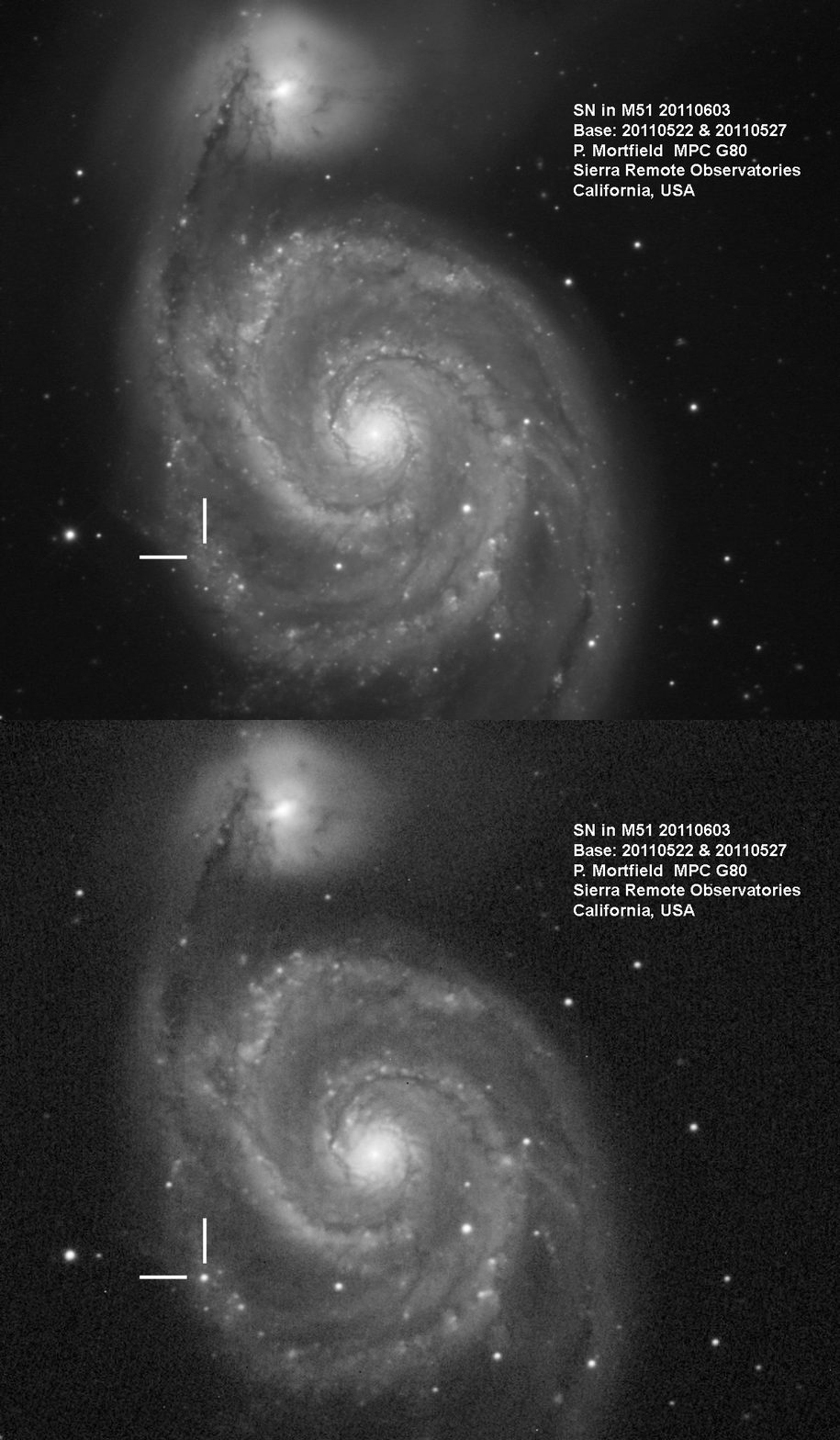
13th mag. supernova in famous Whirlpool galaxy M 51 - widely observed before even official ...
Normally there is an IAU Circular, spawning alerts through various astronomy news services, leading to observations - but with a supernova discovered in the night June 1/2 in the famous galaxy Messier 51 it was very different. As this blog 'goes to print' object "PSN J13303600+4706330" still hasn't been announced officially as a supernova, yet the web is full of great pictures and other data, including spectral information confirming a type II SN. There are early confirming pictures here, here (triggered by yours truly last night and spreading quickly), here, here (in the order in which I learned of them) and several here. Apparently the supernova was already there on May 31 but seems to be absent on May 30; here is also the regular view of M 51. • There is also a new Nova Scorpii, also discussed here (picture). • Epsilon Aurigae is almost back & in conjunction with the Sun now. • The H-Alpha Sun today, prominences on May 25 and ideas regarding dark sunspots.
The "midnight solar eclipse" was widely observed in northern Europe and also in Russia and N America: more previews here, here and here, pictures from Russia here and here, from Finland here (with sunspots!), here and here, from Sweden here and here, from Norway here, here and here, from Iceland here, here, here and here (later) and from Alaska here - picture collections can also be found here, here, here, here (related article) and here. • The 1-day Moon after the eclipse was imaged in the U.S., Mexico and Brazil. • More previews of the June 15 lunar eclipse here, hier and hier. • The color of the full moon enhanced. • Saturn at Porrima.
The morning planets and the Moon on May 31 from Poland, May 30 from Argentina, May 29 (and other dates) from South Africa and May 28 from California and Australia. • Centaur 174P/Echeclus in outburst, and image of 2009 P1 (Garradd) (which should be bright next year), new comets P/2011 JB15 (Spacewatch-Boattini) and C/2011 K1 (Schwartz-Holvorcen), Elenin still faint and still orbited by idiots - and anoth comet plunging into the Sun Mai 21st. • A fly-by by 2009 BD and a bolide in Georgia on May 20. • A little audio introduction to NLCs. • And glorious pictures by D. Caxete of the ISS & Endeavour in front of the Sun, plus some trails of the two later - and a video of the reentry over Yucatan.




The "midnight solar eclipse" was widely observed in northern Europe and also in Russia and N America: more previews here, here and here, pictures from Russia here and here, from Finland here (with sunspots!), here and here, from Sweden here and here, from Norway here, here and here, from Iceland here, here, here and here (later) and from Alaska here - picture collections can also be found here, here, here, here (related article) and here. • The 1-day Moon after the eclipse was imaged in the U.S., Mexico and Brazil. • More previews of the June 15 lunar eclipse here, hier and hier. • The color of the full moon enhanced. • Saturn at Porrima.


The morning planets and the Moon on May 31 from Poland, May 30 from Argentina, May 29 (and other dates) from South Africa and May 28 from California and Australia. • Centaur 174P/Echeclus in outburst, and image of 2009 P1 (Garradd) (which should be bright next year), new comets P/2011 JB15 (Spacewatch-Boattini) and C/2011 K1 (Schwartz-Holvorcen), Elenin still faint and still orbited by idiots - and anoth comet plunging into the Sun Mai 21st. • A fly-by by 2009 BD and a bolide in Georgia on May 20. • A little audio introduction to NLCs. • And glorious pictures by D. Caxete of the ISS & Endeavour in front of the Sun, plus some trails of the two later - and a video of the reentry over Yucatan.


Tuesday, May 31, 2011
June 2011: three eclipses - 2 partial solar, 1 total lunar - in one month!
This triple eclipse headline is literally true for the Eastern Pacific, where June begins and ends with partial solar eclipse (for the remainder of the planet and UTC the 2nd solar eclipse falls on July 1st already and hardly anyone will see it in any case). These - and a few other - highlights of this month:
In other news unusual views of the Moon: in polarized light, used as a diffracting edge, in extreme libration and with impacts by 3 Eta Aquarids and one Quadrantid (some background on this kind of observation here and here). • Images of poor comet Elenin of May 24 and May 16 and what the future may bring (and what not). There are also a new comet C/2011 J3 (LINEAR) (more) - and pre-discovery observations (and non-observations) of C/2010 A2 (LINEAR). • Some bizarre (non-)impact stories: another megacryometeor mystery and weird circumstances of the Dryas (more) and Chiemgau non-impacts.
• From the Sun May prominences (from every day from May 19 ... 26), the May 25 full Sun in H-Alpha and a May 9/10 CME movie, aurora over Tasmania on May 28, plus preventing space storm damage on Earth - and a weird scene from an art exhibition (headline - not connected to the pic - NSFW) ... • A star's proper motion in 110 years documented. • The first NLC sightings of the year are in; see also here. • Some post-processing of ESO movies showing Paranal rotating in a fixed Universe. • A rare timelapse movie of geostationary (or rather not so stationary!) satellites. • An Endeavour water dump (more). • And the ISS & Endeavour in front of the Sun with veeery high and not quite so high resolution (one more) - this low-res movie shows how fleeting these 'transits' are.
- June 2/1 (because the Int'l Date Line is crossed): Partial solar eclipse in the far North, with the greatest magnitude (mag. 0.6) in Russia.
- June 14: Saturn just 1/4° from bright star Porrima; the two are forming a nice 'double star' already now!
- June 15/16: Total eclipse of the Moon, best seen from E & S Africa and W Asia (websites from RSA, Pakistan and India) but also a little bit at the end from Central Europe.
- June 28: Dwarf planet Pluto in opposition at 14th mag. in 31 AU distance.
- July 1: Partial solar eclipse just off Antarctica - and nowhere else. D'uh!


In other news unusual views of the Moon: in polarized light, used as a diffracting edge, in extreme libration and with impacts by 3 Eta Aquarids and one Quadrantid (some background on this kind of observation here and here). • Images of poor comet Elenin of May 24 and May 16 and what the future may bring (and what not). There are also a new comet C/2011 J3 (LINEAR) (more) - and pre-discovery observations (and non-observations) of C/2010 A2 (LINEAR). • Some bizarre (non-)impact stories: another megacryometeor mystery and weird circumstances of the Dryas (more) and Chiemgau non-impacts.

• From the Sun May prominences (from every day from May 19 ... 26), the May 25 full Sun in H-Alpha and a May 9/10 CME movie, aurora over Tasmania on May 28, plus preventing space storm damage on Earth - and a weird scene from an art exhibition (headline - not connected to the pic - NSFW) ... • A star's proper motion in 110 years documented. • The first NLC sightings of the year are in; see also here. • Some post-processing of ESO movies showing Paranal rotating in a fixed Universe. • A rare timelapse movie of geostationary (or rather not so stationary!) satellites. • An Endeavour water dump (more). • And the ISS & Endeavour in front of the Sun with veeery high and not quite so high resolution (one more) - this low-res movie shows how fleeting these 'transits' are.


Sunday, May 15, 2011
Planet show continued: the Venus/Jupiter/Mercury trio
As they say: "The cosmic ballet goes on," with the morning planets moving into new shapes every day. Further impressions - now with a Venus/Jupiter/Mercury triangle - of May 15 from Australia (scroll down), of May 14 from South Africa, Malaysia and the Philippines, of May 13 from South Africa and Australia (more, more [details], more), of May 12 from the U.S. (more, more), Canada, Poland (at 50° North!), Israel, Iran and Australia (more, cloudy) and of May 11 from Uruguay, Canada, the U.S., the Canary Islands, Spain, Italy, Austria, Poland, Israel, Indonesia and Australia. • Plus a rare drawing of Saturn from May 12.
In other news new faint comets C/2011 J2 and C/2011 H1, plus the demise of the latest SOHO comet (also an animation [bottom]; more, more). • Dubious stories about a meteor bang w/o a meteor and a meteorite crater w/o a meteorite (more). • A paper on the high solar activity in Nov. 2003 and a new warning system from Germany. • Pictures of SN 2011by of May 12 (another close-up), May 7 and May 4 - while T Pyx is near its peak now. • The ISS on the Sun. • More coverage of the new big sky mosaic (final graf) here, here, here and here - and all three mosaics in direct comparision. • And how amateur astronomy has benefited from the unrelenting advance of technology.


In other news new faint comets C/2011 J2 and C/2011 H1, plus the demise of the latest SOHO comet (also an animation [bottom]; more, more). • Dubious stories about a meteor bang w/o a meteor and a meteorite crater w/o a meteorite (more). • A paper on the high solar activity in Nov. 2003 and a new warning system from Germany. • Pictures of SN 2011by of May 12 (another close-up), May 7 and May 4 - while T Pyx is near its peak now. • The ISS on the Sun. • More coverage of the new big sky mosaic (final graf) here, here, here and here - and all three mosaics in direct comparision. • And how amateur astronomy has benefited from the unrelenting advance of technology.
Tuesday, May 10, 2011
Great morning planets show seen around the clock around the world
The line-ups & conjunctions of four naked-eye planets just west of the Sun - see also here, here, here, here, here, here and here plus an animation; a close Venus/Jupiter conjunction on May 11 & 12 is the next highlight - have been a great show in Southern and extremely tough to see in mid-Northern latitudes. Here are impressions of May 9 from Argentina, California and Australia, of May 8 from Austria, Jordan, Turkey and Australia (again), of May 7 from Chile, Italy, Austria (daytime close-ups!) and Tasmania, of May 6 from the U.S. and Austria, of May 5 from Argentina and Australia, of May 4 from Australia, of May 3 from Australia, of May 2 from Chile, of May 1 from Chile (cropped), the U.K., Australia (again and again) and the Philippines, of April 30 from Florida and Venezuela and of April 29 from New Zealand.
In small bodies news a big paper on how to get asteroid shapes from lightcurves and stellar occultations, the funny lightcurve of 2010 TU5, another 2005 YU55 press release (picked up here and here) and a long German story on NEO defense. • In Poland a meteorite hit a house (more, more and more) and a new mineral - named krotite - has been found in a meteorite. • There is a 3rd mag. Kreutz comet in this May 10 SOHO image at 7 o'clock (earlier today), comet Elenin on May 4, May 3 (more) and more dates, with absurdly high, optimistic and pessimistic predictions around, and new comet websites with hot visual estimates and Argentinian pictures.
In other news The H-Alpha Sun on May 3 and a geostorm on April 30. • T Pyxidis might be fading after brightening (another report). • SN 2011by has risen to 12.3 mag. as many confirm. • Eps Aurigae is now in egress with the eclipse soon over - and a lot of science results left behind. • Two more fine sky timelapse movies from the Canary Islands and Greece. • Close-ups of NanoSail D here and here, a Brasilian reentry video, explained here and here (more and more on the satellite), a Russian sky show after a launch, explained here and hier - and a close-up of USA 129, a U.S. spysat.


In small bodies news a big paper on how to get asteroid shapes from lightcurves and stellar occultations, the funny lightcurve of 2010 TU5, another 2005 YU55 press release (picked up here and here) and a long German story on NEO defense. • In Poland a meteorite hit a house (more, more and more) and a new mineral - named krotite - has been found in a meteorite. • There is a 3rd mag. Kreutz comet in this May 10 SOHO image at 7 o'clock (earlier today), comet Elenin on May 4, May 3 (more) and more dates, with absurdly high, optimistic and pessimistic predictions around, and new comet websites with hot visual estimates and Argentinian pictures.


In other news The H-Alpha Sun on May 3 and a geostorm on April 30. • T Pyxidis might be fading after brightening (another report). • SN 2011by has risen to 12.3 mag. as many confirm. • Eps Aurigae is now in egress with the eclipse soon over - and a lot of science results left behind. • Two more fine sky timelapse movies from the Canary Islands and Greece. • Close-ups of NanoSail D here and here, a Brasilian reentry video, explained here and here (more and more on the satellite), a Russian sky show after a launch, explained here and hier - and a close-up of USA 129, a U.S. spysat.


Friday, April 29, 2011
Four planets (and the Moon) in action in the May morning sky - and a nice supernova!
While the play of the planets - Mercury, Venus, Mars & Jupiter - is best seen from moderate Northern and esp. Southern latitudes, the supernova in the Big Dipper is ideally placed for Northerners. It was discovered very early, at 14th magnitude, and could rise to 12th - which would be pretty rare - during the coming week. Of all planets still only Saturn (a nice April 19 pic and several of the ongoing storm) is easily seen from everywhere, while the other four naked eye planets are so close to and west of the Sun that you need a either a steep ecliptic (like in this Australian view from April 26) or binoculars to see them and esp. the various conjunctions of between them, listed below. Some key dates:
- April 30 & May 1: The waning crescent Moon joins the morning planet line-up - simulated April 30 sky views for Australia and later California and the view on May 1 for Germany. On May 1 Mars is 21' north of Jupiter.
- Around May 3: Possible 12 mag. peak of Supernova 2011by in NGC 3972 in UMa; here are the Chinese discovery picture and a color view.
- May 6: Peak of the Eta Aquarids, like the planet show something great only for Southern observers.
- May 8: Mercury 1.5° south of Venus.
- May 11: Mercury 2° south of Jupiter and Venus 34' south of Jupiter (thus a planet trio).
- May 18: Mercury 1.3° south of Venus.
- May 21: Mercury 2° south of Mars.
- May 23: Venus 1° south of Mars (another planet trio, with Mercury).
- May 31: The Moon is once more close to the morning planets.


Monday, April 25, 2011
Solar activity up sharply - and spots so big you can see them on simple sunset pictures!
Solar activity is now really taking off, and the monthly sunspot number values are up sharply in the NOAA diagram here - but since cycle #24 took off so late (as did important precursor events) the prognosis is still for a rather shallow maximum around 2013. There was a lot to see in recent days (and this forum alone is overflowing with images): On April 23 AR 1195 was so big that it appears inadvertendly in this simple sunset picture by yours truly! Also various hi-res H-Alpha scenes and AR 1193 in hi-res on April 20, the white light Sun on April 17, more sunset spots on April 15, a great prominence animation of April 10 and R.A.S. press releases on a coronal mass ejection on March 20, the big solar flare of Feb. 15 (also discussed here and here), the birth of a sunspot, analysis of SDO data and the solar eruption process (also discussed here); at the meeting where these came from the chance of a new Maunder minimum was also discussed. There is also a weird paper on how bacteria in India enjoyed the 2010 annular eclipse, while the webzine TOTALITY! #10 has some 40 pages on the 2010 total eclipse, including a report by yours truly.
In other solar system news here's Saturn on April 17 and April 16 and the - again very big - full moon of April 17 rising and setting. The tables here are helpful in finding future perigee and apogee full moons. • A paper and another one on carbon monoxide in Pluto's atmosphere, also discussed here, here, here, here, hier, hier and hier. • Of the 2011 GP95 NEA fly-by a newer and an older video - and another interesting case coming up on June 2! • Regarding comets, a mini-video of 249P in STEREO's FOV, ideas on Main Belt Comets and the poor show so far by comet Elenin (which also got an article and a FAQ debunking related BS). This blogger also became aware of this 2007 report from the ISS where sensational comet McNaught was apparently only seen "by chance": This is a scandal, plain and simple!
Beyond the solar system recurrent nova T Pyxidis has now settled around 7th mag. after brightening steadily and may yet reach 6th mag.! There are also some spectra - and IR photometry of Eps Aurigae. • The STEREO spacecraft has found a lot of new variable stars, also hailed in this and this press release. • Back on Earth three more great timelapse videos: from Tenerife (mentioned here; the light pollution is quite obvious), Mauna Kea (night of April 23 - great mountain shadow triangle and lens flares, also hailed here) and the continental U.S. (with a moving dolly). • What the AIM satellite found out about noctilucent clouds. • The ISS, imaged from Witten passing high on April 24 (parallel shot from Bonn) and rising vertically on April 23 by yours truly. • The NanoSail D is still up and seen occasionally (see also the Cosmic Mirror #341 header), sometimes pretty bright - and the reentry may not come before July. • And a long table of Easter dates: While having E Sunday on the 2nd-latest date (April 24 as this year) is twice is frequent as hitting the very last day, the two 24 Apr dates framing 2011 are in 2095 and were in 1859, the two 25 Apr dates are in 2038 and 1943, resp. - small number statistics.

In other solar system news here's Saturn on April 17 and April 16 and the - again very big - full moon of April 17 rising and setting. The tables here are helpful in finding future perigee and apogee full moons. • A paper and another one on carbon monoxide in Pluto's atmosphere, also discussed here, here, here, here, hier, hier and hier. • Of the 2011 GP95 NEA fly-by a newer and an older video - and another interesting case coming up on June 2! • Regarding comets, a mini-video of 249P in STEREO's FOV, ideas on Main Belt Comets and the poor show so far by comet Elenin (which also got an article and a FAQ debunking related BS). This blogger also became aware of this 2007 report from the ISS where sensational comet McNaught was apparently only seen "by chance": This is a scandal, plain and simple!


Beyond the solar system recurrent nova T Pyxidis has now settled around 7th mag. after brightening steadily and may yet reach 6th mag.! There are also some spectra - and IR photometry of Eps Aurigae. • The STEREO spacecraft has found a lot of new variable stars, also hailed in this and this press release. • Back on Earth three more great timelapse videos: from Tenerife (mentioned here; the light pollution is quite obvious), Mauna Kea (night of April 23 - great mountain shadow triangle and lens flares, also hailed here) and the continental U.S. (with a moving dolly). • What the AIM satellite found out about noctilucent clouds. • The ISS, imaged from Witten passing high on April 24 (parallel shot from Bonn) and rising vertically on April 23 by yours truly. • The NanoSail D is still up and seen occasionally (see also the Cosmic Mirror #341 header), sometimes pretty bright - and the reentry may not come before July. • And a long table of Easter dates: While having E Sunday on the 2nd-latest date (April 24 as this year) is twice is frequent as hitting the very last day, the two 24 Apr dates framing 2011 are in 2095 and were in 1859, the two 25 Apr dates are in 2038 and 1943, resp. - small number statistics.
Friday, April 15, 2011
50-meter asteroid close to Earth now - with 2 mag. brightness changes
As this posting goes online, 50-meter NEA 2011 GP59 is closest to Earth at 530,000 km, one week after its discovery by an amateur-run sky survey in Spain. This is (or rather was; the optimal visibility was yesterday, with 13 mag. as compared to 14 mag. now) the best NEA Earth visit in several years, and the object has been observed a lot in the past days: Of particular interest were strong brightness fluctuations every four minutes, due to the - probably non-trivial - rotation of the elongated body.
• This is a NEA visit worth of some headlines, but most aren't as small ones come close all the time. The November visit of big 2005 YU55 is a different case, of course. • An asteroid on a long-lived horseshoe orbit 'around' Earth has been identified (another and another press release; some coverage here, here, here and hier. • A story on shady meteorite deals [alt.] has been attacked. • And yet another U.S. fireball that may have dropped.
Comet C/2011 C1 (McNaught) looks like a tiny Hartley 2, making it interesting for photographers: April 10 [alt.], April 5 and April 3 pictures. • The expectations for comet C/2010 X1 (Elenin) are still not clear (another and another story, a light curve with Russian debate - and it won't destroy Earth ...). • New comet C/2011 G1 (McNaught), more on the funny Holmes paper (more and more), a page with light curves and a paper on main-belt comets.
Tonight from 19 to 21 UTC photograph the Moon and the Aristarchus region in particular which was the location of a famous Transient Lunar Phenomenon in Oct. 1963. (And if you check the ground-to-air of Apollo 11 at 076:57:07 and 077:12:51 you see that an alleged Aristarchus TLP even played a little role in the famous mission and also featured in sect. 7:17 of the astronauts' debriefing.)
Great - literally! - Moon mosaics of April 10 (also 2 details by someone else), April 9 and April 8, the young crescent of April 4 from Germany (more) and Portugal, plus the waning crescent of March 3 from Cairns. • The Jovian moons in SOHO's view (animated; STEREO had a better view in the past). • And Saturn on April 3 and - hold your breath! - March 28!
More action on the Sun on April 11/12 (CME video), April 11 (H-Alpha edge), April 10 (hi-res mosaic; also a detail; the fish was gone soon :-), April 6 (prominence video); also various April prominences, a March SDO timelapse movie and March 21 H-Alpha hi-res views. Plus the general rise in solar activity, and the little ice age. • Lots of solar eclipse stories in the Feb. 2011 Practical Astronomy, a great totality earthshine from 2008 - and total eclipses of the next 50 years in one map.
T Pyxidis is in outburst, the first time since 1966 (more, more and mehr). • The brightness of Eps Aur is rising steeply now (also the 8th newsletter). • Also stories on SN 2011az and the Z Cam campaign by the AAVSO. • And an article on a Deep Sky meeting in Linz.
A collection of great aurora pictures from the AuroraMAX camera system (discussed here), an aurora timelapse from an airplane (discussed here) and yet another aurora video. • Without aurorae night timelapse clips from India and South Dakota. • And the analysis of the Iceland volcano ash [Deutsch] over Europe a year ago.
• This is a NEA visit worth of some headlines, but most aren't as small ones come close all the time. The November visit of big 2005 YU55 is a different case, of course. • An asteroid on a long-lived horseshoe orbit 'around' Earth has been identified (another and another press release; some coverage here, here, here and hier. • A story on shady meteorite deals [alt.] has been attacked. • And yet another U.S. fireball that may have dropped.
Comet C/2011 C1 (McNaught) looks like a tiny Hartley 2, making it interesting for photographers: April 10 [alt.], April 5 and April 3 pictures. • The expectations for comet C/2010 X1 (Elenin) are still not clear (another and another story, a light curve with Russian debate - and it won't destroy Earth ...). • New comet C/2011 G1 (McNaught), more on the funny Holmes paper (more and more), a page with light curves and a paper on main-belt comets.

Tonight from 19 to 21 UTC photograph the Moon and the Aristarchus region in particular which was the location of a famous Transient Lunar Phenomenon in Oct. 1963. (And if you check the ground-to-air of Apollo 11 at 076:57:07 and 077:12:51 you see that an alleged Aristarchus TLP even played a little role in the famous mission and also featured in sect. 7:17 of the astronauts' debriefing.)
Great - literally! - Moon mosaics of April 10 (also 2 details by someone else), April 9 and April 8, the young crescent of April 4 from Germany (more) and Portugal, plus the waning crescent of March 3 from Cairns. • The Jovian moons in SOHO's view (animated; STEREO had a better view in the past). • And Saturn on April 3 and - hold your breath! - March 28!


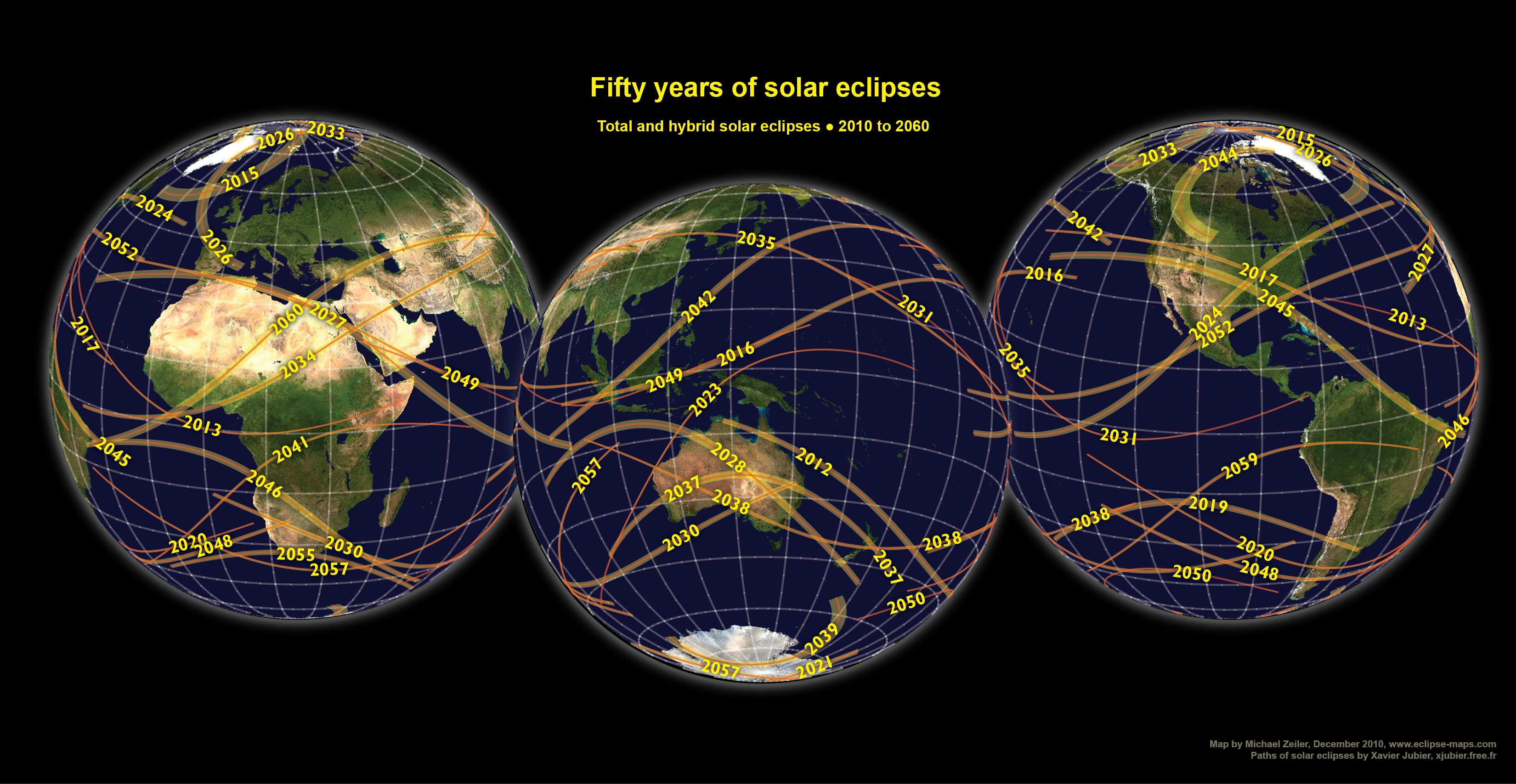
More action on the Sun on April 11/12 (CME video), April 11 (H-Alpha edge), April 10 (hi-res mosaic; also a detail; the fish was gone soon :-), April 6 (prominence video); also various April prominences, a March SDO timelapse movie and March 21 H-Alpha hi-res views. Plus the general rise in solar activity, and the little ice age. • Lots of solar eclipse stories in the Feb. 2011 Practical Astronomy, a great totality earthshine from 2008 - and total eclipses of the next 50 years in one map.


T Pyxidis is in outburst, the first time since 1966 (more, more and mehr). • The brightness of Eps Aur is rising steeply now (also the 8th newsletter). • Also stories on SN 2011az and the Z Cam campaign by the AAVSO. • And an article on a Deep Sky meeting in Linz.
A collection of great aurora pictures from the AuroraMAX camera system (discussed here), an aurora timelapse from an airplane (discussed here) and yet another aurora video. • Without aurorae night timelapse clips from India and South Dakota. • And the analysis of the Iceland volcano ash [Deutsch] over Europe a year ago.
Sunday, April 3, 2011
Saturn reaches opposition, brightness of rings may surge
About 24 hours from now - around 0:00 UTC on April 4 - Saturn reaches the opposition point to the Sun: several effects conspire now to brighten the rings, and some observers claim the phenomenon is already detectable. Some recent amateur observations of March 30, 25, 23, 22, 21/22 (with spokes), 21 and 20, plus a mid-March Hubble image with more storm detail. • Other sky sky highlights in April include Uranus' crossing of the celestial equator - but this is purely academic as the planet cannot be observed right now. And the visibility of all planets except Saturn is very poor to non-existent this month. There is another opportunity to observe a pretty young lunar crescent on April 4 for Northern hemispherians, however.
A look back at Mercury (and Jupiter) low at dusk on March 23 (Germany), March 22 (AZ and Austria), March 19 (Germany: Cologne and herten and March 16 (Sweden), plus a note on Jupiter's SEB return. • Lots of fine pictures of the March 19 perigee full moon are linked here, some collections included.
In small bodies news an analysis of Elenin (still mildly optimistic for fall) and a March 25 picture, some jets of 29P in outburst, new comet C/2011 F1 (LINEAR), a funny paper on the Holmes outburst, a serious paper on the Scheila outburst, a bolide on March 23 (more), a claim of more fireballs in Northern spring and a call for observations regarding a possible Southern stream.
From the Sun a nice March 27 H-Alpha mosaic, SDO action on March 24, various March pics, a claim that maxima are always double and a good solar April fools joke (more space-related jokes of note here, here, here, here, here, here, here, here, hier, here and here :-). • Some light intensity data from the 2009 TSE in India and a contemporary documentary (part 2 with the actual event) about TSE expeditions in 1973.
Elsewhere in the Universe the brightening of Epsilon Aurigae has begun. • A deeep image of the Virgo cluster. • Excellent aurora videos from Norway have turned up on Vimeo here, here (background) and here, also great stills from Norway again and Finland (another trip report, a big panorama and an allsky series). • A fine green flash and another one through a tree. • And finally the ISS in front of the Sun in new images here (with spots), here and here.
A look back at Mercury (and Jupiter) low at dusk on March 23 (Germany), March 22 (AZ and Austria), March 19 (Germany: Cologne and herten and March 16 (Sweden), plus a note on Jupiter's SEB return. • Lots of fine pictures of the March 19 perigee full moon are linked here, some collections included.

In small bodies news an analysis of Elenin (still mildly optimistic for fall) and a March 25 picture, some jets of 29P in outburst, new comet C/2011 F1 (LINEAR), a funny paper on the Holmes outburst, a serious paper on the Scheila outburst, a bolide on March 23 (more), a claim of more fireballs in Northern spring and a call for observations regarding a possible Southern stream.


From the Sun a nice March 27 H-Alpha mosaic, SDO action on March 24, various March pics, a claim that maxima are always double and a good solar April fools joke (more space-related jokes of note here, here, here, here, here, here, here, here, hier, here and here :-). • Some light intensity data from the 2009 TSE in India and a contemporary documentary (part 2 with the actual event) about TSE expeditions in 1973.

Elsewhere in the Universe the brightening of Epsilon Aurigae has begun. • A deeep image of the Virgo cluster. • Excellent aurora videos from Norway have turned up on Vimeo here, here (background) and here, also great stills from Norway again and Finland (another trip report, a big panorama and an allsky series). • A fine green flash and another one through a tree. • And finally the ISS in front of the Sun in new images here (with spots), here and here.

Subscribe to:
Posts (Atom)