"Surely this must be one of the brightest and largest storms in the last few seasons," says Australian planet specialist A. Wesley about a huge white cloud that appeared on Saturn a few days ago: There are already quite a number of images showing it in the international Saturn galleries here, here and here; particularly impressive are this, this and this image. Saturn is approaching 44 Vir 3 times now, by the way, twice very closely. • The SEB revival on Jupiter continues, as again many pictures in this gallery document; there are also summary reports from Dec. 5 and Dec. 3 and some pics of Dec. 2. • A close-up of Venus from Dec. 10. • Some planetary constellations: Moon & Mercury on Dec. 8 (Oz) and Dec. 7 (US; detail), Moon crescent & Mars on Dec. 6 (very low & just after an occultation!), Moon biting the Sun on Dec. 5 (but only for the SDO), the waning lunar crescent on Dec. 4, Mercury from a plane over India on Dec. 3 and Moon, Venus, Saturn & Spica on Dec. 2.
Two major coming attractions are the total lunar eclipse on Dec. 21 (mehr, mehr) - and the Geminids on Dec. 13/14 (more, more, more and more previews): The activity profile is already picking up, we have a colorful spectrum - and there will be several rocket launches with the ECOMA particle detector to study the dust in situ; there is a campaign blog in German. • Lots of excitement in the U.K. over a bolide - that wasn't that bright at all (-5 to -7 mag. at max., I hear), just seen by many. • There may be better access to satellite fireball data for civilian researchers. • Studying an ancient impact with associated earthquake. • And a pretty weird paper linking an anecdotal story of alleged ball lightning in Oz in 2006 (one lonely witness, no physical traces!) to a fireball in the sky - which nonetheless many 'science media' picked up as something of importance, none worthy of linking here.
In other news comets 240P with a tail (also on Dec. 7), P/2010 U2 in front of M 33, P/2010 V1 on Dec. 7 and the development til now, and Hartley 2 on Dec. 7 and Nov. 27. • Also 15 years of SOHO comets, a paper on Holmes photometry with SMEI on Coriolis (alt.) and new details about a quasi-satellite of Venus. • A nice eruption on the Sun on Dec. 6 (image sequence also here -> hier -> here and stories here, here, here and here); the responsible filament also on Dec. 4 and Dec. 3. Plus a storm prediction, solar eruption studies and a paper about the January partial eclipse. • Amateurs helping Hubble with Cepheids, WW Cet, SMEI nova photometry and Eps Aur. • And night pictures from Antarctica.
Saturday, December 11, 2010


Wednesday, December 1, 2010
Total lunar eclipse - bad for Europe, good for Americas - highlight of December
Except for Venus & Saturn in the morning skies (seen in wide shots on Dec. 1 with the Moon and Nov. 26 and in detail on Nov. 28; more below) there hasn't been much - w.r.t. predictable sky events - of note lately, but that is changing in December, as previews e.g. here, hier, hier and hier show:
The revival of Jupiter's SEB is continuing (following the typical scenario laid out 15 years ago in Sanchez-Lavega & Gomez, Icarus 121 [1996] 1-17 almost exactly!): progress reports up to Nov. 27 and Nov. 20, an animation, a map of Nov. 29 an amateur IR image of Nov. 17 and more reports (includig big scope IR imagery) from Nov. 29, Nov. 25, Nov. 24 (also on the IR pics; more, more, more, more, more and mehr) and Nov. 22 (mentioning this blog; more). The SEB disturbance is now so obvious that it can even be detected with poor seeing (Nov. 25). • On Venus a German amateur succeeded again in November to image the planet's surface in the NIR; also UV impressions of Nov. 27.
Hartley 2 is still around: images of Dec. 1 & Nov. 27, Nov. 30, Nov. 27 (more, more), Nov. 26 and Nov. 23, plus a visual report of Nov. 30 and Herschel observations. • The origin of the Oort cloud (paper actually several months old), more thoughts about Pluto & Eris (diameters exactly the same?) and Sedna (at least as mysterious), a paper on triple Cleopatra, new NEO grants and Wisconsin (this spring) and South Africa (looong time ago) meteorite/crater stories.
In other news symbiotic variable AX Per might erupt soon, and the status of Eps Aur (plus the 7th Newsletter of Citizen Sky). • A gorgeous picture of the zodiacal light from this location at an Indian observatory deep in the Himalayas; that took some preparations! • Extremely distorted lunar images from the ISS (as predicted; p. 7), a wild Halo display and an aurora movie. • The MyDarkSky project needs support. And hi-res lunar images by amateurs here as well as here!
- Dec. 1: Mercury in greatest Eastern elongation (21.5°).
- Dec. 2: Venus at greatest brilliance, reaching about -4.7 (sources differ between -4.5 and -4.9) mag.
- Dec. 7: Lunar crescent Moon near Mercury in the evening sky.
- Dec. 13-14: Peak of the Geminid meteors - apart from the Quadrantids next January the only major shower til 2012 without much lunar interference!
- Dec. 14: Mercury & Mars in conjunction, only 1° apart but very hard to observe at dusk.
- Dec. 21: Total lunar eclipse with partiality from 6:33 to 10:01 and totality from 7:41 to 8:53 UTC - this is bad for Europe (and even a bit late for the Eastern U.S.). See this 3-years-old entry for general - yet still seldom-heard - advice on how to get the most out of a total lunar eclipse!
- Dec. 27: Approximate beginning of a little morning visibility of Mercury.
- Dec. 29: The Moon forms an 8° triangle with Saturn and Spica in the mornings skies.
The revival of Jupiter's SEB is continuing (following the typical scenario laid out 15 years ago in Sanchez-Lavega & Gomez, Icarus 121 [1996] 1-17 almost exactly!): progress reports up to Nov. 27 and Nov. 20, an animation, a map of Nov. 29 an amateur IR image of Nov. 17 and more reports (includig big scope IR imagery) from Nov. 29, Nov. 25, Nov. 24 (also on the IR pics; more, more, more, more, more and mehr) and Nov. 22 (mentioning this blog; more). The SEB disturbance is now so obvious that it can even be detected with poor seeing (Nov. 25). • On Venus a German amateur succeeded again in November to image the planet's surface in the NIR; also UV impressions of Nov. 27.
Hartley 2 is still around: images of Dec. 1 & Nov. 27, Nov. 30, Nov. 27 (more, more), Nov. 26 and Nov. 23, plus a visual report of Nov. 30 and Herschel observations. • The origin of the Oort cloud (paper actually several months old), more thoughts about Pluto & Eris (diameters exactly the same?) and Sedna (at least as mysterious), a paper on triple Cleopatra, new NEO grants and Wisconsin (this spring) and South Africa (looong time ago) meteorite/crater stories.


In other news symbiotic variable AX Per might erupt soon, and the status of Eps Aur (plus the 7th Newsletter of Citizen Sky). • A gorgeous picture of the zodiacal light from this location at an Indian observatory deep in the Himalayas; that took some preparations! • Extremely distorted lunar images from the ISS (as predicted; p. 7), a wild Halo display and an aurora movie. • The MyDarkSky project needs support. And hi-res lunar images by amateurs here as well as here!
Sunday, November 21, 2010
Rapid progress in SEB's revival: Jupiter has a new face almost every day
Instead of a bright spot we now have several dark streaks close to each other where the South Equatorial Belt on Jupiter is forming again: a flurry of often hi-res amateur pictures collected here and also here is documenting the first SEB revival since 1993 as fortunately the planet is far from the Sun (in the sky) right now. What has happened so far can be seen at one glance either in an animation spanning Nov. 9 to 20 or a series of Nov. 10 to 19. Image collections and selected images of Nov. 20 (more, more), Nov. 19, Nov. 17, Nov. 16, Nov. 15, Nov. 14 (more, more), Nov. 13 (more), Nov. 12 and Nov. 11. As John Rogers reports, the initial bright plume has appeared Nov. 9 inside the cyclonic circulation barge B2,which had been very dark a year ago, but turned white this May/June: "The rapidly brightening plume is so energetic that we can confidently expect it to develop into the SEB Revival. The SEB Revival is usually spectacular, so we can expect impressive and rapidly changing disturbances over the next 3 months, until the end of the apparition. As the SEB is so thoroughly whitened, and the outbreak has appeared in an isolated location, we can hope to see the phenomena displayed in their most complete form." • For something completely different - but Jovian - a report on a partial eclipse of Callisto on Nov. 12.
From the world of comets two bright sungrazing comets in rapid succession, on Nov. 13/14 and Nov. 17 (video, still, earlier), a picture showing C/2010 U3, the new very distant comet, some suggestion that 236P has split (similar). • From comet C/2010 V1 a Nov. 8 ... 18 panorama and pics of Nov. 15, Nov. 14 (more, more), an animation til Nov. 13, a series of Nov. 9 ... 12 and a pic of Nov. 6 (comment). • And of comet 103P pics of Nov. 16, Nov. 14 (more, more), Nov. 13 and Nov. 12 (more) - plus new cool EPOXI pictures released. • Tiny asteroid 2010 WA came close: discover, spin, earlier, other stories. • And more thoughts on Eris & the dwarf planets (more, interview, comment, yet another story).
The Leonids reached a max. ZHR of about 30 late on Nov. 17, according to the data as they stand now: another and another summary (earlier, other story). • Some ideas re. possible meteor storms decades ahead. • A Croation bolide and a Serbian one (more [translation], more, more and more). • An interview with the Meteorite Men, a story on 2008 TC3, and a possible crater on Ararat. • planets in the morning of Nov. 12. • A magnetic feature on the Sun and more Solar hype. • NASA on the mistaken contrail (picked up here and here; more) - and J. Moos and J. Steward on the whole affair! • Someone made a 1-hr documentary on Epsilon Aurigae. • And a glorious startrail picture was taken in India with two cameras simultaneously.
From the world of comets two bright sungrazing comets in rapid succession, on Nov. 13/14 and Nov. 17 (video, still, earlier), a picture showing C/2010 U3, the new very distant comet, some suggestion that 236P has split (similar). • From comet C/2010 V1 a Nov. 8 ... 18 panorama and pics of Nov. 15, Nov. 14 (more, more), an animation til Nov. 13, a series of Nov. 9 ... 12 and a pic of Nov. 6 (comment). • And of comet 103P pics of Nov. 16, Nov. 14 (more, more), Nov. 13 and Nov. 12 (more) - plus new cool EPOXI pictures released. • Tiny asteroid 2010 WA came close: discover, spin, earlier, other stories. • And more thoughts on Eris & the dwarf planets (more, interview, comment, yet another story).


The Leonids reached a max. ZHR of about 30 late on Nov. 17, according to the data as they stand now: another and another summary (earlier, other story). • Some ideas re. possible meteor storms decades ahead. • A Croation bolide and a Serbian one (more [translation], more, more and more). • An interview with the Meteorite Men, a story on 2008 TC3, and a possible crater on Ararat. • planets in the morning of Nov. 12. • A magnetic feature on the Sun and more Solar hype. • NASA on the mistaken contrail (picked up here and here; more) - and J. Moos and J. Steward on the whole affair! • Someone made a 1-hr documentary on Epsilon Aurigae. • And a glorious startrail picture was taken in India with two cameras simultaneously.
Thursday, November 11, 2010
Hartley still big, visual comet discovery in outburst, Eris occultation, Jupiter SEB action & more
A lot has happened in the sky in the past ten days, with the main event, of course, the visit paid to comet 103P/Hartley (2) by Deep Impact: Here are (in German) a live blog, early insights, smoother animation and yet more analysis; many more links (mostly to stuff in English) are here in the header. Seen from the Earth the comet hasn't changed much, though the tail more prominent now: selected pictures of Nov. 10 (more), Nov. 9, Nov. 8, Nov. 7 (more), Nov. 6 (more, more and an animation), Nov. 4, Nov. 3 (more) and Nov. 2. It is also clear now that there was not a single meteor from Hartley 2 - as was expected anyway - according to systematic observers. However in a bad move the Center for Astrophysics put out (and later quietly deleted, re-using the URL for something else!) a press release claiming otherwise, based on vague stories - there are still hundreds of copies of the bad text out there like this one, while e.g. Universe Today and Space.com had fallen for the nonsense ...
A double visual discovery of a comet in outburst happened in Japan in early November: In a place where one of the two observers hadn't seen anything the day before, suddenly a comet was seen (a report from the other discoverer), first causing excitement (a close bright NEA?) before the cometary nature was clear and a number and then the names were assigned when a first orbit was known. Comet C/2010 V1 (Ikeya-Murakami) has since evolved quickly, a bit like outburst comets Vales and Holmes: selected pictures of today (more), Nov. 9 (more, more; wide), Nov. 8 (more, more), Nov. 7 (more) and Nov. 6 (small; also a visual report). More stories - not all accurate! - about the new comet here, here, here, here, here, here, here, here and here. And a particularly stupid one, mistaking an airplane trail for the comet ... • Another interesting comet discovery is C/2010 U3 (Boattini) which will reach its perihelion only in 2019 at 8 AU from the Sun!
For the first time a star occultation by dwarf planet Eris was observed by three (small) telescopes in two locations in Chile - and the preliminary analysis suggests that Eris and Pluto are about the same size, with current error bars overlapping (if the body is a sphere, 3 points = 1 1/2 chords are enough to fix the diameter). Which also means that Eris has an extremely high albedo as well as (predominantly rocky) density. The forecast(s), an early report (more), a video, early thoughts by Eris' discoverer (still earlier; more) and stories here, here, here, here, hier, hier und hier. • Perhaps the biggest TNO is still to be found as surveys in the Southern sky are taking off only now. Plus various Centaur & TNO tidbits from a recent conference. • From small bodies closer to home: another bolide caught on camera, expectations of an improved orbit for Apophis from 2013 astrometry, and a live plot of the Leonids ZHR; not much there yet.
The revival of the SEB of Jupiter seems to have begun with the appearance of an isolated small bright spot: early summary stories at Planetary Society Blog, ALPO Blog, ALPO Japan, Sky & Telescope (earlier) and SpaceWeather. You can check here what Jupiter is doing: The Nov. 9 page has the first indications, the Nov. 10 collection many more confirming images. Events are also tracked on Cloudy Nights. • A Jupiter trail with Diwali fireworks in India, and Venus + the waning lunar crescent on Nov. 5 (two more views); also Venus on Oct. 31. • Proof that you can track an exoplanet transit with a cheaaaap telescope (selling for some 50 EUR), though a good CCD camera is also required.
Many spacecraft are observing the Sun right now, including some lesser known ones like Proba 2 and Picard; we also have new results from the Sunrise balloon flight and details about SDO's operations. • There was a major flare on Nov. 6 (more, more) as well as on Nov. 3, the physics of CMEs are discussed, and in Egypt space weather experts meet. • A 12 mag. supernova and the distance to Eps Aur. • A big ESO competition for image processing buffs. • A misunderstood airplane contrail (more, more, more and more - also a similar shot by yours truly). • And Soyuz debris found in Australia.


A double visual discovery of a comet in outburst happened in Japan in early November: In a place where one of the two observers hadn't seen anything the day before, suddenly a comet was seen (a report from the other discoverer), first causing excitement (a close bright NEA?) before the cometary nature was clear and a number and then the names were assigned when a first orbit was known. Comet C/2010 V1 (Ikeya-Murakami) has since evolved quickly, a bit like outburst comets Vales and Holmes: selected pictures of today (more), Nov. 9 (more, more; wide), Nov. 8 (more, more), Nov. 7 (more) and Nov. 6 (small; also a visual report). More stories - not all accurate! - about the new comet here, here, here, here, here, here, here, here and here. And a particularly stupid one, mistaking an airplane trail for the comet ... • Another interesting comet discovery is C/2010 U3 (Boattini) which will reach its perihelion only in 2019 at 8 AU from the Sun!


For the first time a star occultation by dwarf planet Eris was observed by three (small) telescopes in two locations in Chile - and the preliminary analysis suggests that Eris and Pluto are about the same size, with current error bars overlapping (if the body is a sphere, 3 points = 1 1/2 chords are enough to fix the diameter). Which also means that Eris has an extremely high albedo as well as (predominantly rocky) density. The forecast(s), an early report (more), a video, early thoughts by Eris' discoverer (still earlier; more) and stories here, here, here, here, hier, hier und hier. • Perhaps the biggest TNO is still to be found as surveys in the Southern sky are taking off only now. Plus various Centaur & TNO tidbits from a recent conference. • From small bodies closer to home: another bolide caught on camera, expectations of an improved orbit for Apophis from 2013 astrometry, and a live plot of the Leonids ZHR; not much there yet.
The revival of the SEB of Jupiter seems to have begun with the appearance of an isolated small bright spot: early summary stories at Planetary Society Blog, ALPO Blog, ALPO Japan, Sky & Telescope (earlier) and SpaceWeather. You can check here what Jupiter is doing: The Nov. 9 page has the first indications, the Nov. 10 collection many more confirming images. Events are also tracked on Cloudy Nights. • A Jupiter trail with Diwali fireworks in India, and Venus + the waning lunar crescent on Nov. 5 (two more views); also Venus on Oct. 31. • Proof that you can track an exoplanet transit with a cheaaaap telescope (selling for some 50 EUR), though a good CCD camera is also required.
Many spacecraft are observing the Sun right now, including some lesser known ones like Proba 2 and Picard; we also have new results from the Sunrise balloon flight and details about SDO's operations. • There was a major flare on Nov. 6 (more, more) as well as on Nov. 3, the physics of CMEs are discussed, and in Egypt space weather experts meet. • A 12 mag. supernova and the distance to Eps Aur. • A big ESO competition for image processing buffs. • A misunderstood airplane contrail (more, more, more and more - also a similar shot by yours truly). • And Soyuz debris found in Australia.
Monday, November 1, 2010
Comet Hartley still huge, tail more prominent, three days before the encounter
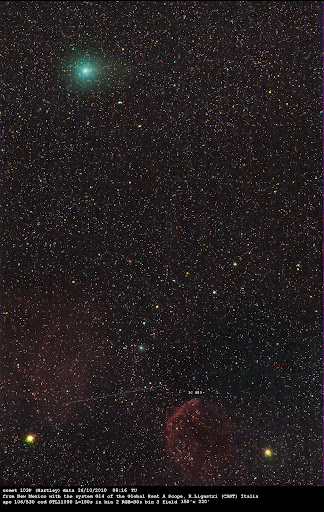
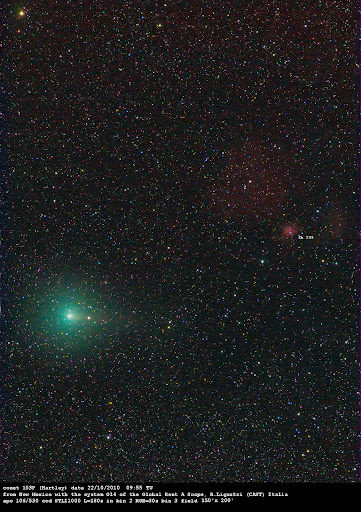
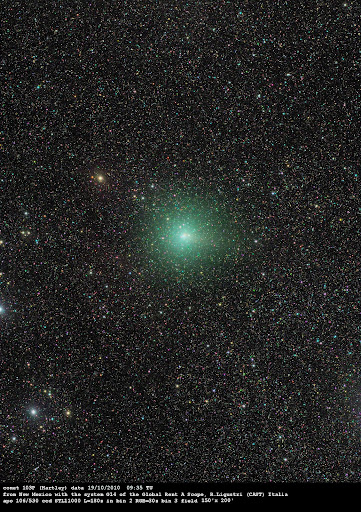
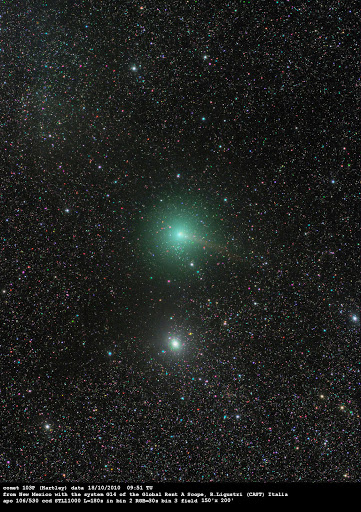
All that's been said about the difficult viewing conditions for 103P/Hartley (2) despite its fine overall brightness still holds true two weeks later, now that the Moon is gone and it's observable again high in dark skies after midnight (in the N hemisphere): The comet - information collections here, here, here, here and here (esp. on the space mission) - is as hard as ever when the sky isn't great, also observed here and here. Selected pictures of today (note the growing tail; also a wide view with a nebula), Oct. 30, Oct. 26, Oct. 23, Oct. 22 (more, more), Oct. 20 (no tracking!), Oct. 19 (also an Oct. 13 ... 19 collage), Oct. 18 (near Eps Aur; more, more), Oct. 17 (more and esp. deep), Oct. 16 (more, processed) and Oct. 15 (animation). Also an Oct. 12 drawing (context), an Oct. 8 super-wide view (context, more) and a September Subaru image and development sequence (small and medium).
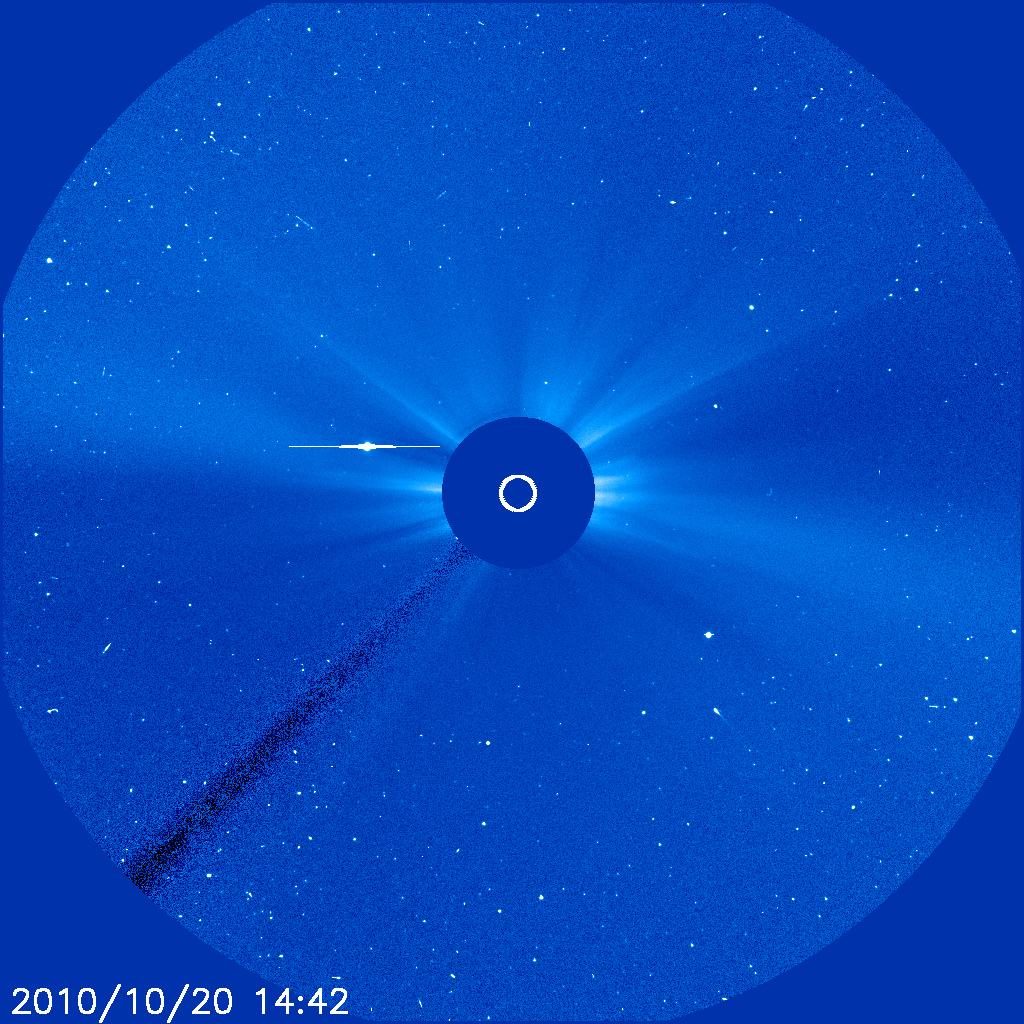
In other small-bodies news there was a bright sungrazing comet (more, more, earlier, LASCO C3 video and still, plus the context). • Some strange is happening with comet Tempel 2 (context), there is a new comet Hill, and PanSTARRs has found its 1st comet. • The rules to be a "discoverer" have changed again, and there is a new place for comet observations. • Fine bolide videos here and here - and the possibility of meteors from comet Mellish. • The close passage of minor planet 2003 UV11 (more, mehr & mehr) was documented e.g. here, here, hier and hier (more), with earlier observations here and here (more).
In other news interesting views of Venus on Oct. 31 near inferior conjunction (also its sky track; more), a lot of Saturn moon events in 2009/10 and - older - adaptive optics views of Uranus and esp. Neptune with the Hale telescope. • Sunspot 1117 was substantial, an old butterfly diagram has been reconstructed, new insights into aurora physics, the solar storm watch in action and ways to observe the Sun. • The 1st Irish supernova, the results of the U Sco campaign, the ISS on the Moon, a great timelapse collection and a huge all-sky with the gegenschein et al. (an earlier such view). • Finally there isn't anything special expected in November (mehr), so we rather look forward to the meteor showers and other highlights (mehr) of 2011.





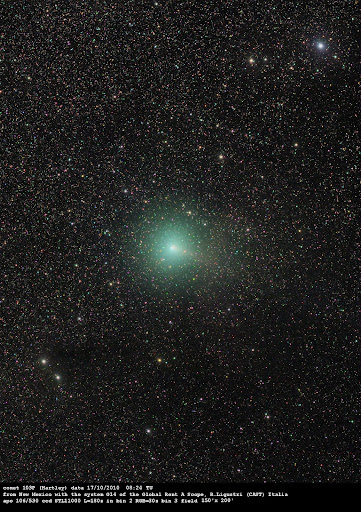
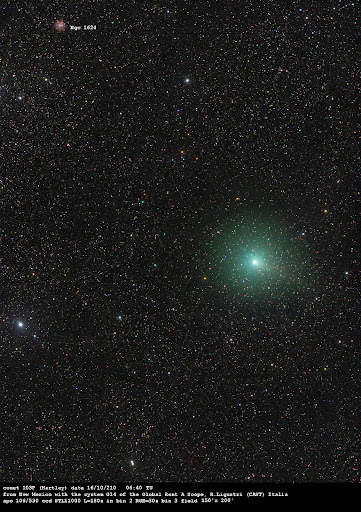


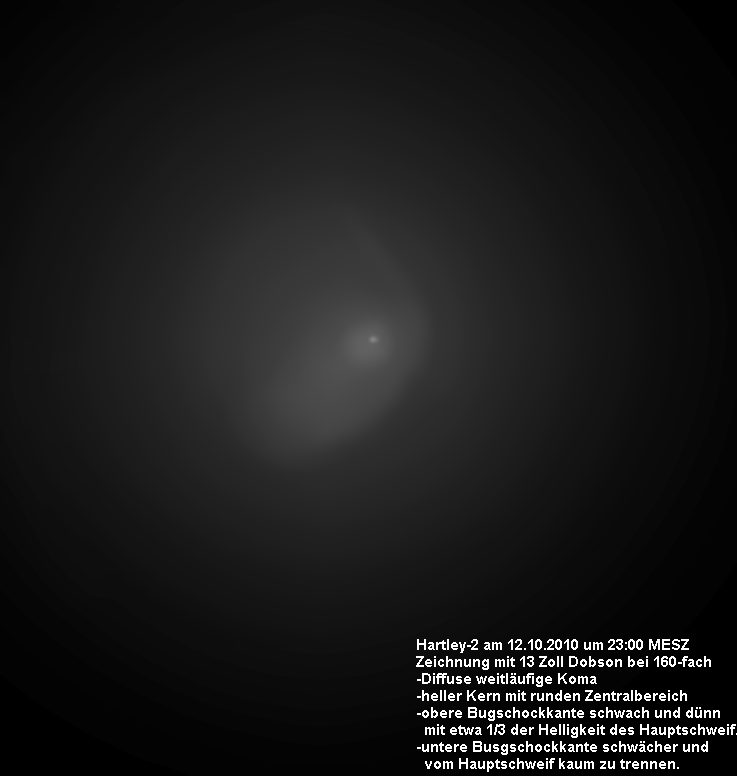


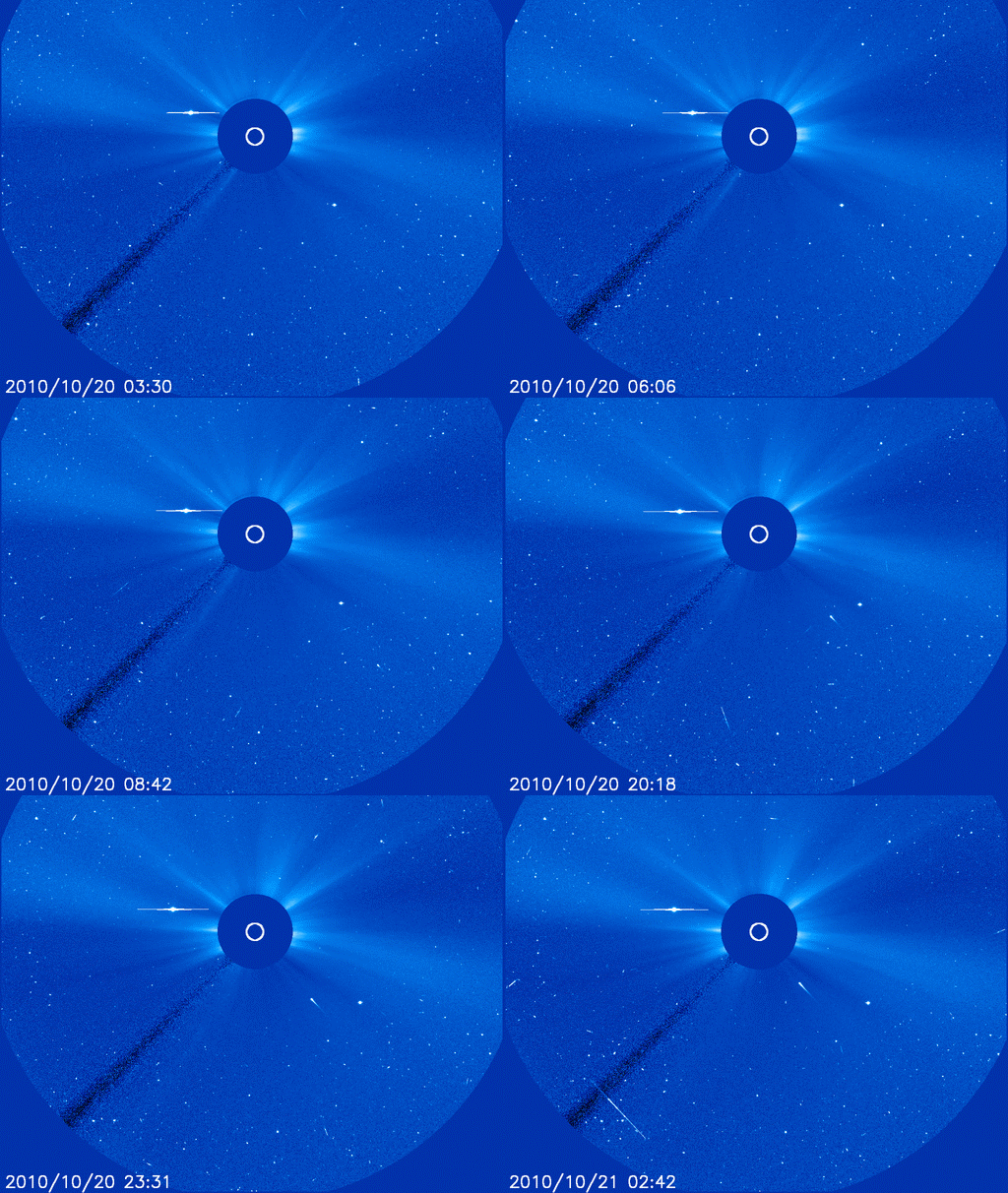
In other small-bodies news there was a bright sungrazing comet (more, more, earlier, LASCO C3 video and still, plus the context). • Some strange is happening with comet Tempel 2 (context), there is a new comet Hill, and PanSTARRs has found its 1st comet. • The rules to be a "discoverer" have changed again, and there is a new place for comet observations. • Fine bolide videos here and here - and the possibility of meteors from comet Mellish. • The close passage of minor planet 2003 UV11 (more, mehr & mehr) was documented e.g. here, here, hier and hier (more), with earlier observations here and here (more).

In other news interesting views of Venus on Oct. 31 near inferior conjunction (also its sky track; more), a lot of Saturn moon events in 2009/10 and - older - adaptive optics views of Uranus and esp. Neptune with the Hale telescope. • Sunspot 1117 was substantial, an old butterfly diagram has been reconstructed, new insights into aurora physics, the solar storm watch in action and ways to observe the Sun. • The 1st Irish supernova, the results of the U Sco campaign, the ISS on the Moon, a great timelapse collection and a huge all-sky with the gegenschein et al. (an earlier such view). • Finally there isn't anything special expected in November (mehr), so we rather look forward to the meteor showers and other highlights (mehr) of 2011.
Friday, October 15, 2010
Hartley's huge coma - over 1° - means visibility dramatic function of sky quality
Its brightness is now beginning with a "5", but how well comet 103P/Hartley 2 (more general info here, here, here, here, hier and here) can be seen in the sky is extremely dependent on the brightness of the sky background - because the huge coma is spreading the light widely. Some see nothing at all, others a bit, and still others report naked-eye sightings, all at the same time. A detailled analysis (earlier; more) shows that peak brightness is already near, so an improvement in Hartley's visibility, esp. with the return of the Moon, seems unlikely. The comet has been a subject of studies e.g. at Lowell Obs., and from space, of course: EPOXI is coming closer (blog; animation), and Hubble as well as WISE have observed it.
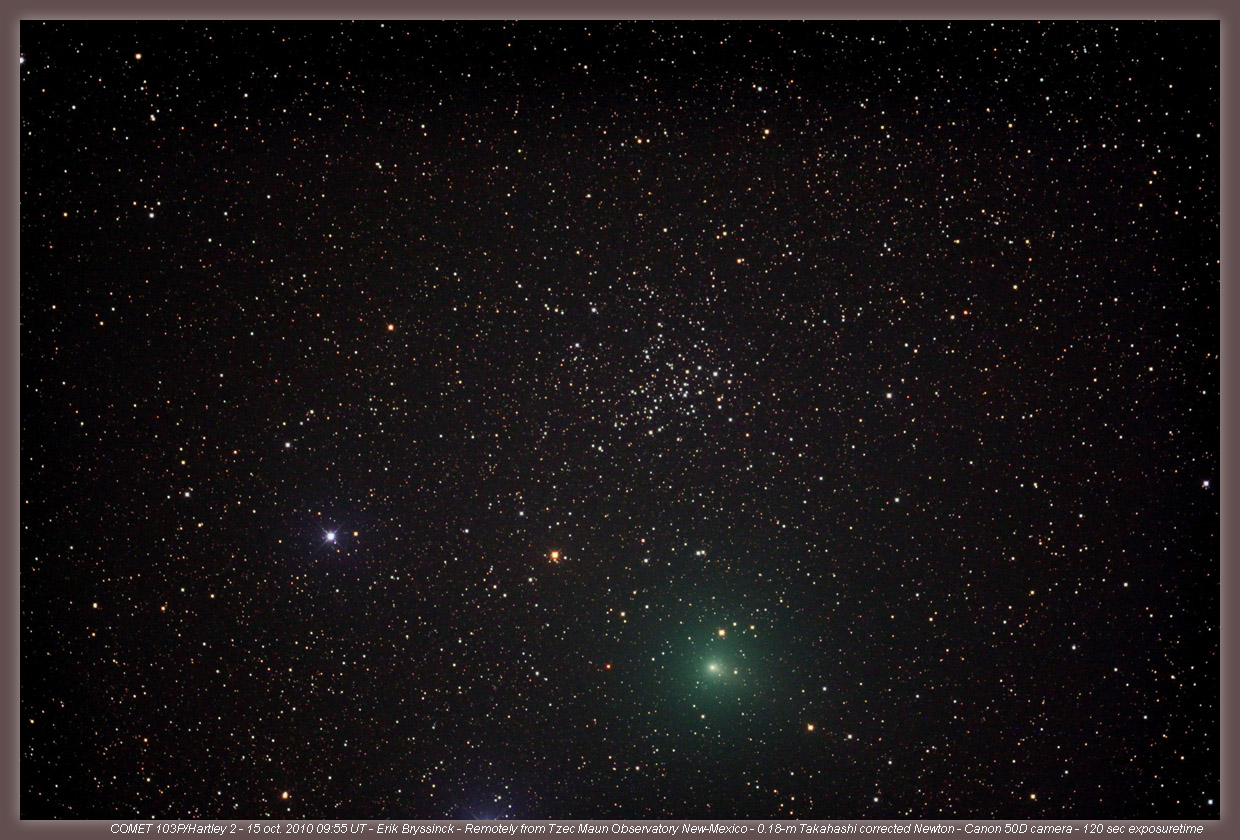
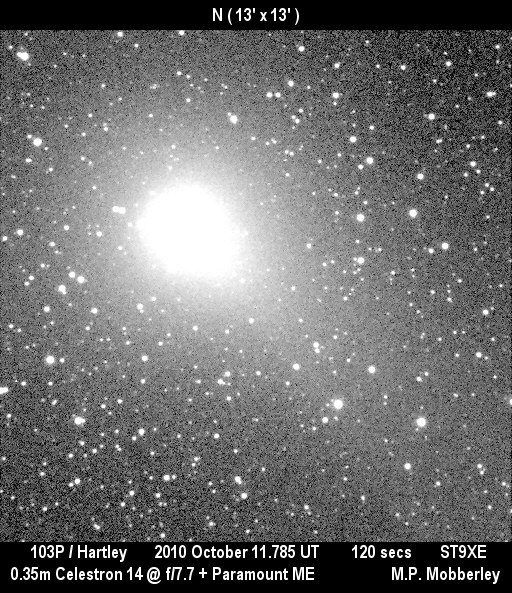
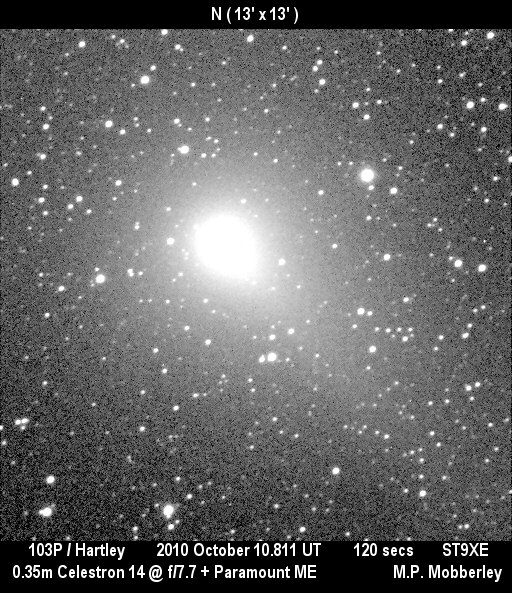
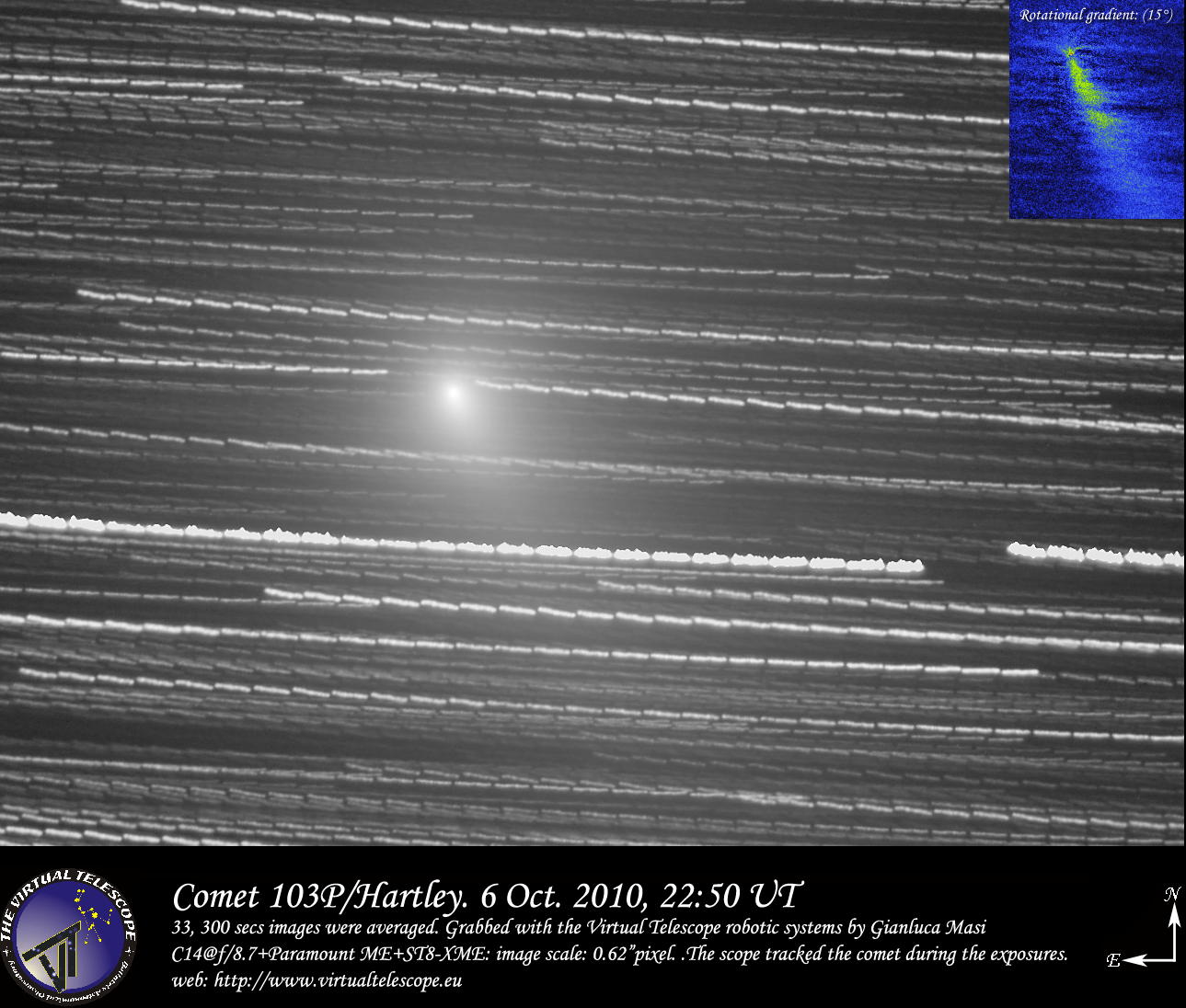
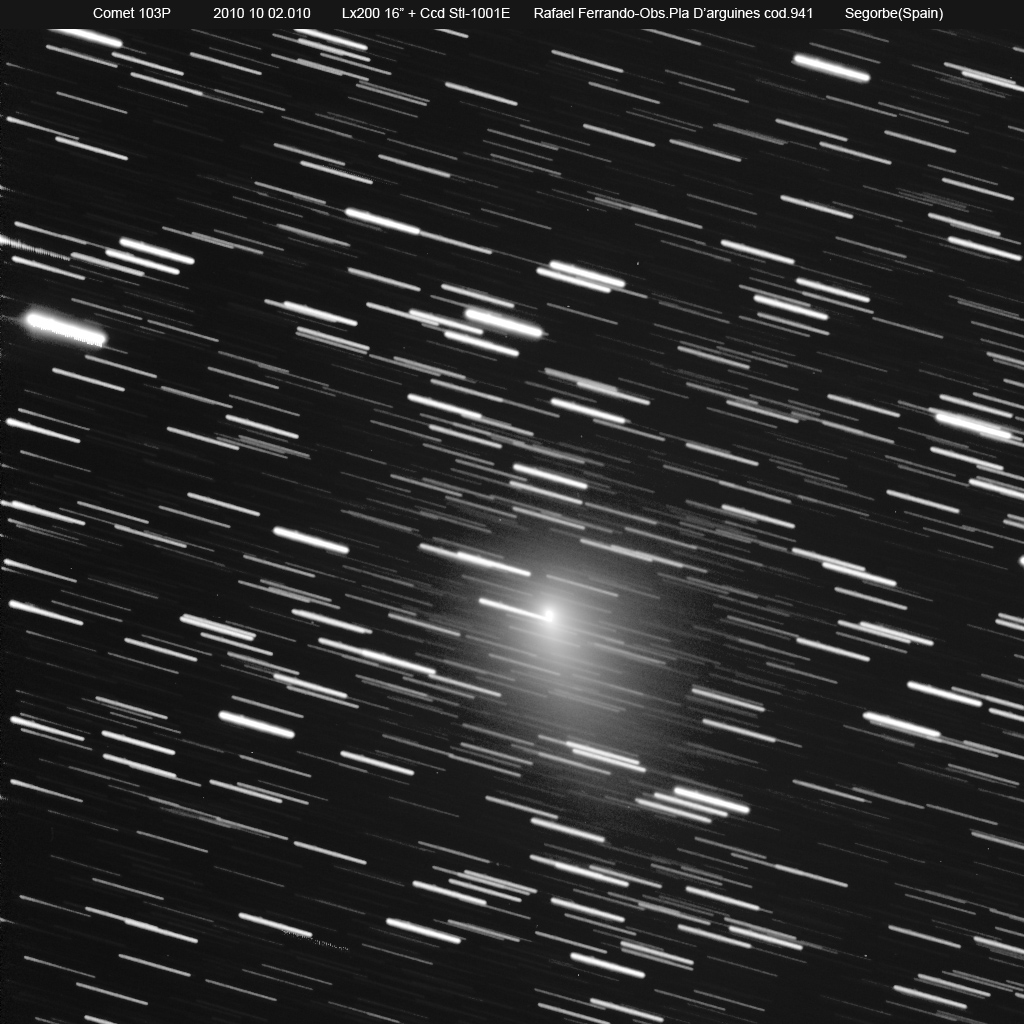
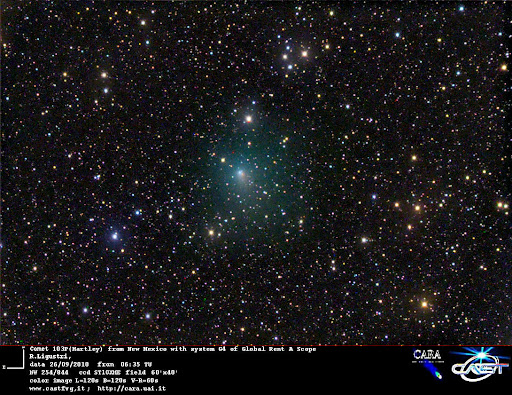
For the experienced amateur photographer Hartley 2 has been a fine show as well: selected pictures of Oct. 13-15 (mosaic), Oct. 15 (other field of view), Oct. 14., Oct. 13, Oct. 12 (more), Oct. 11 (more, more), Oct. 10 (more, more, more, more, more, more), Oct. 9 (more, more, more, wide view [explained hier and hier], more), Oct. 8 (C/A to double cluster; more, more, more, more, more, wide view), Oct. 7 (more, more, more), Oct. 6 (more), Oct. 5 (more), Oct. 4 (more, more), Oct. 3, Oct. 1-2 (collage), Oct. 2 (more, more, more), Oct. 1 (more, more, more, more, more), Sep. 30 (more), Sep. 29 (more, more, animation), Sep. 28, Sep. 26 and Sep. 20 (more), plus more pix. • There's also the new comet P/2010 T1 (McNaught).
In other small body news a prediction for a Draconids outburst in 2011 (also covered here and hier), though rather uncertain and drenched in moonlight anyway. • Reports of fireballs in New Mexico (more) and Germany. • A paper, press trelease and story about activity in Geminids-parent Phaethon which may be a "rock comet". • A paper and another one (also here), numerous press releases such as here, here, here, here, here, here, here, here and here and articles like this, this, this, this, dieser and more argue for an asteroid collision as the cause of P/2010 A2's tail. As I comment here the Spanish faction stands by its alternate explanation reported here earlier. • More about the Kamil crater discovery.
It's now 20 years since the 1st automatic NEO discovery with Spacewatch, and the technology is pretty mature now - e.g. at the La Sagra Sky Survey run entirely by amateurs which just bagged another comet. And somewhat controversial PanSTARRS has also found its first PHA (more, mehr). • Meanwhile another space rock of 5-10 meters has whizzed by Earth, 2010 TD54: video clips (also here; earlier), a demonstration how it came closer, a light curve unveiling rapid rotation and more video. • A video of a star occultation by Isis on Sep. 20 - and it's been 30 years since a major event with Kleopatra.
News from the Sun include data taken during the January annular eclipse in India, weird shadow band effects (it seems) projected on to clouds during the July total eclipse in the Pacific (one more story) and cool pics from September. • SOHO's EIT in in semi-retirement, replaced largely by the SDO - which had a partial lunar eclipse as well as an encounter w/Earth (more). • There was an aurora on Oct. 11, also seen here, here and here. Activity had been very low during the past minimum. A new aurora camera, explained here and here. • New insights in to the physics of flares (which we don't need to fear) and solar storms, while forecasting activity is hard. • And a rather weird paper on the Sun's spectrum, perhaps wrong but making headlines e.g. here, here, here, here, here and here, while the 'hockey stick' lives and the past N summer was hot ...
In other solar system news some great images from Pic du Midi with striking resolution. • More on Jupiter's record-close opposition - with Uranus nearby - here, here and here, plus a collage showing both in motion, questions and one success re. naked-eye visibility of the Galilean moons, some Jupiter images, also of Sep. 29, Sep. 22 (IR rotation movie, als a visible panel) and Sep. 13 plus more. Also the role of amateurs in monitoring Jupiter and the Harvest Moon nearby which looked like this (and later like this and this). • Mars 2010 rotating. • The ISS in transit of Venus (also shown here), Venus as a crescent and the ISS transiting a sunspot and the H-Alpha Sun. • Elsewhere some news from Eps Aur. • And regarding what's up in October, other than Hartley 2 and Jupiter with Uranus little from the solar system can be seen easily, as previews here, hier, hier, hier and hier show - the Orionids are lost in moonlight.
For the experienced amateur photographer Hartley 2 has been a fine show as well: selected pictures of Oct. 13-15 (mosaic), Oct. 15 (other field of view), Oct. 14., Oct. 13, Oct. 12 (more), Oct. 11 (more, more), Oct. 10 (more, more, more, more, more, more), Oct. 9 (more, more, more, wide view [explained hier and hier], more), Oct. 8 (C/A to double cluster; more, more, more, more, more, wide view), Oct. 7 (more, more, more), Oct. 6 (more), Oct. 5 (more), Oct. 4 (more, more), Oct. 3, Oct. 1-2 (collage), Oct. 2 (more, more, more), Oct. 1 (more, more, more, more, more), Sep. 30 (more), Sep. 29 (more, more, animation), Sep. 28, Sep. 26 and Sep. 20 (more), plus more pix. • There's also the new comet P/2010 T1 (McNaught).







In other small body news a prediction for a Draconids outburst in 2011 (also covered here and hier), though rather uncertain and drenched in moonlight anyway. • Reports of fireballs in New Mexico (more) and Germany. • A paper, press trelease and story about activity in Geminids-parent Phaethon which may be a "rock comet". • A paper and another one (also here), numerous press releases such as here, here, here, here, here, here, here, here and here and articles like this, this, this, this, dieser and more argue for an asteroid collision as the cause of P/2010 A2's tail. As I comment here the Spanish faction stands by its alternate explanation reported here earlier. • More about the Kamil crater discovery.
It's now 20 years since the 1st automatic NEO discovery with Spacewatch, and the technology is pretty mature now - e.g. at the La Sagra Sky Survey run entirely by amateurs which just bagged another comet. And somewhat controversial PanSTARRS has also found its first PHA (more, mehr). • Meanwhile another space rock of 5-10 meters has whizzed by Earth, 2010 TD54: video clips (also here; earlier), a demonstration how it came closer, a light curve unveiling rapid rotation and more video. • A video of a star occultation by Isis on Sep. 20 - and it's been 30 years since a major event with Kleopatra.

News from the Sun include data taken during the January annular eclipse in India, weird shadow band effects (it seems) projected on to clouds during the July total eclipse in the Pacific (one more story) and cool pics from September. • SOHO's EIT in in semi-retirement, replaced largely by the SDO - which had a partial lunar eclipse as well as an encounter w/Earth (more). • There was an aurora on Oct. 11, also seen here, here and here. Activity had been very low during the past minimum. A new aurora camera, explained here and here. • New insights in to the physics of flares (which we don't need to fear) and solar storms, while forecasting activity is hard. • And a rather weird paper on the Sun's spectrum, perhaps wrong but making headlines e.g. here, here, here, here, here and here, while the 'hockey stick' lives and the past N summer was hot ...
In other solar system news some great images from Pic du Midi with striking resolution. • More on Jupiter's record-close opposition - with Uranus nearby - here, here and here, plus a collage showing both in motion, questions and one success re. naked-eye visibility of the Galilean moons, some Jupiter images, also of Sep. 29, Sep. 22 (IR rotation movie, als a visible panel) and Sep. 13 plus more. Also the role of amateurs in monitoring Jupiter and the Harvest Moon nearby which looked like this (and later like this and this). • Mars 2010 rotating. • The ISS in transit of Venus (also shown here), Venus as a crescent and the ISS transiting a sunspot and the H-Alpha Sun. • Elsewhere some news from Eps Aur. • And regarding what's up in October, other than Hartley 2 and Jupiter with Uranus little from the solar system can be seen easily, as previews here, hier, hier, hier and hier show - the Orionids are lost in moonlight.

Sunday, September 19, 2010
Substantial sunspot group arrives, preceded by two nice eruption shows
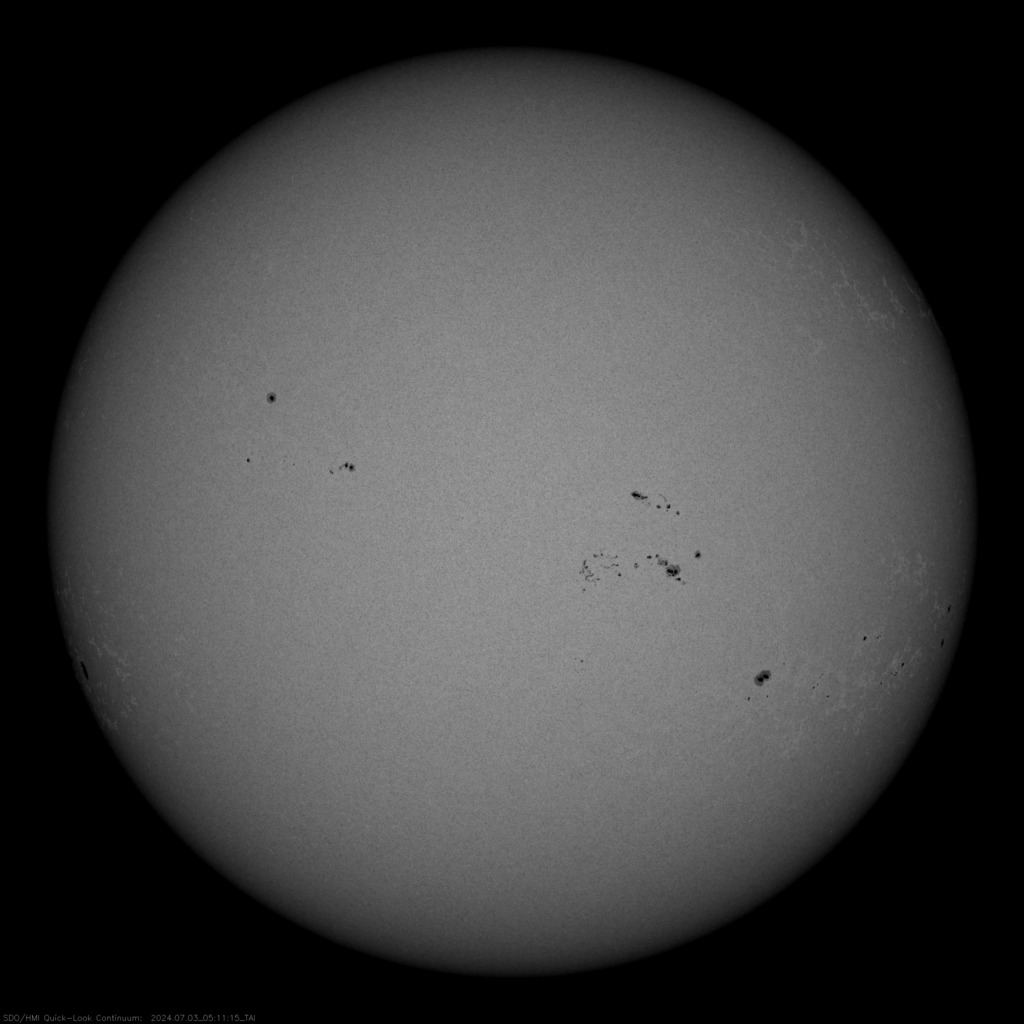
Since a few days a conspicious sunspot group, AR 1108, is rotating onto the disk, as can be followed best via near-live white-light images from SDO's HMI instrument but also amateur equipment as here on Sep. 19 (more), Sep. 18 (more) and Sep. 17. Earlier there were spectacular eruptions on Sep. 15 (timesteps one and two) and on Sep. 8 (movie, more, more, later, coverage here and hier, plus the group responsible earlier on the disk). • There is some indication that sunspots are losing contrast over time (covered also here and here), more on the state of the cycle, the continued lack of an effect on climate - and a preview of the deep partial eclipse next January. • Meanwhile Epsilon Aurigae in still in deep eclipse near the middle of the long event.
The closest approach of Jupiter since 1963 is making news here, here, here, here and here; some pictures of Sep. 7/8, Sep. 4 (more) and Aug. 25 (infrared); Uranus is very close to it as seen in images of Sep. 17, Sep. 5 and Aug. 28; also Uranus' moons on Sep. 6. • Jupiter is an excellent target for amateur science, esp. impact monitoring: There are new papers on the June 2010 flash [alt.] and the 2009 aftermath, discussed by ESO, NASA, JPL, NASA HQ, Gemini and Sandia Releases, Science@NASA and stories here, here, here and hier. • There was a Venus occultation by the Moon on Sep. 11 in Southern Africa, also seen here and here; in Spain, Germany (more), India and Australia (earlier) there was only a conjunction. Also Venus, Mars and the Moon in dark skies on Sep. 11 and Sep. 10.
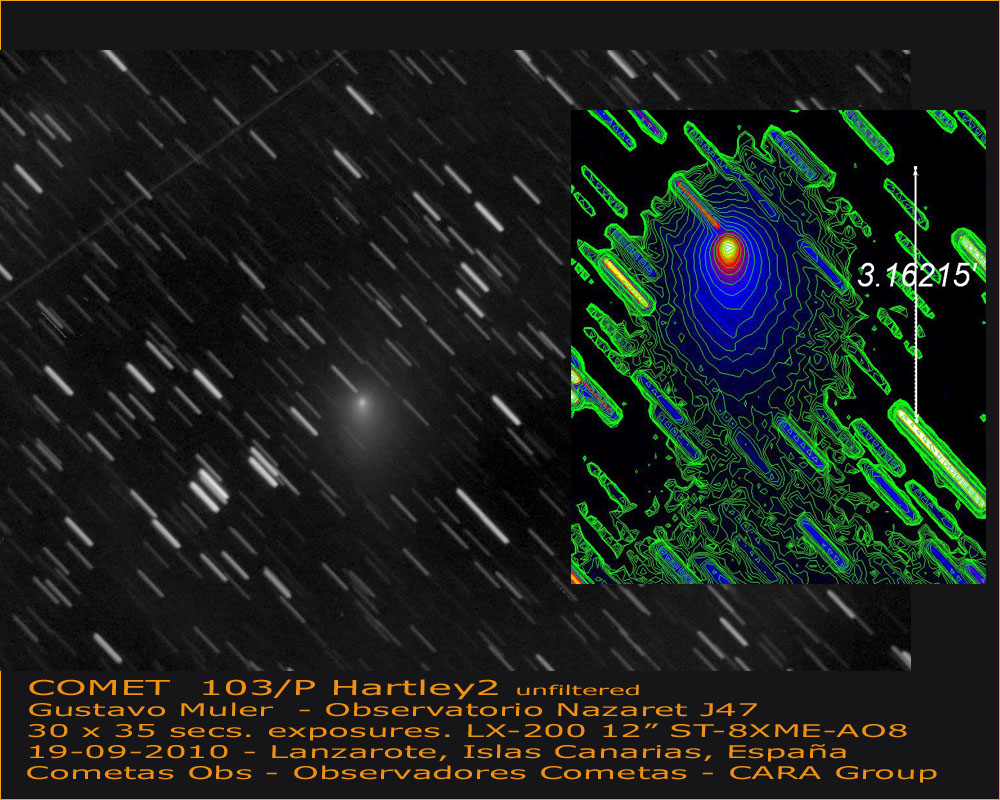
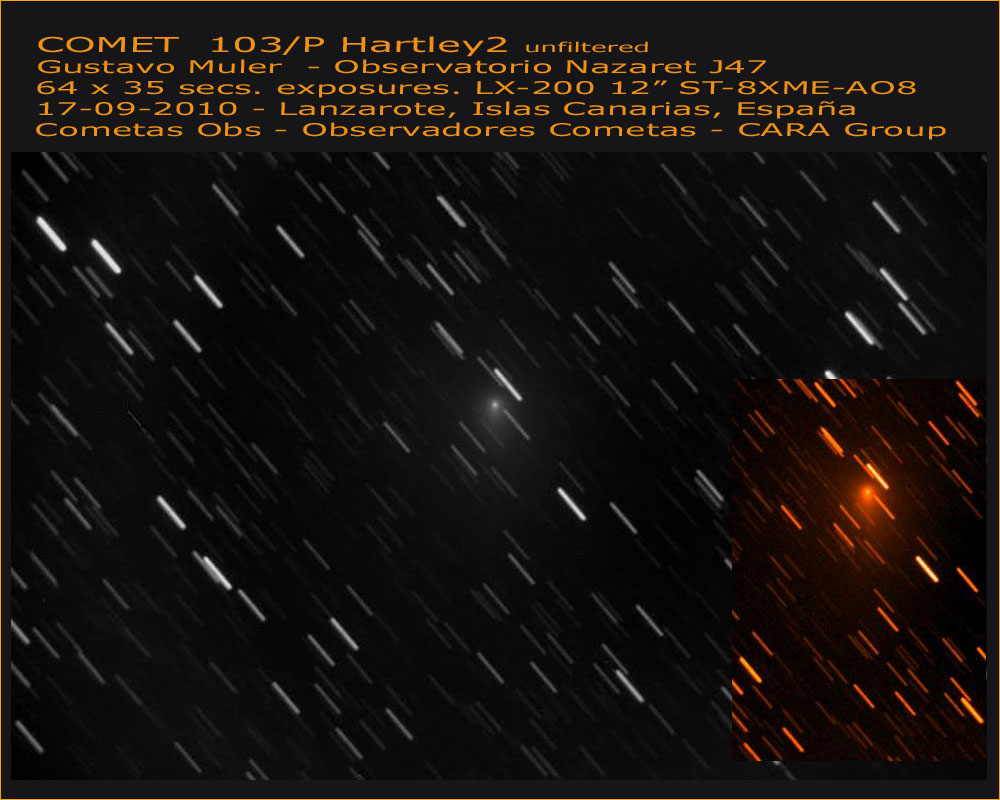
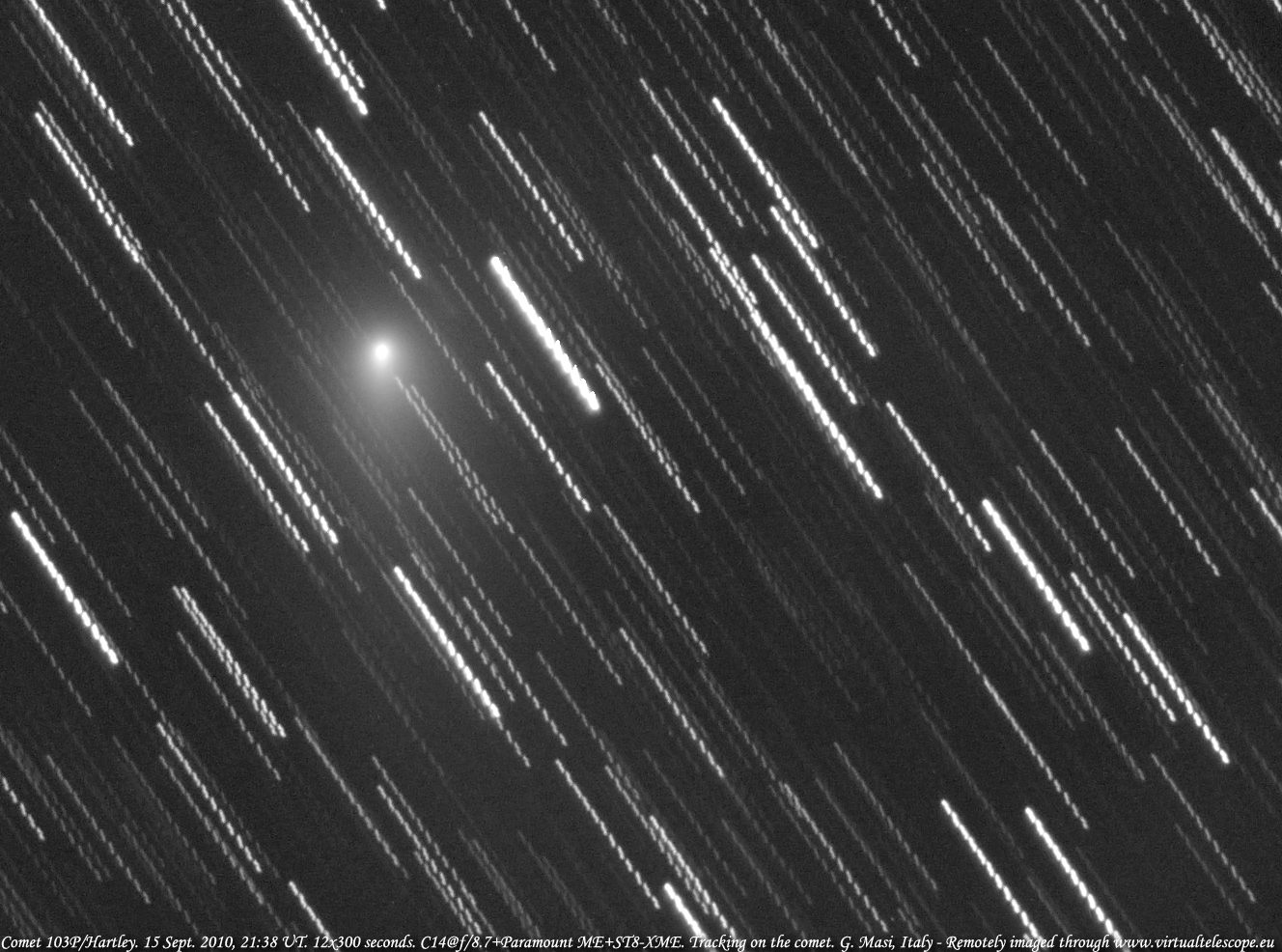
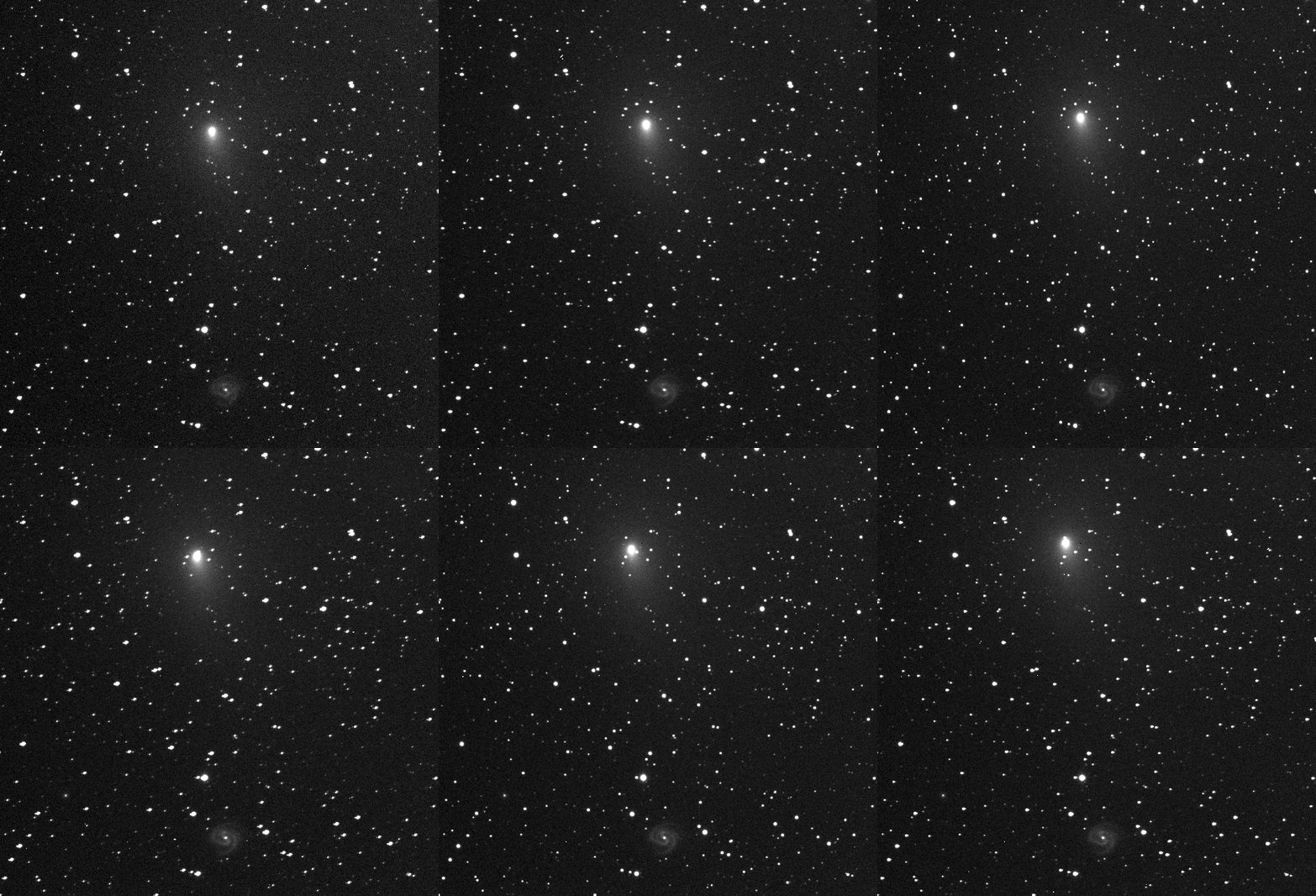
The race is on between Deep Impact and amateurs worldwide to capture the best views of comet 103P/Hartley (2) as the approaching spacecraft from the EPOXI mission is now sending images as well: a blog, the status, the pictures, the 2nd one, the 1st one and discussion here, here, here and here. Some general info on the brightening comet here, here, here and hier, some images, also from Lowell Obs., and selected amateur shots of Sep. 19 (more), Sep. 18 (more), Sep. 17, Sep. 16, Sep. 15, Sep. 11-13, Sep. 13, Sep. 12 (more), Sep. 11 (more, more and an animation), Sep. 8, Sep. 7, Sep. 6 (more, more), Sep. 5 (more, more, more) and Sep. 4 (more, more). • Even more interesting, though, is 10P/Tempel as seen on Sep. 16 (also Sep. 17 and Sep. 18 [more]), 236P/LINEAR has a little tail, and there is yet another La Sagra comet discovery, seen here on Sep. 18.
Two tiny asteroids - or space rocks perhaps? - came moderately close on the same day, Sep. 8: images of 2010 RF12 (more, more, more, more and more) and 2010 RX30, the respective MPECs 49 and 50 and various announcements and articles here, here, here, here, here, here, here, here, here (earlier), here, here, here (lousiest headline; see also the even worse URL!), hier, hier and hier - and there are discoveries all the time! • Did one crash in Colombia? Inconclusive reporting here (earlier, still earlier, even earlier), here, here and aqui - and yet more stories ...
Finally something to look at - the Astronomy Photographer of the Year winners of 2010, celebrated e.g. here, here, here, here, here and here. • And while we're at it, these extreme star trails and these Perseids drawings are also worth noting. • A closing note: While the preparations for and progress and aftermath of the International Year of Astronomy have been amply documented in a parallel blog (in German but covering the whole world, with most links to English sources), it's worth noting that both the international and the German final reports have come out this month and are freely available, the former also summarized here. There'll be a lot of obvious - and not so obvious - legacy of the IYA 2009, promised ...




The closest approach of Jupiter since 1963 is making news here, here, here, here and here; some pictures of Sep. 7/8, Sep. 4 (more) and Aug. 25 (infrared); Uranus is very close to it as seen in images of Sep. 17, Sep. 5 and Aug. 28; also Uranus' moons on Sep. 6. • Jupiter is an excellent target for amateur science, esp. impact monitoring: There are new papers on the June 2010 flash [alt.] and the 2009 aftermath, discussed by ESO, NASA, JPL, NASA HQ, Gemini and Sandia Releases, Science@NASA and stories here, here, here and hier. • There was a Venus occultation by the Moon on Sep. 11 in Southern Africa, also seen here and here; in Spain, Germany (more), India and Australia (earlier) there was only a conjunction. Also Venus, Mars and the Moon in dark skies on Sep. 11 and Sep. 10.
The race is on between Deep Impact and amateurs worldwide to capture the best views of comet 103P/Hartley (2) as the approaching spacecraft from the EPOXI mission is now sending images as well: a blog, the status, the pictures, the 2nd one, the 1st one and discussion here, here, here and here. Some general info on the brightening comet here, here, here and hier, some images, also from Lowell Obs., and selected amateur shots of Sep. 19 (more), Sep. 18 (more), Sep. 17, Sep. 16, Sep. 15, Sep. 11-13, Sep. 13, Sep. 12 (more), Sep. 11 (more, more and an animation), Sep. 8, Sep. 7, Sep. 6 (more, more), Sep. 5 (more, more, more) and Sep. 4 (more, more). • Even more interesting, though, is 10P/Tempel as seen on Sep. 16 (also Sep. 17 and Sep. 18 [more]), 236P/LINEAR has a little tail, and there is yet another La Sagra comet discovery, seen here on Sep. 18.

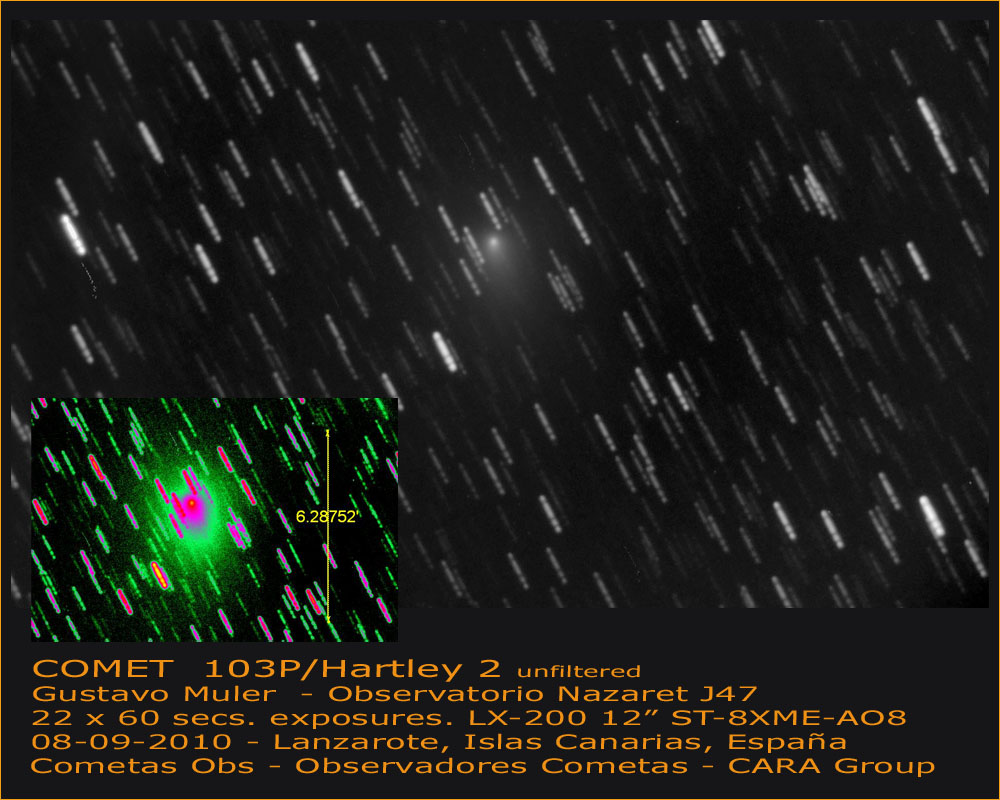


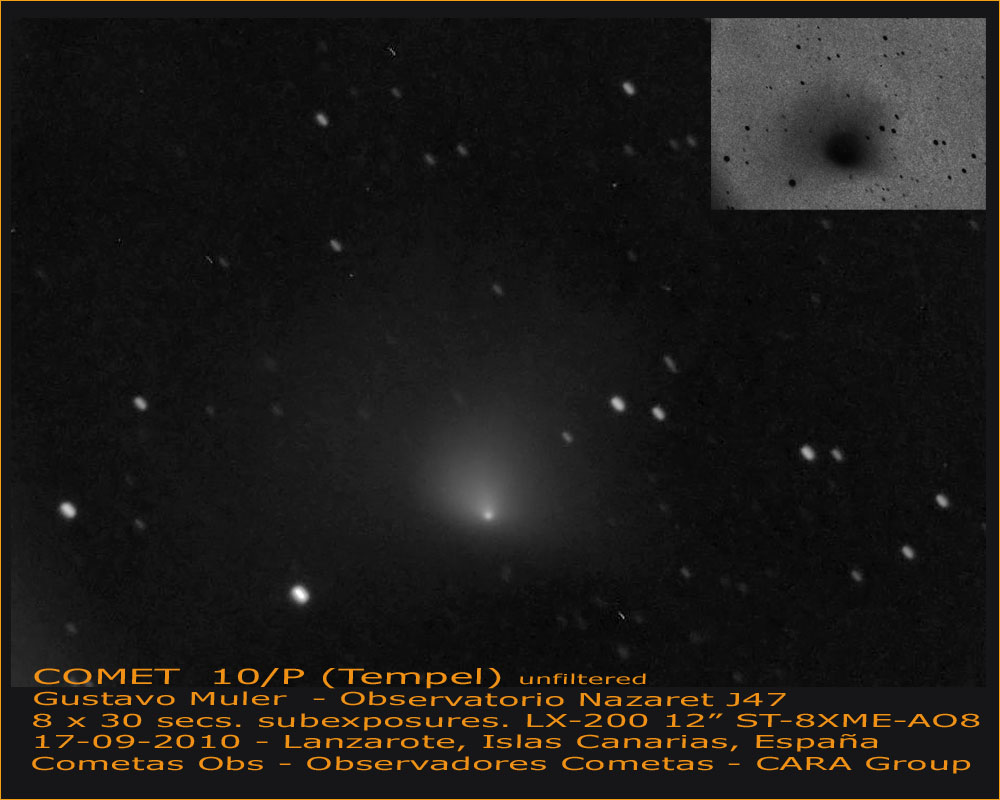
Two tiny asteroids - or space rocks perhaps? - came moderately close on the same day, Sep. 8: images of 2010 RF12 (more, more, more, more and more) and 2010 RX30, the respective MPECs 49 and 50 and various announcements and articles here, here, here, here, here, here, here, here, here (earlier), here, here, here (lousiest headline; see also the even worse URL!), hier, hier and hier - and there are discoveries all the time! • Did one crash in Colombia? Inconclusive reporting here (earlier, still earlier, even earlier), here, here and aqui - and yet more stories ...
Finally something to look at - the Astronomy Photographer of the Year winners of 2010, celebrated e.g. here, here, here, here, here and here. • And while we're at it, these extreme star trails and these Perseids drawings are also worth noting. • A closing note: While the preparations for and progress and aftermath of the International Year of Astronomy have been amply documented in a parallel blog (in German but covering the whole world, with most links to English sources), it's worth noting that both the international and the German final reports have come out this month and are freely available, the former also summarized here. There'll be a lot of obvious - and not so obvious - legacy of the IYA 2009, promised ...
Friday, September 3, 2010
Yet another impact flash on Jupiter, this time recorded - triple - in Japan
The events of June 3 have repeated on August 20, and again in the Far East: This time it were three Japanese amateur astronomers who recorded a brief flash above Jupiter's clouds from three different sites. And again no traces whatsoever are left on the planet - another airburst then, and one wonders how frequent these really are. The three reports (and pictures and videos) are collected here and here, the first video is here (YouTube version), and the 2nd observer reports here. Coverage in the mainstream media seems to be scarce, with samples from the UK, Japan and Russia; it was again bloggers who ruled the day. Like Gish Bar Times (earlier), Sky & Tel. (updated repeatedly) and the Planetary Society (earlier), also this, this, this, this, this, this, this, this, this and this story, plus SpaceWeather (earlier).
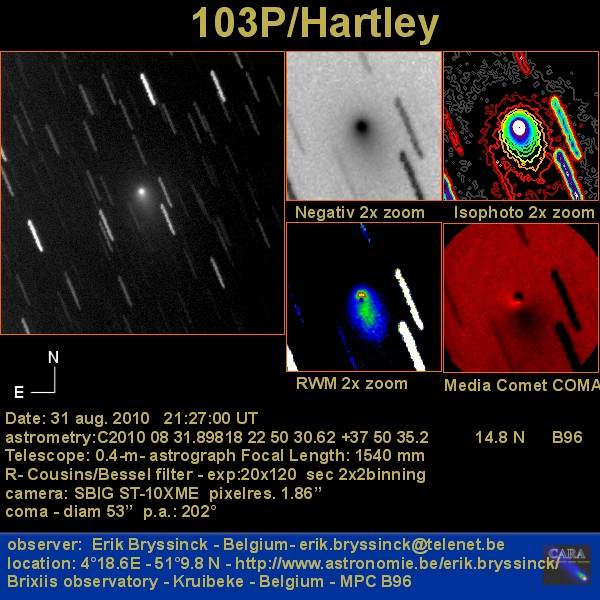
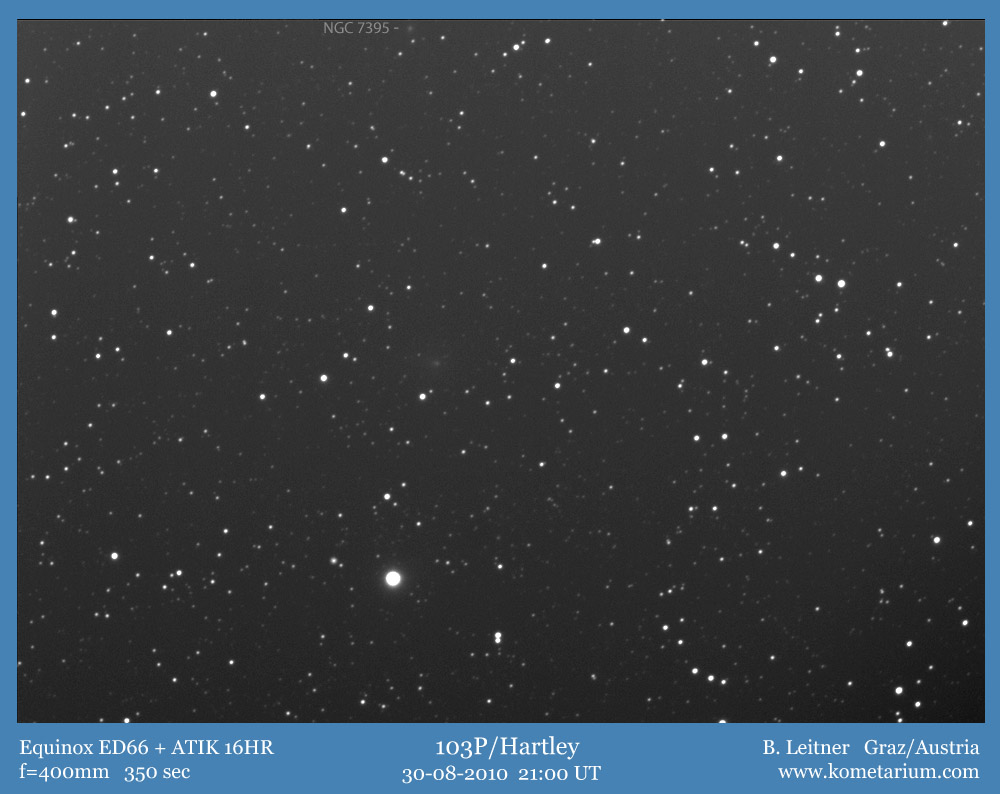
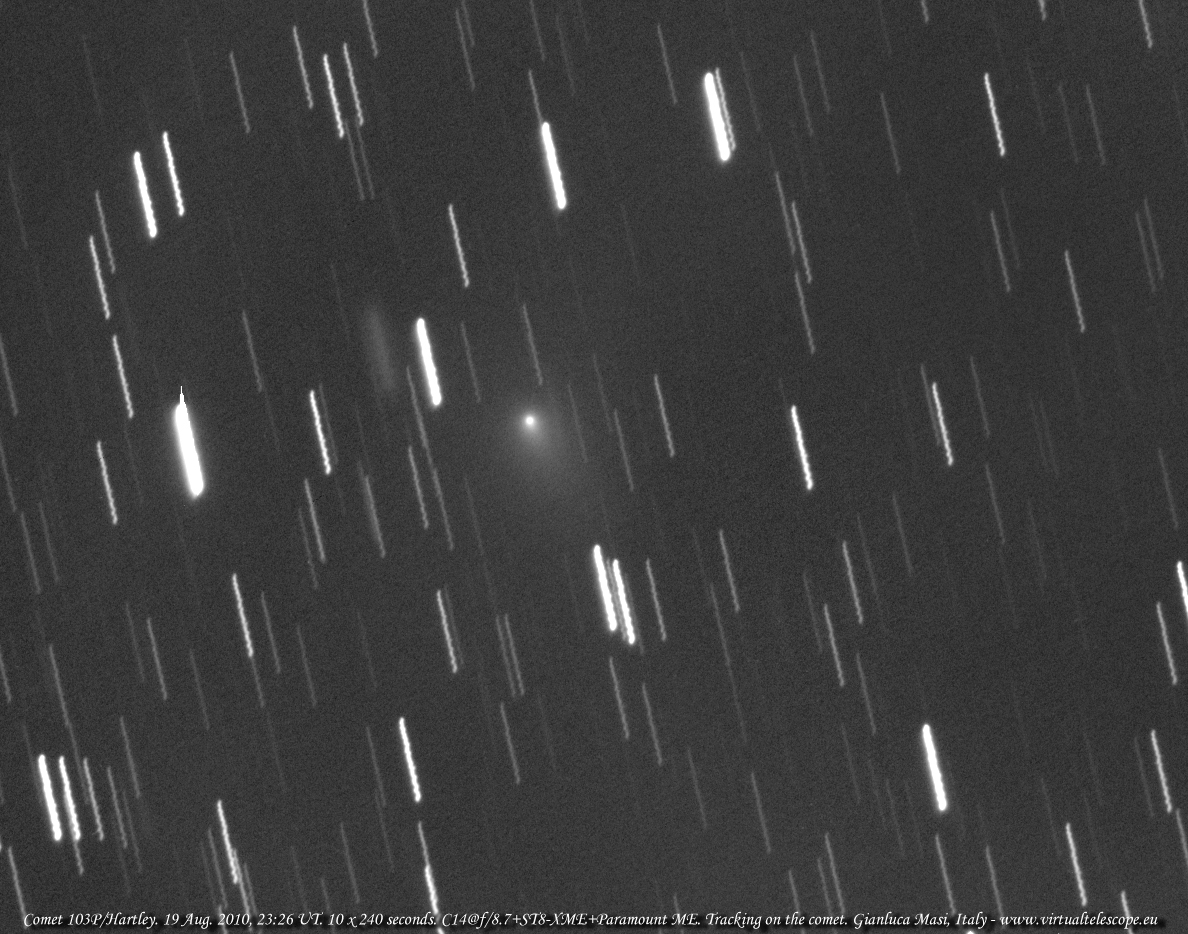
Even without traces of the impact Jupiter is very interesting right now: selected images of Jupiter from Sep. 2, Sep. 1 (more), Aug. 30 (extremely good; from this collection, also here and here), Aug. 22 (more, more), Aug. 21 (more, more) and Aug. 20; also 3 moons resolved. • A trio of Venus, Mars & Spica has turned into a line now, as images from Sep. 2, Sep. 1, Aug. 31, Aug. 29 (Austria vs. Australia) and Aug. 24 show. • Resolved amateur images of Uranus. • A gallery of images of comet 103P/Hartley 2 and a blog from the EPOXI mission that will meet it 2 months from now. The brightness still ain't great; some images of Sep. 2, Sep. 1, Aug. 31 (more), Aug. 30, Aug. 29, Aug. 27, Aug. 22, Aug. 20 (more) and Aug. 19. • Also 2P/Encke on Aug. 22 (explanation) and in STEREO's FOV; it was closest to Earth now. Plus C/2010 G2 (Hill) in outburst, yet another twist in the P/2010 A2 saga - and 30 years of asteroid discoveries visualized. • A sporadic meteor goes bang, and one megacryometeor case finds a likely solution in Germany.
In other news yet more interesting visuals from the July total eclipse: hi-res pics from Tatakoto (also a video from there), several reports from Polynesian islands and film vs. digital images from Rapa Nui. From Patagonia an image collection, featuring a Finnish observer (eclipse report, horizon analysis, source) and yours truly who also stitched TSE panoramas from 2008 from one pair of wide-angle images and another one. • Talking about the Sun, hi-res images from Big Bear (more, more and more), a new SDO video front, 10 years of Cluster (more), the physics and a visualization of the solar B field, a July prominence sequence, solar mosaics, SID data showing increasing activity (which can influence navigation, the upper atmosphere [mehr] and more - or maybe not). There is also speculation that the Sun's action influences the length of the day - and radioactive decay, but this widely reported story is almost certainly wrong.
• For the record: the aurora shown here was actually imaged on July 25th already, but the date generator on the ISS was wrong. And you can make your own aurora, too. • Turning to other stars now, CoRoT has seen asteroseismological evidence for an activity cycle just like the Sun's, only much faster in another star. • Epsilon Aurigae has been observed again with CHARA, but the interferometric images won't be seen anytime soon. Also a V-band light curve. • Tom Boles has, in rapid succession found his supernovae # 133 + 134 and 135.
• It's now one year after the fire that threatened Mt. Wilson. • A video report from a star party in the UK. • The Milky Way over Bryce Canyon. • And an old sun dog image has been sold to the BBC - as a daylight fireball! The beeb has killed the respective website, but here it is, from Google's cache ... • Finally a brief preview of September 2010 (more, more, mehr und mehr): There'll be a good Mercury morning visibility for the N. hemisphere, Sep. 18 has been declared as Observe the Moon Night - and on Sep. 21 we have, simultaneously, Uranus and Jupiter in Opposition, the latter coming closest since 1963.
Even without traces of the impact Jupiter is very interesting right now: selected images of Jupiter from Sep. 2, Sep. 1 (more), Aug. 30 (extremely good; from this collection, also here and here), Aug. 22 (more, more), Aug. 21 (more, more) and Aug. 20; also 3 moons resolved. • A trio of Venus, Mars & Spica has turned into a line now, as images from Sep. 2, Sep. 1, Aug. 31, Aug. 29 (Austria vs. Australia) and Aug. 24 show. • Resolved amateur images of Uranus. • A gallery of images of comet 103P/Hartley 2 and a blog from the EPOXI mission that will meet it 2 months from now. The brightness still ain't great; some images of Sep. 2, Sep. 1, Aug. 31 (more), Aug. 30, Aug. 29, Aug. 27, Aug. 22, Aug. 20 (more) and Aug. 19. • Also 2P/Encke on Aug. 22 (explanation) and in STEREO's FOV; it was closest to Earth now. Plus C/2010 G2 (Hill) in outburst, yet another twist in the P/2010 A2 saga - and 30 years of asteroid discoveries visualized. • A sporadic meteor goes bang, and one megacryometeor case finds a likely solution in Germany.
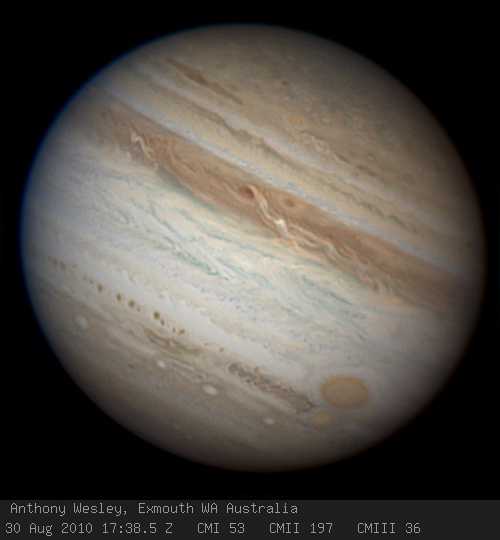
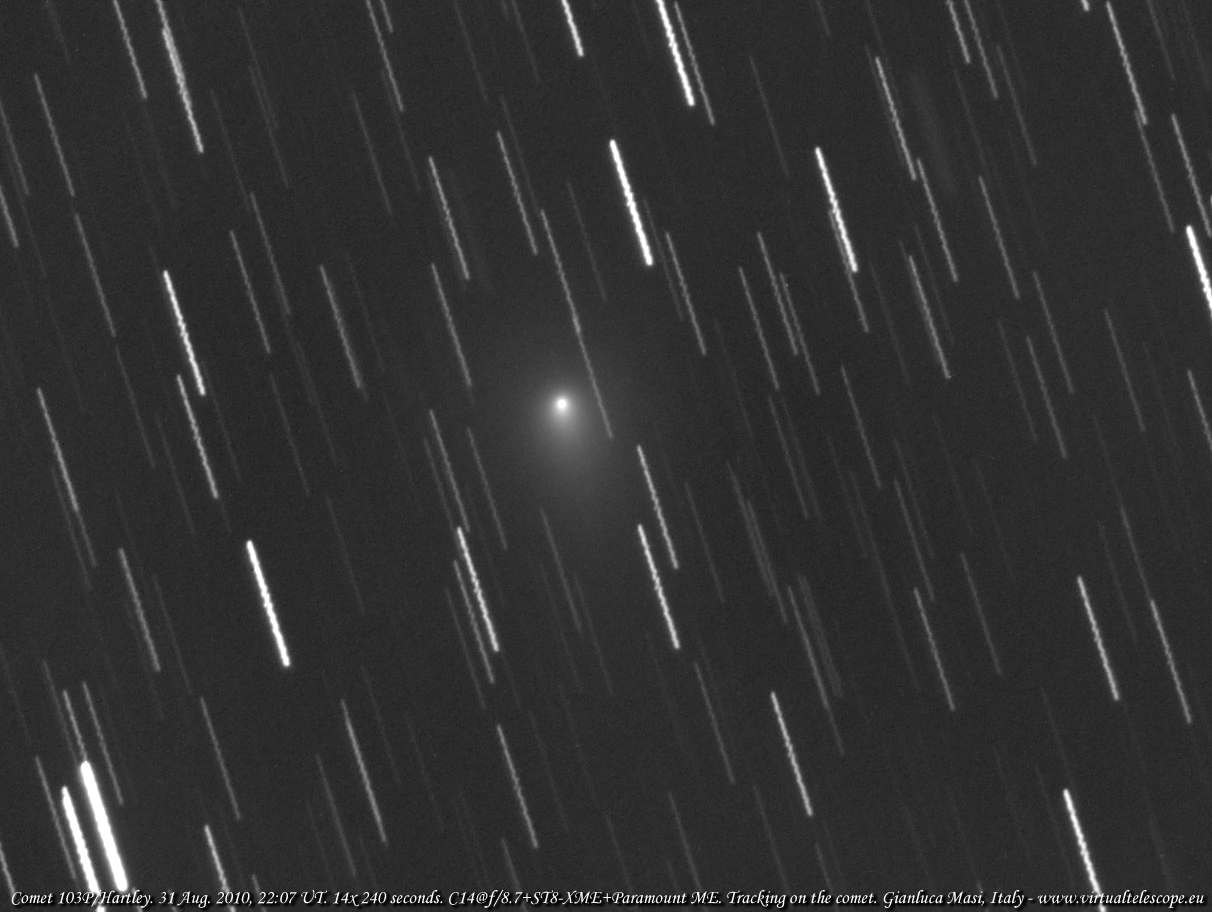


In other news yet more interesting visuals from the July total eclipse: hi-res pics from Tatakoto (also a video from there), several reports from Polynesian islands and film vs. digital images from Rapa Nui. From Patagonia an image collection, featuring a Finnish observer (eclipse report, horizon analysis, source) and yours truly who also stitched TSE panoramas from 2008 from one pair of wide-angle images and another one. • Talking about the Sun, hi-res images from Big Bear (more, more and more), a new SDO video front, 10 years of Cluster (more), the physics and a visualization of the solar B field, a July prominence sequence, solar mosaics, SID data showing increasing activity (which can influence navigation, the upper atmosphere [mehr] and more - or maybe not). There is also speculation that the Sun's action influences the length of the day - and radioactive decay, but this widely reported story is almost certainly wrong.
• For the record: the aurora shown here was actually imaged on July 25th already, but the date generator on the ISS was wrong. And you can make your own aurora, too. • Turning to other stars now, CoRoT has seen asteroseismological evidence for an activity cycle just like the Sun's, only much faster in another star. • Epsilon Aurigae has been observed again with CHARA, but the interferometric images won't be seen anytime soon. Also a V-band light curve. • Tom Boles has, in rapid succession found his supernovae # 133 + 134 and 135.

• It's now one year after the fire that threatened Mt. Wilson. • A video report from a star party in the UK. • The Milky Way over Bryce Canyon. • And an old sun dog image has been sold to the BBC - as a daylight fireball! The beeb has killed the respective website, but here it is, from Google's cache ... • Finally a brief preview of September 2010 (more, more, mehr und mehr): There'll be a good Mercury morning visibility for the N. hemisphere, Sep. 18 has been declared as Observe the Moon Night - and on Sep. 21 we have, simultaneously, Uranus and Jupiter in Opposition, the latter coming closest since 1963.
Subscribe to:
Posts (Atom)