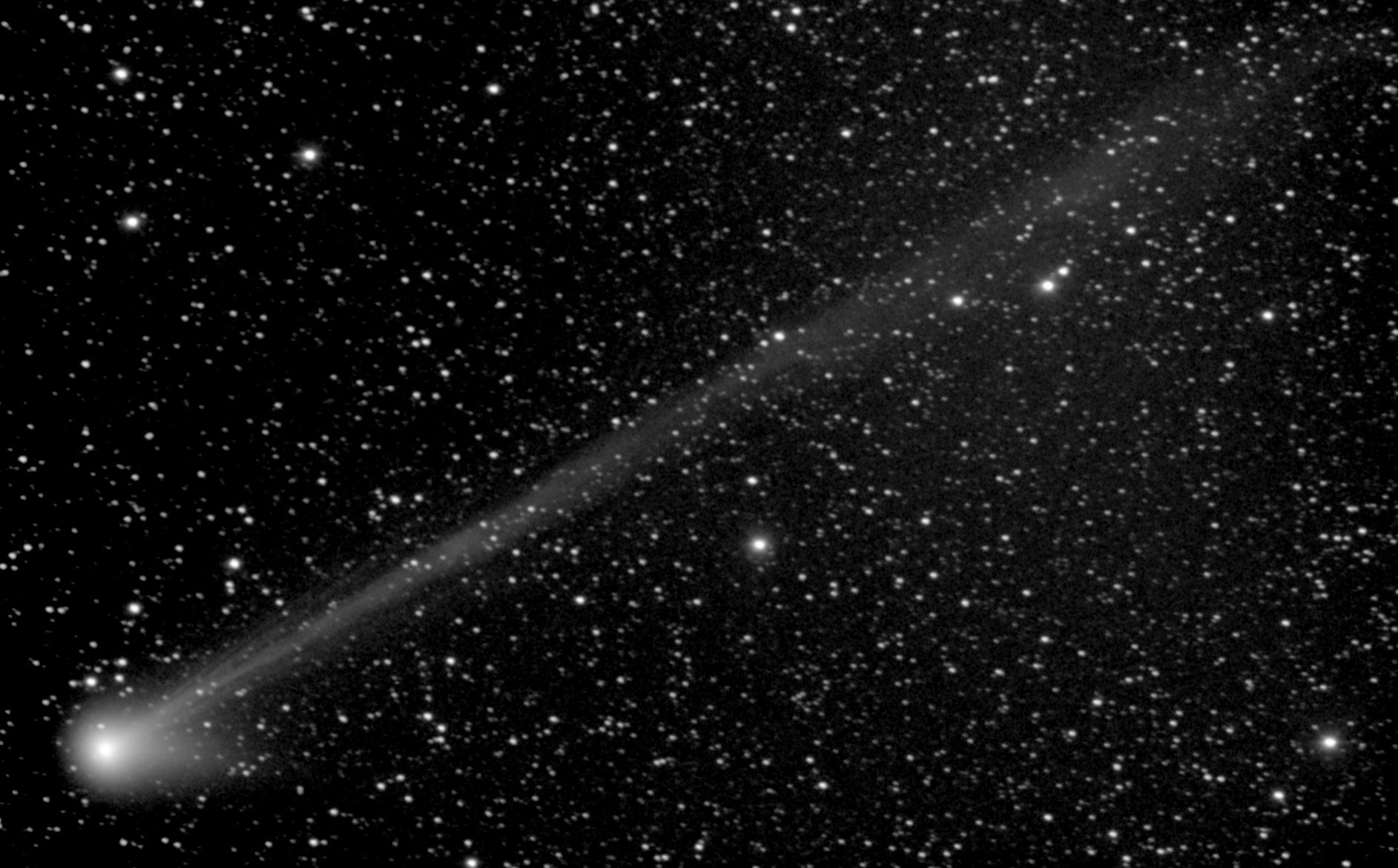
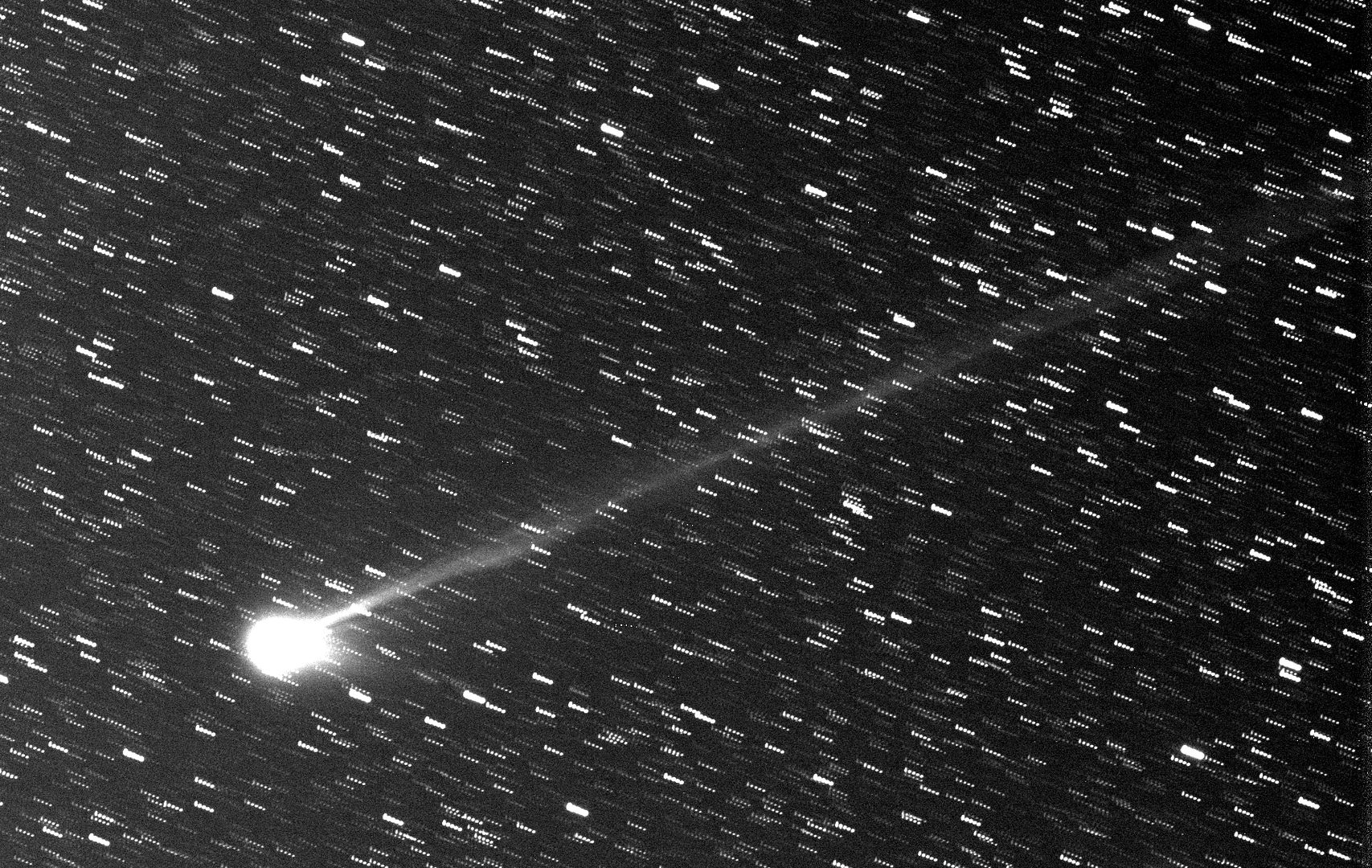
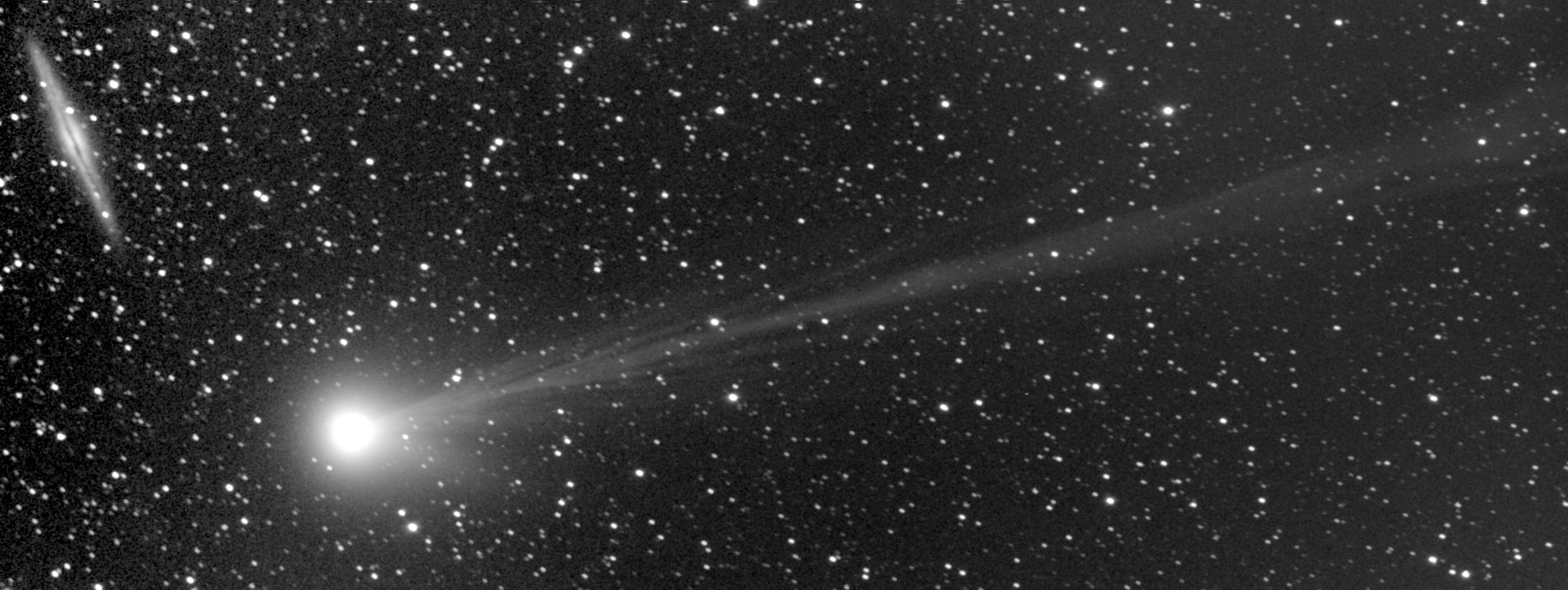
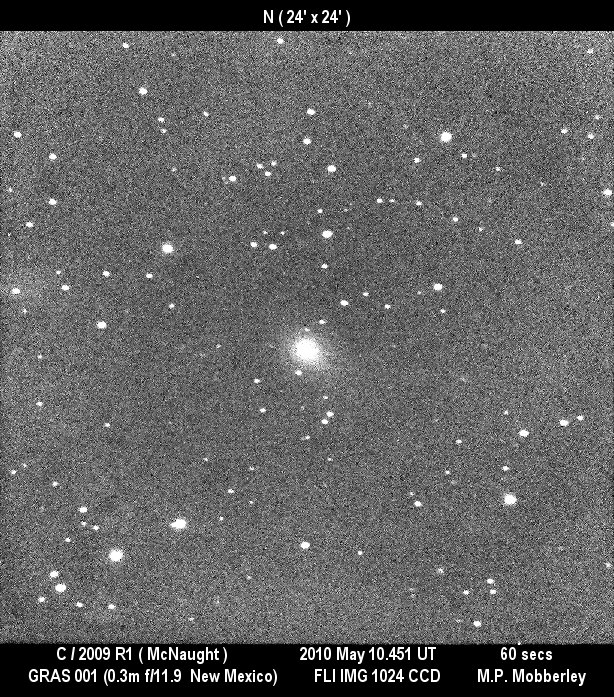
Have we seen the best of comet C/2009 R1 (McNaught) already? The first two weeks of June produced a flurry of great photographs, but this has come to an end as the window of (good) visibility is decreasing again. And a detailled analysis also raises doubts that McNaught will reach 2nd magnitude: It may stop at 3.5 to 4 mag. which is pretty bad given the poor viewing geometry. The report also hightlights the fact that the coma is very small, only a few arc minutes, and the ion tail - which photographers saw at up to 7° in length - very faint visually: In 'normal' binoculars (which this blogger has also pointed at the comet repeatedly) McNaught is just a tiny fuzzball, reminiscent of a distant globular cluster perhaps, and the same goes for small telescopes. Only in huge binoculars and big telescopes does the comet give something to the visual observer.
Here are selected pictures from the mornings of June 16, June 15 (also a drawing and another one), June 14, June 13 (also with NLCs, more wide views, more, more, more and a visual report from a large scope), June 12 (more, more, very small and a visual report), June 11 (an animation; more, more, more and more pics), June 10 (more, more), June 9 (more, more,more), June 8 (more, more, more, more, more, more), June 7 (more, more, more) and June 6 (more, more, more, more, more, more, more, more, more, more). Numerous general articles on the comet appeared e.g. here, here, here, here, here, here, here, here, here, here, here, here, here, here, here, hier, hier und hier - some very misleading, of course, touting a "bright green comet" easy to find by just looking North ...
The June 3 Jupiter impact left not the slightest trace in the clouds of Jupiter, even with the vision of the Hubble Space Telescope, as also reported here, here, here, here, here, here, here, here and hier. There are many ideas why nothing was seen after the impact which had earlier made news also here, here, here, here, here, here, here and here. • Constellation-wise here are Venus & the Moon on June 15; it's now a good time for this and other planets in the evening. E.g. here are Mars on June 4, the Mars/Regulus conjunction on June 6 (more and the view from down under) and a Tethis-Dione event at Saturn on June 5. • In the distant solar system the results of the first-ever observed stellar occultation by a Kuiper Belt Object have been published and a rather big one has been discovered - while comet Hale-Bopp was detected by Herschel at 30 AU from the Sun.
In other news the first two dwarf planets are in opposition (with Ceres being much easier than Pluto, of course), and a stellar occultation by asteroid (80) Sappho has yielded nice chords. • There is some speculation that the 2011 Draconids could have an outburst, while others see a maximum ZHR of just 40 to 50 or even just 10 - nonetheless commercial tours like this and this one are being offered to watch the shower/outburst/storm. Which happens around full moon, though. • Another "meteor caused fire" nonsense evaporated quickly in Canada, also the story of NWA 5400 and NASA asking for help in finding meteorites. Plus more arguments against an impact/Dryas link and about the meteor poem (more). • Speculations and warnings regarding the future behavior of the Sun made many headlines, such as this, this, this, this, this, this and this, letting some scratch their heads over contradictions.
• There is no mid-eclipse brightening of Epsilon Aurigae so far, while something strange is happening regarding Eta Carinae's stellar wind. • Sightings of NLCs are now on the increase, with observations e.g. on June 16, June 15 (also a video), June 14 and June 13; earlier they were rare, and a claimed sighting in Austria on the 9th is thought erroneous now. • A nice sunset from the ISS made headlines, and there is an analysis of the Icelandic ash from the volcano plume. • An ISS transit and more on the Falcon 9 spiral over Oz (more, more, more). • The reentry of Hayabusa resulted in a brilliant sky show over Oz: more images here and here. • PanSTARRS is now operational and finding supernovae. • And finally a transportable 107-cm amateur scope with a convenient eyepiece position!
Wednesday, June 16, 2010







Saturday, June 5, 2010
Impact flash on Jupiter seen - but no traces detected yet
The two most avid Jupiter watchers in the 'Eastern hemisphere' have simultaneously observed something hit Jupiter on June 3rd at 20:31 UTC, causing a short bright flash - but since then no dark stuff has been reported at the impact site as had been seen easily after the 1994 Shoemaker-Levy 9 impacts as well as the July 2009 impact. Anthony Wesley in Australia observed the impact in realtime and got a great video at 60 fps. He immediately alerted the world, including Cristopher Go in the Philippines who had been recording Jupiter blindly at the same time: His video caught the same flash at the same time in the same location, and since he was in a very different place on Earth, the reality of the event is out of the question. (A similar flash on Jupiter in 1983 lacks such confirmation, unfortunately.) As reported in this forum, this report and on SpaceWeather, no traces whatsoever of the impact have since been seen; see also pics from June 4 and June 5 that show the site and follow further developments through JALPO's collection.
As usual these days, reporting of this solar system event fell largely to astronomy websites and blogs, with the 'main-stream media' lagging behind (though getting some soundbites from bewildered experts): Here are some stories from Sky & Telescope, the Planetary Society Blog (earlier, still earlier), the Cosmic Diary, the Gish Bar Times (earlier), Random Thoughts, AstroBob, Comets & NEOs, Cosmic Log, Catching the Light, Discovery, Astronomy, Ars Technica, Nat'l Geographic, Bad Astronomy, New Scientist Blog, Eureka, Science Blogs, KosmoLogs, Astronomy Now, Space.com, News.com.au, Science News and BBC. And for historical context, the author of this paper tells this blog that he still sees not one clear historical case of a Jupiter impact pre-1994. • Talking about Jupiter, the 'loss' of its SEB is still making headlines, e.g. here, here, here, here and here. • Interesting data from last years occultation of 45 Cap by Jupiter were presented at the Planetentagung 2010, notably a lightcurve from Hakos (Namibia) and a glorious video from Calar Alto (Spain): The star went and came back multiple times over 1/2 hour while 'scanning' Jupiter's atmosphere!
• Numerous events involving Saturn's moons were observed by B. Gährken, including transits of Titan (from Australia). Also a May 24 pic of Saturn, rings still narrow. • Two results from the opposition of Mars 2010: a map and the best pictures by another observer. • Venus on June 3rd. • The Moon occulting Venus was observed in the Philippines (more, more, more, more and more) and Hongkong at night and India (video; low-res pic) and Greece (more, more, more and more) in daytime, while a close daytime apparition was seen from Germany and the ISS (dito). More pics from the 16th are here, plus further evening views of Venus & the Moon from May 17 in Namibia, May 16 in the U.S. (more), the U.K. (more, more, more, more, more, more), India (wider, very wide, dito, wider, dito, dito, dito and an animation) and Australia and May 15 from the U.S. (earlier, more, more, more), the U.K. (earlier, other site) and India. Meanwhile this handy calculator gives you more planet occultations by the Moon! And we have weather stats for the 2010 Transit of Venus.
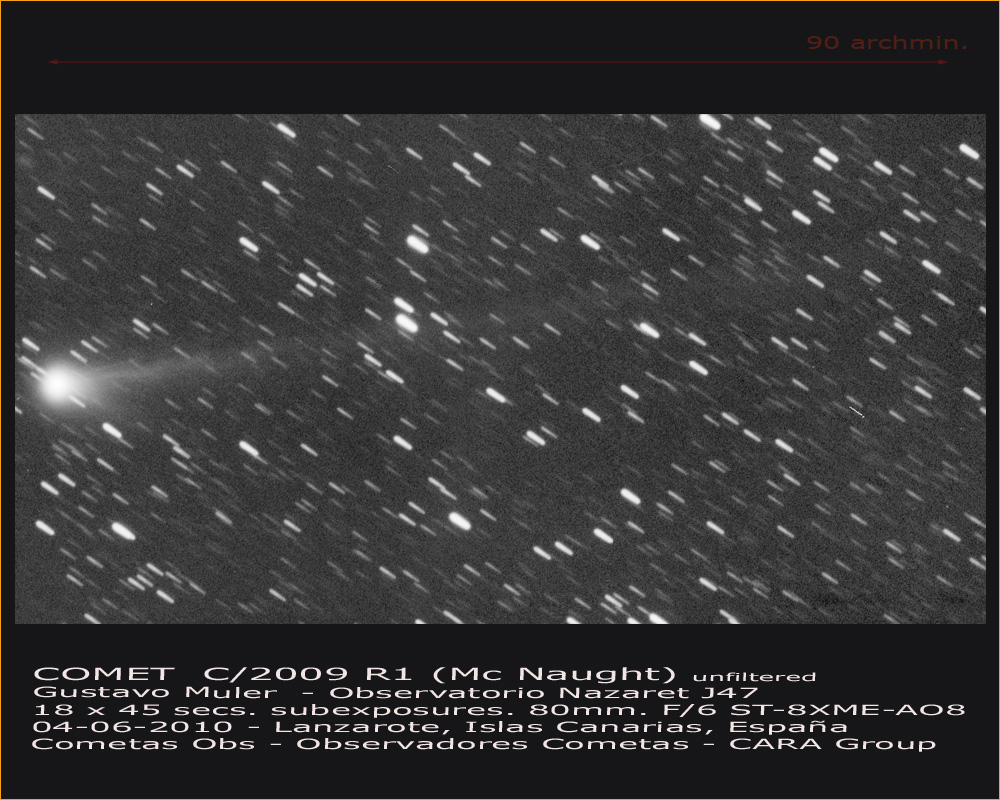
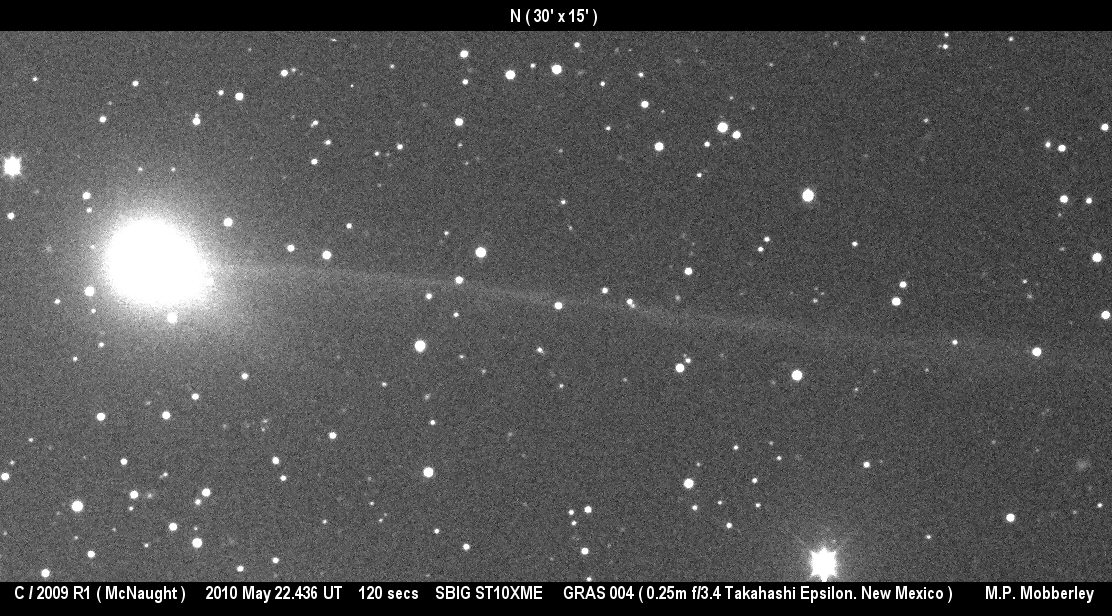
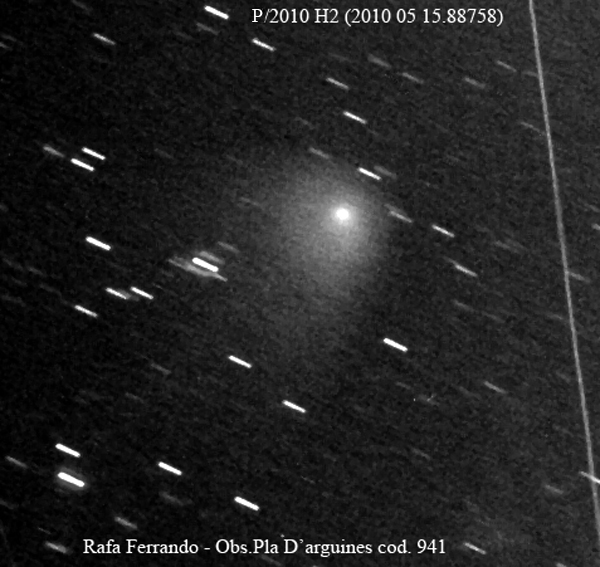
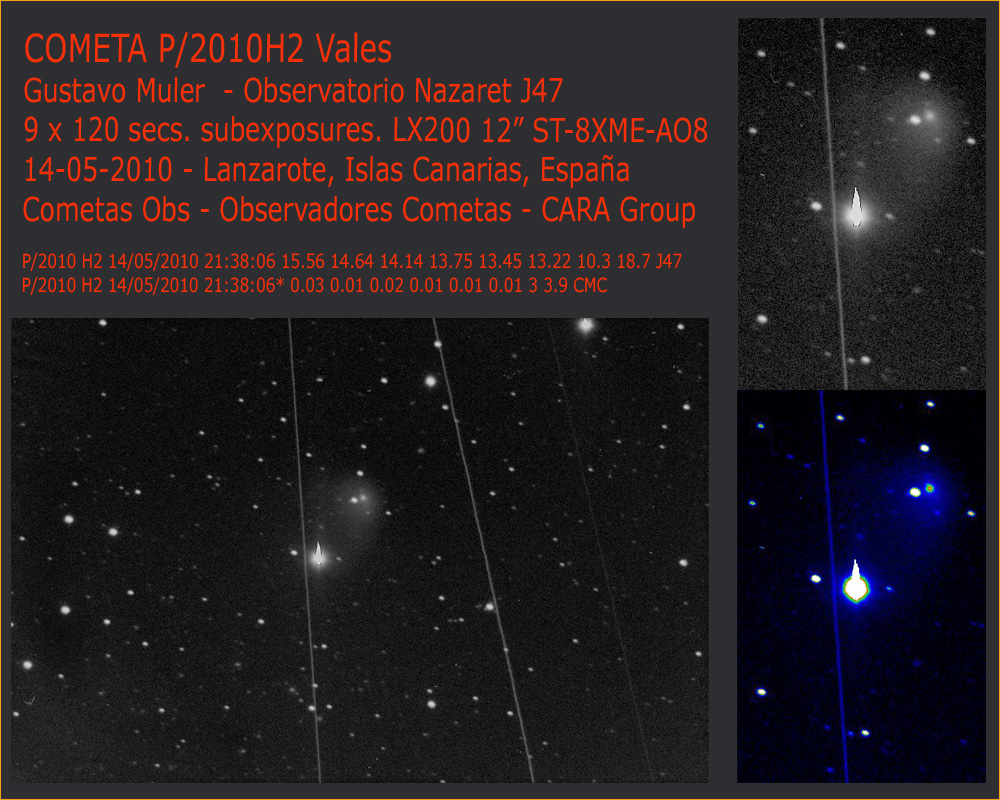
The McNaught show is underway as the comet C/2009 R1 - see previews here, here, hier, hier and hier - has now brightened to ~6th mag and has a nice structured plasma tail: You can find growing picture collections here, here and here as well as selected pictures of June 5 (more, more, more and more), June 4 (more and more), June 3 (more and more), June 2, May 31, May 30 (more), May 29, May 26 (annotated, animation, more), May 25 (more), May 24, May 23 and May 22 (more, more, more). • For C/2010 H2 (Vales) we have another analysis and pics of June 5, June 2, June 1 (more), May 22, May 16 (more), May 15 and May 14. Also a paper on the outburst of Holmes. • Wild 2 on May 18. • Joint STEREO & SOHO observations of a comet hitting the Sun (more, more, mehr). • Talking about the Sun, thoughts on its irradiance and effects as well as recent behavior, also summarized here.
In other news There seems to be the - predicted - mid-eclipse brightening of Epsilon Aurigae, we have a supernova impostor and the real SN 2010dn in NGC 3184 (the discovery photo by Koichi Itagaki w/60 cm) as well as a transit of TrES-3b. • "Asteroid" 2010 KQ is probably man-made (more, earlier, more, earlier, more, mas and more). • A report on the fast fly-by of 2010 KO10, a possible impact-role in Antarctica, a meteorite recovery in Oregon, a twisted meteor (probably only the camera was shaking) and a meteor story in an old poem (more, more and more) • Plus a visit to Arecibo - and astrophotography from Puerto Rico.
• The first NLCs (a preview), subtle volcanic dust effects on the Sun (also nighttime tracking w/Calypso, the need for a space-based laser, volcano science, measuring flights and the need for limits). • A veeery old newsreel on amateur astronomer Percy Wilkins. • How to build your own planetarium. • A sky show over Australia - great video! - after the Falcon 9 launch. • Amateur imaging of KH 11 satellites (with some doubts re. image processing), the X-37B (see also here ["Amateurastronomen ..."] y aqui) and the ISS on May 16 and May 22 (more) by T. Legault and May 23 (hi-res) as well as in daytime.
• Finally some highlights of this month (see also here, here, here, hier und hier):

As usual these days, reporting of this solar system event fell largely to astronomy websites and blogs, with the 'main-stream media' lagging behind (though getting some soundbites from bewildered experts): Here are some stories from Sky & Telescope, the Planetary Society Blog (earlier, still earlier), the Cosmic Diary, the Gish Bar Times (earlier), Random Thoughts, AstroBob, Comets & NEOs, Cosmic Log, Catching the Light, Discovery, Astronomy, Ars Technica, Nat'l Geographic, Bad Astronomy, New Scientist Blog, Eureka, Science Blogs, KosmoLogs, Astronomy Now, Space.com, News.com.au, Science News and BBC. And for historical context, the author of this paper tells this blog that he still sees not one clear historical case of a Jupiter impact pre-1994. • Talking about Jupiter, the 'loss' of its SEB is still making headlines, e.g. here, here, here, here and here. • Interesting data from last years occultation of 45 Cap by Jupiter were presented at the Planetentagung 2010, notably a lightcurve from Hakos (Namibia) and a glorious video from Calar Alto (Spain): The star went and came back multiple times over 1/2 hour while 'scanning' Jupiter's atmosphere!
• Numerous events involving Saturn's moons were observed by B. Gährken, including transits of Titan (from Australia). Also a May 24 pic of Saturn, rings still narrow. • Two results from the opposition of Mars 2010: a map and the best pictures by another observer. • Venus on June 3rd. • The Moon occulting Venus was observed in the Philippines (more, more, more, more and more) and Hongkong at night and India (video; low-res pic) and Greece (more, more, more and more) in daytime, while a close daytime apparition was seen from Germany and the ISS (dito). More pics from the 16th are here, plus further evening views of Venus & the Moon from May 17 in Namibia, May 16 in the U.S. (more), the U.K. (more, more, more, more, more, more), India (wider, very wide, dito, wider, dito, dito, dito and an animation) and Australia and May 15 from the U.S. (earlier, more, more, more), the U.K. (earlier, other site) and India. Meanwhile this handy calculator gives you more planet occultations by the Moon! And we have weather stats for the 2010 Transit of Venus.


The McNaught show is underway as the comet C/2009 R1 - see previews here, here, hier, hier and hier - has now brightened to ~6th mag and has a nice structured plasma tail: You can find growing picture collections here, here and here as well as selected pictures of June 5 (more, more, more and more), June 4 (more and more), June 3 (more and more), June 2, May 31, May 30 (more), May 29, May 26 (annotated, animation, more), May 25 (more), May 24, May 23 and May 22 (more, more, more). • For C/2010 H2 (Vales) we have another analysis and pics of June 5, June 2, June 1 (more), May 22, May 16 (more), May 15 and May 14. Also a paper on the outburst of Holmes. • Wild 2 on May 18. • Joint STEREO & SOHO observations of a comet hitting the Sun (more, more, mehr). • Talking about the Sun, thoughts on its irradiance and effects as well as recent behavior, also summarized here.

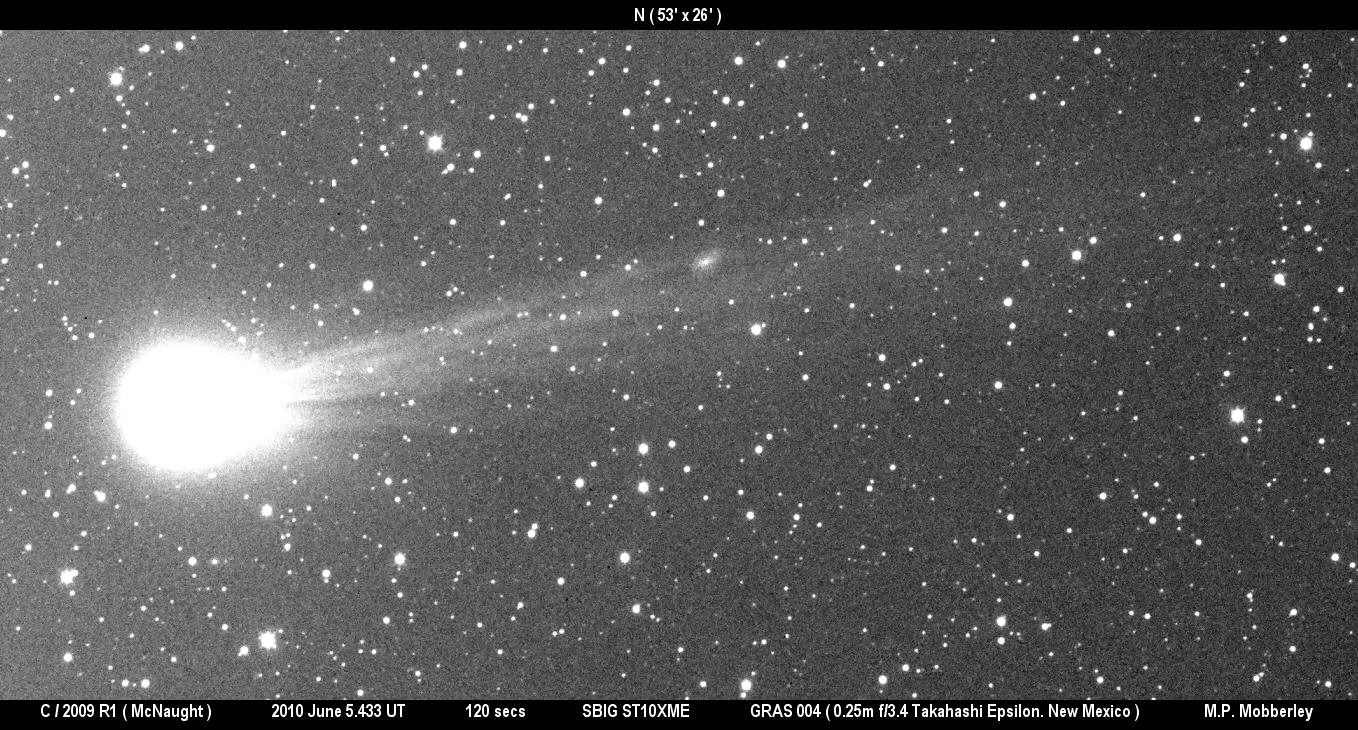
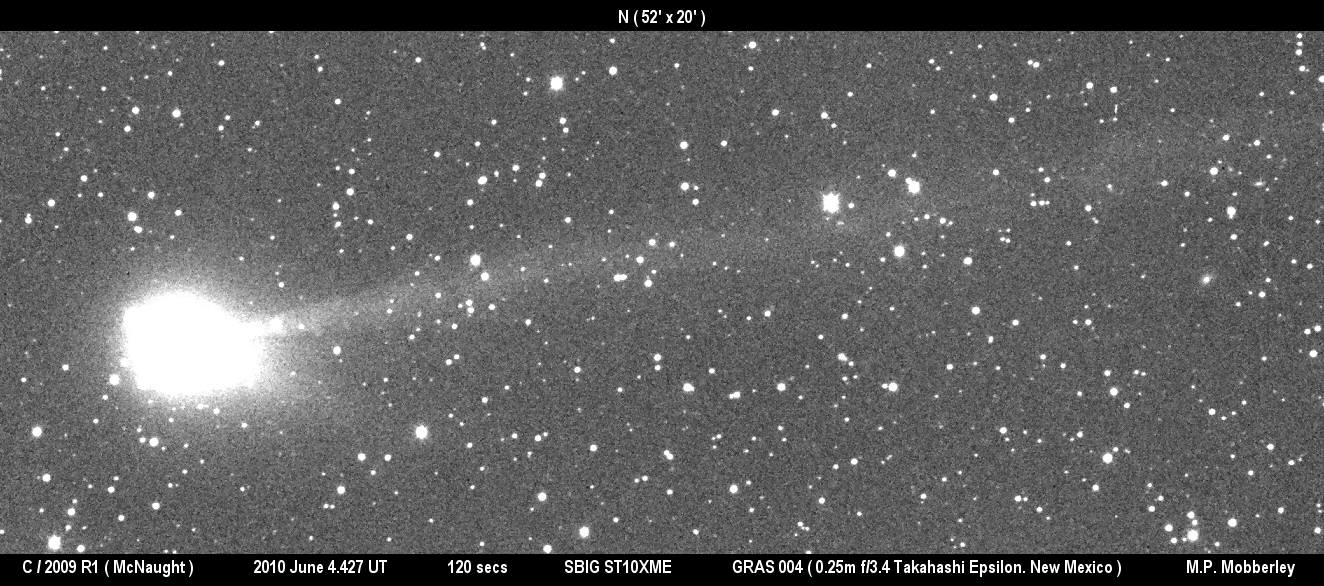

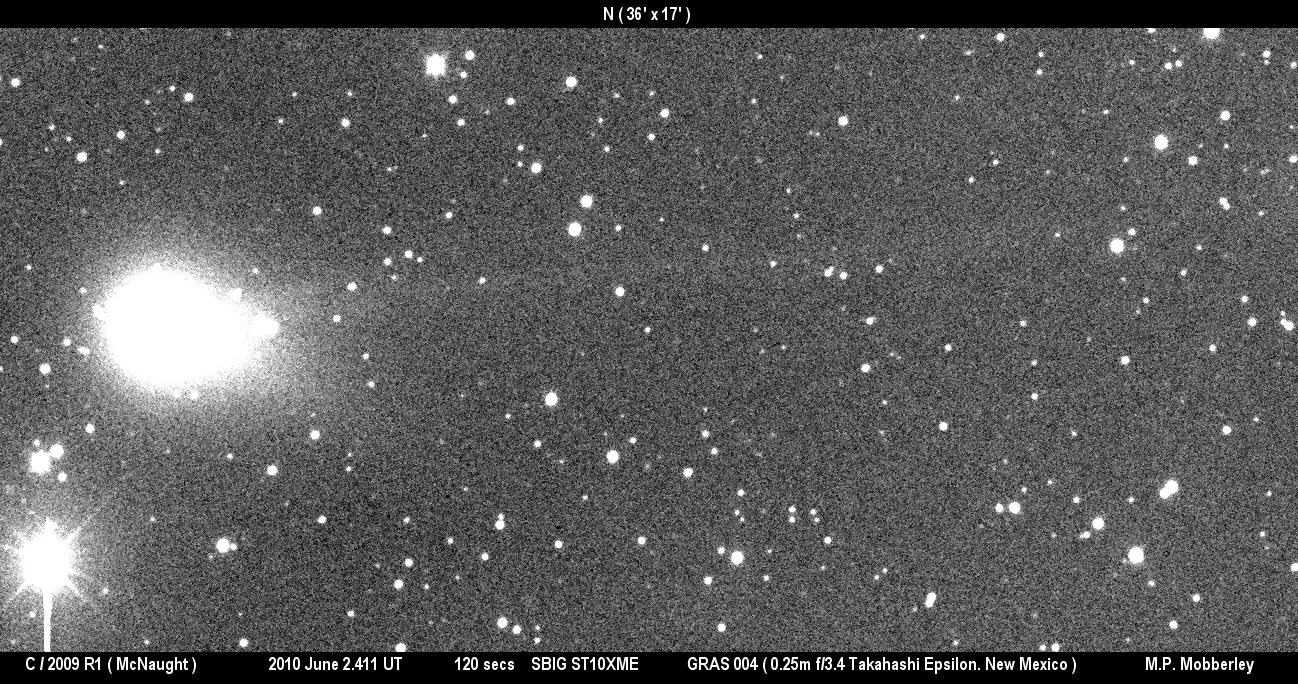


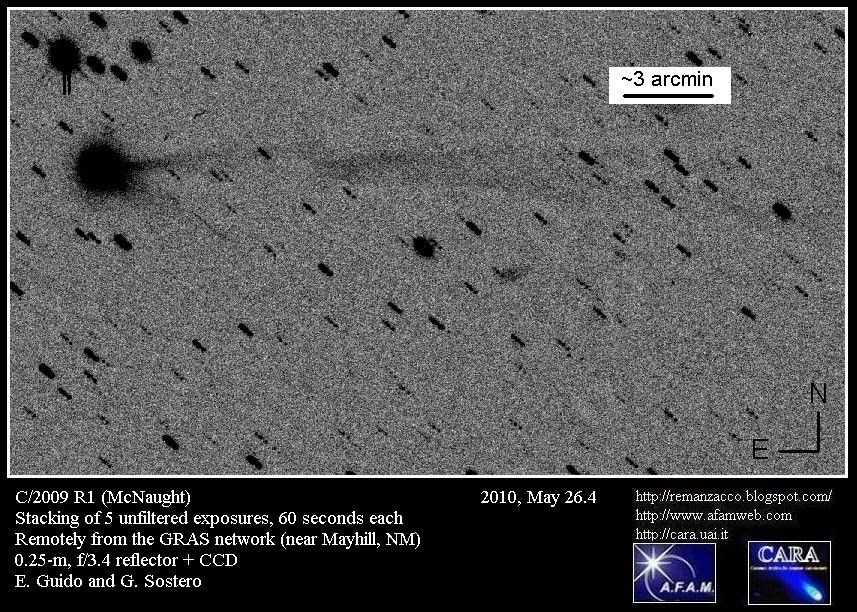
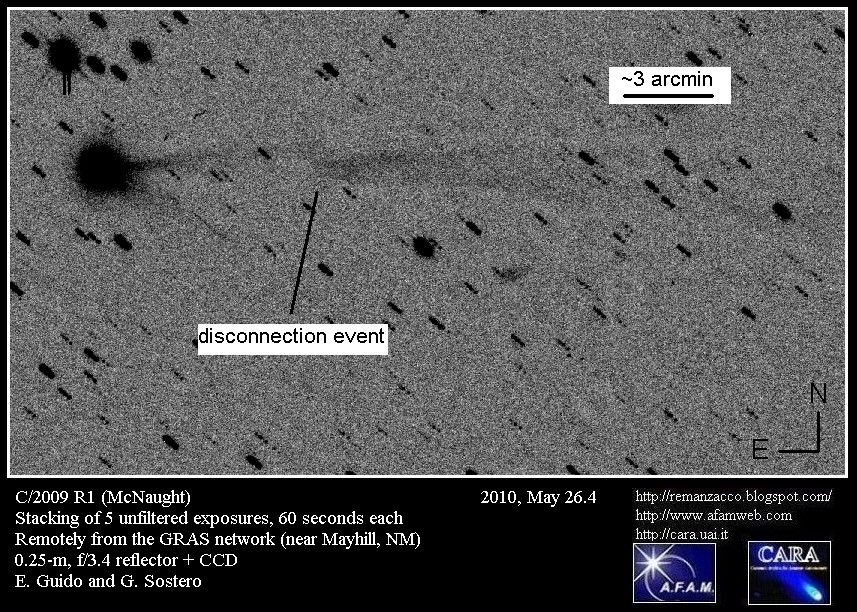
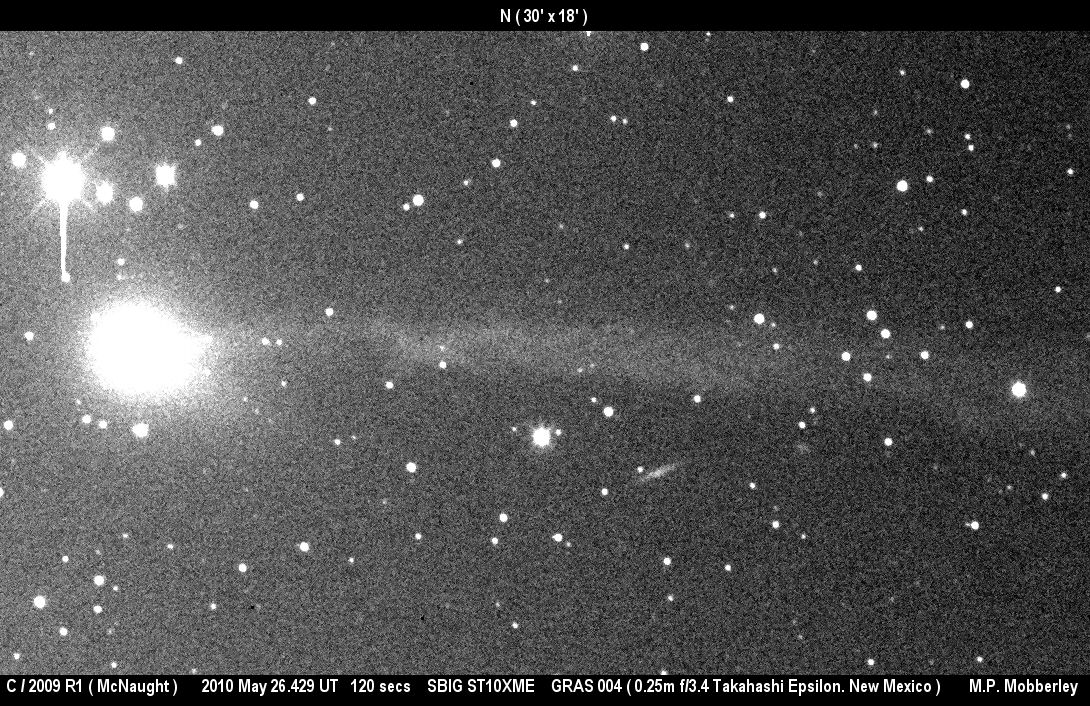
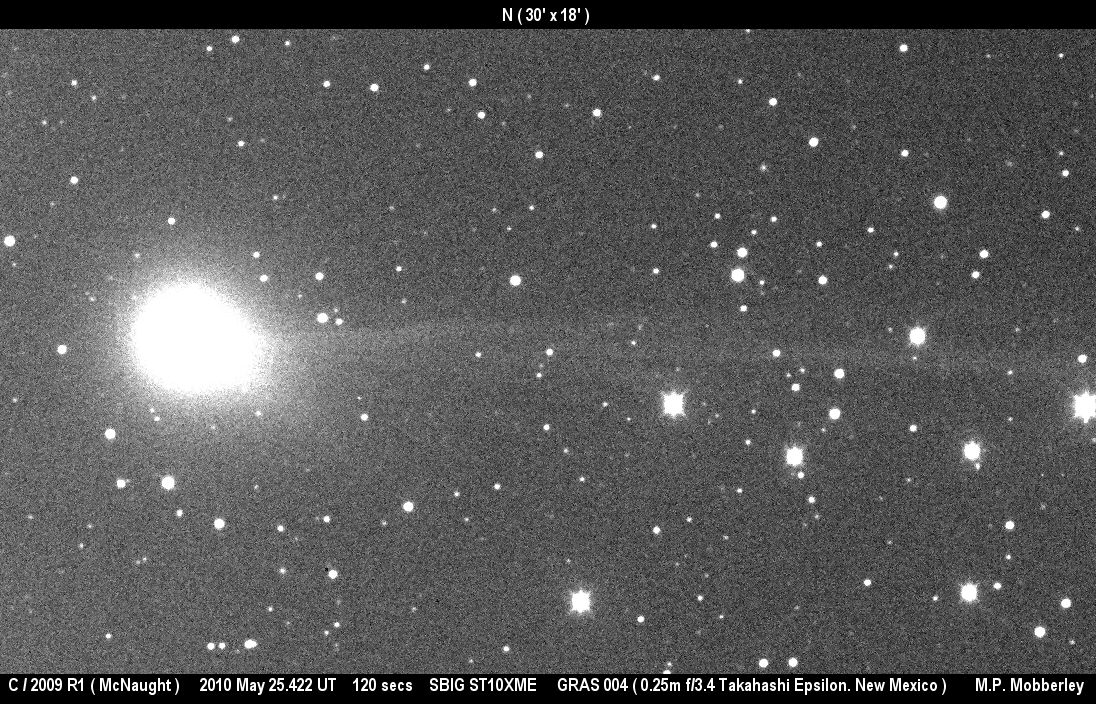
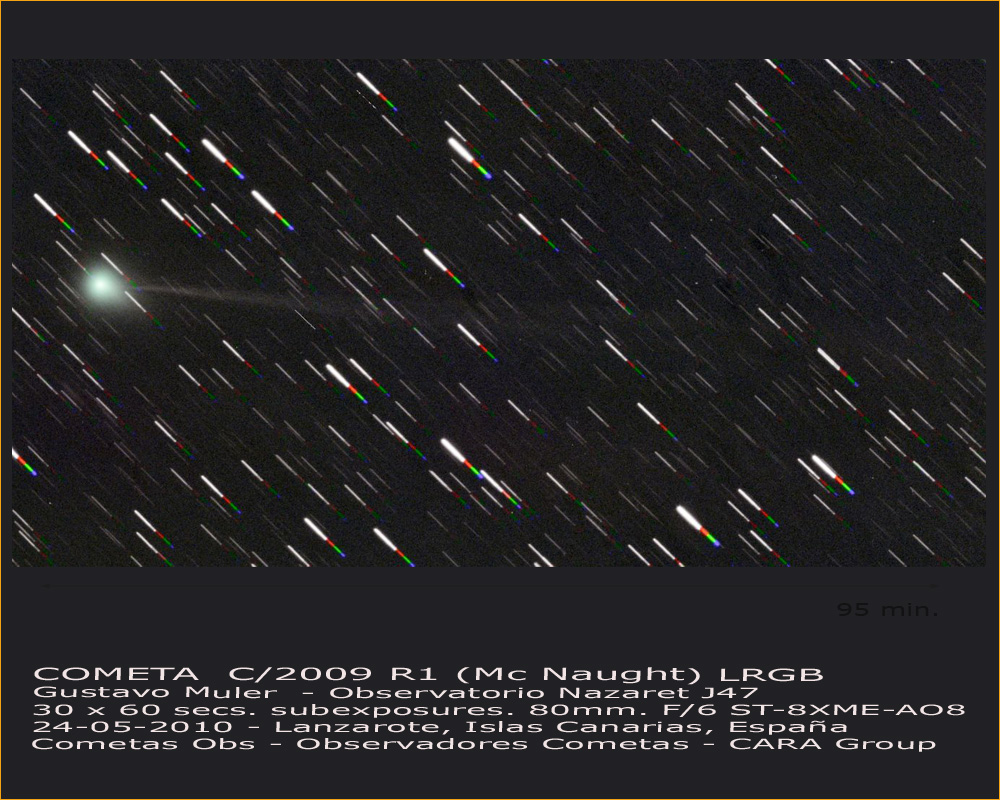





In other news There seems to be the - predicted - mid-eclipse brightening of Epsilon Aurigae, we have a supernova impostor and the real SN 2010dn in NGC 3184 (the discovery photo by Koichi Itagaki w/60 cm) as well as a transit of TrES-3b. • "Asteroid" 2010 KQ is probably man-made (more, earlier, more, earlier, more, mas and more). • A report on the fast fly-by of 2010 KO10, a possible impact-role in Antarctica, a meteorite recovery in Oregon, a twisted meteor (probably only the camera was shaking) and a meteor story in an old poem (more, more and more) • Plus a visit to Arecibo - and astrophotography from Puerto Rico.

• The first NLCs (a preview), subtle volcanic dust effects on the Sun (also nighttime tracking w/Calypso, the need for a space-based laser, volcano science, measuring flights and the need for limits). • A veeery old newsreel on amateur astronomer Percy Wilkins. • How to build your own planetarium. • A sky show over Australia - great video! - after the Falcon 9 launch. • Amateur imaging of KH 11 satellites (with some doubts re. image processing), the X-37B (see also here ["Amateurastronomen ..."] y aqui) and the ISS on May 16 and May 22 (more) by T. Legault and May 23 (hi-res) as well as in daytime.
• Finally some highlights of this month (see also here, here, here, hier und hier):
- June 6: Mars close to Regulus, should feel equally bright although Regulus is 3x10^6 times farther away.
- June 8: Uranus only 28' from Jupiter, first of 3 conjunctions 2010/11
- June 11: Venus in one line with Castor and Pollux
- June 19: Dwarf planet (1) Ceres in opposition, reaching 7.1 mag.
- June 20: Comet McNaught - see above - close to Capella (and possible some NLCs as well). Also Venus in/near the Beehive cluster
- June 26: Partial lunar eclipse in the Pacific area, max. magnitude 0.53
Friday, May 14, 2010
Lost belt of Jupiter, storm on Saturn - and the Moon occults Venus (for some)
When the planet Jupiter had re-emerged from the Sun's glare in late March it was already obvious that something was amiss: The South Equatorial Belt had nearly disappeared. Within weeks the view of the planet got much clearer, and the SEB's loss was widely known in the amateur community - yet only after one blog and then other showed hi-res views by A. Wesley and C. Go did the news spread beyond, e.g. here, here and hier. • Also a detailled paper on the July 2009 impact on Jupiter. • Another storm on Saturn - pics on Apr. 28; more and many more - is again uniting amateurs & Cassini, also reported here and here. • The only significant predictable sky event this month - see here, here, hier, hier and hier - is an occultation of Venus by the Moon in Africa and Asia on April 16, mostly in the daytime: predictions for India and the Philippines.
In other news a Near Earth Asteroid, 2005 YU55, was imaged by radar (more, more, more, mehr). • More meteorites have been found in Wisconsin, plus the story of Almahata Sitta. • Lots of coverage around an alleged destructive meteorite - no cosmic matter recovered so far! - in Indonesia here (video clips), here (earlier), here, here (earlier), here, here, here (earlier), here, here and hier. • The 'meteorite' in Israel definitely was none. • And I have no clue whether the 'ice from the sky' in Bavaria - reported hier, hier, hier und hier - was a 'megacryometeorite' or something else.
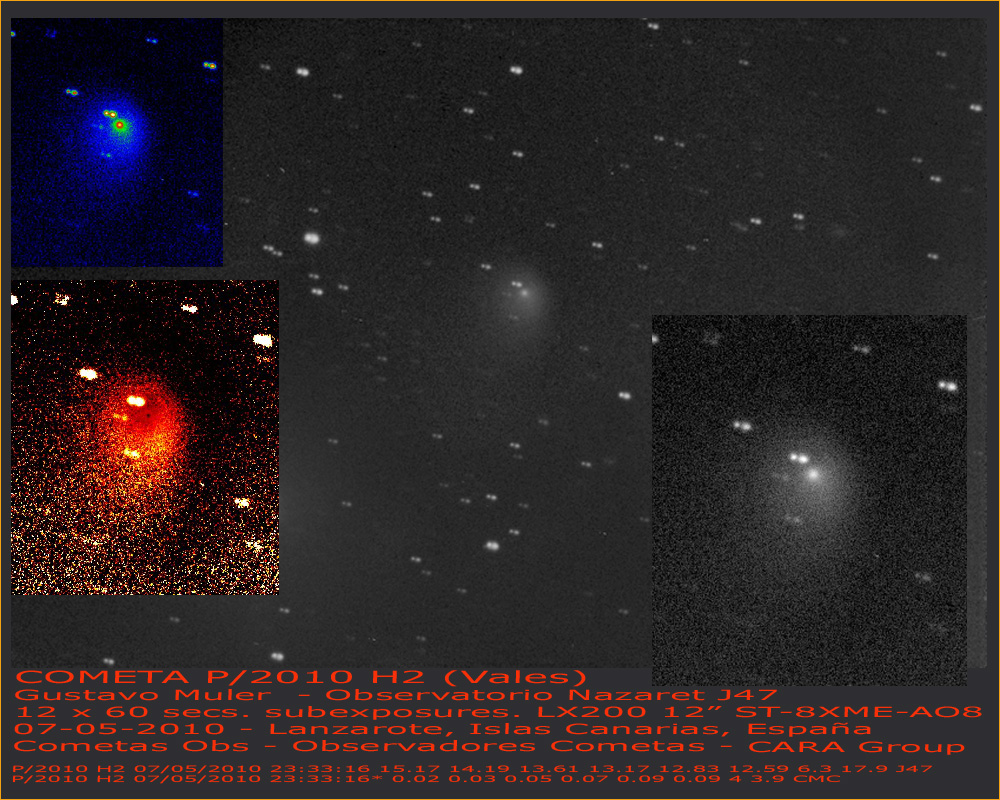
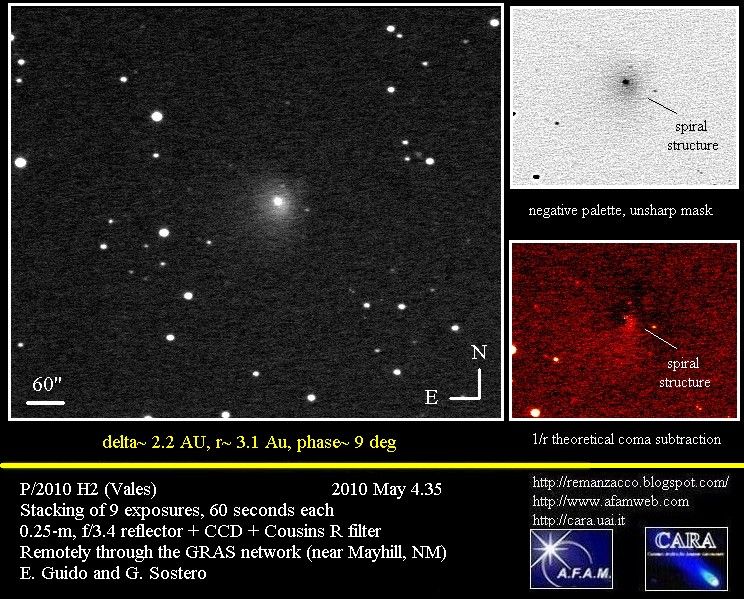
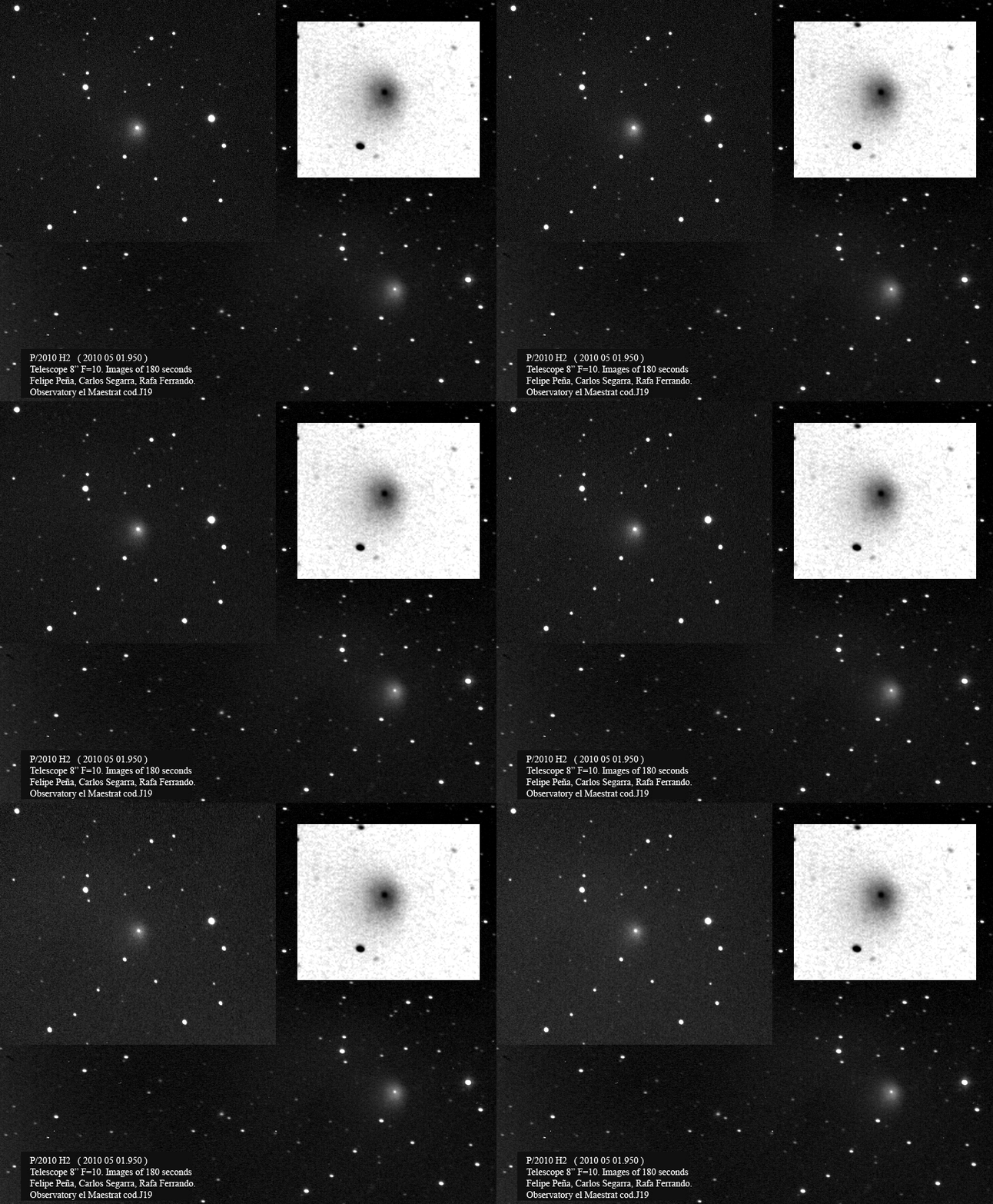
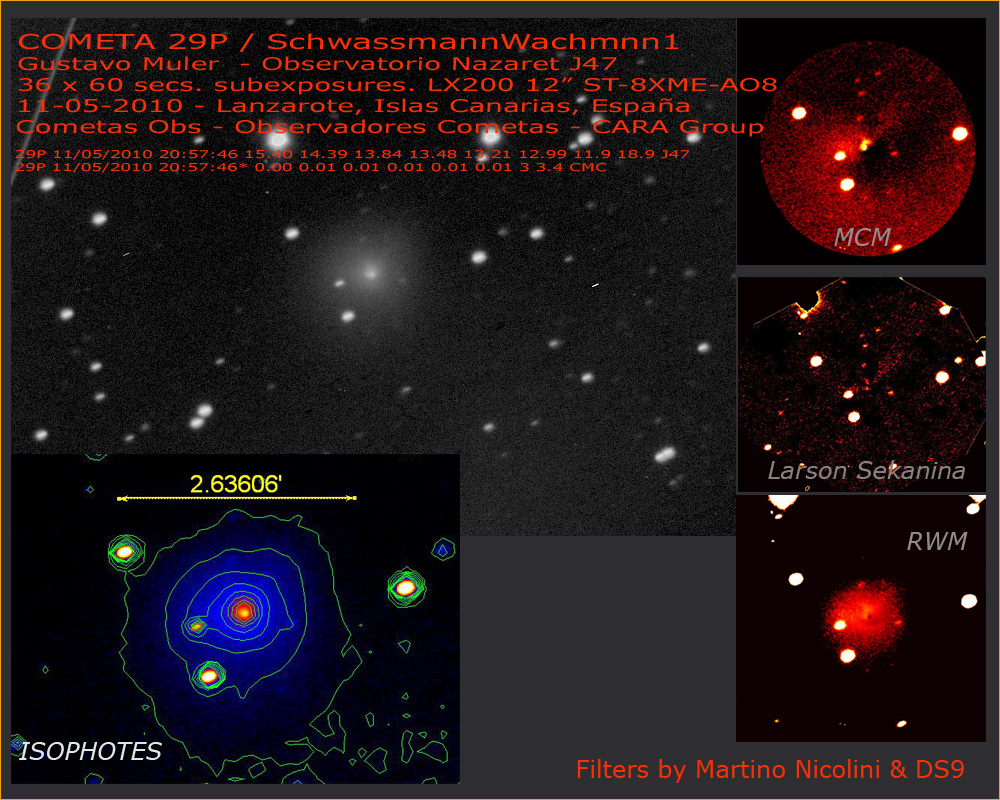
• After the outburst of comet Vales interesting coma structure is being observed with large telescopes as reported here (earlier) and here (pics) - new images with smaller scopes also of May 8, May 7, May 6, May 4 (more), May 1 and April 30. • A mid-April animation and May 11 and May 7 pics of 29P in outburst. • Siding Spring on May 9 and April 22. • McNaught on May 9 and May 8 (more). • Wild on May 8. • New comets C/2010 J1 (Boattini) (on May 12, May 9 and May 7) and C/2010 J3 (McMillan). • Another McNaught (C/2009 R1) (mehr, mehr, mehr and a May 10 pic) is now visible - and could be so during the July eclipse. • The nucleus of Hartley 2 - EPOXI's target - at aphelion. • And a prediction of big thing in the Oort cloud.
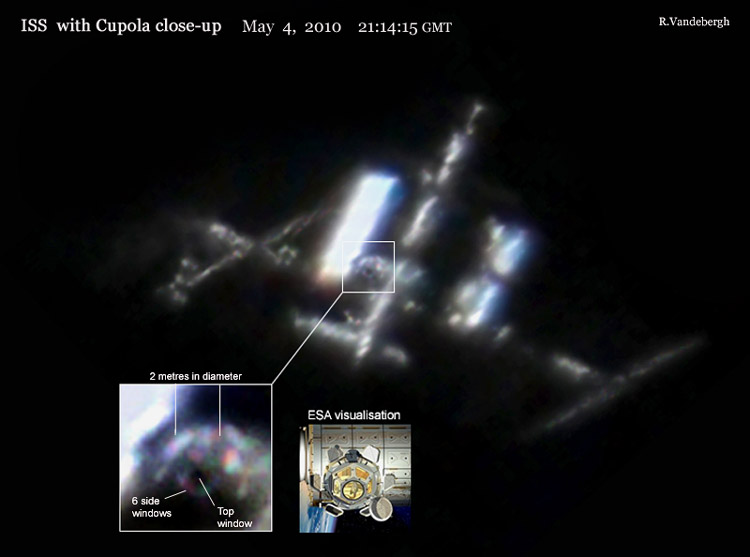
• Observations by SOHO's MDI over one solar cycle strongly suggest that the solar diameter is very constant, also reported here and here. • A big archive of solar eclipse images and a 66-page report about a TSE 100 years ago in Tasmania. • There is a moderately bright transient in Pegasus. • A science fiction website explains sun dogs - and Wired has a remarkable gallery of terrestrial clouds imaged from orbit. • A detailled ISS picture resolves the cupola - and others show the ISS in 3D in motion (more).
In other news a Near Earth Asteroid, 2005 YU55, was imaged by radar (more, more, more, mehr). • More meteorites have been found in Wisconsin, plus the story of Almahata Sitta. • Lots of coverage around an alleged destructive meteorite - no cosmic matter recovered so far! - in Indonesia here (video clips), here (earlier), here, here (earlier), here, here, here (earlier), here, here and hier. • The 'meteorite' in Israel definitely was none. • And I have no clue whether the 'ice from the sky' in Bavaria - reported hier, hier, hier und hier - was a 'megacryometeorite' or something else.
• After the outburst of comet Vales interesting coma structure is being observed with large telescopes as reported here (earlier) and here (pics) - new images with smaller scopes also of May 8, May 7, May 6, May 4 (more), May 1 and April 30. • A mid-April animation and May 11 and May 7 pics of 29P in outburst. • Siding Spring on May 9 and April 22. • McNaught on May 9 and May 8 (more). • Wild on May 8. • New comets C/2010 J1 (Boattini) (on May 12, May 9 and May 7) and C/2010 J3 (McMillan). • Another McNaught (C/2009 R1) (mehr, mehr, mehr and a May 10 pic) is now visible - and could be so during the July eclipse. • The nucleus of Hartley 2 - EPOXI's target - at aphelion. • And a prediction of big thing in the Oort cloud.


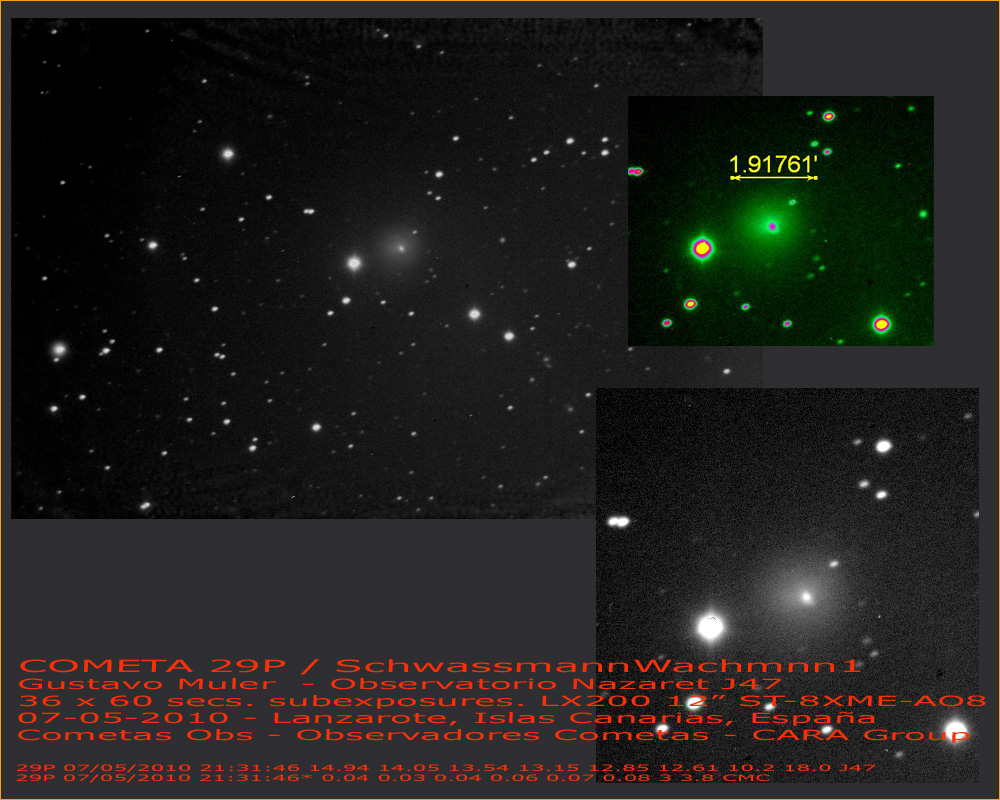

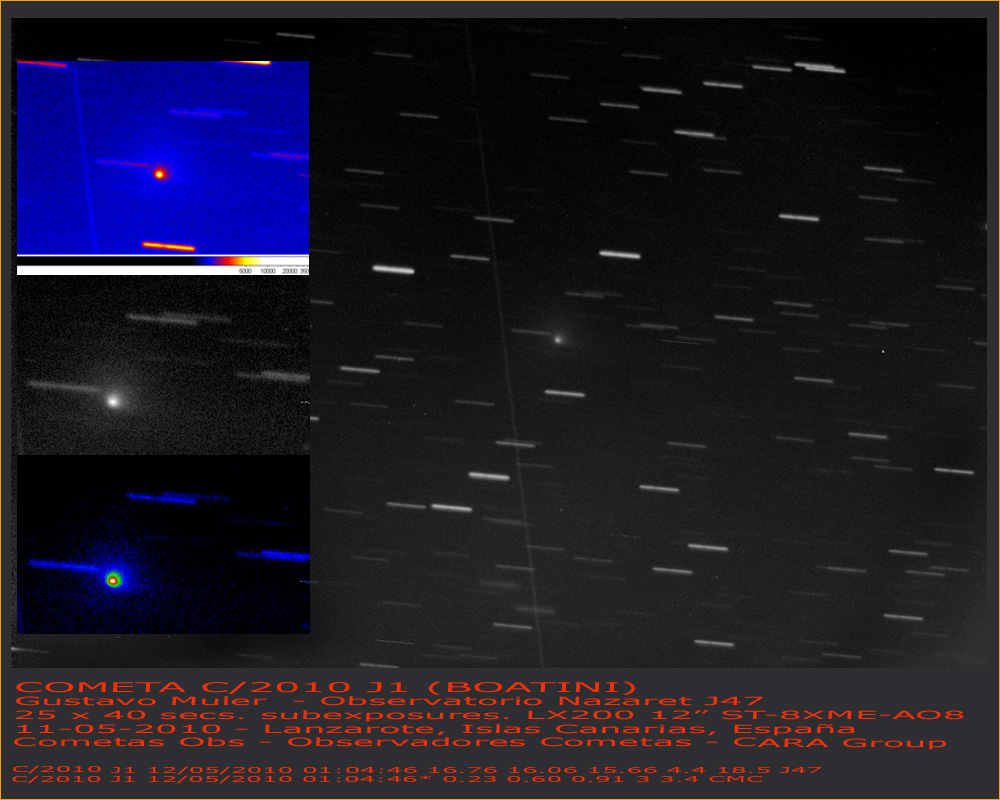
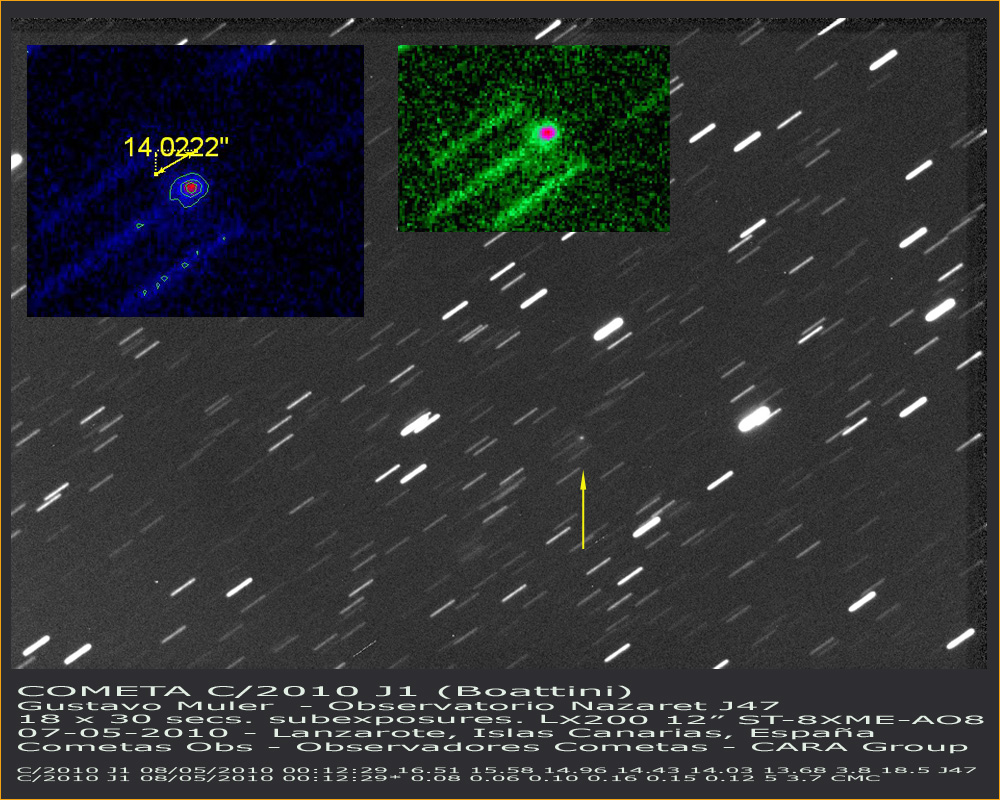
• Observations by SOHO's MDI over one solar cycle strongly suggest that the solar diameter is very constant, also reported here and here. • A big archive of solar eclipse images and a 66-page report about a TSE 100 years ago in Tasmania. • There is a moderately bright transient in Pegasus. • A science fiction website explains sun dogs - and Wired has a remarkable gallery of terrestrial clouds imaged from orbit. • A detailled ISS picture resolves the cupola - and others show the ISS in 3D in motion (more).
Monday, April 26, 2010
Quite a meteorite shower after a fireball over Wisconsin - and much more
Quite a collection of meteorites (alt.) has come together already in the days after a bright fireball streaked over Wisconsin and several other U.S. states late on April 14! A lot more reports - in no particular order - about the bolide and the string of meteorite recoveries can be found here, here, here, here, here, here, here, here, here, here, here, here, here, here, here, here, here, here, here, here, here, here and here. • Meanwhile a "meteorite" fall in Israel quickly turned out to be nothing of the sort; the hot temperature had shown that early on. • And the Lyrids of 2010 delivered an average ZHR of ~15.
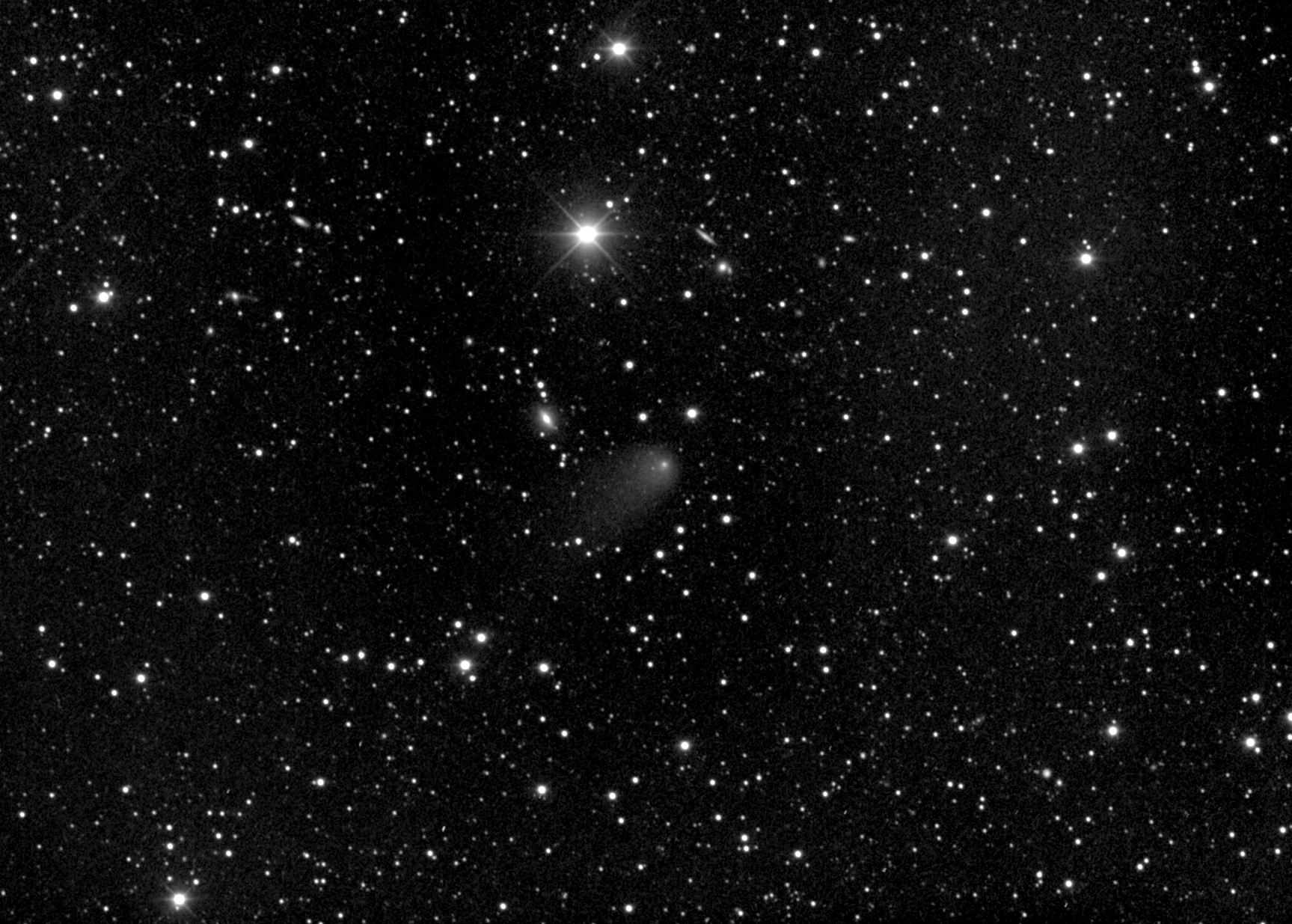
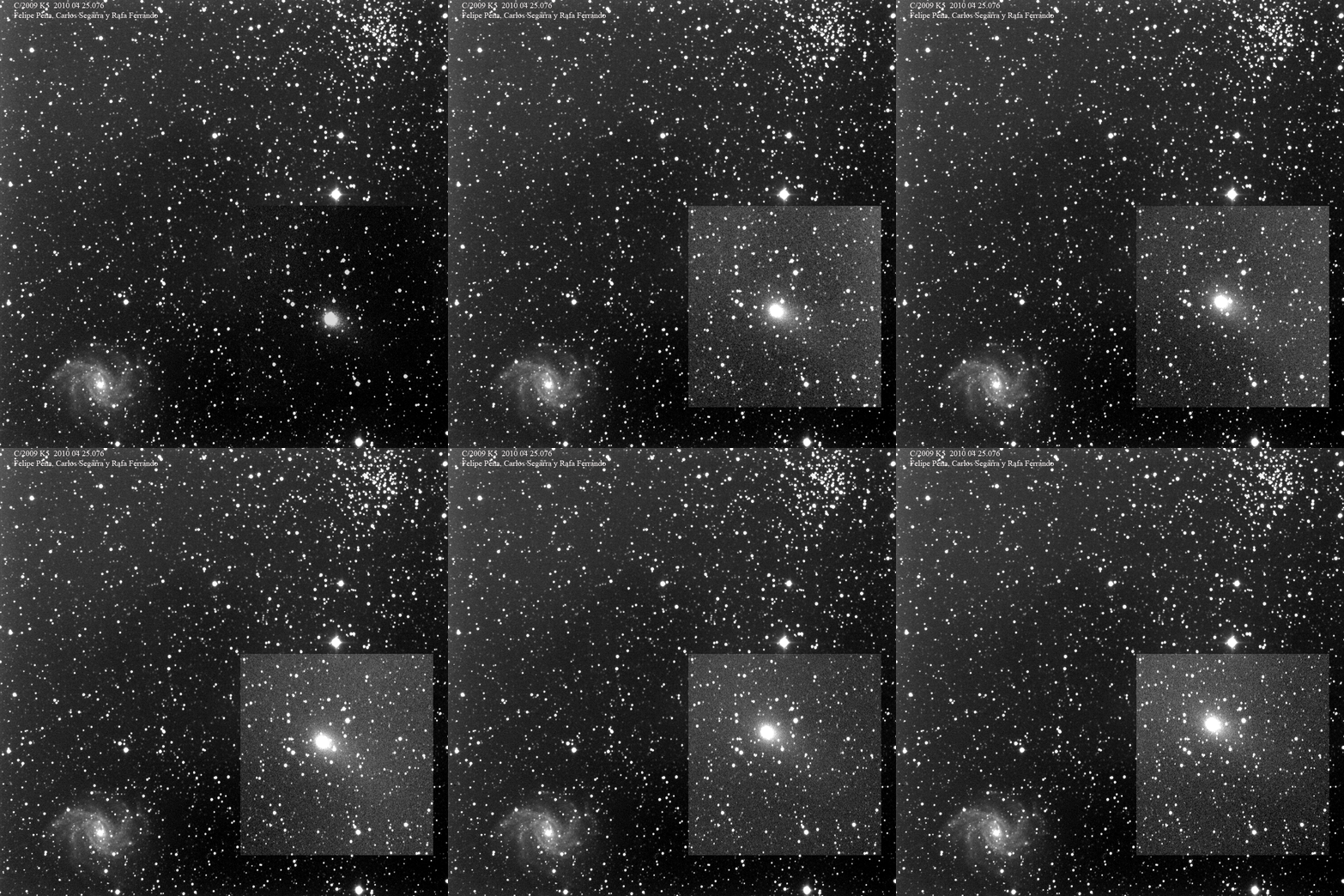
and is now P/2010 H2 (Vales): prediscovery observations, the actual discovery, also reported here and here as well as by the discoverer and images and reports of April 21, April 20, April 19, April 18 (more, more) and April 17 (more, mehr). • A fragment has apparently broken off comet C/2009 K5 as images from April 24 show; on April 25 the comet was inbetween a galaxy and a star cluster (description, b/w version; animation by different observers).
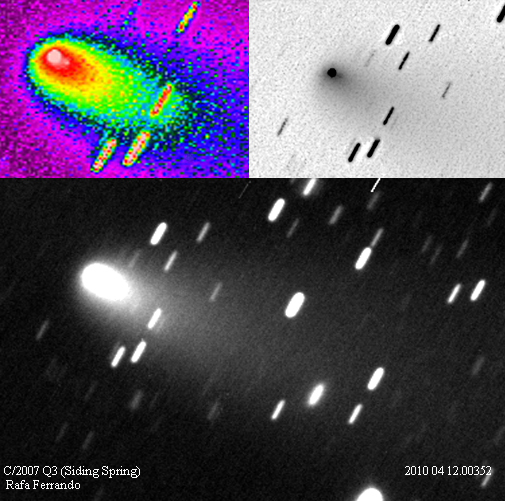
• Details about the current outburst of comet SW1, also an April 5 picture. • P/2010 A2 on April 17 with a star cluster and April 7. • Siding Spring on April 22, April 17 and April 12. • Comet Wild on April 16 and April 10 (from this observatory in Namibia). • A new Comet C/2010 G2 (Hill). • Studies of Churyumov-Gerasimenko's coma (also the German original). • And Ulysses data show that McNaught had the longest tail ever, plasma-wise (another and another press release and a story).
Neptune is currently close to where it was discovered; next year it will have completed one orbit. • Saturn on April 24 (more, more) and April 23 (more, more), with various moon shadows in transit (compare that to these and these 2009 reports), and April 12. • Mars on April 20. • The Moon/Venus/Mercury evening show in a composite and invidually on April 17 from Germany (more, more), April 16 from the U.S. (more), Italy (more, more), the U.K. (more, with Venus close-up, more), the Isle of Wight, Germany (more) and India (more in the stream) and April 15 from the U.S., from the U.K. and Germany (more).
was successful on April 14 - but an elongation record as claimed it was not: Already in in 2008 the Moon was imaged at the same distance from the Sun! • Two solar prominences on April 25, a CME movie of April 13 (stills, a still), sunspots on April 6 and Proba 2 observations of April 3. Plus science news on a CME tracked from Sun to Earth all the way, ACE & STEREO in space weather forecasts and yet another Sun/Earth climate claim, also reported here, here, here and hier. And how the Earth's orbital changes affect its climate.
• A possible nova in Sco (pics), a nova in Sgr, more analysis (ctd.) of the Eps Aur pics and the Nature paper as a preprint, plus a cataclysmic variable in the Kepler field. • The ISS in transit over the H-Alpha Sun, a lot of hi-res ISS and Discovery images here (also a Discovery flare), here (explained here), here (analysis), here and here - plus the view down at night!
The eruption of Eyjafjallajökull (the pronounciation is given here at the end!) had mostly subtle effects on sky colors and visibility as already outlined here a week ago as well as by seasoned sky observers here and here. Sometimes observations were attributed without evidence to the volcano's ash, and it remains to be seen whether the sky near the Moon has something to tell. Hard data on the state of the atmosphere over Europe have been collected a lot with more sophisticated means and are summarized e.g. hier, here, here or here.
There is a detailled report (earlier English version) about the 1st DLR research flight of April 19 (mehr, mehr, mehr, mehr, früher, mehr), and there was a 2nd flight (outcome and conclusions). Also reports about another, another and yet another research flight and groundbased work in Stuttgart, Hamburg and Hohenheim plus from the Helmholtz Soc. (more).
Some thoughts on the real danger (more), a lot of satellite pics (also from Radarsat 2, Proba 1, ALOS, EO-1 [also from yesterday] and Terra), a dramatic video with shock waves in the plume and another one, pictures of flashes in the plume, general thoughts about volcanism in the solar system, what Earth has in store and what the plane-free skies meant, some pseudoscience and also some humor (more, more). • The variation of NLCs has been modelled. • And particle acceleration over thunder clouds.
A comet suddenly appeared out of nowhere
and is now P/2010 H2 (Vales): prediscovery observations, the actual discovery, also reported here and here as well as by the discoverer and images and reports of April 21, April 20, April 19, April 18 (more, more) and April 17 (more, mehr). • A fragment has apparently broken off comet C/2009 K5 as images from April 24 show; on April 25 the comet was inbetween a galaxy and a star cluster (description, b/w version; animation by different observers).


• Details about the current outburst of comet SW1, also an April 5 picture. • P/2010 A2 on April 17 with a star cluster and April 7. • Siding Spring on April 22, April 17 and April 12. • Comet Wild on April 16 and April 10 (from this observatory in Namibia). • A new Comet C/2010 G2 (Hill). • Studies of Churyumov-Gerasimenko's coma (also the German original). • And Ulysses data show that McNaught had the longest tail ever, plasma-wise (another and another press release and a story).

Planetary action, continued - with many Saturn moon shadow transits
Neptune is currently close to where it was discovered; next year it will have completed one orbit. • Saturn on April 24 (more, more) and April 23 (more, more), with various moon shadows in transit (compare that to these and these 2009 reports), and April 12. • Mars on April 20. • The Moon/Venus/Mercury evening show in a composite and invidually on April 17 from Germany (more, more), April 16 from the U.S. (more), Italy (more, more), the U.K. (more, with Venus close-up, more), the Isle of Wight, Germany (more) and India (more in the stream) and April 15 from the U.S., from the U.K. and Germany (more).


An observation of the Moon exactly at new
was successful on April 14 - but an elongation record as claimed it was not: Already in in 2008 the Moon was imaged at the same distance from the Sun! • Two solar prominences on April 25, a CME movie of April 13 (stills, a still), sunspots on April 6 and Proba 2 observations of April 3. Plus science news on a CME tracked from Sun to Earth all the way, ACE & STEREO in space weather forecasts and yet another Sun/Earth climate claim, also reported here, here, here and hier. And how the Earth's orbital changes affect its climate.
• A possible nova in Sco (pics), a nova in Sgr, more analysis (ctd.) of the Eps Aur pics and the Nature paper as a preprint, plus a cataclysmic variable in the Kepler field. • The ISS in transit over the H-Alpha Sun, a lot of hi-res ISS and Discovery images here (also a Discovery flare), here (explained here), here (analysis), here and here - plus the view down at night!


No significant atmospheric optical effects due to the Iceland volcano
The eruption of Eyjafjallajökull (the pronounciation is given here at the end!) had mostly subtle effects on sky colors and visibility as already outlined here a week ago as well as by seasoned sky observers here and here. Sometimes observations were attributed without evidence to the volcano's ash, and it remains to be seen whether the sky near the Moon has something to tell. Hard data on the state of the atmosphere over Europe have been collected a lot with more sophisticated means and are summarized e.g. hier, here, here or here.
There is a detailled report (earlier English version) about the 1st DLR research flight of April 19 (mehr, mehr, mehr, mehr, früher, mehr), and there was a 2nd flight (outcome and conclusions). Also reports about another, another and yet another research flight and groundbased work in Stuttgart, Hamburg and Hohenheim plus from the Helmholtz Soc. (more).
Some thoughts on the real danger (more), a lot of satellite pics (also from Radarsat 2, Proba 1, ALOS, EO-1 [also from yesterday] and Terra), a dramatic video with shock waves in the plume and another one, pictures of flashes in the plume, general thoughts about volcanism in the solar system, what Earth has in store and what the plane-free skies meant, some pseudoscience and also some humor (more, more). • The variation of NLCs has been modelled. • And particle acceleration over thunder clouds.
Sunday, April 11, 2010
Disk occulting Epsilon Aurigae resolved with optical interferometry
When the approaching rare eclipse of Eps Aur was advertised in earnest in 2008 it was mentioned (3rd graf) that optical interferometers would try to watch 'close-up' what was happening in that mysterious system. This week we learned that the technique has succeeded! A sequence of interferometric images with the Michigan Infra-Red Combiner (MIRC) instrument at the CHARA array on Mt. Wilson near LA in CA is good enough to show a dark disk move over the bright star: The images zoom in enough to reveal the shape of the dark object's shadow. A geometrically thin, dark, dense, but partially translucent cloud can be seen passing in front of Epsilon Aurigae, demonstrating that the basic paradigm for the eclipses was right, although the disk appears much flatter than recent modeling from the Spitzer Space Telescope suggests. A lot of coverage here, here, here, here, here, here, here, here, here, hier und hier, further discussion here, here and here and the light curve.
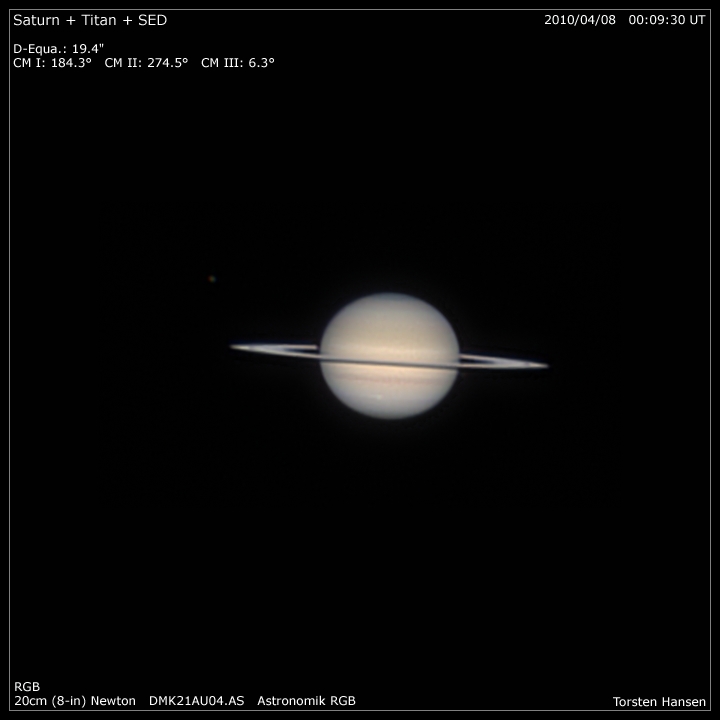
The Venus/Mercury pair "dominated" the other news in the past week, with the latter fading rapidly in the last few days: selected images of today from Germany, yesterday from Canada and Germany (more), April 9 from the U.S. (more) and Germany, April 8 from Austria and Germany (wide view with Mars included!), April 7 from the U.K. (more, more) and Germany, April 6 from Austria and Germany (with the Pleiades and some effects; more, more, more, more and more, also the 2 preceding ones), April 5 from the U.S., U.K., Spain and Germany (more, more and more, also the 4 preceding ones), April 4 from the U.S. (more) and the U.K., April 3 from the U.S. and U.K., April 2 from Austria and Germany (more and more) and April 1 from Germany (timelapse video). One of mine also made it into this collection and Venus and Mercury were resolved in daytime observations - plus the future of Venus this year. • Mars is now in the Beehive; images of April 10 (also a drawing), April 6 and April 2 and Saturn on April 8 (more and more, incl. an animation).
In yet other news another sungrazing comet came and vanished (animation, story, still), images of 81P/Wild of April 10, April 9, April 8 (more), April 5 and April 4, with a substantial dust tail, split C/2007 Q3 (Siding Spring) today (processed), on April 9 (more, processed), April 5 and April 2, also Machholz and a new Boattini. • A proposal regarding a lower size limit for dwarf planets made headlines here and here, Quaoar is very dense, a minor planet came close, a meteorite hit a car in Canada, others were found after the Feb. 28 bolide, a visit to the Hoba meteorite and a JPL Release advertising meteor showers.
• From the Jan. 15 annular eclipse in India a new Baily's Beads movie from the edge and a slide show from Kanyakumari. • The profile of asteroid Anastasia from an occultation of a bright star (most missed it), and a video of a short grazing occultation by the Moon. • A faint aurora was seen over N. Germany (more; story), plus spot 1057. • A video and a picture (report) of the ISS crossing the Sun and a picture of the ISS over the Moon (more). • The aurora from the ISS (later). • And phenomenal cloud FX after the last STS launch, discussed hier, here, here, here, here, here, here and here.
The Venus/Mercury pair "dominated" the other news in the past week, with the latter fading rapidly in the last few days: selected images of today from Germany, yesterday from Canada and Germany (more), April 9 from the U.S. (more) and Germany, April 8 from Austria and Germany (wide view with Mars included!), April 7 from the U.K. (more, more) and Germany, April 6 from Austria and Germany (with the Pleiades and some effects; more, more, more, more and more, also the 2 preceding ones), April 5 from the U.S., U.K., Spain and Germany (more, more and more, also the 4 preceding ones), April 4 from the U.S. (more) and the U.K., April 3 from the U.S. and U.K., April 2 from Austria and Germany (more and more) and April 1 from Germany (timelapse video). One of mine also made it into this collection and Venus and Mercury were resolved in daytime observations - plus the future of Venus this year. • Mars is now in the Beehive; images of April 10 (also a drawing), April 6 and April 2 and Saturn on April 8 (more and more, incl. an animation).


In yet other news another sungrazing comet came and vanished (animation, story, still), images of 81P/Wild of April 10, April 9, April 8 (more), April 5 and April 4, with a substantial dust tail, split C/2007 Q3 (Siding Spring) today (processed), on April 9 (more, processed), April 5 and April 2, also Machholz and a new Boattini. • A proposal regarding a lower size limit for dwarf planets made headlines here and here, Quaoar is very dense, a minor planet came close, a meteorite hit a car in Canada, others were found after the Feb. 28 bolide, a visit to the Hoba meteorite and a JPL Release advertising meteor showers.
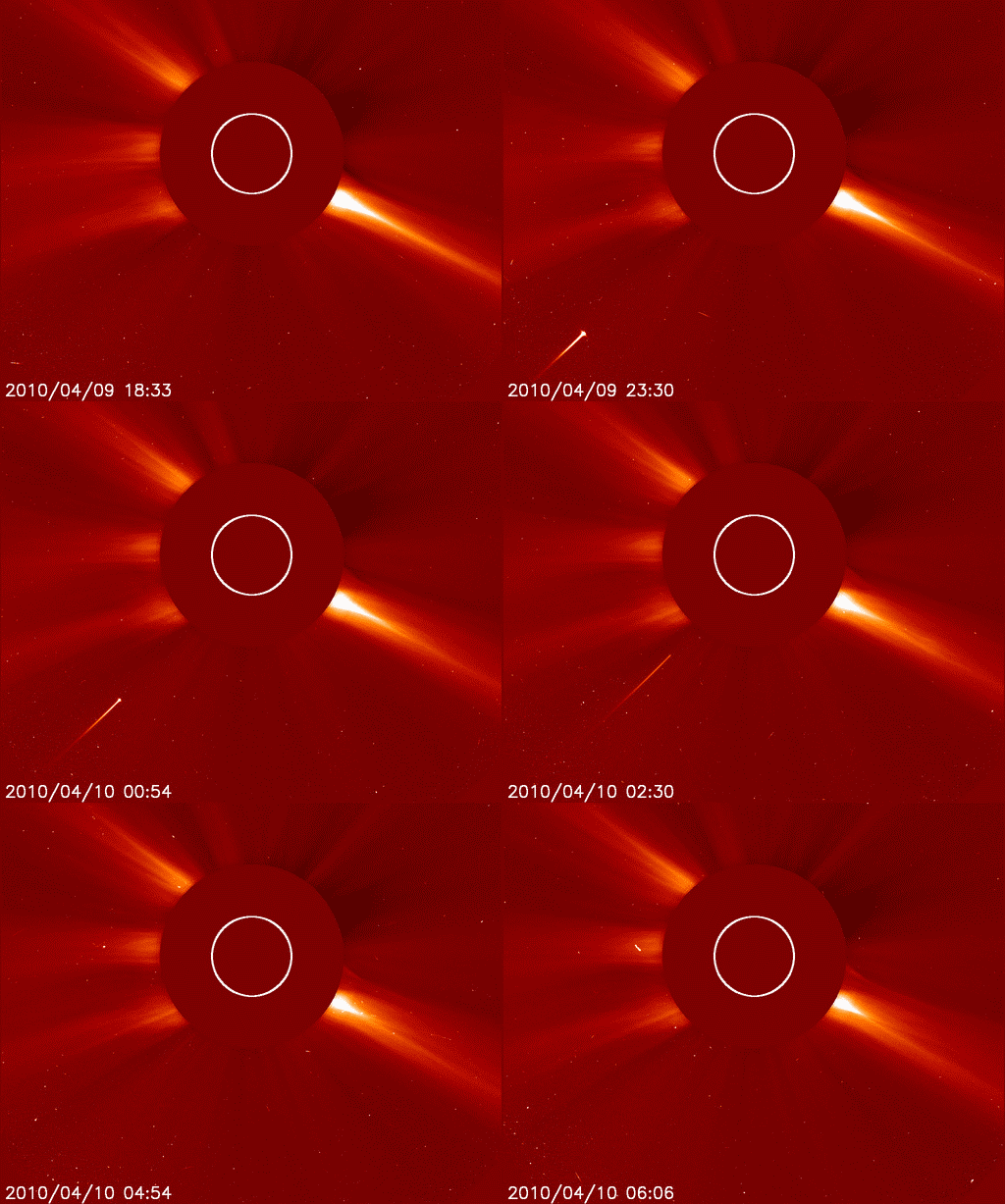


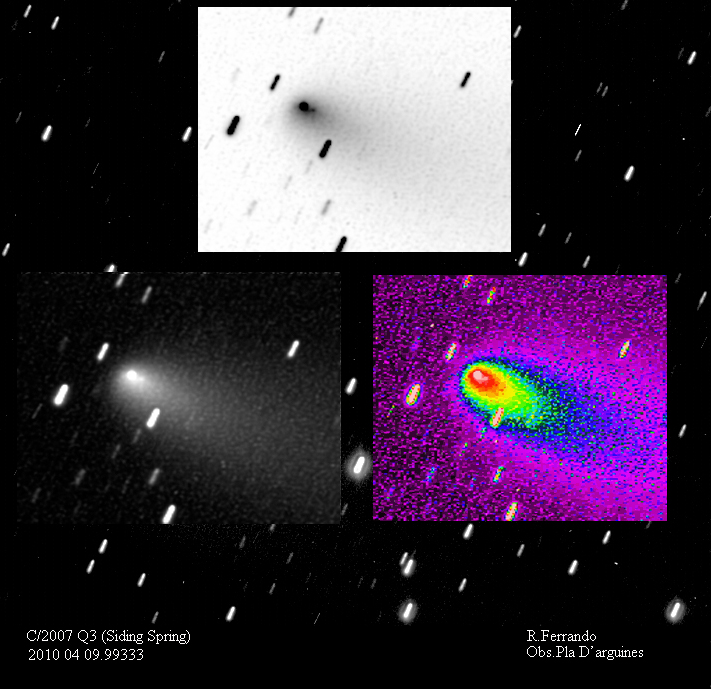


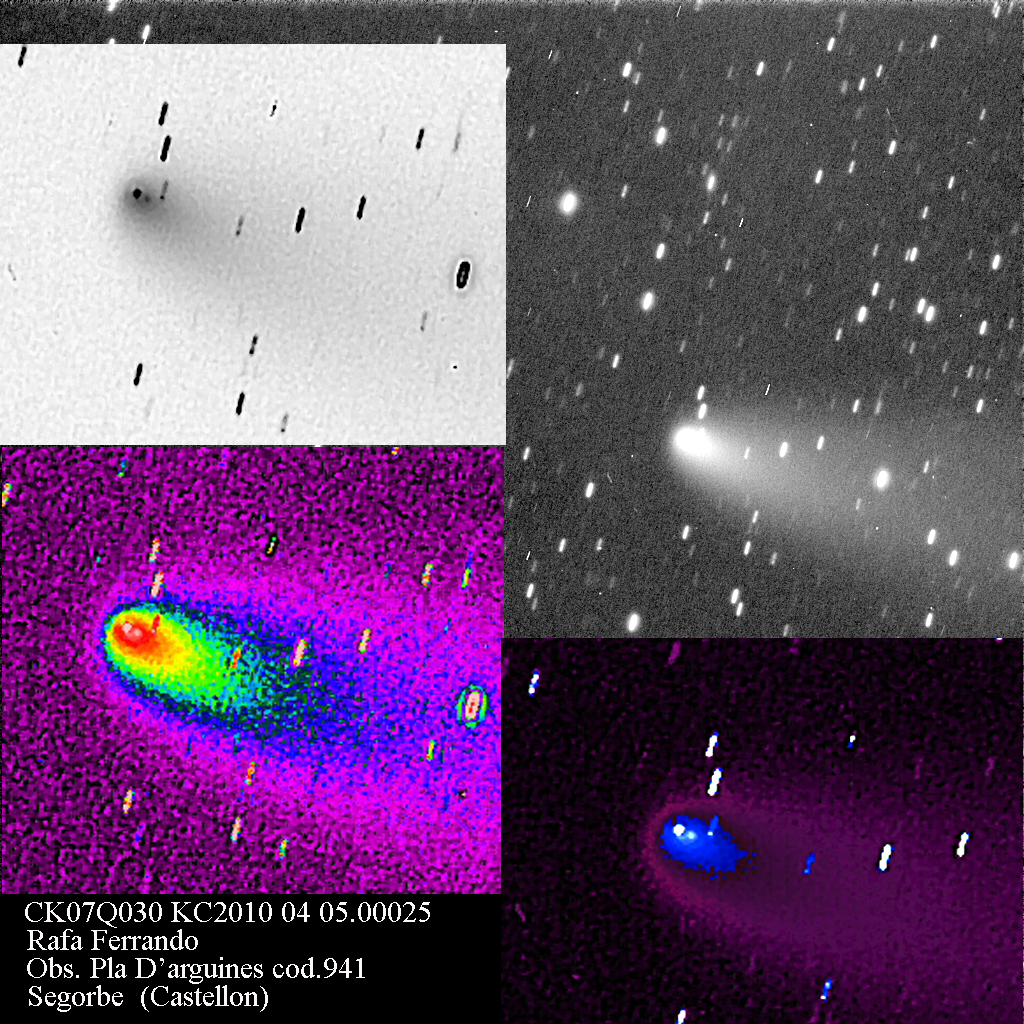

• From the Jan. 15 annular eclipse in India a new Baily's Beads movie from the edge and a slide show from Kanyakumari. • The profile of asteroid Anastasia from an occultation of a bright star (most missed it), and a video of a short grazing occultation by the Moon. • A faint aurora was seen over N. Germany (more; story), plus spot 1057. • A video and a picture (report) of the ISS crossing the Sun and a picture of the ISS over the Moon (more). • The aurora from the ISS (later). • And phenomenal cloud FX after the last STS launch, discussed hier, here, here, here, here, here, here and here.

Friday, April 2, 2010
Mercury the only - planned - main show of April 2010
As already indicated in the last posting (3rd graf), we are in the midst of the best evening apparition of Mercury for the whole year, with Venus as a bonus: Pictures on April 1 from the U.S. (near Albany, NY), Königswinter (more, more), Wetzlar and other places in Germany (also a wide view) and Scotland, on March 31 from the U.S. (SC), Königswinter and Bonn in Germany, Austria and Rome, Italy (making even headlines ...), on March 30 from Japan, on March 29...31 from Germany and on March 28 from the U.S. (KS). More pictures are here, there is demand for them, and Science@NASA, Sky & Tel. and Nat'l Geographic have further "ads". The planet pair is also the main attraction of (the 1st half of) April, as previews hier, here, here, hier and hier show:


- April 3 (Americas) or April 4 (Europe): Closest approach of Venus & Mercury, about 3°, though technically this is 'only' a quasi-conjunction as at no time do Mercury and Venus have the same right ascension or ecliptic longitude.
- Night April 5/6: For the western USA and Alberta a naked-eye star will be occulted by a big asteroid in the brightest asteroidal occultation ever predicted for North America involving an asteroid this large.
- April 9: Greatest Eastern elongation of Mercury (19.3°), but the planet has faded quite a bit by then.
- April 15: Just as Mercury's evening apparition ends (~April 18; inferior conjunction is on April 28), the crescent Moon is close by (only 30 hours old when dusk arrives in Germany) to the now pretty faint planet at +1.4 mag.
- April 16: Moon close to Venus.
- April 16 to 18: Mars passes through the Beehive cluster (and the April 21 the Moon is nearby).
- Night April 22/23: Peak of the Lyrid meteor shower; the 1st quarter Moon sets early enough. Not a high ZHR usually, but outbursts possible.

Sunday, March 28, 2010
Don Machholz has found his 11th comet!
The famous - and totally visual! - comet hunter has done it again: On March 23 Don Machholz hit on what would become comet C/2010 F4 (Machholz) while sweeping the sky with a 47-cm reflector at x77 from Colfax in California. The the 11-mag. object didn't move in the remaining less than 20 minutes before morning twilight got too strong, though, and Machholz had to wait a full three days before he could see it again and claim his first find after 607 hours of searching since the last discovery in 2004. So far the orbit isn't known well; the comet seems to be heading towards the Sun with shrinking elongation but constant magnitude from Earth, with a 1/2 AU perihelion in early April. Here are a picture from March 27 and another one.
• More nice comet pictures: broken Siding Spring (a video interview with the split's discoverer) on March 23 (wide-field) and March 22 (close-up), 81P/Wild in the night March 23/24 - and great image collections of past comet beauties by Michael Jäger and Ronaldo Ligustri. • Also a meteor caught on camera over Alabama (more, more), a meteor tv clip from Philadelphia, a space image of a possible big impact crater in the D.R.Congo, the outcome of the TAOS Kuiper Belt search via stellar occultations and the small object discoveries by WISE (which NASA reported wrongly first).
In other news Mars can still be fun as pictures from March 23, March 22, March 19 and March 11 show, but the planet is shrinking rapidly and is now smaller than 10" again. • An early picture of Mercury & Venus of March 27, now that the joint evening show of both planets has begun. And there can be something seen on Mercury with effort ... • Finally a nice bipolar sunspot on March 27 and a great ISS/sunspot conjunction with the same group (AR 1057) two days earlier!
• More nice comet pictures: broken Siding Spring (a video interview with the split's discoverer) on March 23 (wide-field) and March 22 (close-up), 81P/Wild in the night March 23/24 - and great image collections of past comet beauties by Michael Jäger and Ronaldo Ligustri. • Also a meteor caught on camera over Alabama (more, more), a meteor tv clip from Philadelphia, a space image of a possible big impact crater in the D.R.Congo, the outcome of the TAOS Kuiper Belt search via stellar occultations and the small object discoveries by WISE (which NASA reported wrongly first).


In other news Mars can still be fun as pictures from March 23, March 22, March 19 and March 11 show, but the planet is shrinking rapidly and is now smaller than 10" again. • An early picture of Mercury & Venus of March 27, now that the joint evening show of both planets has begun. And there can be something seen on Mercury with effort ... • Finally a nice bipolar sunspot on March 27 and a great ISS/sunspot conjunction with the same group (AR 1057) two days earlier!

Monday, March 22, 2010
Unusual stellar eruption, comet fragmentation make news
The star V407 Cygni was previously classified as a symbiotic star, a binary star system in which a red giant transfers mass to a white dwarf companion. Occasionally, the material on the white dwarf becomes hot enough that it begins to undergo nuclear fusion, and the system goes into outburst. A similar process occurs in classical novae, but in the symbiotic stars these outbursts are less intense and a more steady process while in classical novae the thermonuclear ignition is explosive - and on March 10 V 407 Cyg actually underwent what appears to be just such a classical nova explosion! Furthermore the star is now also suspected of being a gamma ray transient, something never observed in a symbiotic system. Observations are encouraged; articles and updates are here (alt.), here, here (earlier), here, hier and here. • Also news about the variables GW Lib and GK Per.
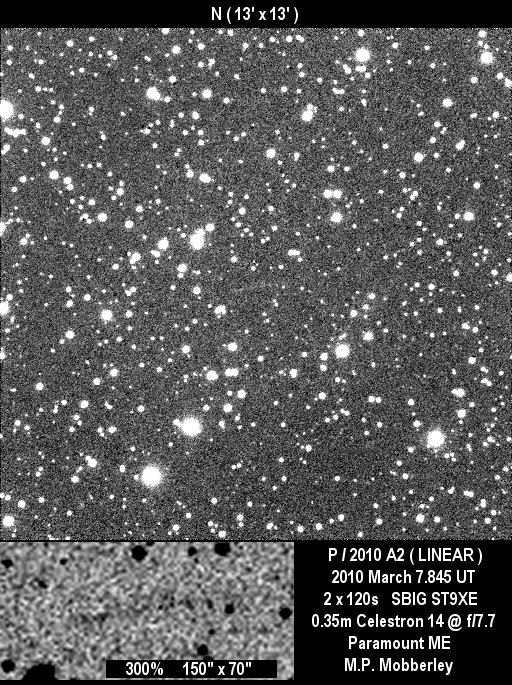
The nucleus of comet C/2007 Q3 (Siding Spring) has split, though the fragment in the coma requires larger instruments to see: Stories of March 22, March 19, March 17 and March 9, several pictures and selected ones of March 14, March 19, March 20, March 21 and March 22 (zoom, more zoom). • Also 29P in outburst on March 18, 81P/Wild with nice tail & coma details on March 6, March 8, March 12, March 19 and March 21 - and the dusty streak of C/2010 A2 was still there on March 4, March 7 and March 11. • The discoveries of P/2001 Q11 after 9 years, C/2010 E5 (Scotti), C/2010 E1 & E2 (the latter involving D. Levy). • 30P met 31P on March 4, Rosetta target comet 67P is still visible for experts (but then gone til he encounter), and several Kreutz comets fell into the Sun in mid-March (mehr, mehr). • Also a bolide in Hungary and speculation about an impact crater in the D.R.Congo.
In other news there was a big sunspot group in mid-March, the understanding of the solar cycle may advance (more, more), while the Sun may now return to normal activity levels after a Grand Maximum lasting the past 60-70 years. • Mars pics of March 19 (more, more), March 11 (1 to 11), March 8, March 7 (more), March 6, March 4 (more) and March 1 (more). • Jupiter's GRS in thermal IR (more, more, more and mehr), several Titan transits in 2009/10 and Saturn in opposition (earlier). • Venus & the lunar crescent on March 17 and March 16 and the Moon on the 16th from the ISS; also a movie of the ISS in hi-res and an ISS Sun transit. • A Messier Marathon report from India and another one, a new public observatory and an article (PDF) on remote observing and how it helps amateurs hunt exoplanets.
The nucleus of comet C/2007 Q3 (Siding Spring) has split, though the fragment in the coma requires larger instruments to see: Stories of March 22, March 19, March 17 and March 9, several pictures and selected ones of March 14, March 19, March 20, March 21 and March 22 (zoom, more zoom). • Also 29P in outburst on March 18, 81P/Wild with nice tail & coma details on March 6, March 8, March 12, March 19 and March 21 - and the dusty streak of C/2010 A2 was still there on March 4, March 7 and March 11. • The discoveries of P/2001 Q11 after 9 years, C/2010 E5 (Scotti), C/2010 E1 & E2 (the latter involving D. Levy). • 30P met 31P on March 4, Rosetta target comet 67P is still visible for experts (but then gone til he encounter), and several Kreutz comets fell into the Sun in mid-March (mehr, mehr). • Also a bolide in Hungary and speculation about an impact crater in the D.R.Congo.


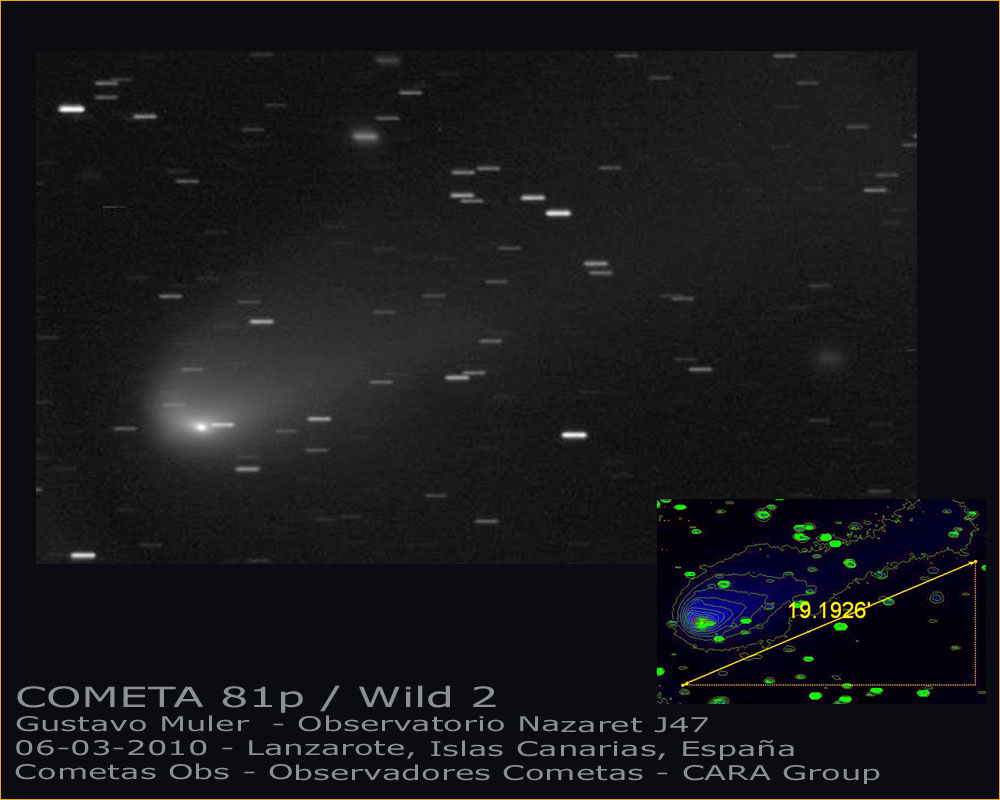



In other news there was a big sunspot group in mid-March, the understanding of the solar cycle may advance (more, more), while the Sun may now return to normal activity levels after a Grand Maximum lasting the past 60-70 years. • Mars pics of March 19 (more, more), March 11 (1 to 11), March 8, March 7 (more), March 6, March 4 (more) and March 1 (more). • Jupiter's GRS in thermal IR (more, more, more and mehr), several Titan transits in 2009/10 and Saturn in opposition (earlier). • Venus & the lunar crescent on March 17 and March 16 and the Moon on the 16th from the ISS; also a movie of the ISS in hi-res and an ISS Sun transit. • A Messier Marathon report from India and another one, a new public observatory and an article (PDF) on remote observing and how it helps amateurs hunt exoplanets.


Friday, March 5, 2010
Opposition of Saturn sky's highlight for March
While the rare Saturn ring plane crossings took place already last year, there is an almost-crossing coming up in June when the rings will be less than an arc second wide (as can be checked with this calculator). Currently they are twice as wide and very obvious in any telescope, which they better be as this month Saturn is in opposition to the Sun on March 22nd - the sky highlight of this month (see also here, here, hier, hier, hier und hier). Also the visibility of Venus at dusk improves a bit throughout the month (with the Moon nearby on the 16th - hard! - and 17th), and in late March the best evening visibility of Mercury for the year should begin - during the interval March 27 ... April 4 the elusive planet may be easiest to spot. Meanwhile it's not to early to dream of comet 103P/Hartley (2), well visible in the fall. And already in summer 10P/Tempel could be nice.
In solar news there has been much talk (like here, here, here, here, here, here and here) about the "Solar Storm Watch" where everyone is invited to track coronal mass ejections via the HI instruments on the STEREO spacecraft - let's see how this crowdsourcing for space weather alerts works out. Meanwhile you can turn to the Community Coordinated Modeling Center of the Space Weather Laboratory at NASA's Goddard Space Flight Center. • Some solar action on Feb. 7 and in Feb. and earlier, Feb. 15 aurorae and more on the non-effect of the Sun on climate matters. • A new type of variable stars has been discovered, a new Nova Sco, we have a precovery of KT Eri, insights into Eps Aur here, here and here and Swift observations of U Sco.
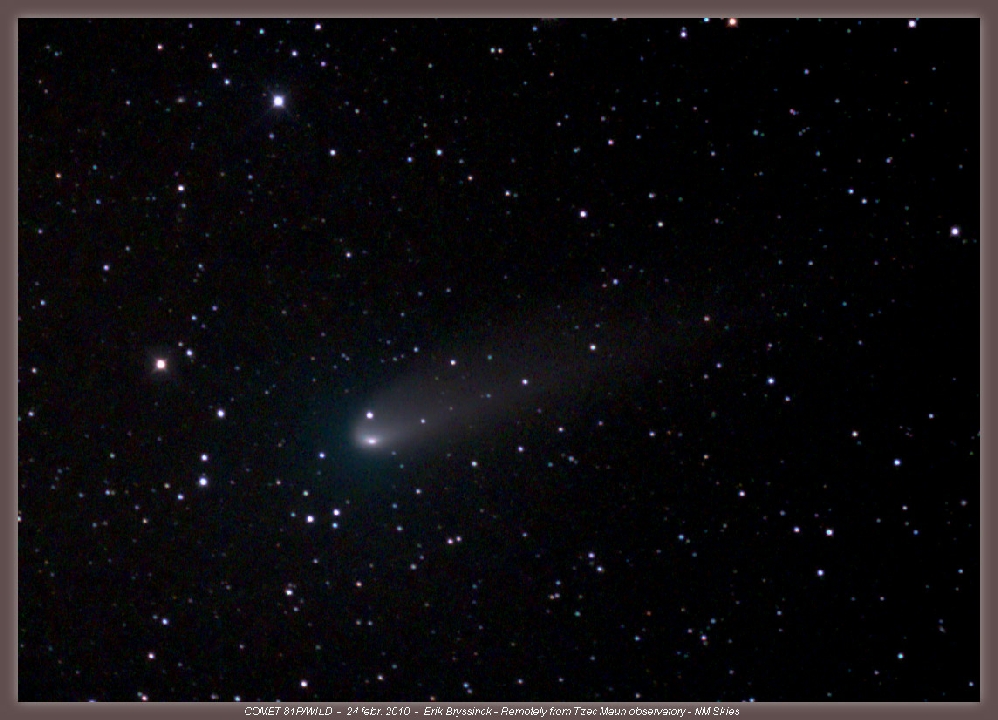
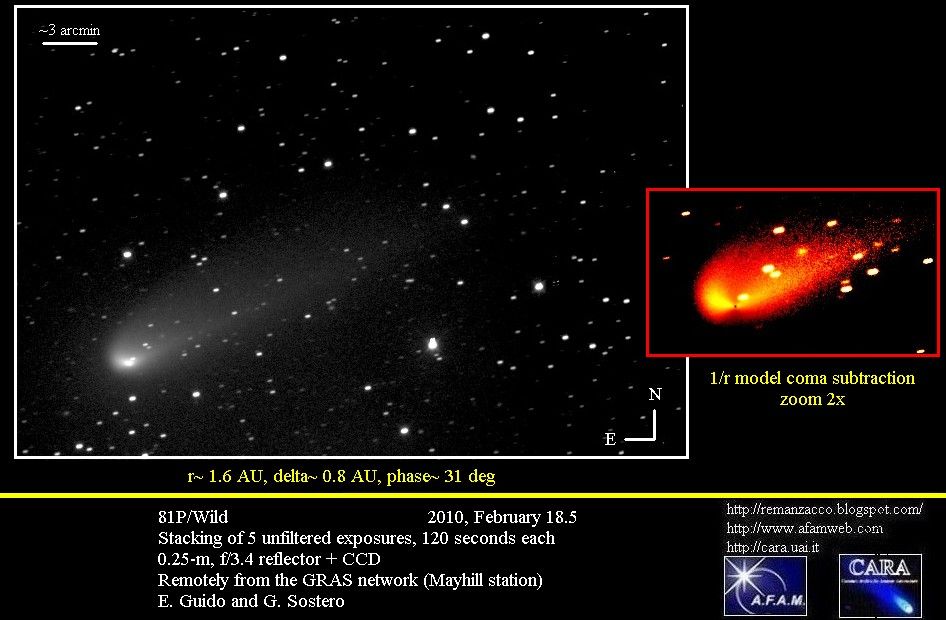
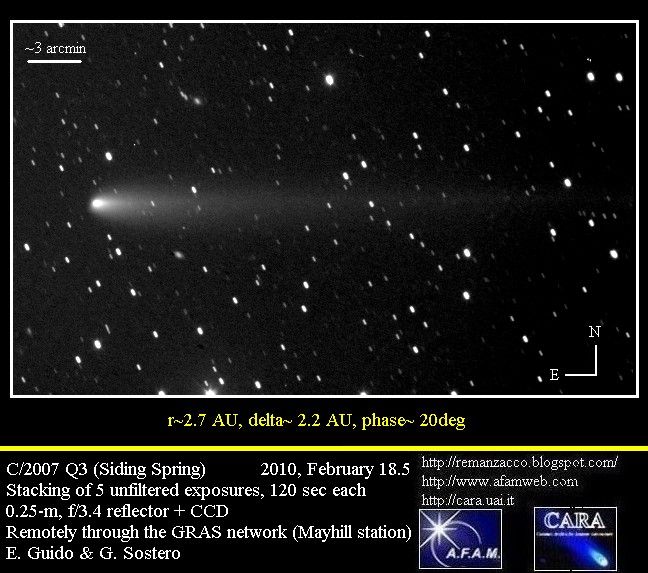
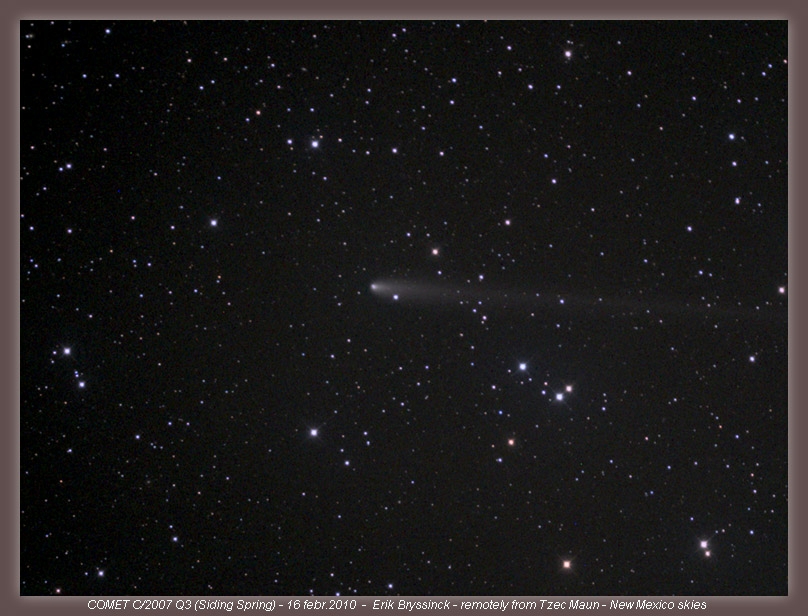
In the solar system we had a 3rd outburst of comet 29P, nice pics of 81P on Feb. 24, Feb. 22, Feb. 18 and Feb. 17 (more), 2007 Q3 on Feb. 18 and Feb. 16 plus a January WISE picture - and yet another model for Holmes' weird outburst in 2007. • A fireball in Hungary, craters in Antarctica and the Arctic, dark NEOs and a lightcurve of NEO 2009 UN3. • Asteroid Vesta in opposition (advertised here, here an here) was well observed: a movie on Feb. 18 and a passage between two stars on Feb. 16 (more, mehr, mehr, earlier, still earlier). • Of Mars in the month after opposition nice pictures of March 4, March 1 (more, more and more), Feb. 24 (also in blue), Feb. 23, Feb. 20/21 (Feb. 21, Feb. 20), Feb. 17 (more), Feb. 16 and Feb. 1. • With Venus just back at dusk, a conjunction w/Jupiter has been observed on Feb. 16 in the U.S. and Germany; the lunar crescent was way above the tough planet pair.
In other news a video of a grazing occultation of a Pleiades star by the Moon in Greece (the appulse from Germany), the Moon imaged from the ISS, also in hi-res (more) and just rising - too bad the photographer is coming back in June. Also polar clouds from Space in January (more), bright sundogs seen on March 4 from Germany and elsewhere: a coincidence or particular atmospheric conditions, widespread? One could ask the AKM which even runs meetings on halo phenomena! • A stolen telescope in Texas is back (more), an interview w/Ashcroft, a review of robotic astronomy, and amateur astronomy Decadal Survey, one guy's story, pop astro at ASU, various citizen science projects ... and a crazy WWT/Earth mapping blend.
In solar news there has been much talk (like here, here, here, here, here, here and here) about the "Solar Storm Watch" where everyone is invited to track coronal mass ejections via the HI instruments on the STEREO spacecraft - let's see how this crowdsourcing for space weather alerts works out. Meanwhile you can turn to the Community Coordinated Modeling Center of the Space Weather Laboratory at NASA's Goddard Space Flight Center. • Some solar action on Feb. 7 and in Feb. and earlier, Feb. 15 aurorae and more on the non-effect of the Sun on climate matters. • A new type of variable stars has been discovered, a new Nova Sco, we have a precovery of KT Eri, insights into Eps Aur here, here and here and Swift observations of U Sco.
In the solar system we had a 3rd outburst of comet 29P, nice pics of 81P on Feb. 24, Feb. 22, Feb. 18 and Feb. 17 (more), 2007 Q3 on Feb. 18 and Feb. 16 plus a January WISE picture - and yet another model for Holmes' weird outburst in 2007. • A fireball in Hungary, craters in Antarctica and the Arctic, dark NEOs and a lightcurve of NEO 2009 UN3. • Asteroid Vesta in opposition (advertised here, here an here) was well observed: a movie on Feb. 18 and a passage between two stars on Feb. 16 (more, mehr, mehr, earlier, still earlier). • Of Mars in the month after opposition nice pictures of March 4, March 1 (more, more and more), Feb. 24 (also in blue), Feb. 23, Feb. 20/21 (Feb. 21, Feb. 20), Feb. 17 (more), Feb. 16 and Feb. 1. • With Venus just back at dusk, a conjunction w/Jupiter has been observed on Feb. 16 in the U.S. and Germany; the lunar crescent was way above the tough planet pair.





In other news a video of a grazing occultation of a Pleiades star by the Moon in Greece (the appulse from Germany), the Moon imaged from the ISS, also in hi-res (more) and just rising - too bad the photographer is coming back in June. Also polar clouds from Space in January (more), bright sundogs seen on March 4 from Germany and elsewhere: a coincidence or particular atmospheric conditions, widespread? One could ask the AKM which even runs meetings on halo phenomena! • A stolen telescope in Texas is back (more), an interview w/Ashcroft, a review of robotic astronomy, and amateur astronomy Decadal Survey, one guy's story, pop astro at ASU, various citizen science projects ... and a crazy WWT/Earth mapping blend.
Subscribe to:
Posts (Atom)