Sunday, January 24, 2010

All the stuff that's fit to link about the thickest ring of fire of the millennium

And it's a lot: The annular eclipse with the smallest lunar/solar diameter ratio of the 3rd millennium (or the thickest ring - or the longest duration when near the point of maximum eclipse) of 15 January has been observed widely all along its track from Central and Eastern Africa over the Maldives, India, Sri Lanka, Bangladesh, Myanmar and China, and pictures and reports are still coming in 9 days later. Thanks to TwitPic as well as eager Indian journalists, the small tour led by yours truly to Varkala, Kerala, India, and our results were mentioned quite often; these links are marked by an asterisk (*).

First some general galleries by Universe Today* (the only ones who asked for permission to use our pictures, by the way), SciBuff* (more*), Facebook*, InFuture* (in Russian!), SpaceWeather, KC Star, Telegraph, Nat'l Geographic, StumbleUpon, DJMick, BBC, ABC, Hindu, IndiaToday, HuffPost, Yahoo, Flickr, LifeBob and FunZug. Numerous reports are linked by SoFi2010 or published on EclipseChasers; there's also a chaotic video collage. Now individual reports from the annularity strip:News coverage of the eclipse was generous - first from individual countries. From Uganda this story. From the Maldives this story and a strange one (relating to this fringe science). From India a TV debate on eclipse superstitions (also this clip) and stories here, here*, here*, here*, here* (more*), here*, here, here, here (alt.), here, here, here, here, here, here, here, here, here, here, here, here, here and here. Specifically about sounding rockets fired for geophysical studies during the eclipse are an ISRO Press Release and stories here, here, here and here, while here lots more stories are linked.

From Bangladesh stories here, here and here, from China this and this story, and stories about the eclipse worldwide here* (alt.*, alt.*, alt.*, alt.*, in Spanish* and in French*), here*, here*, here, here, here, here, here, here, here, here, here, hier, hier, hier, hier*, hier, hier und hier. The eclipse led to a brief surge in web searches; many more pre-eclipse stories can be found here!

In other Sun-related news the sunspot situation on Jan. 23, the big group #1040 (earlier) which was also visible during the eclipse. • There is also a new method to predict flares, and during recent total solar eclipses the corona has been imaged in a new light by Fe XI. • From the partial lunar eclipse preceding the ASE we have further pictures from the Philippines taken with unusual equipment (an AstroScan!) and from India (more, more). • It is also noteworthy that the upcoming full moon will be the biggest of the year.

Other happenings in the sky in the past three weeks


A small asteroid came moderately close to Earth (with some speculation that it may be related to the Venus Express mission): NEO News (alt.) about 2010 AL30, a radar detection, the Cosmic Diary (earlier), Remanzacco (earlier), Transient Sky (earlier), Planetary Society (earlier, still earlier), SpaceWeather, KosmoLogs and news coverage e.g. here (blog), here, here, here, here, here, here and hier and pictures and movies here, here, here and here. • There has been an arrest in connection with the 2008 TC3 meteorites in Sudan (also here and here). • A meteorite hit a dentist's office in Virginia, as reported here, here, here, here, here, here and hier - and another meteo-wrong.

The Curious Case of Comet P/2010 A2 (LINEAR) is discussed by TransientSky, Discovery, AstroEngine, S&T and AstroFan80 - did we witness a collision in the asteroid belt? • There was another sungrazer, quickly gone, while from the previous one we have further pictures & videos, a report (more), a movie (hectic and alt. versions) and stills from C2 (more) and from C3. • Comet C/2007 Q3 with a globular cluster (NGC 5466), and 81P/Wild on Jan. 20 and Jan. 2.

Mars is approaching opposition now: some pictures of Jan. 22, Jan. 21, Jan. 18, Jan. 15, Jan. 4 (more and one in 3D ...) and Jan. 2. • Epsilon Aurigae has now reached minimum (more and more reports); there is a possible explanation for the system, but many questions remain open. • A new nova has gone off in Sagittarius. • An amateur astrononomer has found a mistake in the Arp Atlas: abstract, story, press release, conference report, another one! • Free for all: a Sky & Tel. story (PDF) on Amateur Spacecraft Imaging. • And finally the Sun and the Telegraph hail an amateur astronomer and "space fanatic" ...

Saturday, January 2, 2010

Bright sungrazing comet in SOHO's field of view right now!

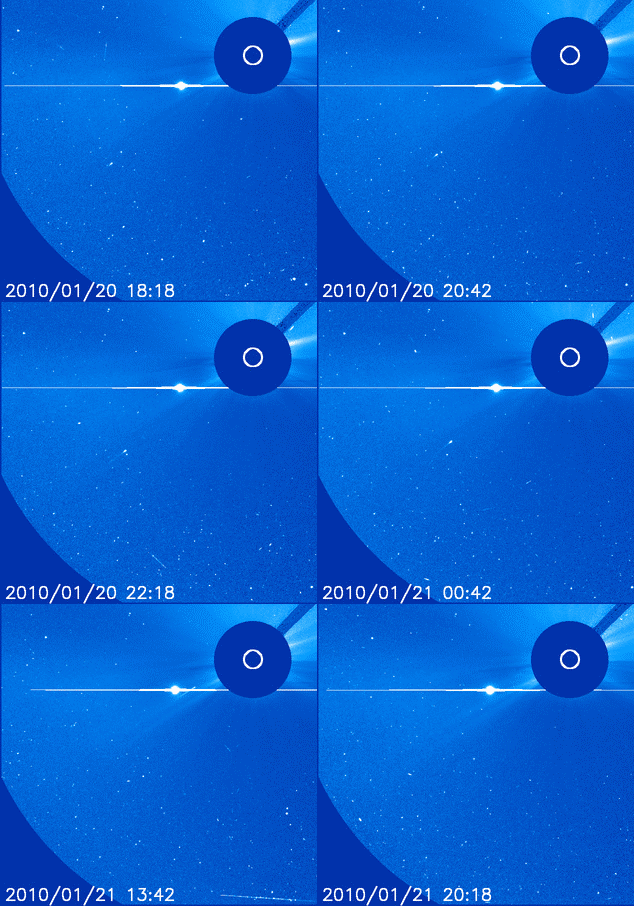
It was discovered by an amateur Dec. 30 on STEREO images, but now it can be seen clearly in images from SOHO's LASCO C3 coronagraph: In the last hours the brightness of the - now saturated - comet has risen to zero or -1 mag. Somewhat more predictable events in January (see lists and articles here, here, here, here, hier, hier, hier und hier) includeThere are also a preview for the full year and a lot of links to reviews of the past one. (In other comet news a lot of great Halley pictures from 1985/6 have now been scanned and put online; from current comets we have C/2007 Q3 on Dec. 25 and 81P on Dec. 19).

In other news the ZHR profile of the Geminids of 2009 can be interpreted as a drawn out plateau of perhaps a double peak - in any case, most of the activity came many hours early! There is one famous picture (explained here), a composite shows 34 GEM in one view (more composites) - and an IMO spokesman on TV! • A bolide in China may have dropped meteorites - and the hunt is on again after an old fall in the U.S. • A star occultation by (599) Luisa was very well observed in Europe: reports here (ctd.) and here. • 2009 YE9 is the biggest KBO find in 5 years, among many hundreds.

• The partial lunar eclipse of 31 Dec. or 1 Jan. was a webcast-only event for many, but great pictures were possible e.g. in Athens, the Philippines, Mallorca, Malaysia, Spain, Dublin, Sri Lanka or Chennai (more previews here, here, hier, hier or here; some don't get it at all, though ...) • From the July 22 total solar eclipse a Japanese satellite view, Indian picture collections and a late trip report. • A stellar occultation by the Moon observed in India.

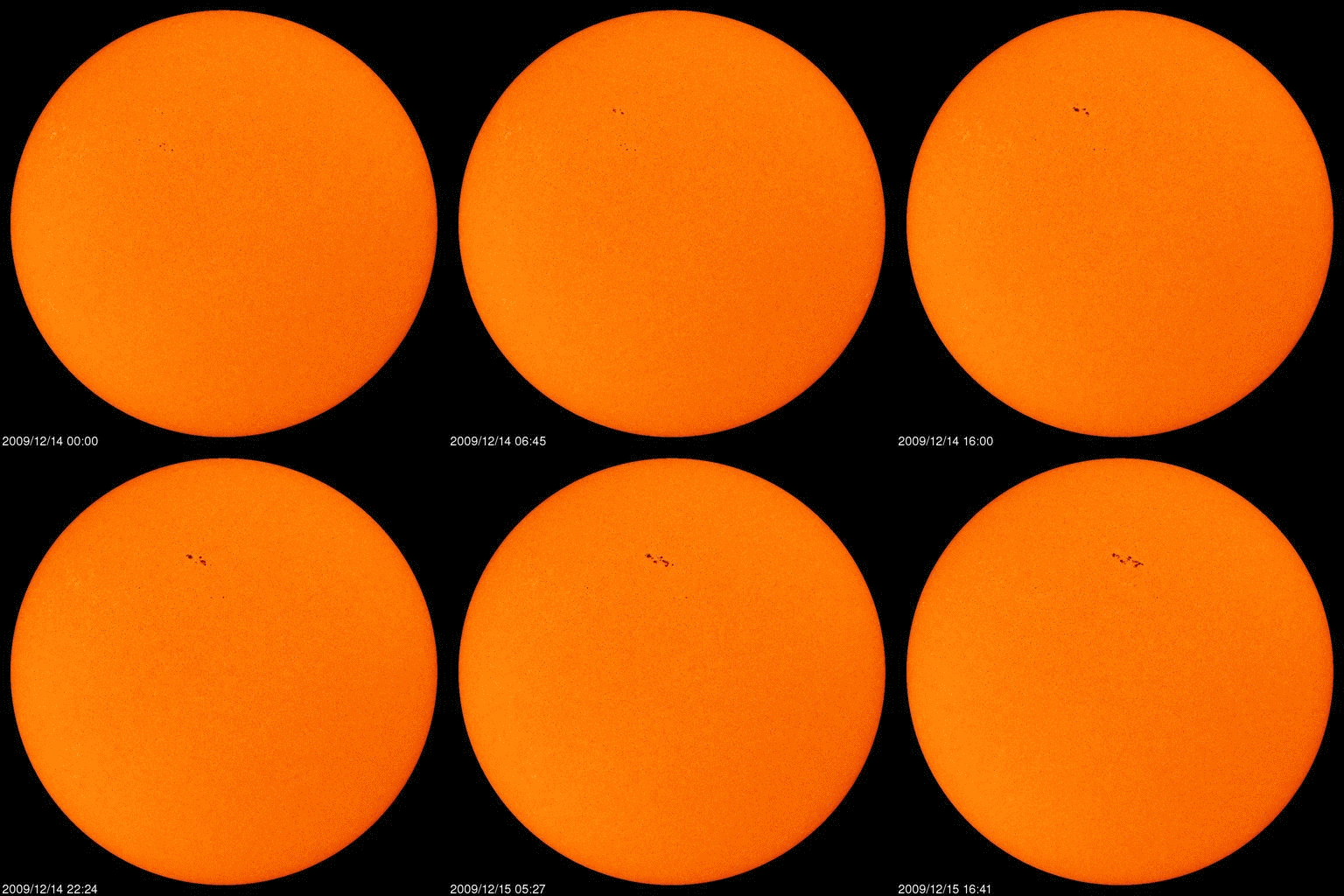
• Solar activity is finally rising, at least w.r.t. the number of non-spot-free days ... December brought something to see indeed, on the 19th, 18th (at sunset), 17th, 16th (more, more; earlier) and 15th (more, more and a movie until the 15th). • Also the "fingerprint" of the new cycle, how the low EUV flux cools the upper atmosphere, how the Sun is innocent in global warming (more) and 10 years of AcrimSat monitoring the solar 'constant'.

• Great hi-res views of Mars from Jan. 1, Dec. 29, Dec. 28, Dec. 27, Dec. 14 and Dec. 5. • Mercury, Jupiter and Moon constellations on Dec. 21 (more), Dec. 20 (more), Dec. 19 (all three from Oz), Dec. 18 and Dec. 17. • Jupiter & Neptune on Dec. 25 and Dec. 11. • Epsilon Aurigae images and reports of Dec. 19, Dec. 15 and Dec. 14 and a Delta Cephei lightcurve obtained with a simple digital camera. • Deep sky drawings from India. • An accidental green segment image. • A winter star party ... in Austria! • A Dark Sky Park in California. • And Indians going for Jovian radio emmissions.

Friday, December 11, 2009

Moon-free Geminids and a lunar micro-eclipse conclude International Year of Astronomy

From an observational point of view the International Year of Astronomy was not that outstanding, with respect to both planned and unplanned sky events, apart perhaps from the longest total solar eclipse of the century and surprisingly strong - but Moon-lit - Perseids. The final month, though, brings perhaps the best "unlit" meteors of the year and concludes with a shallow partial lunar eclipse on new year's eve (though it's already 2010 then in Asia).The celestial "highlight" of the past two weeks was man-made: A failed Russian military rocket test launch created an amazing luminous spiral in Norway's skies early on Dec. 10. News and blog reports, often with great pictures, are here, here, here, here, here, here, here, here, here, here, here, here, here, here, hier, hier, hier, hier, here, here (earlier), here, here and here. Amazingly the phenomenon was repeated over Siberia just a day later ... • Talking about natural sky shows, a late report on the South African bolide, an analysis of the Utah bolide - and comet 107P did not form a coma on Dec. 4 (or before or since), so it's probably truly dead but still raises questions galore.

In other news the stellar occultation of (234) Barbara led to this shape, discussed in this movie and based on these observers. So the U.S. effort worked very well; in Europe only a few were successful, too. • Epsilon Aurigae news from Dec. 8 and amateur spectra; also of Nova Scuti and Nova Eridani (which is really one). • A solar prominence on Nov. 28. • Exciting lunar (also discussed here) and solar halos from Finland - and the top places to see the aurora. • Stories about the Chromoscope website here, here, here, here and here, a Hubble advent calendar, a comic (!) about the 1994 Jupiter impact observations with Hubble and the whereabouts of all our spacecraft in the solar system this month.

Saturday, November 28, 2009

Two well-videotaped bolides, right after poorly performing Leonids

Once it was a rarity that a meteor fireball was accidentally caught by a surveillance or a police car dashboard camera - but now it has happened twice within three days, first in the U.S. during the maximum night of the (otherwise unimpressive) Leonids and unrelated to them, then in South Africa. • From the South African bolide of 21 November an overview & many reports, a video (also here, plus three stills), a different video (also here and here), a video of the sky brightening and more news coverage here, here and here. • From the November 18 bolide over Utah which caused a lot of excitement (and was also seen from other states) many videos exist, e.g. shown here (nice TV report), here and here, also this (also here), this, this, this, this, this and this one. One could try to triangulate a possible strewn field, unfortunately in a restricted area, to the chagrin of would-be meteorite hunters ... A report, several more, the residual cloud in the sky and a lot of coverage here, here, here, here, here, here, here, here and here, with more news linked here, here, here, here and here.

The Leonids of 2009, according to the worldwide visual data as of today, fell below even the most pessimistic predictions, with a peak ZHR of barely 100 (around 20:30 UTC on Nov. 17) - this would be less than half of what any of the three Perseids peaks reached this year: an early summary and links collection just 24 hours later, another early summary, more reports - and videos! - from the Philippines, Singapore, Nepal, India (again, plus preparations), Canada and the U.S., a picture, a less than informative wire story, one more model, a preview of net sources and more, more and more previews (also a bad and another bad one). • More recent fireball reports here (hi-res pic), here, here, here, here and here and stories about the European Network of fireball cameras and an Aussie meteorite problem. • The Barbara occultation event was observed: Here is a one lightcurve apparently confirming its binarity. • Cometwise we have C/2007 Q3 in the Virgo Cluster: pictures of Nov. 13 and Nov. 25 - plus a call for vigilance re. 107P.

In other news modest activity on the Sun (but a nice prominence and news about solar 'tsunamis' and a possible climate role in past centuries). • The eclipse of Eps Aur is progressing, a nova in Scu reached 7th mag. while Nova Eri even reached 5th mag. (but now it's down to 8 mag.), Mira is near maximum, Eta Car is brightening and should be watched as might be Zeta Aur. • There are now 50 named moons of Jupiter. • A nice video of the Oct. 21 Antares occultation by the Moon. • An amateur observatory designed with wheelchairs in mind. • A new Galaxy Zoo project involving galaxy mergers (more, more, more, more, more, more und mehr. • And finally four amateur astronomy personality stories about Jones, Boles, Legault and Mellinger.

Tuesday, November 10, 2009

RANT EXTRA: On the state of the astro-blogosphere

(Too) much has been written lately on how old-fashioned journalism is gonna die and to be replaced by blogs or tweets or wiki-whatevers. In the field of science and esp. space-related reporting the borders are blurred anyway, and the volume of 'copy' produced by bloggers is way outweighing the classical formats in any case. Just watch what the blog feed catcher of the Portal to the Universe (in the creation of which this blogger was actually involved) sucks in all the time. There is a lot of redundancy here, as noted by the PTTU editors early on, often little more than copy-&-past-ing of press releases, and only occasional original work. The watchdog function many blogs in the political area play is mostly missing - and just recently so many examples of poor reporting and/or judgement have come across my screen that this rant just had to get out. I won't name - or link to - individual 'sinners' here: You know who you are, as do your readers. Three examples:
  • On Nov. 5 the British Natural History Museum put online a story about a meteorite with unusual properties that had been recovered thanks to an Australian camera network imaging its fall. Many blogs, including several 'famous' ones, treated this as a news story - when in fact the respective paper had been published in Science on Sep. 18, together with a press release by CSIRO and lots of timely news coverage, e.g. in the New Scientist. Apparently none of the blogger stars had recalled this major astronomy news event from less than two months ago - what does it say about how serious they are with their reporting work? Particularly shocking is that this oversight happened to a number of the 'big names' in the business.

  • There have been two 'incidents' with minute asteroids of 5 to 10 meters in diameter recently, one exploding over Indonesia on Oct. 8, the other missing Earth on Nov. 6. While the former case was at least unusual (bodies of this size hit Earth only every few years), the latter was not as similar approaches to Earth w/o impact are ten times as frequent. Yet there were those blog stories again about how Earth just escaped another "asteroid" collision. Of course nothing other than an Indonesia-style fireball would have occurred, and no distinction between harmless airbursting rocks and dangerous bodies of 25+ meters was made or at least emphasized. The headlines should have been "Earth missed another nice bolide event" ... but instead we got served the dire view that these (non-)cases are further proof that Earth is defenseless against grave danger from space - which does exist, of course, but on an entirely different scale.

  • One week from now the Leonid meteors may or may not produce a decent shower when the Earth encounters some dust trails left by the parent comet. Last year a crude model calculation by a French astronomer (now working at Caltech) had predicted a maximum Zenithal Hourly Rate - i.e. meteor/hour under the best possible viewing conditions - of 500 or more: This would have qualified as half a "storm", reminding meteor veterans of great drama a decade ago, and the prediction was picked up by NASA and even by the IAU in an IYA press release. But this high prediction always stood alone, with other experienced theorists predicting a much smaller outburst. Still NASA ignored the doubts and many bloggers - with rare exceptions - took the 500+ figure for granted, until today. Alas, some time ago the theorist retracted it and is now predicting some 200, while the main 'competitor' is at around 175 and yet another pioneer of the field sees around 100. Even NASA conceded today that the 500 are history (but still thinks 300 possible without presenting the calculations leading to this).
The same NASA website that promoted the high prediction (and was not particularly successful in picking the right model with other meteor events in the past) may also have played a - minor - role in the ongoing 2012 'end of the world' nonsense. For when it came to predictions of how high the next maximum of solar activity might be, it strongly promoted one theorist whose results were at the very high end. And when a big panel of solar physicists in 2007 determined that the next peak would be average at best and almost certainly not high, this finding - reinforced two years later - wasn't communicated well. It's hard to prove causalities in this emotionally charged field of astronomy, but said NASA site is being copied-and-pasted (and absorbed, one would think) a lot, especially by astronomy aficionados not necessarily reading the original literature. And now I hear the makers of the "2012" movie premiering this week in a making-of on German TV (last Sunday) stating as an undisputed scientific fact that the coming solar maximum will be extremely high. Who else is wondering where that "information" came from? And now back to our regular fare of actual astronomy news that are new and correct ...

Thursday, November 5, 2009

Pretty unusual stellar occultation by an asteroid highlight of November

Asteroids are always causing interest, be it a discovery in New Zealand or a very small one occulting a very bright star along a narrow strip (so far either negative or clouded-out reports have been received). A more promising and scientifically important event is coming up on the morning of Nov. 21, however, when (234) Barbara hits at 7.5 mag. star - and this asteroid is double and has been measured by optical interferometry. Chords from the occultation - visible in Florida and Europe - would provide a crucial test of this method and could actually deliver higher resolution. Other than that only the Leonids (with a max. ZHR between 150 and 200 according to the latest models) and a Jupiter/Moon conjunction on Nov. 23 seem to be important in November; other previews here, hier, hier, hier and/und hier.

In other news three comets in one picture (one undiscovered at the time), two comets in one view and LINEAR on Oct. 26 and Oct. 24. • Just for the record another impact hoax, this time in Latvia and obviously faked from the video alone (more, more, more, more, more, more, more, more, more, more, more, more, more, more and more links, more or less enlightened). • Detailed analysis of an Antares occultation by the Moon. • Mars inside Messier 44 (a preview and Mars close-up) plus a Moon/Jupiter conjunction from the Philippines. • The largest sunspot in ages on Oct. 30, Oct. 28 (more) and Oct. 26 (more). • Nova Sgr 2009 #4 (more). • A Bright Star Monitor at work. • The Mellinger mosaic has now a press release, copied e.g. here and here. • What an almost blind astronomer can do. • An ISS/Moon transit from Germany. • And a fullmoon rainbow in the headlines.

Saturday, October 24, 2009

An Orionids "peak" that never ends? ZHR ~40 for 3+ days now

Expectations were for a prolonged maximum of the Orionids meteor shower this year, but with a more or less distinct peak either early on Oct. 21 or Oct. 22. Instead the activity remains high at a level of roughly ZHR ~40 since early October 20 - for three full days now and with no drop-off in sight. Some pictures, a report on the long maximum (earlier, still earlier), some analysis and for the record further previews here, here, here (earlier), here and here. • Finally some consensus re. the Leonids this year is building: The "500 or more" modeller has come down to ~200 as the max. ZHR - and his main 'competitor' is up to ~175. So it'll be a shower a bit below the Perseids this year? But in any case with less lunar interference! • The Canadian September bolide has led to several meteorite discoveries! A press release, an earlier one and coverage here and here. • From the Dutch/N German bolide much better pictures and stories here, here, here, here, here, here, hier, hier, hier, hier, hier, hier, hier, hier (mehr), hier and/und hier.

In other minor body news such a body of 5 to 10 meters exploded over Indonesia on Oct. 8 (well studied thanks to infrasound recordings), while a rock of similar size safely passed Earth a week later - and the exact events around the case of 2008 TC3 and the political 'impact' are still debated. • Meanwhile the largest NEO discovery in over one year has been reported (and doubted!); with a H~16 the size is around 2 km. • And in Russia a meteorite. • Elsewhere in the solar system comet 217P/LINEAR suffered an outburst - while never exceeding 10th mag., the comet looked a bit like 17P/Holmes in good pictures initially. Here are some of Oct. 22, Oct. 18 (more), Oct. 17 (more, more, more, more), Oct. 16 (more), Oct. 15 (more, more), Oct. 14 (more, more) and Oct. 13, plus a visual report from Sep.; the Indian observer wasn't impressed.

In other news a Moon/Antares appulse (actual occultation missed) and the morning planet/Moon arrangements of Oct. 16 in Germany and Italy and on Oct. 15 (more), Oct. 14 in the U.S. and Germany (sequence 1 - 2 - 3 and more) and Oct. 13, plus several more pictures. • STEREO images of a big prominence (alt.; more). • As this blogger also confirmed visually this morning, Epsilon Aurigae is at 3.4 mag., half-way between max. and min. The eclipse may have been delayed a bit - and while visual estimates are easy, though some)(it's easy, they can be off by several tenths of a mag., depending on the eye). • Will R CrB ever become bright again? The current minimum lasts 2+ years already! • Another amateur exoplanet detection. • Stellar occultations by Minerva are worth observing. • predicted effects from unusual experiments (see 16:37 entry) during a rocket launch led to weird sky effects over South Africa and Europe; see also here! • Finally winners of an astrophoto competition and another near-space balloon flight just for fun.

Tuesday, October 13, 2009

Spectacular fireball over Netherlands this evening not the only one in recent days

It happened near 17:00 UTC today over the Netherlands but was also seen - low in the sky - from Northern Germany: a bright fireball at dusk of which also a dramatic photograph exists. Soon more reports came in, like here, here, here, here, here, here, here and here (the latter with great pics of the smoke trail dispersing): The bolide split in mid-flight into half a dozen fragments, and a trail in the sky remained for many minutes. • There were also bright fireballs over New Mexico on Oct. 9 and Canada on Sep. 25 (a possible meteorite-dropper, also mentioned last time and also here, here, here and here). • Also an update on the Pacific bolide and an unusual bolide report from a soccer fan forum! • An all-too-often quoted prediction for the 2009 Leonids had them peak at a max. ZHR of 500 - but this calculation (never supported by other dust trail theorists) has now been retracted, with a max. ZHR of 200 instead. Still impressive perhaps, but only on a par with e.g. this year's Perseids. • More insights about the asteroid-turned-bolide-turned-meteorites 2008 TC3 have been published (alt., alt., more, more and more). And the impact risk for Apophis is all but gone as discussed in detail here.

In other news the La Sagra Sky Survey - just recently successful for the first time - has discovered its 2nd comet, with perihelion next January. • Recent studies deal with the rotation of the nuclei of comets Tempel 2 and Lulin (also discussed here). • Nice pictures of the tails of Garradd and 217P/LINEAR on Oct. 4. • Of the current morning sky show with various conjunctions of planets nice views of Oct. 13 (Saturn close to Venus) and Oct. 9 (Saturn close to Mercury), plus a Moon/M 45 conjunction on Oct. 7 (also a - controversial - composite attempt). • Meanwhile on Jupiter a dark spot on Sep. 19 (rotating), the surface of Callisto and a mutual event on Oct. 3 (another and yet another report). • Hi-res pics of the Moon. • An analysis and Oct. 3 report on Eps Aur's fade - and TT Ari is fading, too. • Finally Earth weather leaking into space, problems with Pan-STARRS, the sociology of Galaxy Zoo volunteers and a fine ISS in front of moon (not its shadow, of course).

Wednesday, September 30, 2009

The eclipse of Epsilon Aurigae has begun: 0.3 mag. drop evident

Go to the light curve generator of the AAVSO, enter "eps aur" as the object, 60 or 80 days as the interval and select only "V" magnitudes: out comes a light curve that monotonously falls from a level 3.0 mag. to 3.25 mag. right now over approximately the past month (using "visual" instead leaves a much noisier picture). Thus the long-awaited eclipse of mystery star Epsilon Aurigae has clearly begun, the first in 27 years - and this time the interest is higher than ever, esp. with the (much promoted) Citizen Sky campaign under way. Here the lightcurve is discussed in detail (earlier, still earlier, even earlier); using the last eclipse of the weird long-period system as a template, the brightness should drop to 3.8 mag. over the next two to three months and then hover there throughout 2010. • Meanwhile an outburst of Z And has been reported.

In other news there were two sunspot groups on the disk simultaneously, something not seen in a long time! A close-up of one of the groups on Sep. 26 (when also a big prominence was seen) and reports from Sep. 23 (more), Sep. 22 and Sep. 21. • Sun-related also a comparision of H-alpha telescopes (but is it fair?) and new insights about the solar cycle and a current surge of cosmic rays due to the low activity level (more, more and more). • In the comet world we have the first discovery by the La Sagra Sky Survey, comet 217P over M 42 (also an AAPOD) and one day later, Garradd with a long tail (by F. Kugel), the case of Pigott-LINEAR-Kowalski and Christensen. • Big bolides have been reported e.g. from Argentina, Canada and Namibia, numerous new weak meteor showers have been recognized; we have a new PHA - and the discoverer of 2008 TC3 has now a piece of "his" asteroid after it turned into a meteorite shower over Sudan! There will be a conference on the subject right there, in December - including further meteorite searching!

• Here is a long report about a possible detection of Io's atmosphere by an amateur during a mutual event; also "normal" event reports of Sep. 26 (also as a dramatic video!) and Sep. 9. Plus fine Jupiter images from September and also July - the latter taken at Pic du Midi with 1 meter. • There's now another Galaxy Zoom concentrating on the center region (also reported here) - plus a direct comparision of the two full-sky mosaics discussed 2 weeks ago: Mellinger's has higher resolution becuase Brunier's is actually oversampled. (There's also a another mosaic of only the Lagoon Nebula.) • A short-lived rocket experiment created a glowing cloud in the U.S. sky, causing some news coverage (see also here, here and here). • Also a remarkable amateur picture of the HTV (see also here and here) - and amateur satellite watchers found out what a secret satellite is probably good for. • Sky highlights in October 2009 mostly deal with constellations of the planets.
  • Oct. 6 morning: Largest elongation of Mercury with 18° (best morning apparition of the year for the Northern hemisphere; best view should be from Oct. 6 to 15)

  • Oct. 8 morning: Mercury just 0.3° SW of Saturn (which just emerges from the Sun's glare); Mercury 5 times brighter.

  • Oct. 10 morning: Venus, Saturn and Mercury close together

  • Oct. 12 morning: Moon close to Mars

  • Oct. 13 morning: Venus 0.6° W of Saturn (and 100 times brighter) - and the opposition loop of Jupiter ends

  • Oct. 16 morning: Mars, Saturn, Venus, Mercury and the Moon form a nice constellation

  • Oct. 21 late afternoon: The Moon occults Antares for Europe
Meteor-wise it'll be mainly the Orionids that should cause interest - and around their Oct.21 peak the Moon is practically gone. • Finally a report from the HHT, a star party in Eastern Germany (another, another and another report); also a note on a starparty on Palomar Mtn. - and the 1st issue of Practical Astronomy is out.

Wednesday, September 16, 2009

Who's got the best mega-mosaic of the whole sky in visible light?

What an amazing coincidence: Practically simultaneously two color mosaics of the whole sky with more than half a billion pixels each have been published, one by a physicist, the other by a science writer, but both did their work as tireless amateur astronomers over many months. One is by Axel Mellinger who also describes his work in a scientific paper: Great care was taken to achieve photometric calibration and foreground subtraction. This amazing achievement went unnoticed in an ESO Press Release a few weeks later presenting another mosaic by Serge Brunier which has even more pixels but less photometric precision it would seem (the images were taken with a DSLR cameras and stitched with commercial software). Still ESO is incorporating the latter mosaic into its "Giga-Galaxy Zoom" project - let's see which mosaic will become the new gold standard (as Mellinger's original mosaic made from chemical pictures in 2000 might be called).

In other news we have a rare outburst of the suspected UGWZ star VX For (a sensation for some), the 125th supernova discovery by an individual amateur, the Catalina Real-Time Transient Survey (where everyone can help) and the Hyper-Velocity Stars Project utilizing the SDSS Galaxy-Zoo-style. • From the 22 July Total Solar Eclipse we have a hi-res corona composite and a 3rd contact by Druckmüller & al., the official word and a 21-min. video about the Indian commercial eclipse flight, pictures and a slide show from Wuhan, a report from Hangzhou, a narrated slide-show from Wuzhen (featuring yours truly; incl. Wuhan) and a report from Shanghai. There are also a very detailled report on the 1 Aug. 2008 TSE, a speculative "eclipsology" blog - and, vastly more on the fringe, the TSE/UFO madness of 2009 ... • Talking about the Sun, there are speculations about its fading B field (summarized here and discussed here) and facts about the - minuscule - climate impact of solar events. And it was 150 years ago that the most powerful flare ever struck.

• Many more mutual events of Jovian moons have been observed, e.g. on Sep. 12, Sep. 8/9 (more), Sep. 1, Aug. 24/25 (more, more), Aug. 19 (more), Aug. 15 and other dates. • Pictures of the Wesley impact spot on Aug. 18 and various dates; it's pretty much gone now. • There is yet another comet McNaught with a moderately promising outlook; we had unusual activity in 217P (earlier, more), the recovery of P/2003 A1 (LINEAR), a new Hill, the unusual asteroid 2009 QY6, indications on 17P/Holmes splintering in connection with its 2007 outburst, the 2009 Wilson Awards and the 50th comet discovery by R. McNaught. • There were lots of reports about an Irish bolide on Sep. 3 while more has been reported about the Belgian case - and fine composite images of the 2009 Perseids have been published. • A fine "Etruscan Vase" Moon (more here), other recent "Vases" of Sun & Moon and various atmospherical optics in Ireland, plus a visit to Tacande Obs. on La Palma. • Finally some highlights of September 2009 -
  • Sep. 16: Uranus in Opposition at 5.7 mag. (try it with the naked eye).

  • Sep. 17: Saturn in Conjunction with the Sun, spoiling attempts to follow the ring plane crossing events from Earth.

  • Sep. 29: The Moon visits Jupiter, still a great sight (and the main target of the Galilean Nights a month later).
While the planet Mercury is in conjunction with the Sun this month, it can still be "observed" very well near the end of it, by the way: MESSENGER will perform its 3rd close fly-by on Sep. 29 (about when a morning apparition begins) for a final gravity assist that will enable it to enter orbit about Mercury in 2011. With more than 90 percent of the planet’s surface imaged during the previous two fly-bys, the team will turn its instruments on specific features and uncover more information about the planet closest to the Sun.