The main planetary action in the coming days and weeks takes place at dusk and at midnight: While Saturn is now in opposition to the Sun, Venus will almost suddenly disappear from the evening sky later this month, but as a slender crescent almost one arc minute in size. The opposition of Saturn may result in noticeably brighter rings, thanks to the opposition effect. You can find some of the best amateur pictures here, while here Pic du Midi's 1-m scope images (also hailed here) abound, including some unusual IR views. And here's another transit of Titan et al. Regarding Venus's grand finale in the evening, it was possible to catch the Moon and Venus as crescents in the same FOV. Again many great views are in the Japanese archive, including several successful detections of the nightside glowing in the IR like here. None of the results seem to match what was achieved in 2007, though, although many are trying hard (or just for for pretty pictures). The size of a telescope doesn't always matter, by the way, as an analysis of mutual events of Uranus's moons in 2007 shows (40 cm as good as 10 m). Talking of occultations, here's a recent Antares graze; the video gets better towards the end.
News with an impact (or 'almost'): While the launch of the LCROSS mission has slipped to NET May 20, preparings for observations of the impacts continue, with a discussion forum for observers now in place. • Did another meteorite fall in Finland? (Some info and a map.) • Here's a long story on meteorite hunting in Texas. • And at least 16 pieces of asteroid 2008 TC3 have already been recovered. • After its Earth visit on March 2 we've found out that NEA 2009 DD45 belongs to the S class, has thus a high albedo and small diameter of 19±4 meters; still in the closest approaches list the object (here's the last dedicated MPEC) figures prominently (on this one it's missing). There are a picture, movie and more movies - and lots of coverage in the old and new media such as here, here, here, here, here, here, here, here, here, here and here in English and here, here, here and here in German.
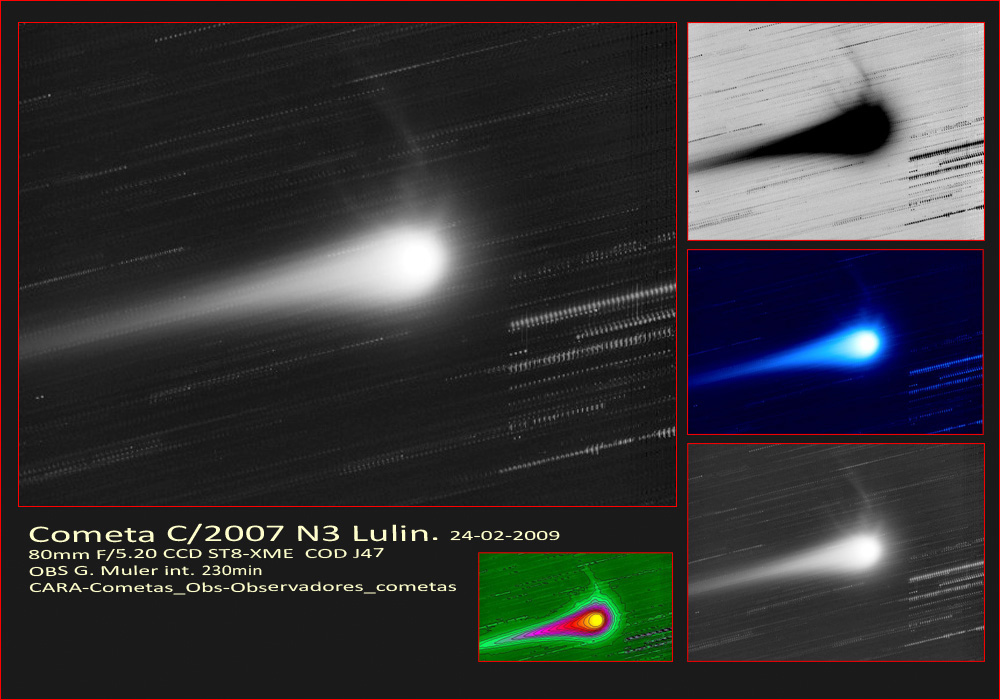
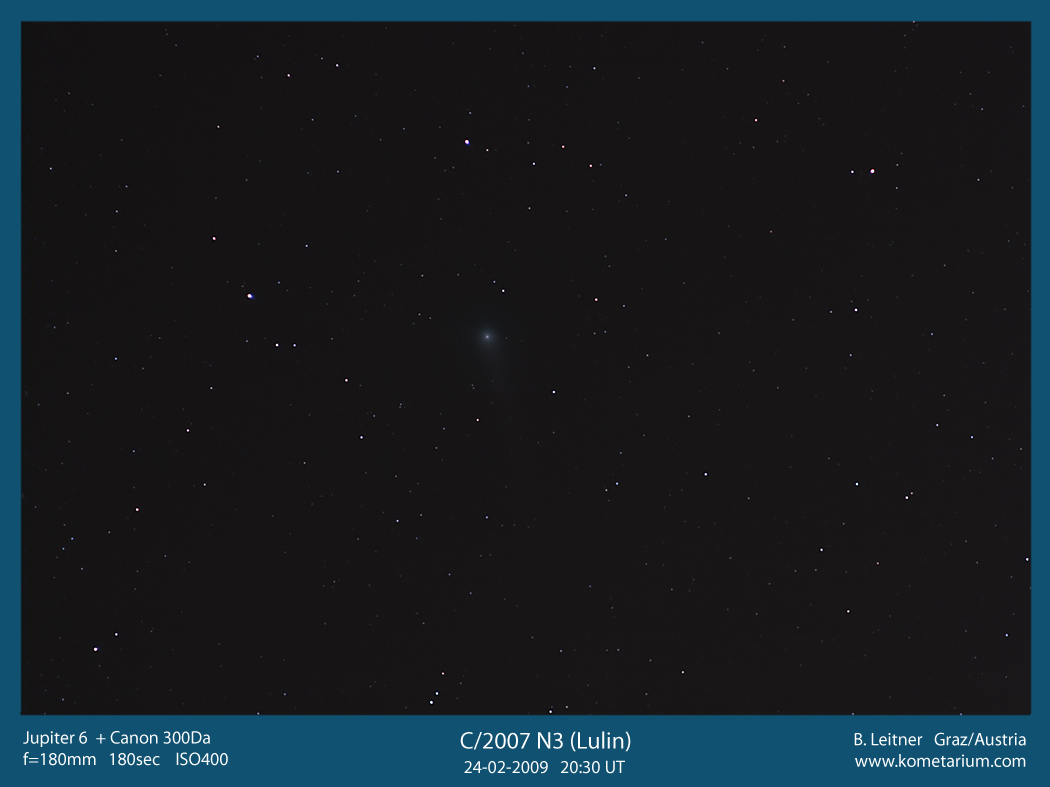
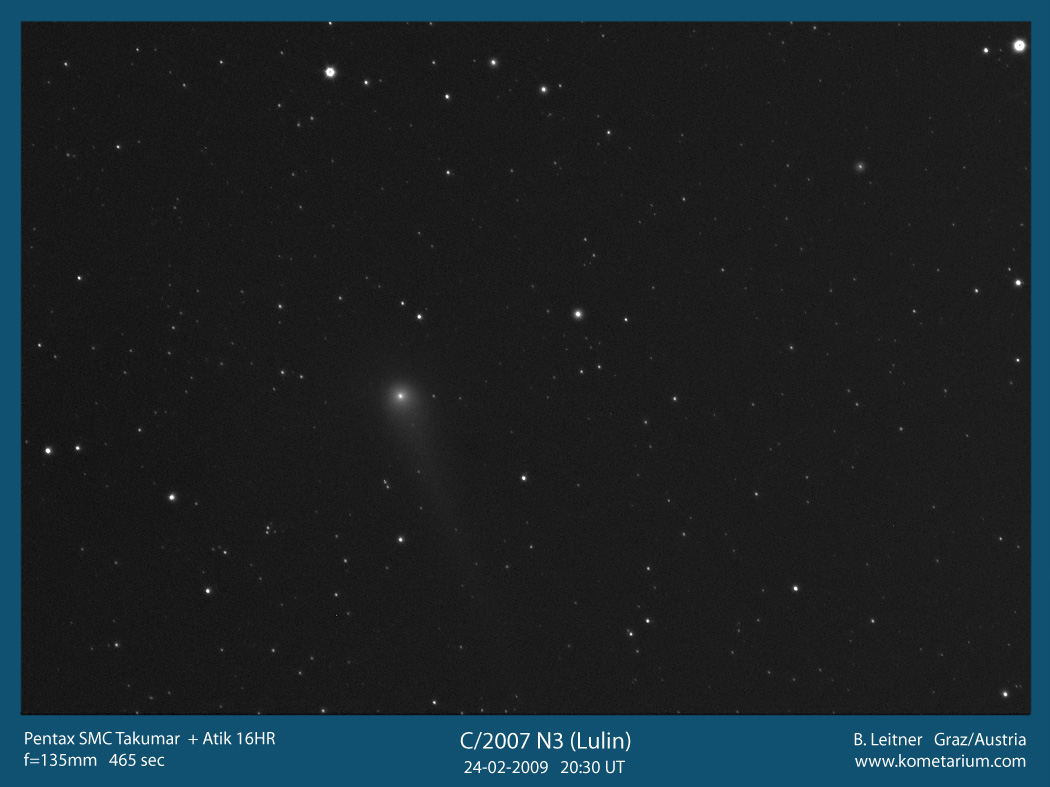
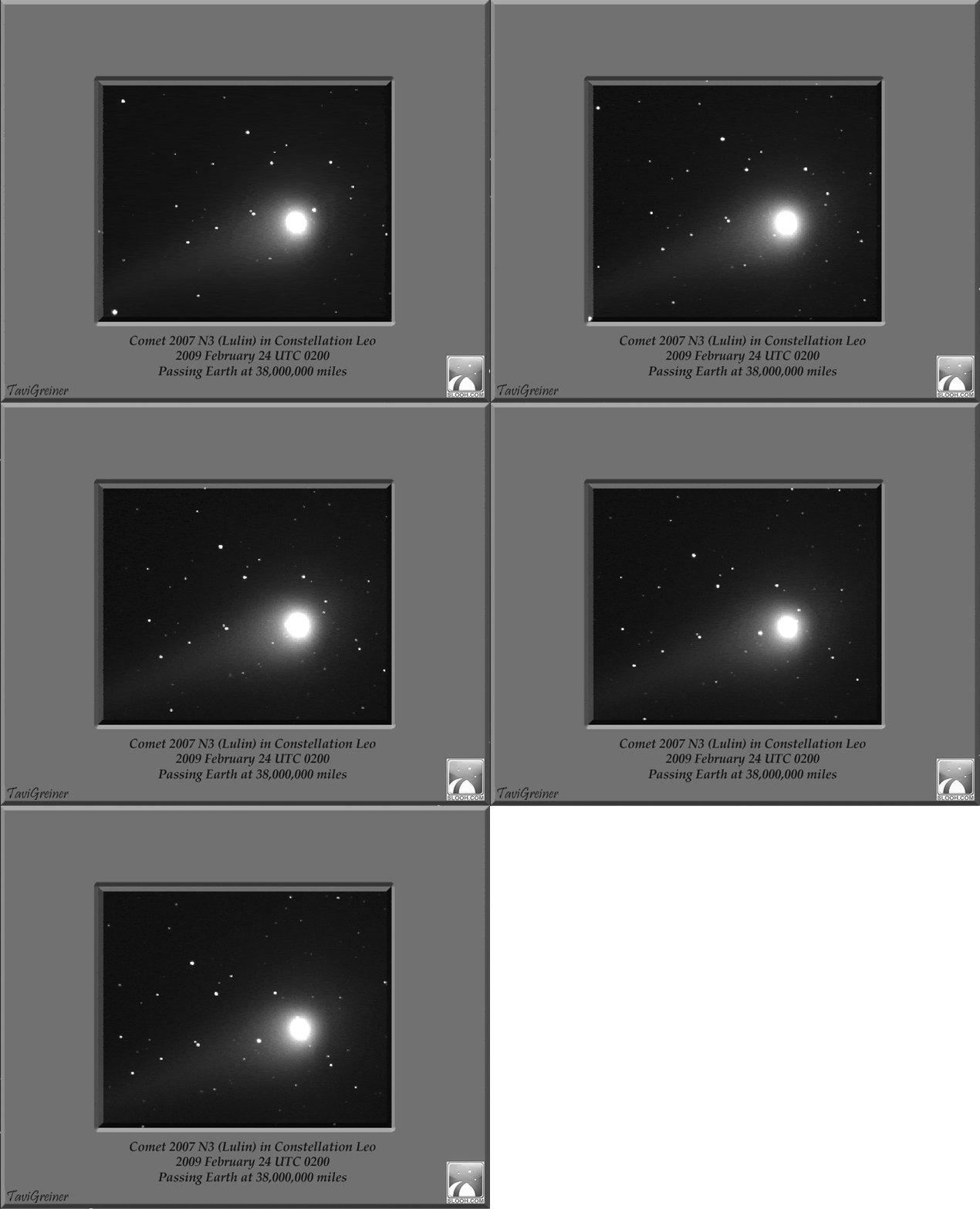
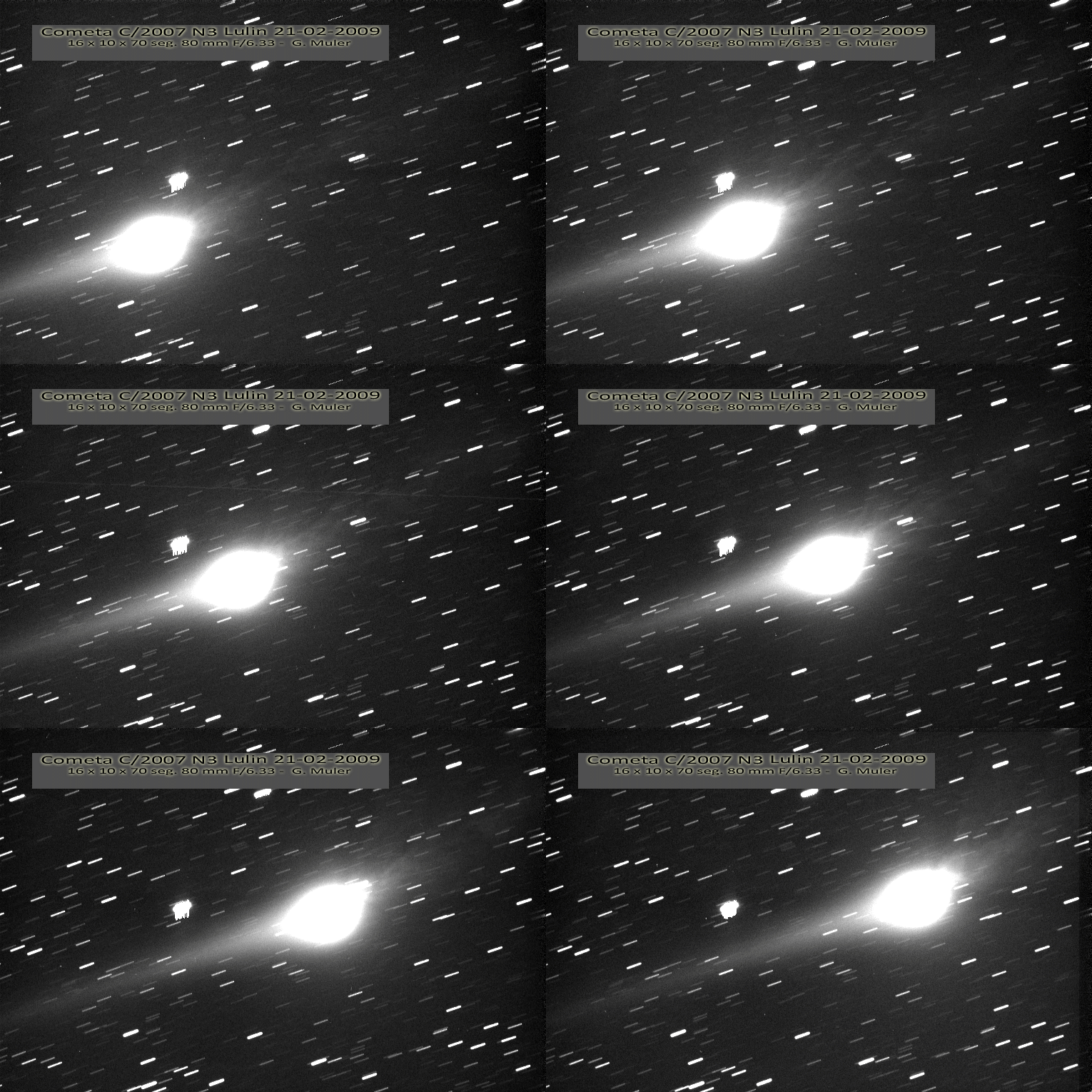
In other news the Lulin show went into a brief lunar hiatus, but there are a lot of afterthoughts and even new pictures: a nice multi-day mosaic, the light curve, excellent pictures from Southern France, a recorded webcast from Israel, a best of and thoughts and pictures by Lulin's discoverer. New pictures, videos and reports have come in from March 5/6 (with M44, plus a visual report), March 4/5, March 3/4 (more, more, more, an animation and a disappointment), March 2/3 (more), March 1/2 (more, more and even unguided), Feb. 28/Mar. 1 (more, also mentioned here, more, more, more, more, more and more) and Feb. 27/28. Older but cool pictures come from Feb. 25 from Oz and Italy and Feb. 23 as well as a movie from Feb. 22. • Meanwhile yet another outburst of comet Daniel (earlier), • a "comsat cloud" and • a review of a new camera. • And an Austrian amateur is making ample use of the robotic Slooh telescopes in February as well as March from Chile (earlier, still earlier) and Tenerife.
Sunday, March 8, 2009


Sunday, March 1, 2009
Best window for Lulin closing - while Saturn rules March
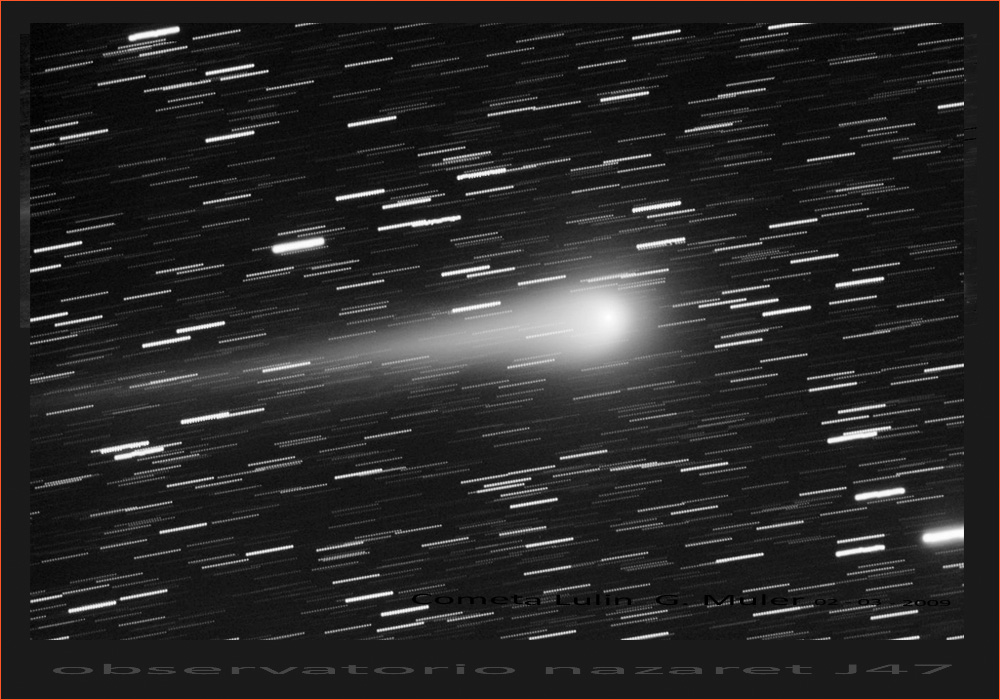
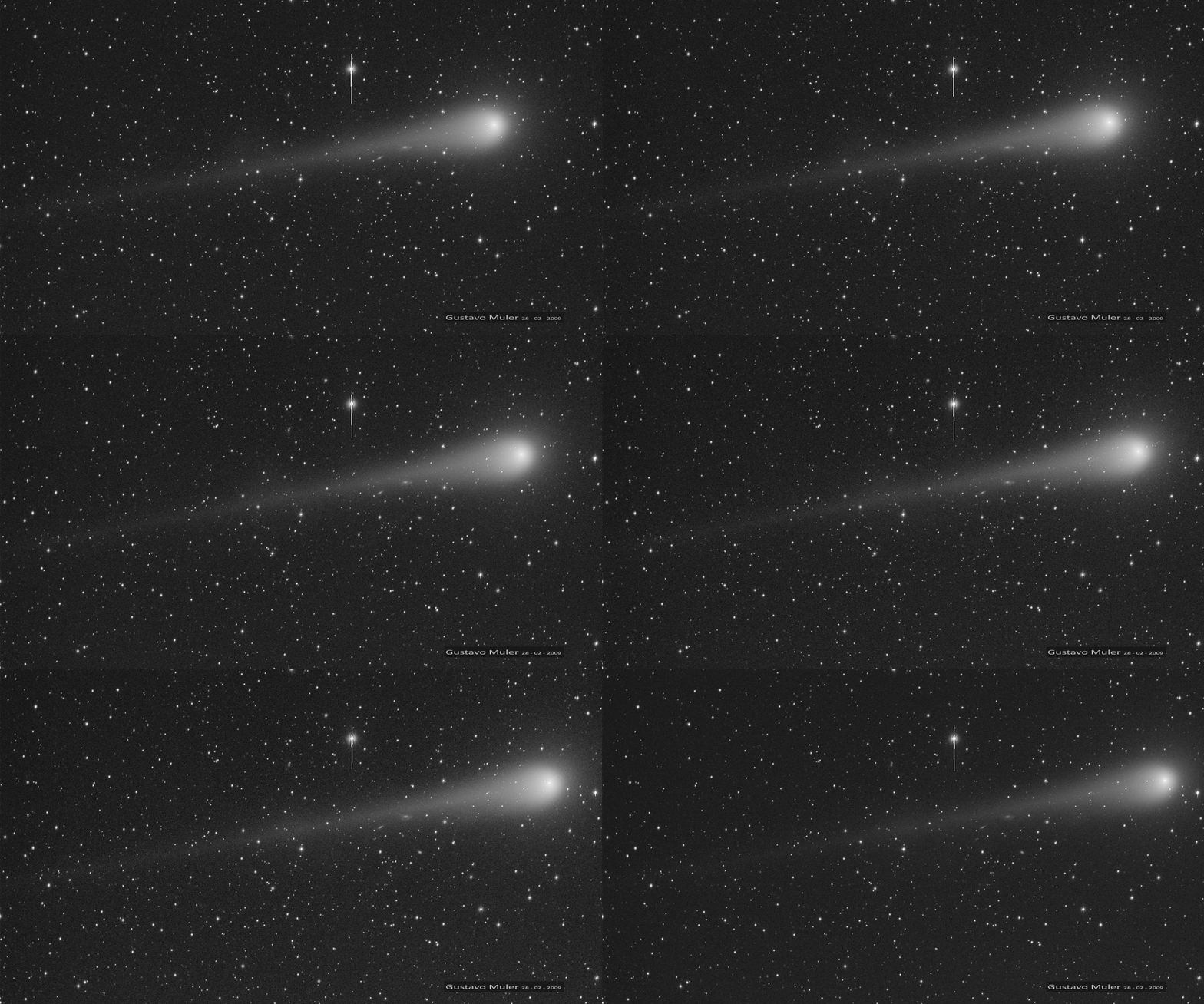
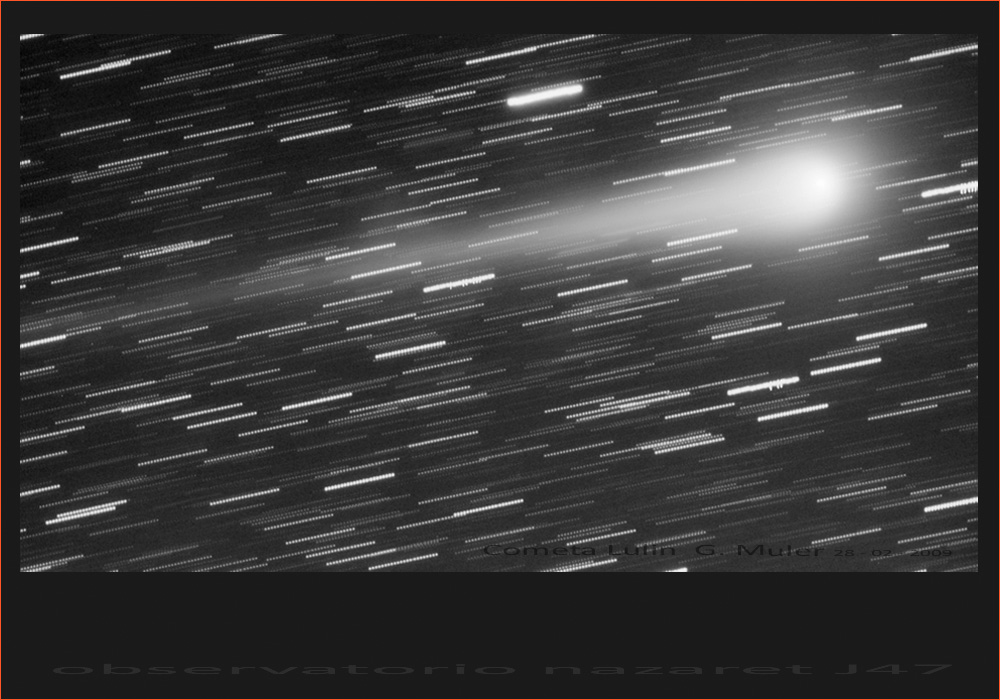
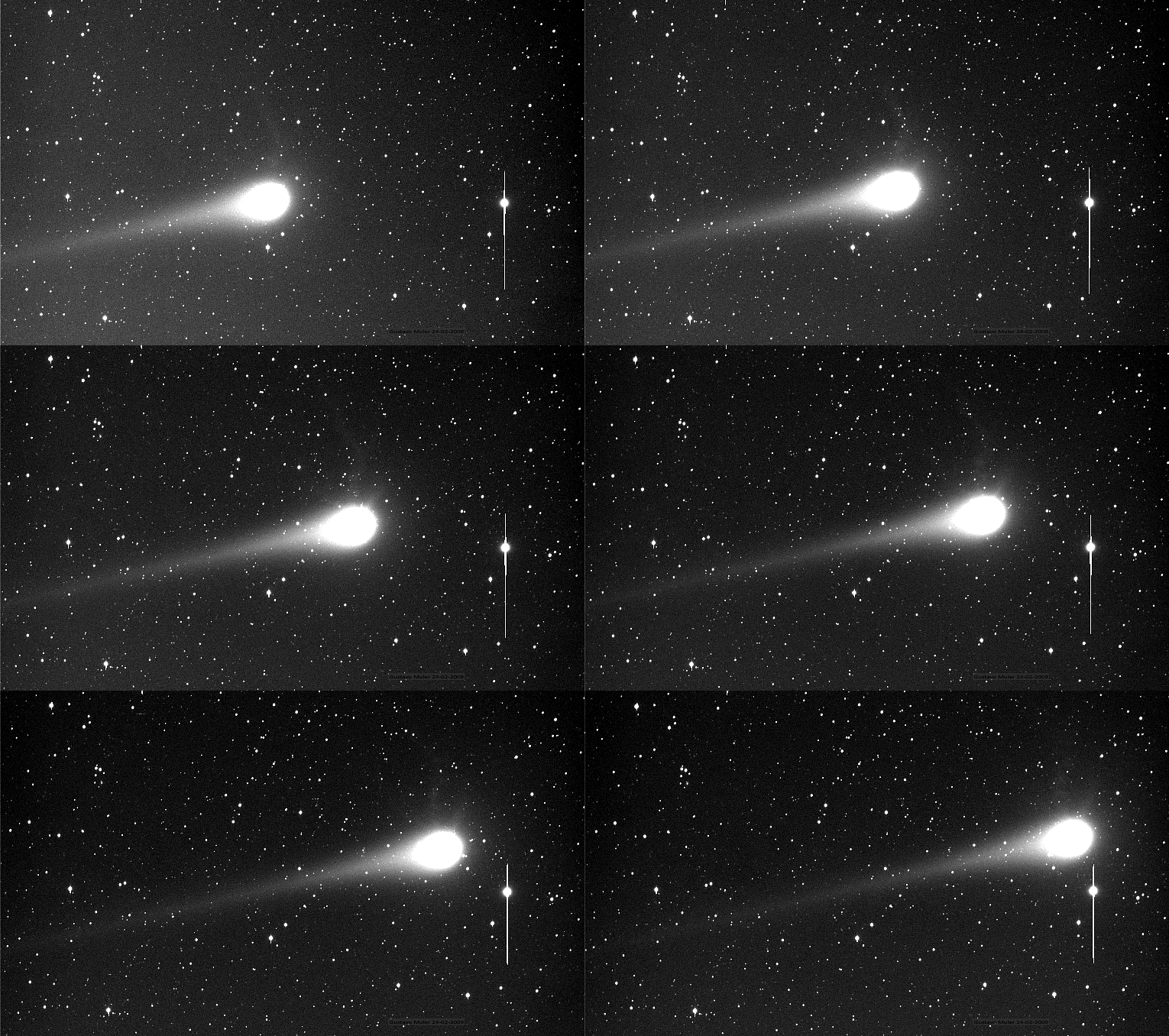
While never becoming an obvious naked-eye spectacular, comet Lulin was a pretty impressive binocular sight in the last third of February when it was closest to the Earth and the Moon was out of sight: This blogger cannot recall a case when a comet's dusty anti-tail had been visible so easily - and so long, several degrees - with little optical help. Even under bad conditions Lulin could be found. It was mainly astrophotographers, though, who could also catch the geometrically shortened but highly variable plasma tail: While not exactly a "textbook" comet (with the most obvious tail pointing in the 'wrong' direction), Lulin is certainly a unique case to remember. But now the Moon is rapidly creeping closer - and will actually occult the comet in less than a week. Some highlights of March, which will actually begin with a surprise visit!
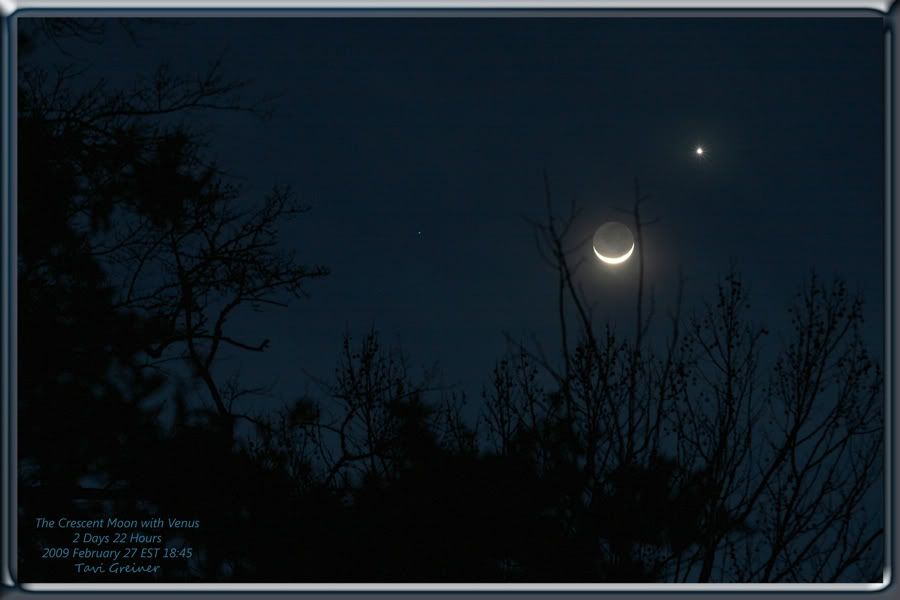
In other news there was again a nice conjunction of the Moon and Venus: pictures of Feb. 28 from Tenerife and India, Feb. 27 from the U.S. (more, more, more, more), Tenerife, India (more in the stream) and Australia (more pics) and Feb. 26 from Tenerife. • A few days earlier a "massing" in the (Southern) morning sky: pictures of Feb. 24, Feb. 23 (APOD; more) and Feb. 22. • A moonrise with omega effect had considerable media impact - and on the same day this blogger caught an omega sunset from Tenerife, after witnessing an omega sunrise in eclipse in 2006. • The weather prospects for the 2010 ASE, the aurora from Norway and the ISS over Puerto Rico. • And this blog was mentioned in a blog on the recovery of meteorites (also many earlier entries!) from the Texas fireball - soon eight were found by the various searchers. • And a meteorite related to the predicted Sudan bolide has been found!
- March 2 around 13:30 UTC: Newly discovered Near Earth Asteroid 2009 DD45 will pass only some 70,000 km from the center of the Earth, when the body of roughly 20 m diameter should briefly reach 10th magnitude.
- March 5: Lulin passes 2° from the open star cluster Messier 44, but the Moon is already a problem.
- March 7: Lulin is occulted by the Moon (which is almost full) in parts of the world.
- March 8: Saturn in opposition, +0.5 mag. in Leo.
- March 15: Lulin passes the Eskimo Nebula.
- March 16 to 28: Another GLOBE at Night event.
- March 20: Sun-Earth Day, mainly a U.S. event.
- March 22: Venus reaches extreme northern latitude, is evening and morning star; inferior conjunction on March 28.
- March 28: At 20:30 local time another Earth Hour in selected cities where the lights go out.






In other news there was again a nice conjunction of the Moon and Venus: pictures of Feb. 28 from Tenerife and India, Feb. 27 from the U.S. (more, more, more, more), Tenerife, India (more in the stream) and Australia (more pics) and Feb. 26 from Tenerife. • A few days earlier a "massing" in the (Southern) morning sky: pictures of Feb. 24, Feb. 23 (APOD; more) and Feb. 22. • A moonrise with omega effect had considerable media impact - and on the same day this blogger caught an omega sunset from Tenerife, after witnessing an omega sunrise in eclipse in 2006. • The weather prospects for the 2010 ASE, the aurora from Norway and the ISS over Puerto Rico. • And this blog was mentioned in a blog on the recovery of meteorites (also many earlier entries!) from the Texas fireball - soon eight were found by the various searchers. • And a meteorite related to the predicted Sudan bolide has been found!

Thursday, February 19, 2009
Texas fireball leads to meteorite finds, other side effects
Several meteorites - one specimen already identified as a chondrite - have been recovered a few days after a spectacular daylight fireball was seen over Texas on February 15th. (Minutes after the event interesting radar echos had been detected high in the atmosphere, with the physical explanation less clear; there is also a report of a persistent smoke trail.) So this is an astronomy/planetary science story now - but it hadn't always been that way: While astronomically minded folks looking at the video of the fireball (also here from this source as well as here and here and on YouTube numerous times) immediately concluded that it had to be a meteor and not a satellite reentry, seemingly official claims that the sky show that something to do with the satellite collision five days earlier had momentarily confused even those who somehow knew it couldn't be - let alone the mass media often consulting the wrong 'experts'.
Even the New York Times spoke of a "mystery" with the "origin unknown" over a day after everything was clear! And Space.com carried only the wrong story for two days before having an update. The Texas fireball/meteorite dropper was thus also an interesting social study - and for the first hours it seems to have played out mainly on Twitter where it all started with this "news" tweet. Soon the story was all over the place, with a disturbing lack of "normal" news coverage - which followed eventually. News of what it really was had a hard time to percolate through the 'hive mind', though, and a day later "mystery" tales dominated the feeds.
Here's a sampling of the bewildered news stories to which a strange weather advisory and a mysterious NOTAM as well as a short-lived reentry scare in Canada certainly contributed, in roughly chronological order of their first publication (often they were then updated several times): AP, KEYE, WacoTrib, Fox, CNN, Houston Chr., My San Antonio, Dallas News, Star Telegram, Statesman and Bild, an iReport (using a file picture for illustration) and some other blog coverage (also here and here, where a blogger/reporter actually plotted the trajectory of the fireball). • Interestingly the Texas fireball was not the only one making news: Two days earlier there had been cases in Kentucky (more and an article) and Italy (the picture). • The first papers on the fresh Canadian meteorites of last year are out. • And a pioneer of NEO research has died already in January.
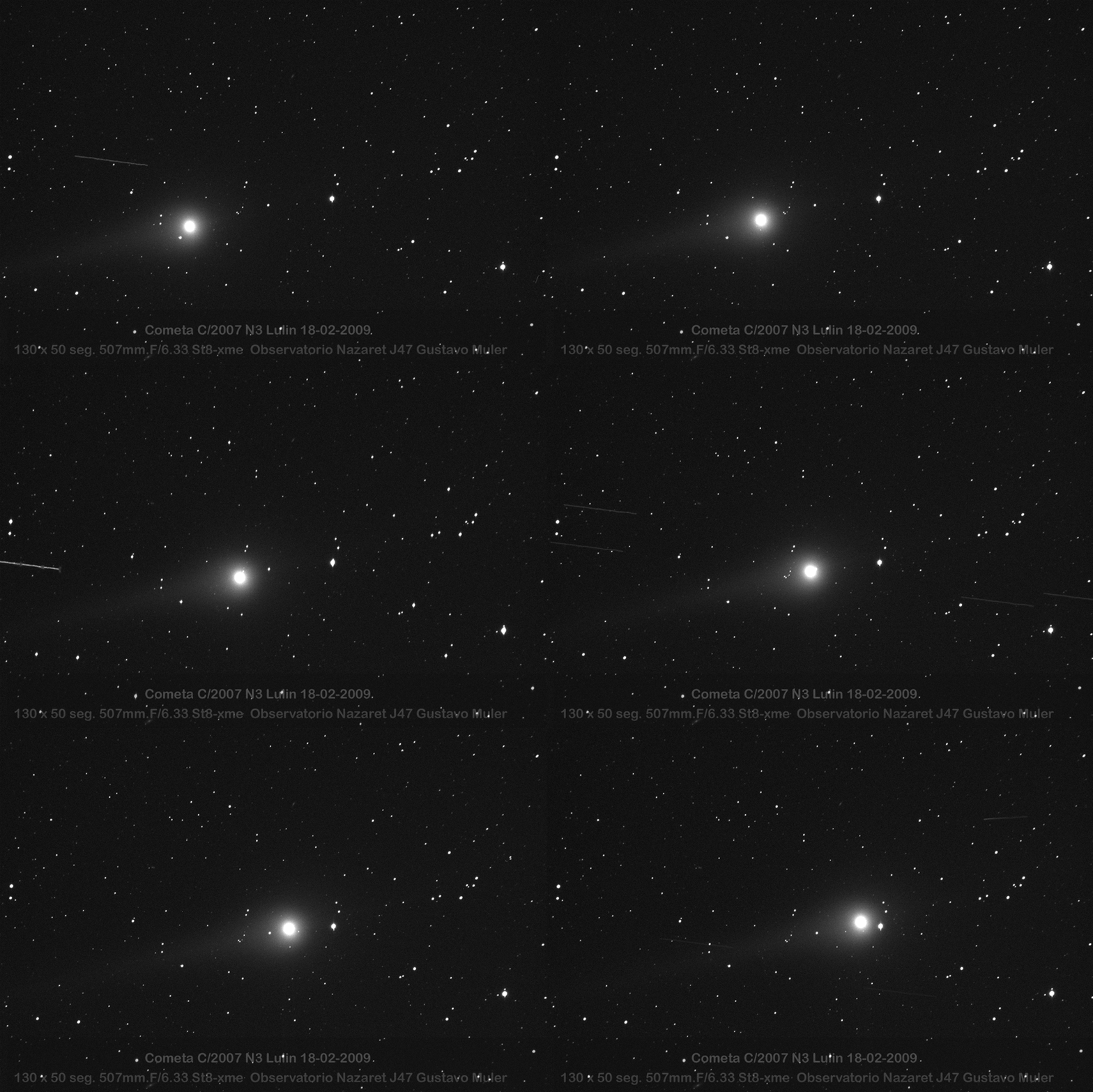
In other news the best viewing window for comet Lulin has begun: observations of Feb. 19 (more and also about a coma asymmetry), Feb. 18 (more), Feb. 17 (a spectacular animation from this site; also Slooh pictures first reported here), Feb. 16 (more; the comet was estimated at 5.3 mag. that day) and Feb. 15 (before that day the Moon was too bright and close), various observing reports, pictures on Flickr and many articles (more, more, more, more and more) plus a weird reaction by Lulin's discoverer ... • Comet 33P/Daniel underwent a small outburst and looked like this, but it's over. • Here is an impressive movie of the last penumbral lunar eclipse as seen from lunar orbit when the Earth rose with the Sun just emerging behind it!
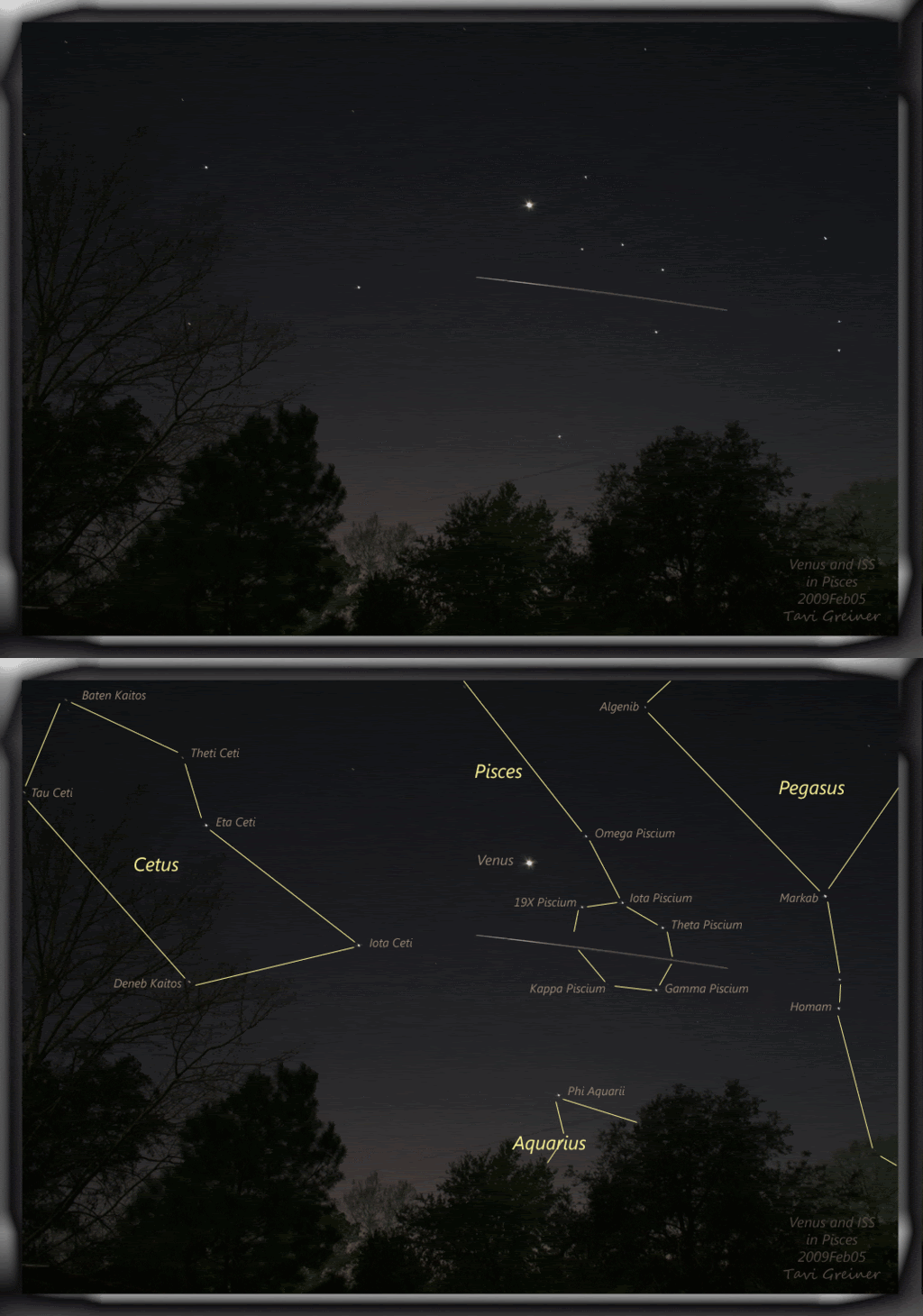
• The more south you are the better these days: Today there was a Mercury/Mars/Jupiter trio visible in the morning sky from Oz where the new Jupiter season is beginning and one can see five planets during the night. • Saturn will experience a quadruple satellite transit on Feb. 24. • And Venus is brighter than ever and frequent UFO trigger now. • Did something strange happen to RX Lyrae last year as this picture may show? • CV V630 Cas may be acting up. • The 2nd Galaxy Zoo has been launched, with reports here, here, here, here, here and here. • Astrometry.net on Flickr is making news. • A 150° star trail panorama from India, a Milky Way panorama from Mauna Kea, the zodiacal light from Tenerife, the coolest-looking observatories on Earth - and this blog and the related Twitter feed being hailed in the context of the Texas fireball, als is the Twitter feed here!
Even the New York Times spoke of a "mystery" with the "origin unknown" over a day after everything was clear! And Space.com carried only the wrong story for two days before having an update. The Texas fireball/meteorite dropper was thus also an interesting social study - and for the first hours it seems to have played out mainly on Twitter where it all started with this "news" tweet. Soon the story was all over the place, with a disturbing lack of "normal" news coverage - which followed eventually. News of what it really was had a hard time to percolate through the 'hive mind', though, and a day later "mystery" tales dominated the feeds.
Here's a sampling of the bewildered news stories to which a strange weather advisory and a mysterious NOTAM as well as a short-lived reentry scare in Canada certainly contributed, in roughly chronological order of their first publication (often they were then updated several times): AP, KEYE, WacoTrib, Fox, CNN, Houston Chr., My San Antonio, Dallas News, Star Telegram, Statesman and Bild, an iReport (using a file picture for illustration) and some other blog coverage (also here and here, where a blogger/reporter actually plotted the trajectory of the fireball). • Interestingly the Texas fireball was not the only one making news: Two days earlier there had been cases in Kentucky (more and an article) and Italy (the picture). • The first papers on the fresh Canadian meteorites of last year are out. • And a pioneer of NEO research has died already in January.

In other news the best viewing window for comet Lulin has begun: observations of Feb. 19 (more and also about a coma asymmetry), Feb. 18 (more), Feb. 17 (a spectacular animation from this site; also Slooh pictures first reported here), Feb. 16 (more; the comet was estimated at 5.3 mag. that day) and Feb. 15 (before that day the Moon was too bright and close), various observing reports, pictures on Flickr and many articles (more, more, more, more and more) plus a weird reaction by Lulin's discoverer ... • Comet 33P/Daniel underwent a small outburst and looked like this, but it's over. • Here is an impressive movie of the last penumbral lunar eclipse as seen from lunar orbit when the Earth rose with the Sun just emerging behind it!

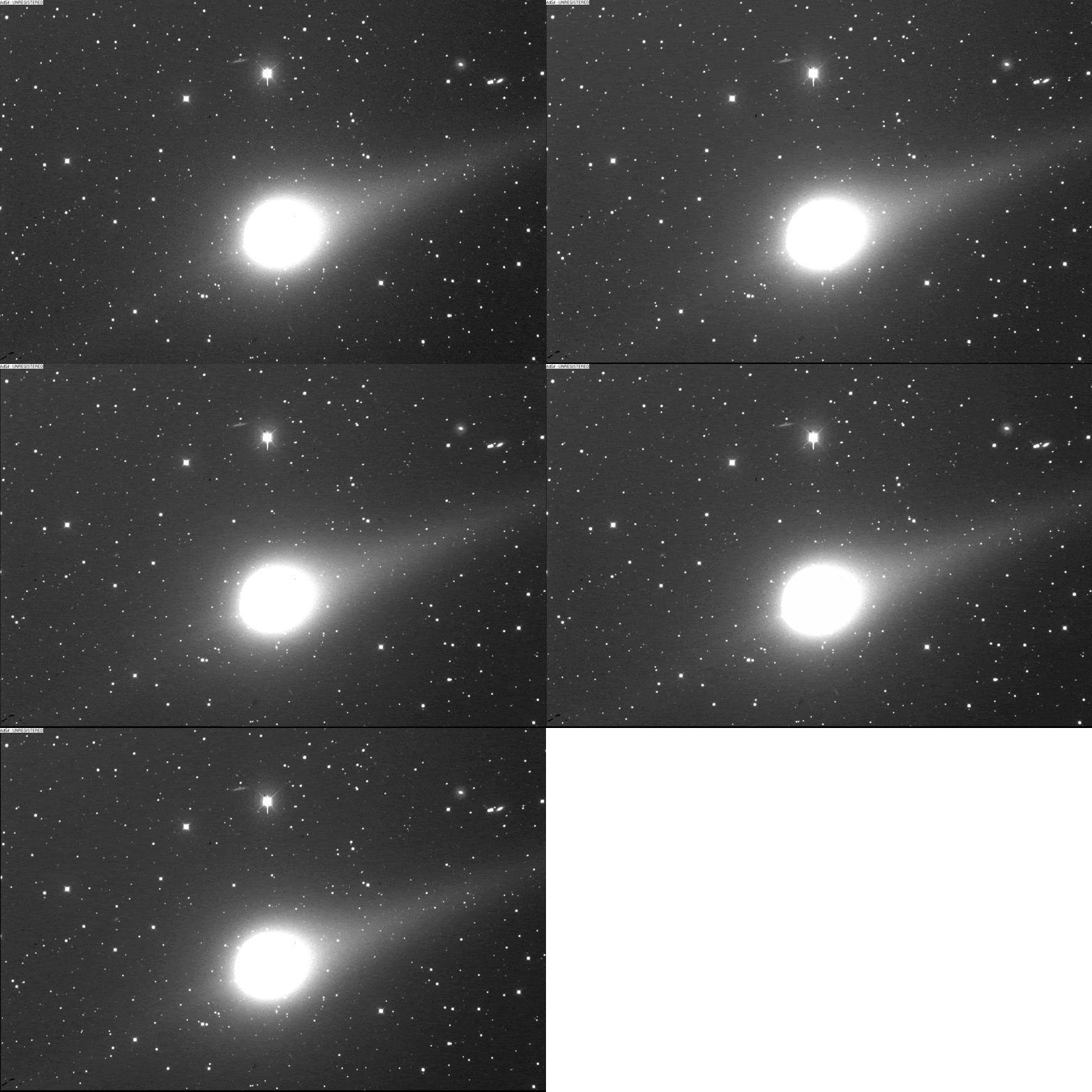
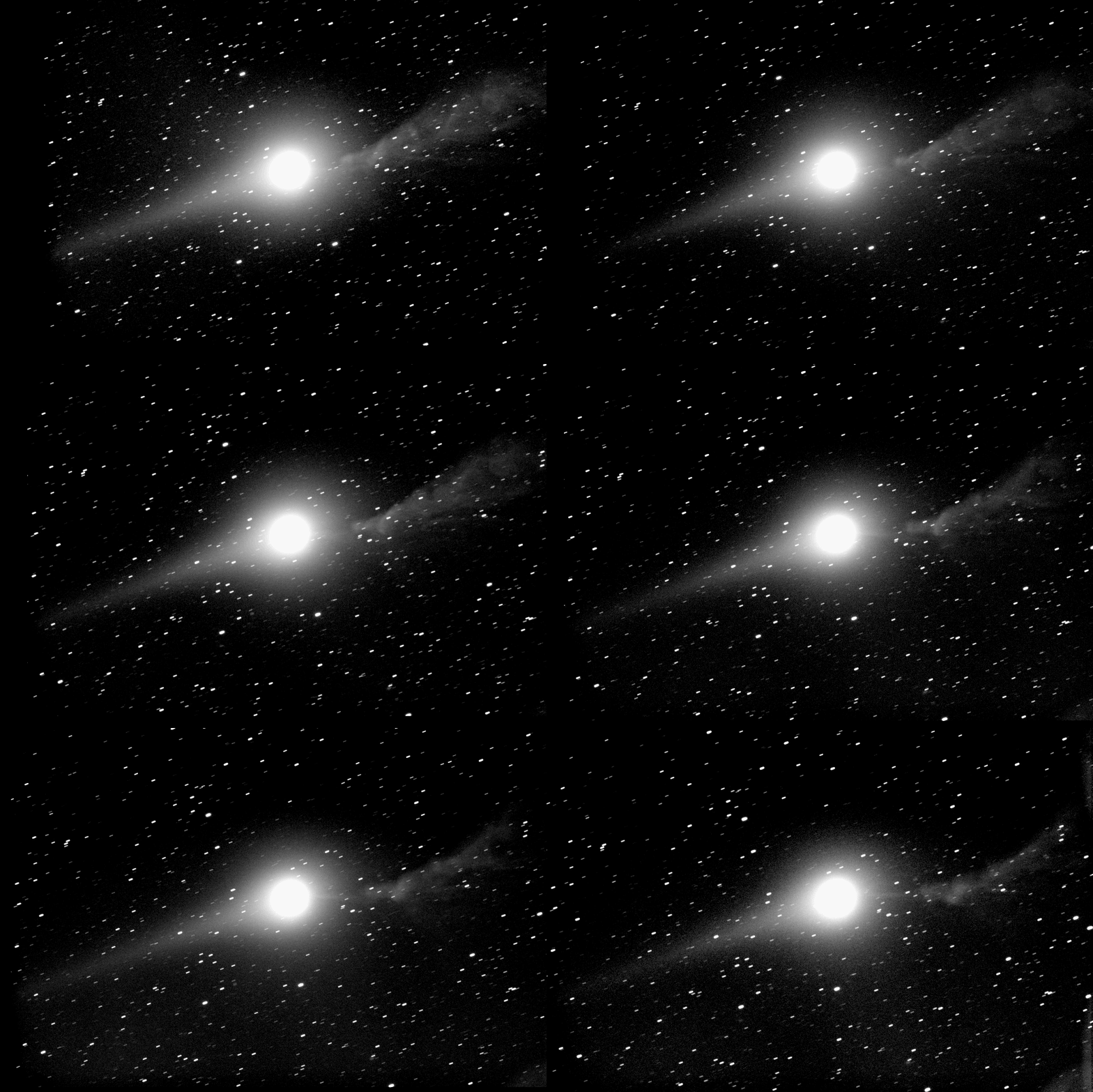
• The more south you are the better these days: Today there was a Mercury/Mars/Jupiter trio visible in the morning sky from Oz where the new Jupiter season is beginning and one can see five planets during the night. • Saturn will experience a quadruple satellite transit on Feb. 24. • And Venus is brighter than ever and frequent UFO trigger now. • Did something strange happen to RX Lyrae last year as this picture may show? • CV V630 Cas may be acting up. • The 2nd Galaxy Zoo has been launched, with reports here, here, here, here, here and here. • Astrometry.net on Flickr is making news. • A 150° star trail panorama from India, a Milky Way panorama from Mauna Kea, the zodiacal light from Tenerife, the coolest-looking observatories on Earth - and this blog and the related Twitter feed being hailed in the context of the Texas fireball, als is the Twitter feed here!
Thursday, February 12, 2009
Penumbral eclipse was evident - when weather, longitude were right
You could do it like in Turkey where they arranged lunar watching parties on the evening of Feb. 9th to celebrate the eclipse after it was over - but it surely was more fun much farther East when the penumbral lunar eclipse could actually be seen and was pretty obvious: Here are good pictures from Oz and more, reports from the Philippines (with pictures), Australia and India (another and another report). The eclipse was also used for a StarPeace event on the Indian-Pakistan border; when the full Moon rose in Europe, the eclipse was over, of course. Here is that moonrise with an omega effect, i.e. an inferior mirage. • Yet more great pictures of the annular solar eclipse from Indonesia have become available - and here you can download a perfect view of the 2nd contact (by the same photographer) with a few Baily's Beads! • While here a connection between the Israeli elections and total eclipses is made ...
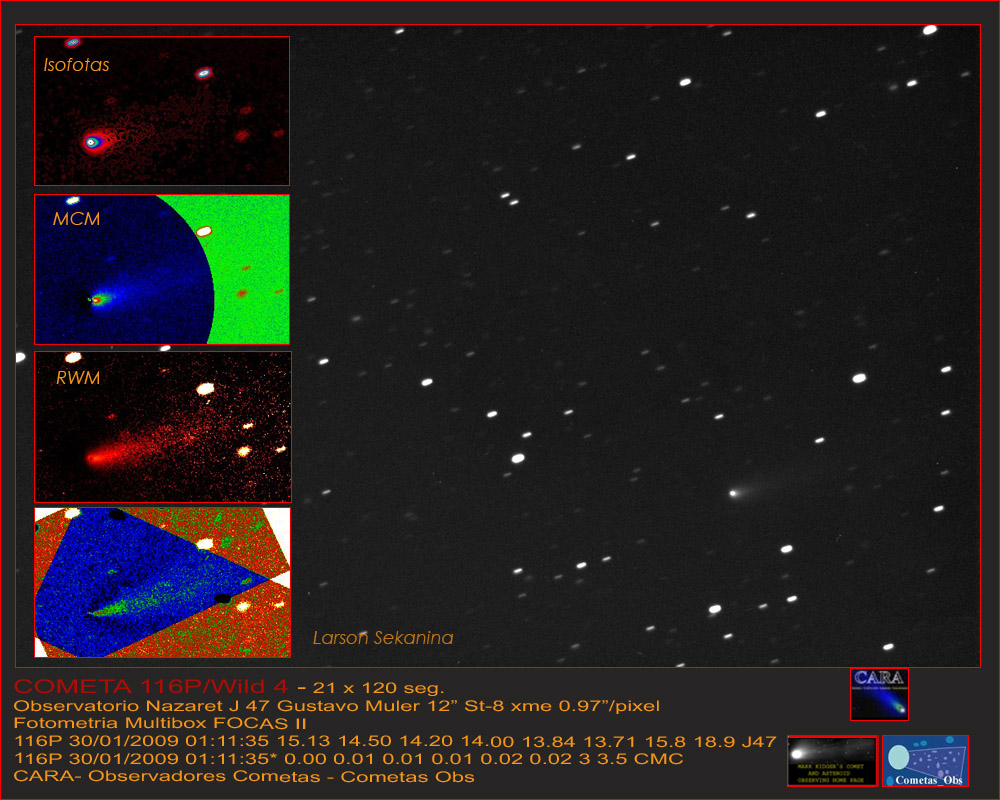
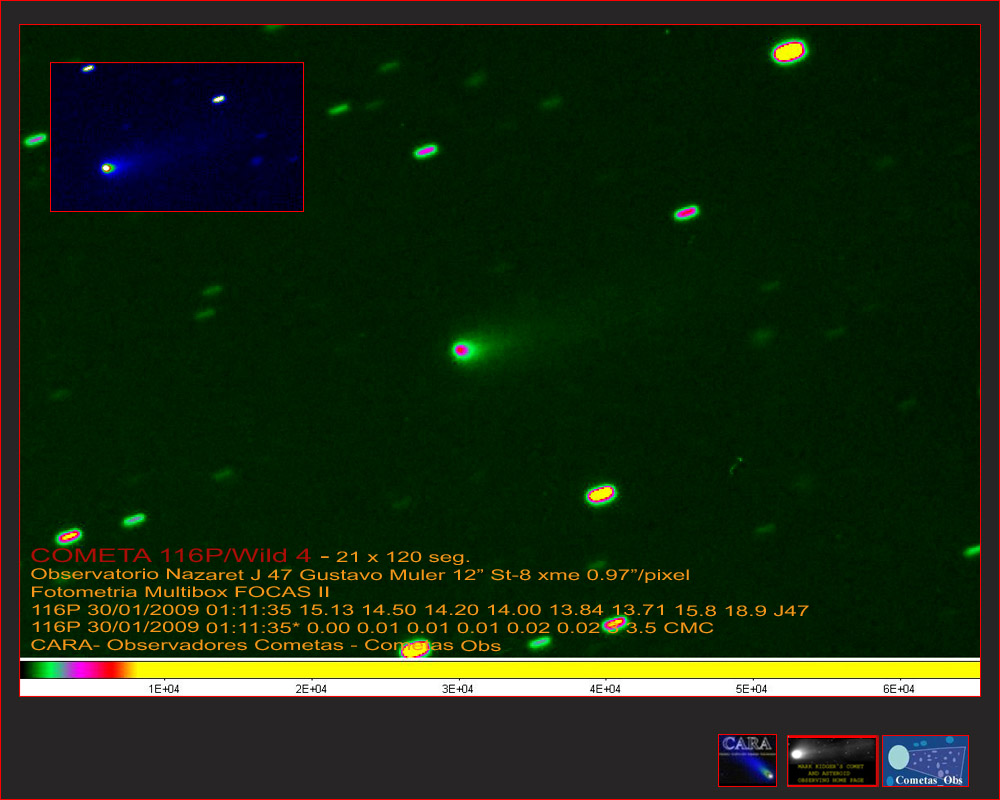
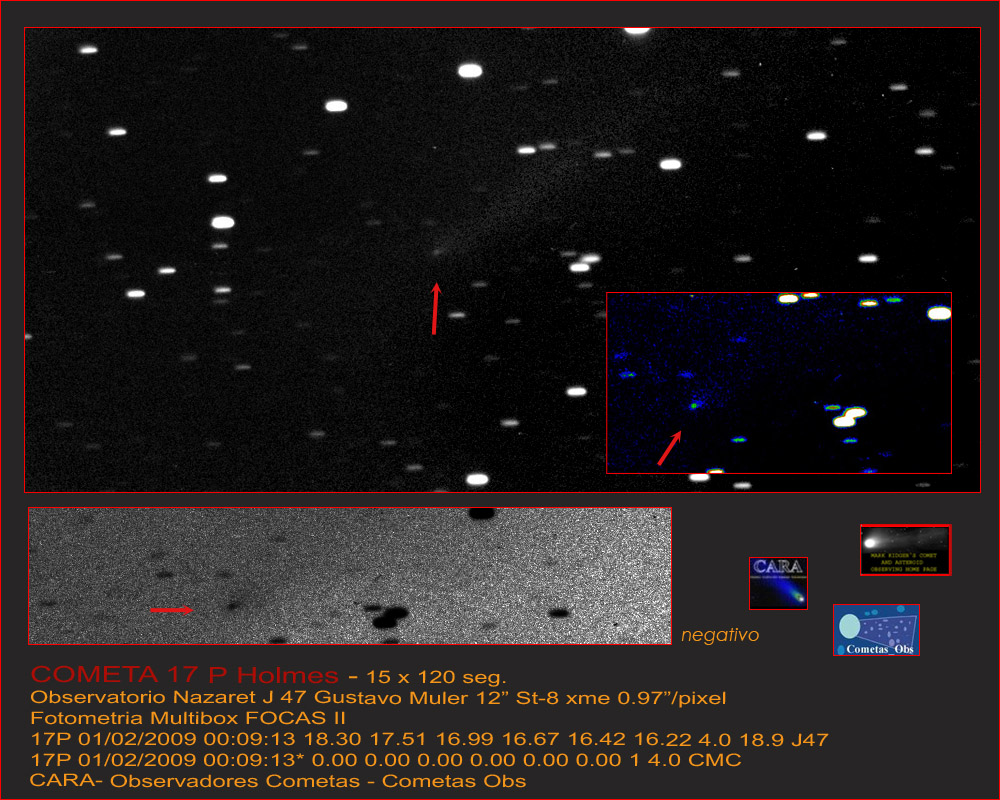
In other news comet Lulin is hard to observe right now because of the waning Moon nearby, but when it peaks around 5th mag., it'll be in the dark again (and visible in the full 2nd half of the night): pictures of Feb. 11 and Feb. 9 (processed) and visual observations up to Feb. 7; also discussion of Lulin's plasma tail. The NASA talk about an in principle poisonous gas in Lulins coma has led to some unfortunate headlines, also in Germany (where this tabloid headline says "green poison comet races by Earth" ...). The comet's appearance has also been linked to the IYA. • Feb. 3 images of 116P and 29P.
• Here now an amateur detection of Saturn's E ring (some of the ring gaps have new names, by the way) and the moon Calypso, an observation of Dione in eclipse under the rings and a Titan transit on Feb. 8. • One may also wonder why Venus is so bright. • There is a Nova in the LMC. • The debris from the big satellite collision on Feb. 10 (see the Cosmic Mirror #325 for many links) is detectable by radar echos. • What is 1999 RQ36 up to? (Not much for now.) • Also NASA's SkyView, 35 stunnung hi-res public domain astro pics and 101 breathtaking near-IR landscape pics of this planet - where it's happy Darwin Day (nice drawing) today!
In other news comet Lulin is hard to observe right now because of the waning Moon nearby, but when it peaks around 5th mag., it'll be in the dark again (and visible in the full 2nd half of the night): pictures of Feb. 11 and Feb. 9 (processed) and visual observations up to Feb. 7; also discussion of Lulin's plasma tail. The NASA talk about an in principle poisonous gas in Lulins coma has led to some unfortunate headlines, also in Germany (where this tabloid headline says "green poison comet races by Earth" ...). The comet's appearance has also been linked to the IYA. • Feb. 3 images of 116P and 29P.

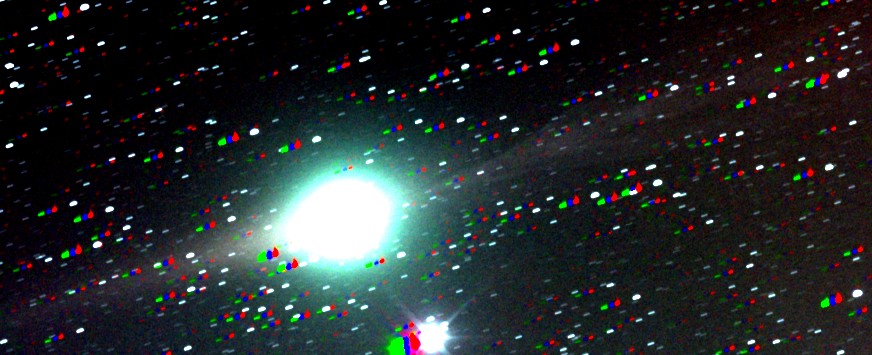
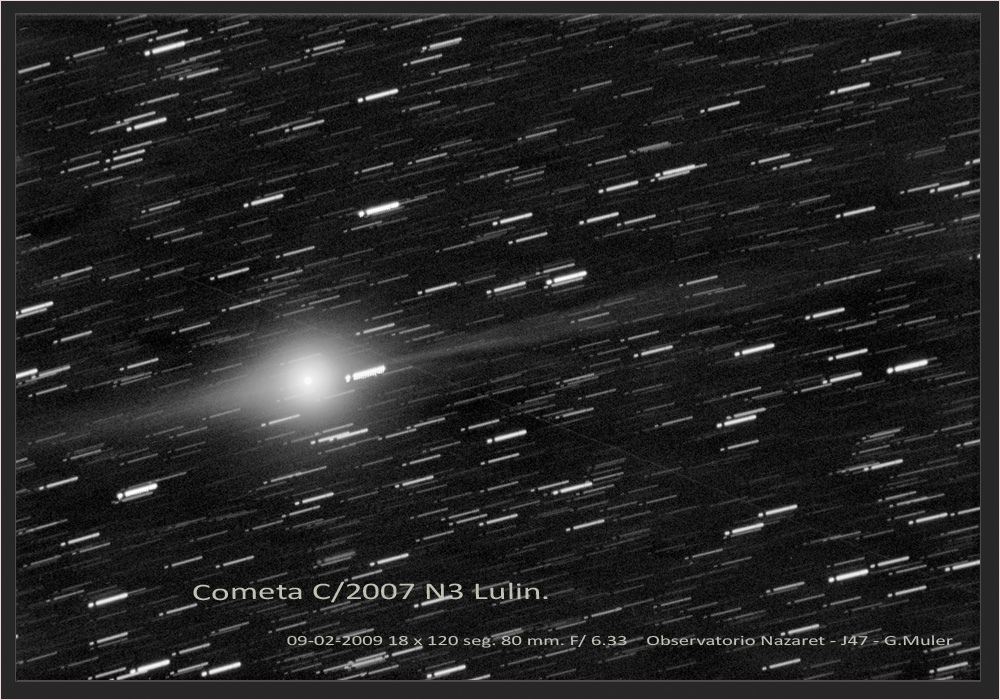
• Here now an amateur detection of Saturn's E ring (some of the ring gaps have new names, by the way) and the moon Calypso, an observation of Dione in eclipse under the rings and a Titan transit on Feb. 8. • One may also wonder why Venus is so bright. • There is a Nova in the LMC. • The debris from the big satellite collision on Feb. 10 (see the Cosmic Mirror #325 for many links) is detectable by radar echos. • What is 1999 RQ36 up to? (Not much for now.) • Also NASA's SkyView, 35 stunnung hi-res public domain astro pics and 101 breathtaking near-IR landscape pics of this planet - where it's happy Darwin Day (nice drawing) today!
Saturday, February 7, 2009
Lulin's ion tail excites astrophotographers - and first naked-eye sightings around 6,0 mag.
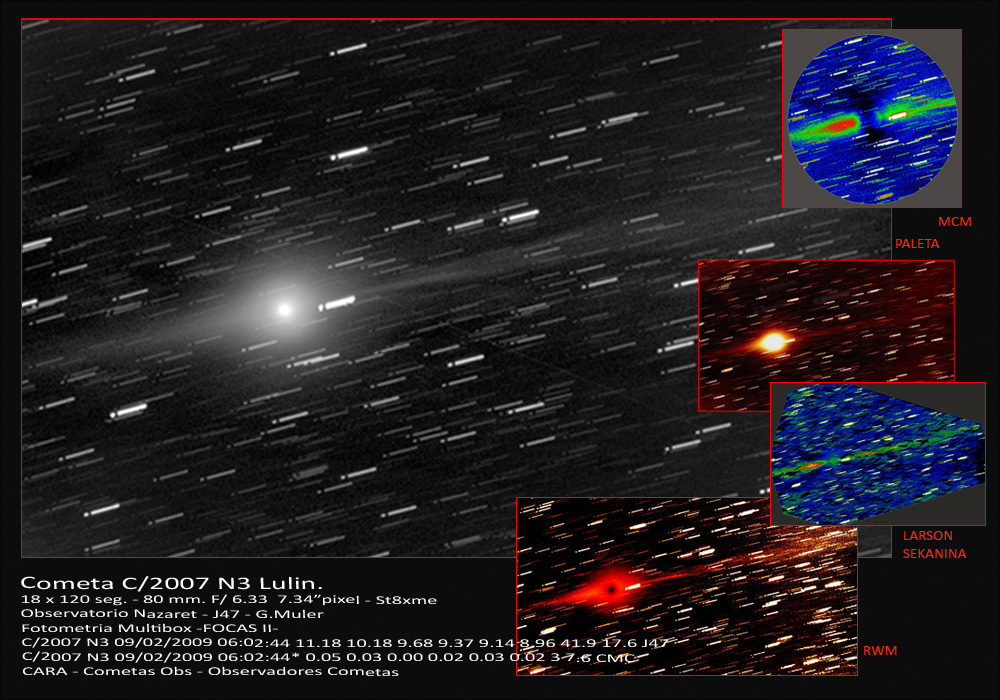
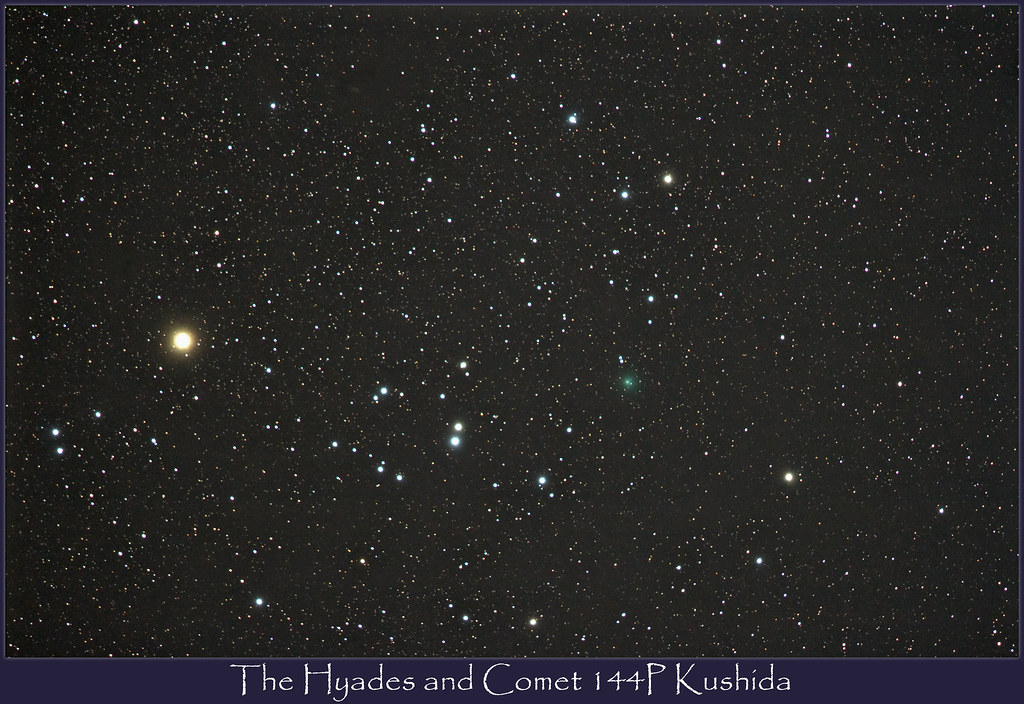
Just before the Moon began to spoil the view for the next 10 days or so, the comet Lulin show really got exciting: its faint ion tail, which has reached some 2° in length, is experiencing fast and complex effects in the solar wind confusing inexperienced observers (though perfectly normal, which includes a major disconnection event on Feb. 4) while the comet's coma - now estimated around 6,0 mag. - has been sighted occasionally with the naked eye in recent days, e.g. in Texas and India. The picture collections like this, this and this are growing; here are selected images and reports from Feb. 7 (pic, vis), Feb. 6 (pic w/long tail, pic, vis, vis), Feb. 5 (pic at Alpha Librae, pic from here, pic, pic, pics, widefield pic, vis), Feb. 4 (pics with the with DE, dito and Feb. 4 vs. Jan. 31 pics), Feb. 3 (pics, pic, pic, vis w/naked-eye averted), Feb. 2 (pic w/tail effects, pic, widfield pic at dawn) and Feb. 1 (pic, pic, pic described here) plus more Lulin articles here, here, here, here and here. • More interesting comet pictures show 77P "facing" two galaxies and 144P in the Hyades on Feb. 2 and Jan. 31, described here.
In other news there will be a transit of Titan on Saturn's disk in the night Feb. 8/9 visible e.g. in Oz; here is an animation of an earlier such event, also seen from down under. Meanwhile the rings have opened a bit again as beautiful images from Feb. 4 (another one, explained here) and Feb. 3 (another one; no data) show. And an amateur has used the almost edge-on view to image Calypso, a small satellite of Saturn! • Amateurs were also involved in observations of a stellar occultaton by Titania of Uranus long ago. • And bright evening "star" Venus is causing UFO alerts around the world. • The penumbral lunar eclipse on Feb. 9/10 following the annular spectacular will mainly be an Asian/Oceanian event with nothing to see e.g. in Germany where it's being discussed nonetheless. So how about Clavius at 200 m/pxl?! • Several asteroid sizes have been measured by optical interferometry while a new PHA isn't exactly hazardous: According to the first orbit it has a mere impact probability of < 1 in 100 million in 2046.
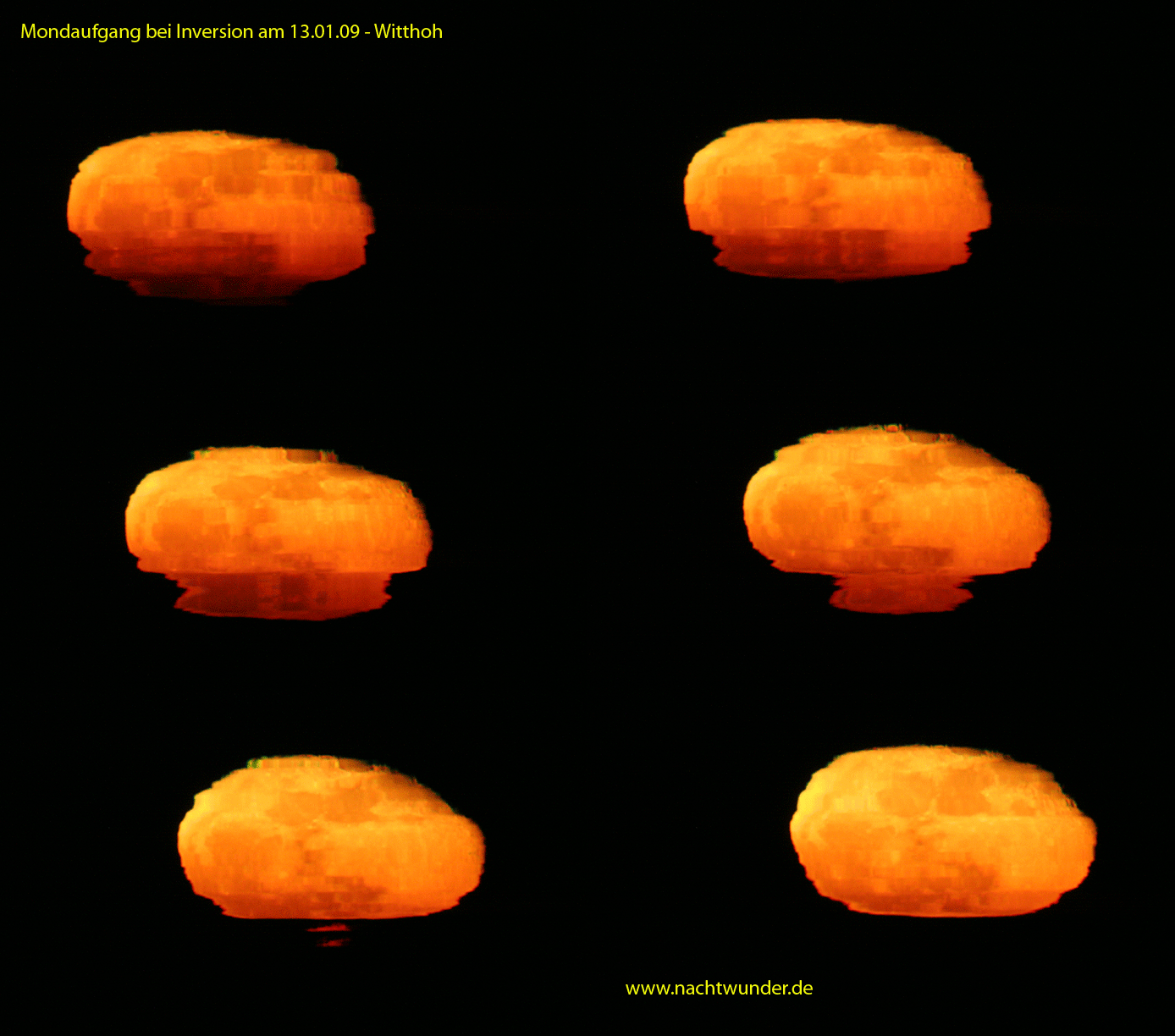
• Here is a Call for Monitoring for a planetary transit of HD 80606 which has been much in the news lately: Around Valentine's Day it could experience a long primary eclipse. Meanwhile the lightcurve of Eta Carinae is doing interesting things. • Brilliant aurora images from Tromso have been published; this one is particularly stunning. And a weird distorted moonrise was imaged recently - the animation is particularly stunning. • Here is a portrait of satellite watchers, a species of amateur astronomers also known for hi-res pics of the ISS in front of or next to the Moon or even transiting Venus. Or just passing by, a frequent view. • Finally, the Chambliss Award for Amateur Achievement for 2008 has been awarded to Steve Mandel, a new sensor material could revolutionize CCD chips - and here is a great collection of digital space art, in case the real Universe isn't enough. :-)


In other news there will be a transit of Titan on Saturn's disk in the night Feb. 8/9 visible e.g. in Oz; here is an animation of an earlier such event, also seen from down under. Meanwhile the rings have opened a bit again as beautiful images from Feb. 4 (another one, explained here) and Feb. 3 (another one; no data) show. And an amateur has used the almost edge-on view to image Calypso, a small satellite of Saturn! • Amateurs were also involved in observations of a stellar occultaton by Titania of Uranus long ago. • And bright evening "star" Venus is causing UFO alerts around the world. • The penumbral lunar eclipse on Feb. 9/10 following the annular spectacular will mainly be an Asian/Oceanian event with nothing to see e.g. in Germany where it's being discussed nonetheless. So how about Clavius at 200 m/pxl?! • Several asteroid sizes have been measured by optical interferometry while a new PHA isn't exactly hazardous: According to the first orbit it has a mere impact probability of < 1 in 100 million in 2046.


• Here is a Call for Monitoring for a planetary transit of HD 80606 which has been much in the news lately: Around Valentine's Day it could experience a long primary eclipse. Meanwhile the lightcurve of Eta Carinae is doing interesting things. • Brilliant aurora images from Tromso have been published; this one is particularly stunning. And a weird distorted moonrise was imaged recently - the animation is particularly stunning. • Here is a portrait of satellite watchers, a species of amateur astronomers also known for hi-res pics of the ISS in front of or next to the Moon or even transiting Venus. Or just passing by, a frequent view. • Finally, the Chambliss Award for Amateur Achievement for 2008 has been awarded to Steve Mandel, a new sensor material could revolutionize CCD chips - and here is a great collection of digital space art, in case the real Universe isn't enough. :-)
Sunday, February 1, 2009
More fascinating solar eclipse pics, stories - while February just has a penumbral lunar one
There has been a lot more coming in from the annular solar eclipse of 26 January or from its partial manifestation away from the narrow antumbral track - although the picture shown in this DLR press release does not show the latter but, as a comparision with this NASA image release reveals, the umbra of the 2006 total eclipse. A Google search for ISS images of the antumbra of 2009 came up empty, so it's not clear whether it was photographed at all. Back on the ground this collection at Bosscha Obs. has some of the best annularity views from Indonesia. There are also an interesting report from Indonesian TV (no annularity, though), some pictures and a video from Anyer, a report from Indonesia (followup) and another one. (These Indonesian stories brought back intense memories to this blogger who experienced his first total solar eclipse in this beautiful country 25½ years ago; reports from other 1983 trips are here, here, here, here and here. Sigh ...)
From partial zone we have yet another Manila sunset and partial phases from Thailand (also with a bird and at sunset, also here, and lots more pics), Sri Lanka and Mauritius. This eclipse was the first somewhat unusual sky event of the International Year of Astronomy and so the connection was made in South Africa (where some eclipse fashion was on display), Sri Lanka (more pictures) and Australia. Finally, here are 19 big and 66 small wire service pics - which showed up, uncredited, in many private websites ... Legally more sound, here are a big (German) review of the event and its new media impact plus a crappy German TV preview. All eyes are already on the next - total - eclipse (which will be a logistical nightmare for Japan), while still new videos of the last TSE turn up (the 2nd one is pretty funny; it happens at 1:04). February, meanwhile, will just serve us the least impressive of all eclipses, a penumbral lunar case. The month - some previews here, here, here, here and hier - will bring:
Views of the Moon passing Venus have been widely appreciated (and caused some UFO alarm in Germany): the situation on Jan. 31 in Germany (more), on Jan. 30 in the U.S., Germany (more, still more, earlier, still earlier and in full daylight), from India (two more in the stream and another one) and Australia plus more and on Jan. 29 from Hawaii, Canada (more in the stream), the U.S. (more) and Germany (more), Norway and Italy in daylight. • An amateur photometrist has already detected dozens of exoplanets in transit. • R CrB has been below 14 mag. since November. • The Sun's still inactive but that's good in general. • Here are some fine ISS close-ups from the end of January. • A weird halo has been seen in the Czech Republic. • And true atmospheric optics aficionados see similar phenomena in the kitchen, too. :-)
From partial zone we have yet another Manila sunset and partial phases from Thailand (also with a bird and at sunset, also here, and lots more pics), Sri Lanka and Mauritius. This eclipse was the first somewhat unusual sky event of the International Year of Astronomy and so the connection was made in South Africa (where some eclipse fashion was on display), Sri Lanka (more pictures) and Australia. Finally, here are 19 big and 66 small wire service pics - which showed up, uncredited, in many private websites ... Legally more sound, here are a big (German) review of the event and its new media impact plus a crappy German TV preview. All eyes are already on the next - total - eclipse (which will be a logistical nightmare for Japan), while still new videos of the last TSE turn up (the 2nd one is pretty funny; it happens at 1:04). February, meanwhile, will just serve us the least impressive of all eclipses, a penumbral lunar case. The month - some previews here, here, here, here and hier - will bring:


- Feb. 9: Penumbral lunar eclipse, visible mainly in Asia and the Western U.S.
- Feb. 16 til March 3 (in particular Feb. 19 til 28): Best viewing window for comet Lulin - brightest and no Moon.
- Feb. 17: The Dawn spacecraft flies by Mars, will take some pictures for calibration purposes.
- Feb. 17: Mars and Jupiter only 0.8° apart in the morning sky.
- Feb. 19 or 20: Venus reaches largest brilliance, -4.6 to -4,8 mag.
- Feb. 22 and 23: Moon close to Mars, Jupiter and Mercury.
- Feb. 23/24: Lulin (moderately) close to Saturn.
- Feb. 24: Mercury, Mars & Jupiter closest together, in a 4° circle at dawn.
- Feb. 25: Ceres in opposition, should reach 6.9 mag.
- Feb. 27: Closer Venus-Moon conjunction than in January.
- Feb. 28: Lulin close to Regulus.


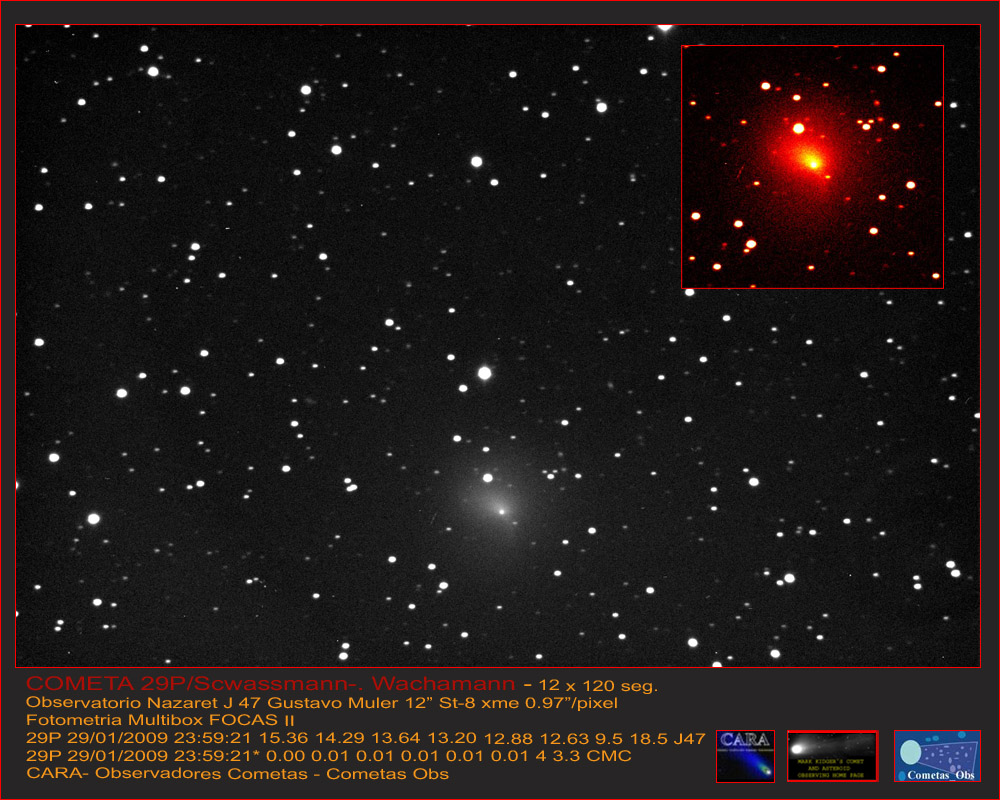
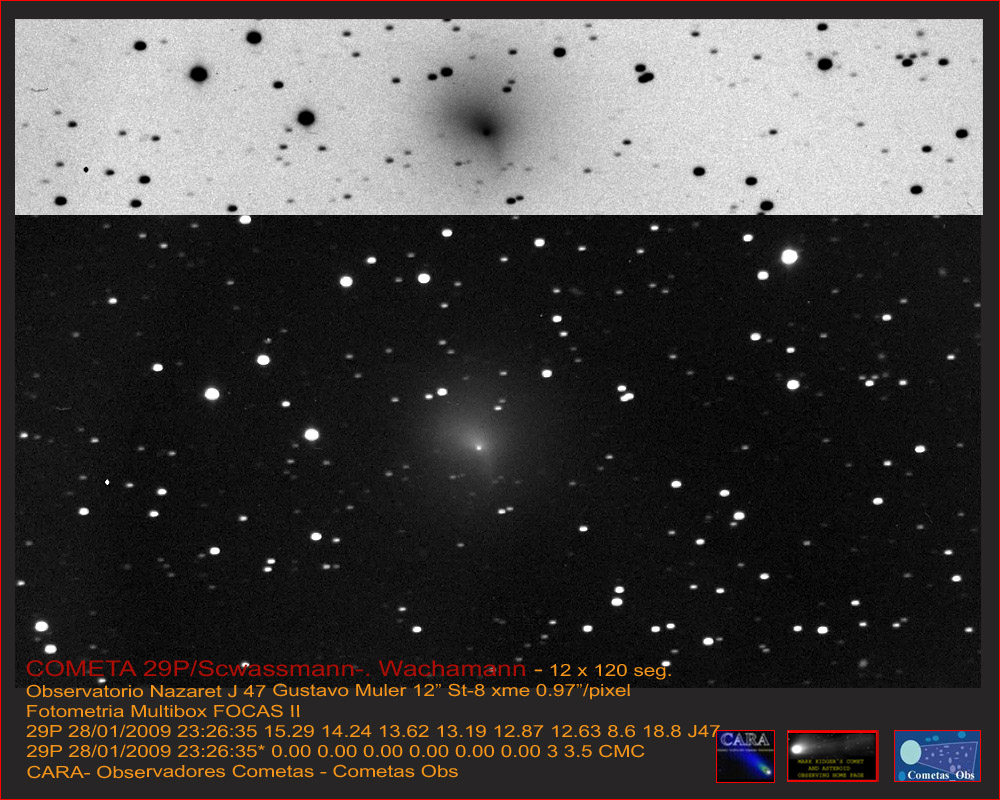
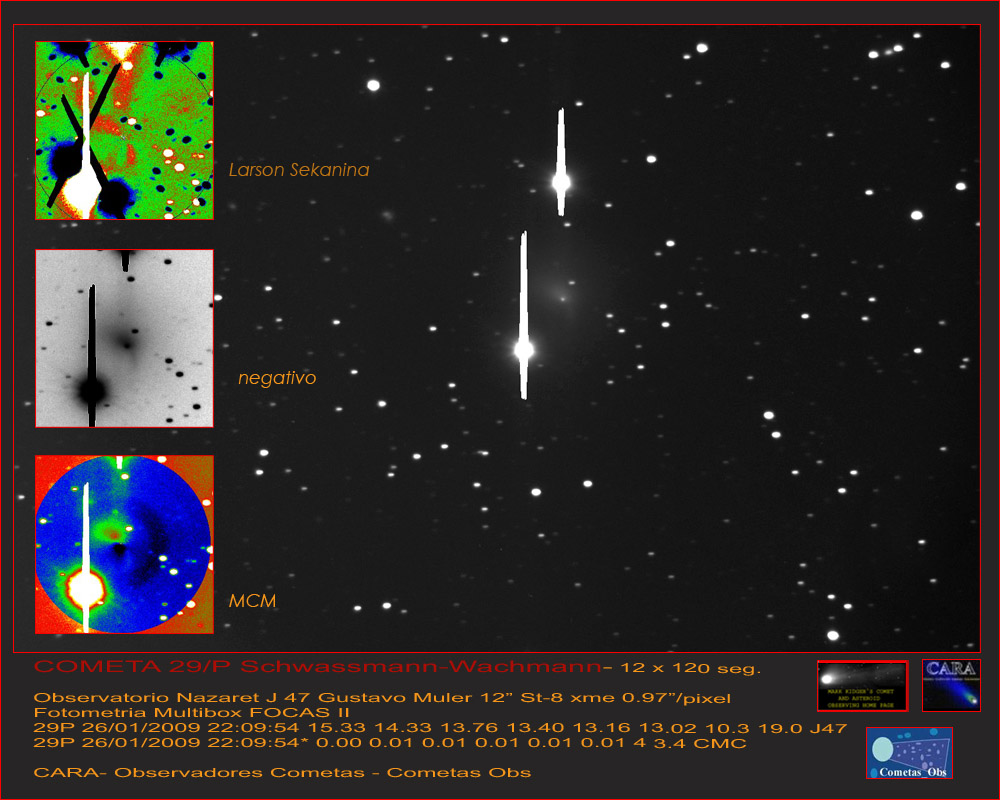


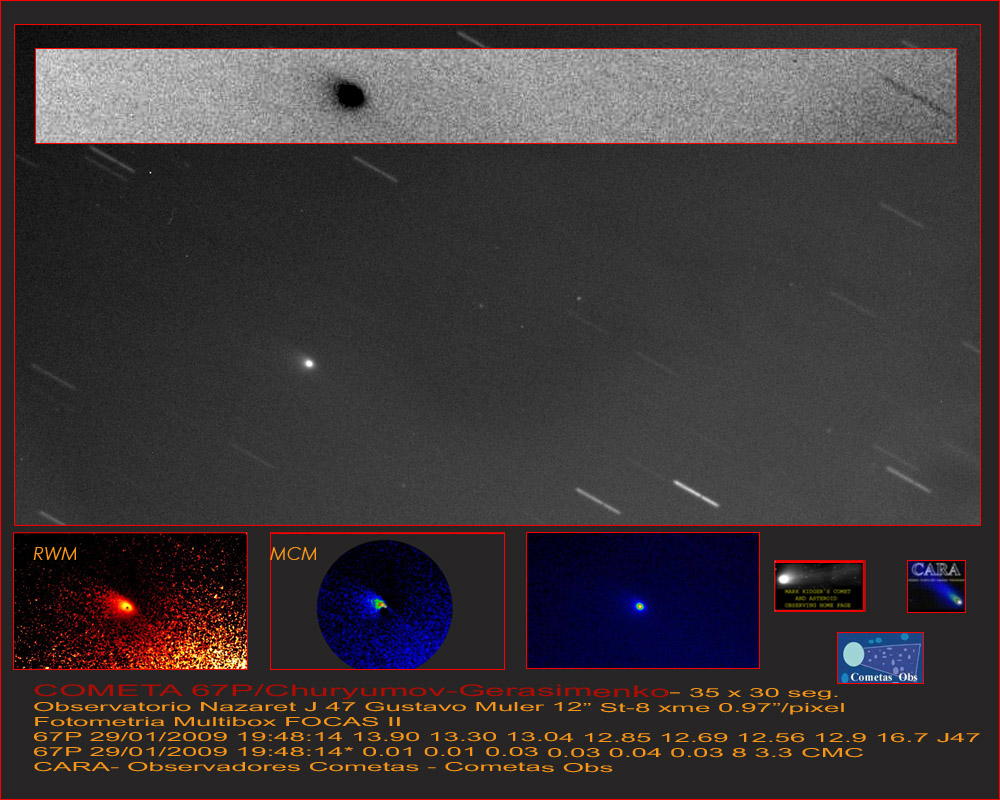

Views of the Moon passing Venus have been widely appreciated (and caused some UFO alarm in Germany): the situation on Jan. 31 in Germany (more), on Jan. 30 in the U.S., Germany (more, still more, earlier, still earlier and in full daylight), from India (two more in the stream and another one) and Australia plus more and on Jan. 29 from Hawaii, Canada (more in the stream), the U.S. (more) and Germany (more), Norway and Italy in daylight. • An amateur photometrist has already detected dozens of exoplanets in transit. • R CrB has been below 14 mag. since November. • The Sun's still inactive but that's good in general. • Here are some fine ISS close-ups from the end of January. • A weird halo has been seen in the Czech Republic. • And true atmospheric optics aficionados see similar phenomena in the kitchen, too. :-)
Tuesday, January 27, 2009
Yesterday's eclipse as an internet phenomenon: a first sampling
It hardly hit any solid ground and only in pretty remote spots of the planet - and yet thanks to the WWW and its old and new communications tools you could almost "be there" during the 26 January solar eclipse while frantically switching between various general 'social media' and highly specialized eclipse-related "feeds". In the early hours several true webcasts (with almost video rate) and open image collection sites, esp. Flickr and Twitpic, plus a special chatroom won hands down regarding speed, though the majority of the early images - access the individual screenshots via the "ase" tag - was poor (with a few really good ones scattered among them); the same was true for the early YouTube entries. With the hours passing after the antumbra had left the Earth, key "firsts" came every hour or so: the first clear image of a deep partial phase through clouds, stunning views of the partially eclipsed Sun setting in Manila Bay, then the first closed ring with hardly any clouds interfering. While most of Indonesia in the path of annularity was cloudy as expected, in several places it had been almost clear - while on the Cocos Islands it was raining like hell at the crucial time, smashing the hopes of the 11 eclipse chasers who had made it there.
As I write this, some 36 hours after it was over, high quality material has started to roll in through the "traditional" amateur astronomical channels, but I haven't seen an image of annularity with clearly visible Baily's Beads so far, let alome the chromosphere inbetween them - thus the Grand Prize of Annularity (easily served in 2005, for example) isn't in yet and may have been missed by the lucky few in the clear zones of Indonesia. But there are outstanding images aplenty - for example somewhat fuzzy TV material of the ring closing, seen here (with Spanish commentary), here (German; from second 56) and here (silent). The best still photos of the ring phase are probably these by an amateur (two more in the stream) from Bontang on Kalimantan and these from Reuters on Sumatra. But regarding "stunningness" they have hard competition from these gorgeous pictures (many in the stream!) from Manila - hardly ever has an eclipsed Sun been captured that clearly on the very horizon. The most convincing picture collections to date are probably those from SpaceWeather (starting with a fine animation of the ring closing), Flickr (an extremely huge set) and a South African IYA project (connected to this Flickr tag).
Special reports from the annularity zone have been received only from Indonesia's Anyer so far: Jay Pasachoff shows his results (heavy clouds but ring seen) and all pictures from the trip while Xavier Jubier has a small sampling. One of the webcast projects in Indonesia also has something to show - and report. From the partial zone reports have been found from Zamboanga City in the S. Philippines (pretty 'artsy' pics), Chennai (with more pictures) and Bangalore in India, Malaysia and Australia (another one). Amateur video clips of note come from Indonesia (another and another one), the Philippines and Malaysia. Selected pictures are worth highlighting from Jakarta (another stream and another pic probably from there) and Manila (probably); Manila shots also appear in the news media here (als #35) and here, while a view from Thailand was used here. And eclipse articles were found here, here, here, here, here, here, here (w/slide show), here, here, here, here and here. And while I'm frantically collecting further results, S. Krause is doing the same here.
As I write this, some 36 hours after it was over, high quality material has started to roll in through the "traditional" amateur astronomical channels, but I haven't seen an image of annularity with clearly visible Baily's Beads so far, let alome the chromosphere inbetween them - thus the Grand Prize of Annularity (easily served in 2005, for example) isn't in yet and may have been missed by the lucky few in the clear zones of Indonesia. But there are outstanding images aplenty - for example somewhat fuzzy TV material of the ring closing, seen here (with Spanish commentary), here (German; from second 56) and here (silent). The best still photos of the ring phase are probably these by an amateur (two more in the stream) from Bontang on Kalimantan and these from Reuters on Sumatra. But regarding "stunningness" they have hard competition from these gorgeous pictures (many in the stream!) from Manila - hardly ever has an eclipsed Sun been captured that clearly on the very horizon. The most convincing picture collections to date are probably those from SpaceWeather (starting with a fine animation of the ring closing), Flickr (an extremely huge set) and a South African IYA project (connected to this Flickr tag).
Special reports from the annularity zone have been received only from Indonesia's Anyer so far: Jay Pasachoff shows his results (heavy clouds but ring seen) and all pictures from the trip while Xavier Jubier has a small sampling. One of the webcast projects in Indonesia also has something to show - and report. From the partial zone reports have been found from Zamboanga City in the S. Philippines (pretty 'artsy' pics), Chennai (with more pictures) and Bangalore in India, Malaysia and Australia (another one). Amateur video clips of note come from Indonesia (another and another one), the Philippines and Malaysia. Selected pictures are worth highlighting from Jakarta (another stream and another pic probably from there) and Manila (probably); Manila shots also appear in the news media here (als #35) and here, while a view from Thailand was used here. And eclipse articles were found here, here, here, here, here, here, here (w/slide show), here, here, here, here and here. And while I'm frantically collecting further results, S. Krause is doing the same here.
Sunday, January 25, 2009
Annular eclipse less than 24 hours away: How much of it will be online?
The first of 2009's two full-silhouette eclipses is almost upon us: On Monday the shadow of the Moon will sweep across the Indian ocean, and while the antumbra makes little landfall, several countries will experience partial phases. Some eclipse chasers have actually made it into areas of annularity, though, and this being the 21st century they will attempt to webcast the ring of fire or at least e-mail pictures to certain websites shortly after the event. One expedition from India has made it to Indonesia and reports good weather: They are twittering their trip, but their webcast can only be seen by subscribers - or at the planetarium in New Delhi. Free webcasts from Indonesia could appear here and here, however, as several more foreign eclipse chasers are in the country, too (Jay Pasachoff has just sent these pictures from Jakarta). And a few others made it to the Cocos (Keeling) Islands in the Indian Ocean, reporting good and bad weather at eclipse time: Their reports and pictures appear here or on the front page of AstroNation, while in South Africa (which will experience a partial eclipse) pictures from all over the world will be collected here. Some articles on this eclipse appeared also in Australia (which won't see much on its mainland), on AFP and in Space.com - where mysteriously one of my 1992 pictures makes an appearance. The New Moon of 26 January also means the New Year for the traditional Chinese calendar. And talking about the Sun: In 2011 the STEREO s/c will - for the first time in history - see everything when they are 180° apart.
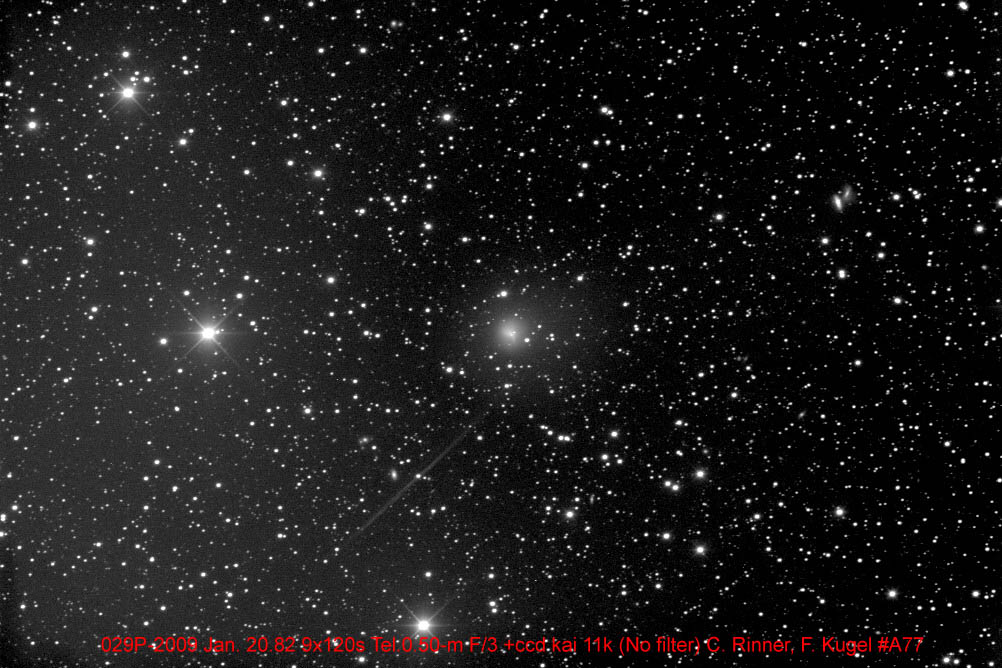
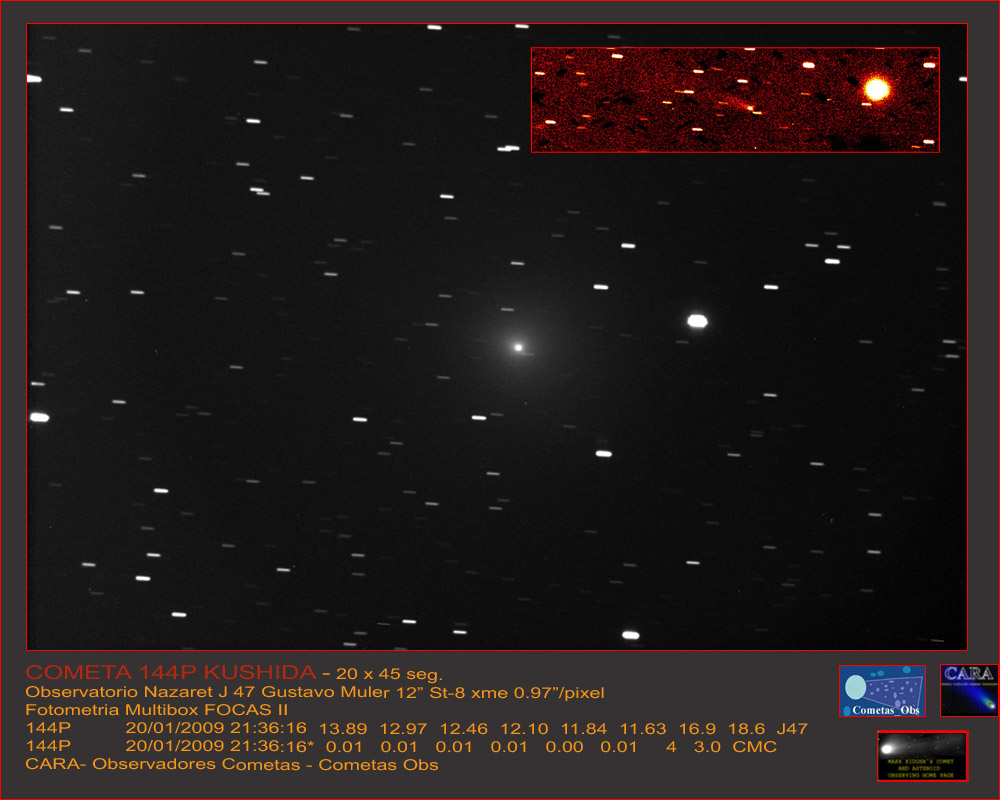
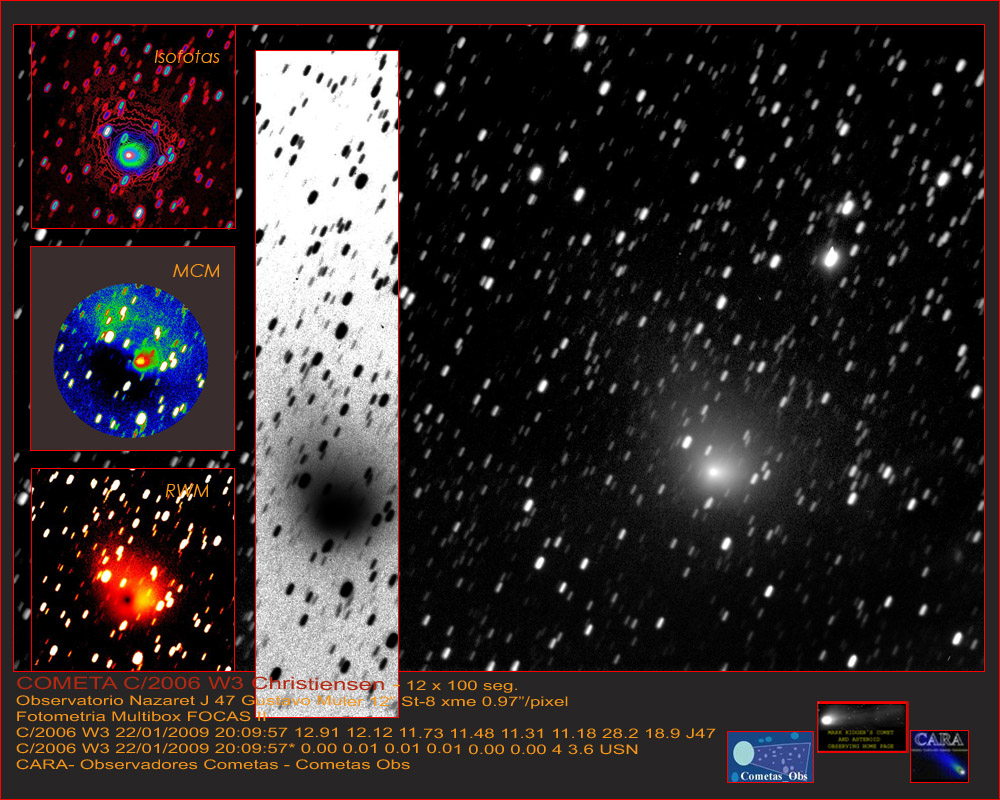
In other news here are Venus & Uranus on 22 January when they were closest together. • There is now an effort to observe occultations by TNOs with vigor, while this paper lists Saturn satellite mutual event successes of a previous season. • On Saturn itself a white spot was discovered and confirmed; also an 18 January picture and the 2009 viewing conditions. Plus - from 2007 but re-published - Jupiter & its moons in action. • Here are nine comets on 23 Jan., the jet in the coma of 29P has intensified (also pics of 21, 20 and 16 Jan.), for Lulin (praise for this page) we have a new analysis and observations of 24, 23 and 21 January, for 17P/Holmes a rare scientific paper about its 2007 outburst and recent pictures of 144P and C/2006 W3.
• Unfortunately there are no good European Network images of the 17 January fireball over Europe (which continues to spawn reports here, here, here, here or here) - so the trajectory of the cosmic body isn't well known. There were other major fireballs in California on 18 January and in Massachussets on 23 January, by the way. • It seems to become a trend to wildly enhance the colors of the full moon as this full-disk and this close-up (of Copernicus) examples show - you can learn something about the Moon's minerals this way. And displaying the full moon in negative also offers new "insights". • There is a major competition going on in the U.K. - but everyone can participate: Astronomy Photographer of the Year 2009. • And finally here's a list of signs you are an astronomer (of the amateur kind, that is).

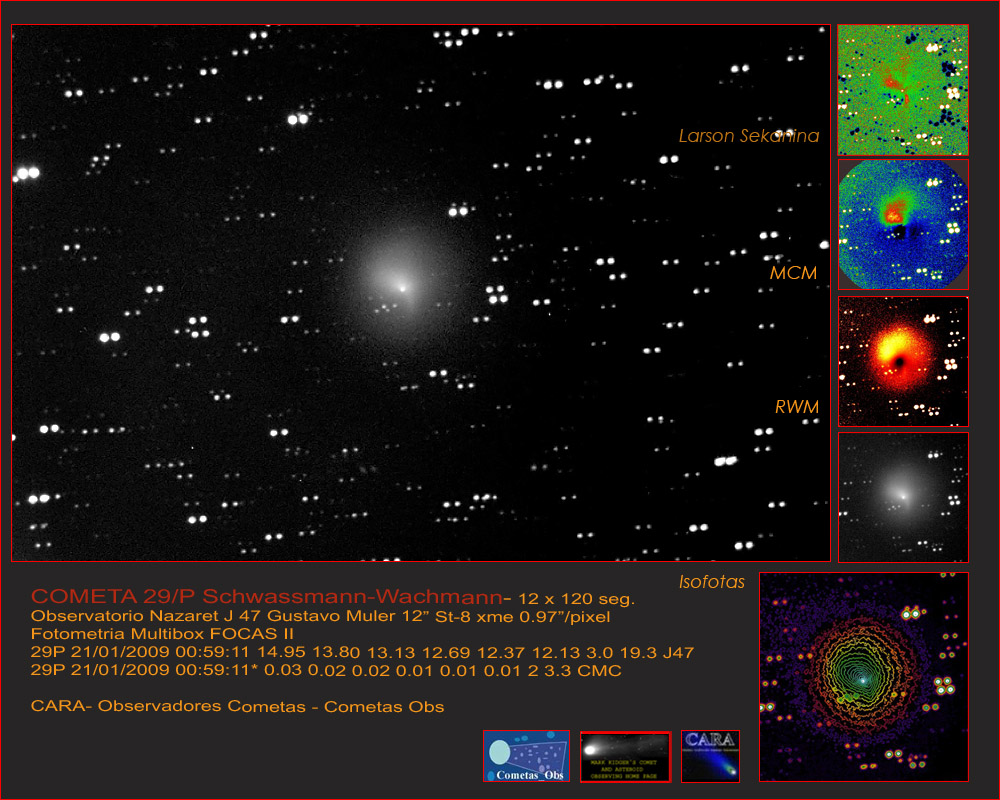
In other news here are Venus & Uranus on 22 January when they were closest together. • There is now an effort to observe occultations by TNOs with vigor, while this paper lists Saturn satellite mutual event successes of a previous season. • On Saturn itself a white spot was discovered and confirmed; also an 18 January picture and the 2009 viewing conditions. Plus - from 2007 but re-published - Jupiter & its moons in action. • Here are nine comets on 23 Jan., the jet in the coma of 29P has intensified (also pics of 21, 20 and 16 Jan.), for Lulin (praise for this page) we have a new analysis and observations of 24, 23 and 21 January, for 17P/Holmes a rare scientific paper about its 2007 outburst and recent pictures of 144P and C/2006 W3.



• Unfortunately there are no good European Network images of the 17 January fireball over Europe (which continues to spawn reports here, here, here, here or here) - so the trajectory of the cosmic body isn't well known. There were other major fireballs in California on 18 January and in Massachussets on 23 January, by the way. • It seems to become a trend to wildly enhance the colors of the full moon as this full-disk and this close-up (of Copernicus) examples show - you can learn something about the Moon's minerals this way. And displaying the full moon in negative also offers new "insights". • There is a major competition going on in the U.K. - but everyone can participate: Astronomy Photographer of the Year 2009. • And finally here's a list of signs you are an astronomer (of the amateur kind, that is).
Sunday, January 18, 2009
Fireball over Northern Europe, strange features in comet 29P, and Lulin's next window
A major fireball on 17 January at 19:08 UTC was seen widely over Northern Central Europe, with reports from Sweden, the Netherland, Germany and Poland so far - and as with the Canadian fireball last year, there is at least one detailled video available (alt. source and stills) as are all-sky images (alt. source). Here are early blog reports from the U.S. and Germany (more, earlier, more); notes in observers' forums in Germany are here and here and media stories here and here. • The Earth flyby of the NExT spacecraft has been observed by some.
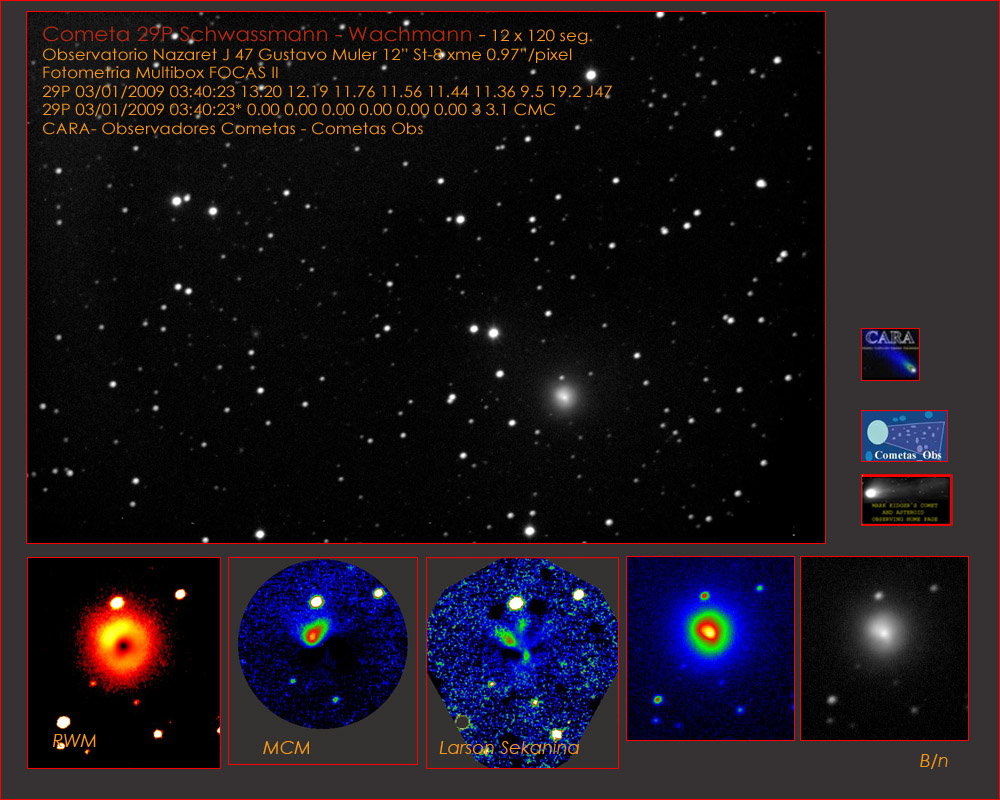
Comets in the News include 29P/Schwassmann-Wachmann which now shows peculiar features in its coma (another report & picture and a Jan. 9 view), 144P/Kushida seen here Jan. 16 and Jan. 14 (also a widefield view with finder chart), C/2006 OF2 on Jan. 14, 67P on Jan. 16 and C/2007 N3 (Lulin) for which we have a growing gallery, info pages and stories here, here, here and here and sparse new observations of Jan. 17 (picture), Jan. 15 and Jan. 12 - but with the Moon about the leave the morning sky, the first good viewing window is opening soon! • Behind all his comets: Meet Boattini - the man!
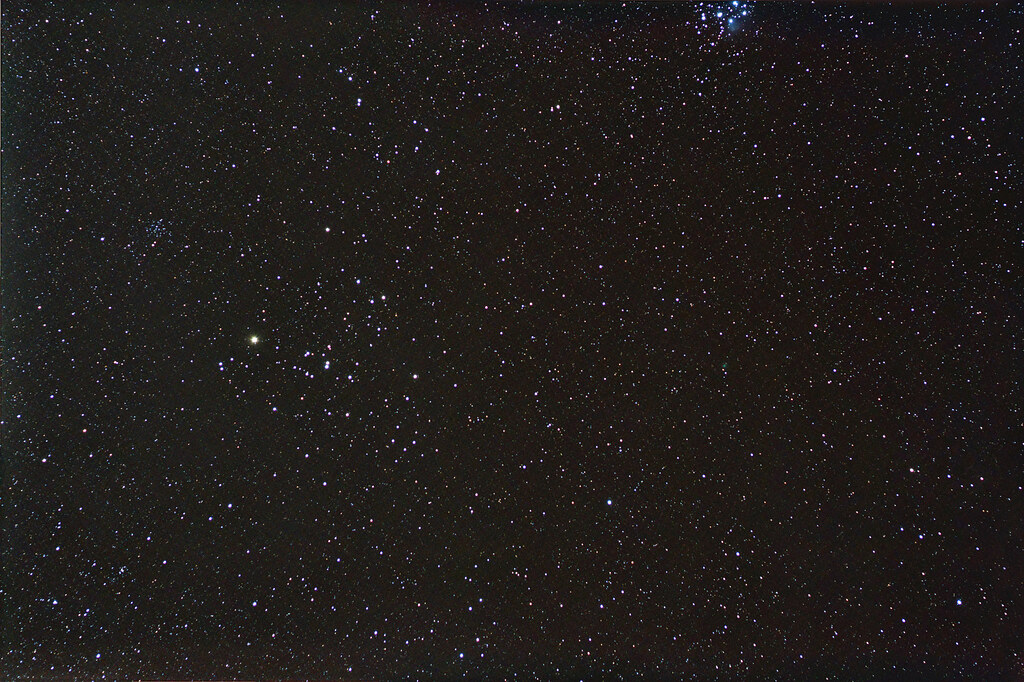
In other news an amateur has succeeded in detecting Saturn's moon Helene with a 10" telescope, thanks to the near-edge-on rings and recorded his third mutual event of two moons. An Saturn collection from the Philippines contains a video of a Titan transit, and other nice Saturn views are from Jan. 11 (again and with moons) and Jan. 6, with more here. • A nice false-color pic of Venus on Jan. 13 can be found here by scrolling down - and amateurs are invited (follow the links to info in English) to share their Venus views with the Venux Express scientists
• Some constellations: Venus & Uranus on Jan. 17, Venus & the Moon in an Indian panorama on Dec. 31 and the very young Moon - after a dramatic sunset - on Dec. 29 (so under perfect conditions it could be found even from Germany that day already). • Preparations for the annular eclipse on Jan.26 are underway in Indonesia and South Africa where it will be partial but pictures from around the Indian Ocean will be aggregated. Also a very late report from the last total solar eclipse, the Sun on Jan. 9 and more pictures of the large full moon here, here and here, plus the view on Jan. 12 and with the ISS in front of it!
• As the light curve shows, Mira its now past its maximum. • Did an astrophotographer detect a bow shock next to the Veil Nebula? • Some impressive atmospheric optics phenomena were apparently due to the extremely cold conditions in Europe lately. • Marvellous pictures of the Earth from space in high resolution - and a similarly amazing detailled amateur image of a space shuttle orbiter in orbit. • And finally a clip from S. Colbert where he makes numerous astrophysically correct jokes about the Andromeda Galaxy, based on these news from the recent AAS Conference which had had quite a media impact ...

Comets in the News include 29P/Schwassmann-Wachmann which now shows peculiar features in its coma (another report & picture and a Jan. 9 view), 144P/Kushida seen here Jan. 16 and Jan. 14 (also a widefield view with finder chart), C/2006 OF2 on Jan. 14, 67P on Jan. 16 and C/2007 N3 (Lulin) for which we have a growing gallery, info pages and stories here, here, here and here and sparse new observations of Jan. 17 (picture), Jan. 15 and Jan. 12 - but with the Moon about the leave the morning sky, the first good viewing window is opening soon! • Behind all his comets: Meet Boattini - the man!



In other news an amateur has succeeded in detecting Saturn's moon Helene with a 10" telescope, thanks to the near-edge-on rings and recorded his third mutual event of two moons. An Saturn collection from the Philippines contains a video of a Titan transit, and other nice Saturn views are from Jan. 11 (again and with moons) and Jan. 6, with more here. • A nice false-color pic of Venus on Jan. 13 can be found here by scrolling down - and amateurs are invited (follow the links to info in English) to share their Venus views with the Venux Express scientists
• Some constellations: Venus & Uranus on Jan. 17, Venus & the Moon in an Indian panorama on Dec. 31 and the very young Moon - after a dramatic sunset - on Dec. 29 (so under perfect conditions it could be found even from Germany that day already). • Preparations for the annular eclipse on Jan.26 are underway in Indonesia and South Africa where it will be partial but pictures from around the Indian Ocean will be aggregated. Also a very late report from the last total solar eclipse, the Sun on Jan. 9 and more pictures of the large full moon here, here and here, plus the view on Jan. 12 and with the ISS in front of it!
• As the light curve shows, Mira its now past its maximum. • Did an astrophotographer detect a bow shock next to the Veil Nebula? • Some impressive atmospheric optics phenomena were apparently due to the extremely cold conditions in Europe lately. • Marvellous pictures of the Earth from space in high resolution - and a similarly amazing detailled amateur image of a space shuttle orbiter in orbit. • And finally a clip from S. Colbert where he makes numerous astrophysically correct jokes about the Andromeda Galaxy, based on these news from the recent AAS Conference which had had quite a media impact ...
Sunday, January 11, 2009
Full moon fever, Quadrantids high, Lulin promises: good start for the IYA
While the International Year of Astronomy, now 11 days old, isn't rich in unusual sky phenomena, it had a good start - and one sky phenomenon, often dreaded for drowning out most others with its glare, turned out to be enormously popular: the record-close full moon of January 10 or 11 (depending on your time zone). If one takes the flow of messages on Twitter containing "moon" as a measure of general interest in a topic, the sky show inspired people in all walks of life: Several tweets per second came in at time during the night and several per minute even on the day after - expressing great fascination, pointing to news stories and good (and bad) pictures taken. Here then are the big celestial newsmakers of early 2009.
The had been ample announcements that the 2nd full moon in a row would be the closest of the year (2008 and 2009, resp.), and tons of photographs were taken: You can see some here (hi-res!) and here and here and here and here and here and here and here and here and here and here and here and here, see growing collections here or here (this blogger's collecting effort being appreciated!) or moonlit Pelican Lake at midnight or attempts to bring out the subtle colors of the lunar surface (this effort has been met with enthusiasm already). • Another Pleiades occultation by the Moon 3 days earlier was hard to photograph, but some good results are here, here, here and here.
Earlier this month, Jupiter slipped by Mercury and is about to disappear in the solar glow soon, to be followed by Mercury - but Venus (with Uranus nearby) will stay on: pictures and stories from January 10 (Austria and Germany), 8 (Austria; also Venus in a moonlit snowscape), 5 (USA, Germany), 3 (Germany, also with Venus), 2 (Austria and Germany) and 1 (Switzerland) as well as December 31 (USA, again at night and in daytime, Austria, Germany, India and many more) and 30 (Germany and India). From India also a newspaper story mentioning the Dec. 31 constellation. • We have also nice close-up pictures of Saturn - still in the morning skies - of Jan. 11 and Jan. 6 (more), observations of another mutual event of two satellites and a Titan egress as well as of Venus on Jan. 10 in false colors and with lots of cloud detail.
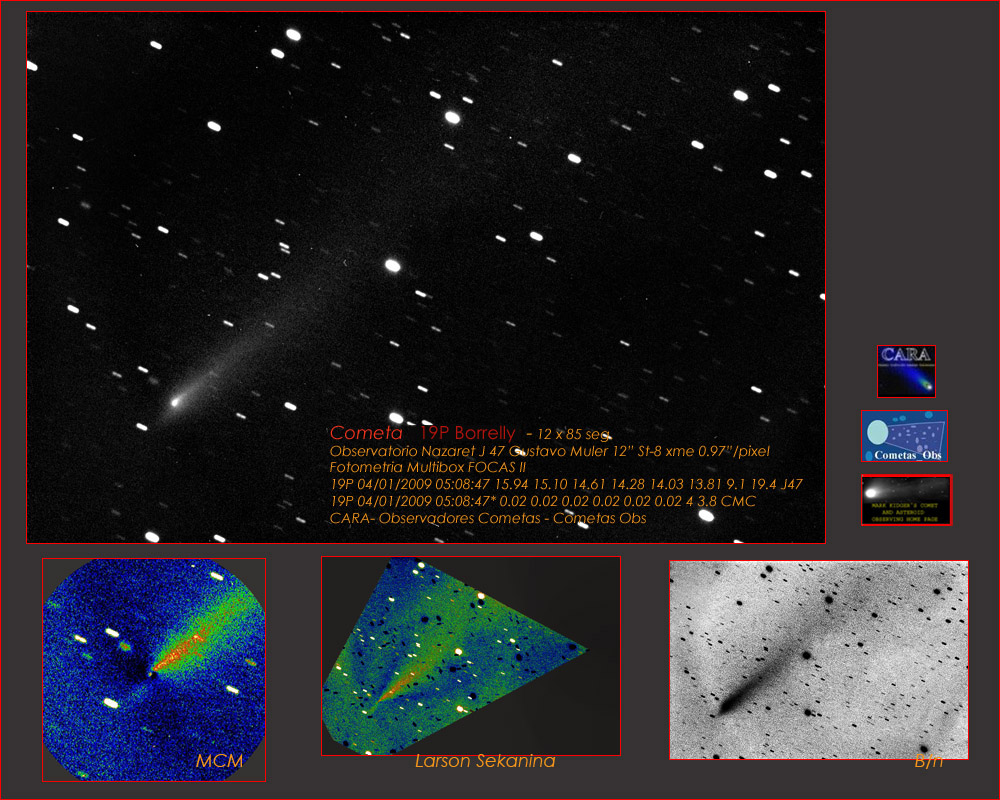
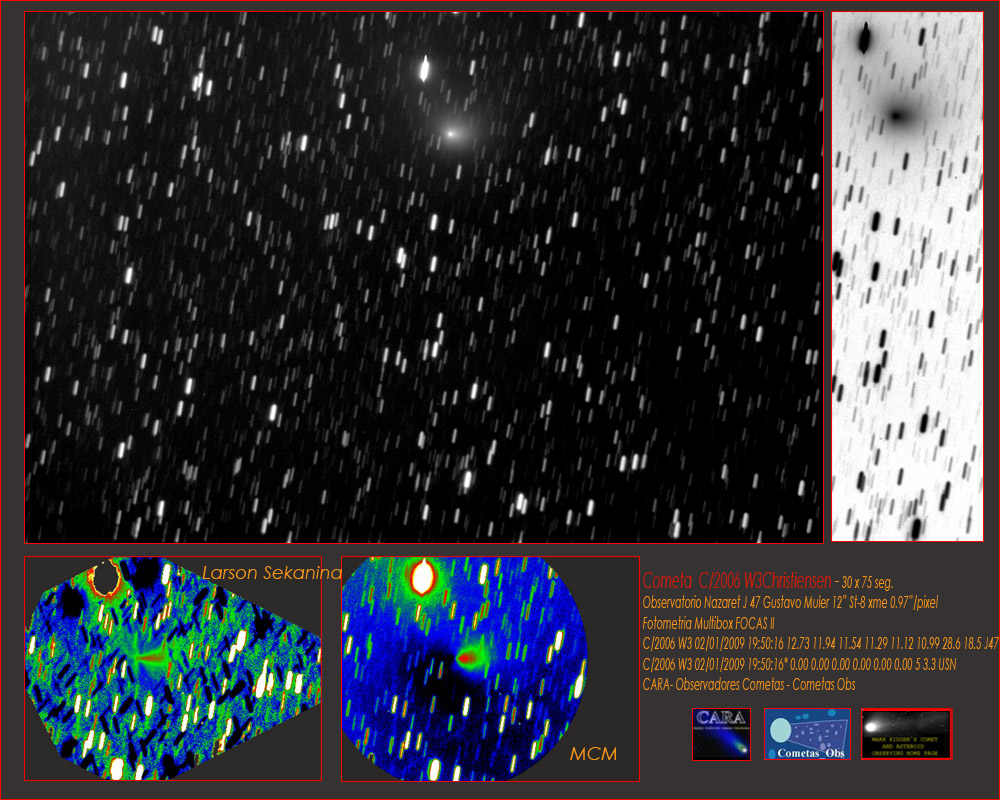
Comet C/2007 N3 (Lulin) is now emerging from the Sun in the morning skies at about 7th magnitude and should reach 5th or 4th in the 2nd half of February, coinciding with perfect viewing geometry and moon-free skies in the Northern hemisphere. General information - and many links - can be found here, here (visibility analysis for 50°N), here and here; the fact that we are in the comet's orbit plane will be important, and there could also be a kind of opposition effect. Here are some particularly good pictures - often with a structured plasma tail in the anti-sunward direction and a dust antitail - from Jan. 8 (more and more), Jan. 7, Jan. 5, Jan. 2/3 (the latter two taken at Lulin Obs. by one of the comet's discoverers), Jan. 3 and Jan. 2 (more and with enhanced contrast) and visual reports of Jan. 9, Jan. 5 and Jan. 2 as well as a picture collection, another one, a wide view and newspaper stories from India and Taiwan. • Some upcoming comet conjunctions with deep sky objects, 144P on Jan. 3 (more) and Dec. 31, C/2006 OF2, 29P, 19P, C/2006 W3 and Christensen (also its dis-/recovery story).
As the visual observing data show, the Quadrantids had a nice, sharp peak - right on time, also! - with a maximum zenithal hourly rate of approx. 150: That's about as good as it gets! There were plenty of videos (more) and pictures (more) taken, and we have exciting observing reports from arctic Canada, Germany and Arizona. • There is now a 2nd "2nd opinion" on the Leonids of 2009, again not confirming a half-storm with 500/hr. • Yet more photographs of the fresh Canadian meteorites. • The first(?) amateur picture of asteroid (3559) Violaumayer; the official citation should make clear why it's close to the heart of German amateurs. Meanwhile the Catalina Sky Survey has received further funding until 2012. • Well equipped amateurs can now try to catch the NExt spacecraft that approaches Earth on Jan. 14.
He is Tom Boles, and in the first week of the new year he caught his supernovae #118 and #119! Even more impressive is the fact that he started not that long ago, works from England - and works alone. Meanwhile a nice supernova appeared in Messier 61 (one more image). • From China comes a nice view of the lunar umbra on Asian soil during the 1 Aug. 2008 TSE. • And on the Sun itself there is now AR 1010 which is not big, but you take what you get when there is so little there - and what will come is notoriously hard to predict ... • From the "just pretty pictures" department, may I recommend SkyPhotographers and pictures from India (more). • An interesting sidenote on light pollution issues: the dangers of polarized light for wildlife (also covered here and here).
More outlooks to the 2009 skies for January, the whole year (more) and from ESA's viewpoint. • Meanwhile here is an actual picture of the recent leap second. • And finally this blogger has seen more "best of 2008" lists of space and related things in the last weeks than ever before; there are even lists of lists here and here and tops of the tops. Some lists now by Discovery, ITV, TPS, New Scientist (more, more and more), Space.com (more), AN, S&T, BAB, Nat'l Geographic, TIME, Universe Today, SciAm, Cosmic Log (more) as well as from the Univ. of AZ, NASA and DLR. And the BBC has 100 things we didn't know 12 months earlier.
Closest full moon of the year widely recognized
The had been ample announcements that the 2nd full moon in a row would be the closest of the year (2008 and 2009, resp.), and tons of photographs were taken: You can see some here (hi-res!) and here and here and here and here and here and here and here and here and here and here and here and here, see growing collections here or here (this blogger's collecting effort being appreciated!) or moonlit Pelican Lake at midnight or attempts to bring out the subtle colors of the lunar surface (this effort has been met with enthusiasm already). • Another Pleiades occultation by the Moon 3 days earlier was hard to photograph, but some good results are here, here, here and here.
The planets are leaving the evening sky, one by one
Earlier this month, Jupiter slipped by Mercury and is about to disappear in the solar glow soon, to be followed by Mercury - but Venus (with Uranus nearby) will stay on: pictures and stories from January 10 (Austria and Germany), 8 (Austria; also Venus in a moonlit snowscape), 5 (USA, Germany), 3 (Germany, also with Venus), 2 (Austria and Germany) and 1 (Switzerland) as well as December 31 (USA, again at night and in daytime, Austria, Germany, India and many more) and 30 (Germany and India). From India also a newspaper story mentioning the Dec. 31 constellation. • We have also nice close-up pictures of Saturn - still in the morning skies - of Jan. 11 and Jan. 6 (more), observations of another mutual event of two satellites and a Titan egress as well as of Venus on Jan. 10 in false colors and with lots of cloud detail.
Comet Lulin on track for a fine February show; fascinating tails already
Comet C/2007 N3 (Lulin) is now emerging from the Sun in the morning skies at about 7th magnitude and should reach 5th or 4th in the 2nd half of February, coinciding with perfect viewing geometry and moon-free skies in the Northern hemisphere. General information - and many links - can be found here, here (visibility analysis for 50°N), here and here; the fact that we are in the comet's orbit plane will be important, and there could also be a kind of opposition effect. Here are some particularly good pictures - often with a structured plasma tail in the anti-sunward direction and a dust antitail - from Jan. 8 (more and more), Jan. 7, Jan. 5, Jan. 2/3 (the latter two taken at Lulin Obs. by one of the comet's discoverers), Jan. 3 and Jan. 2 (more and with enhanced contrast) and visual reports of Jan. 9, Jan. 5 and Jan. 2 as well as a picture collection, another one, a wide view and newspaper stories from India and Taiwan. • Some upcoming comet conjunctions with deep sky objects, 144P on Jan. 3 (more) and Dec. 31, C/2006 OF2, 29P, 19P, C/2006 W3 and Christensen (also its dis-/recovery story).





Quadrantids 2009 as good as they can get, with a max. ZHR of 150
As the visual observing data show, the Quadrantids had a nice, sharp peak - right on time, also! - with a maximum zenithal hourly rate of approx. 150: That's about as good as it gets! There were plenty of videos (more) and pictures (more) taken, and we have exciting observing reports from arctic Canada, Germany and Arizona. • There is now a 2nd "2nd opinion" on the Leonids of 2009, again not confirming a half-storm with 500/hr. • Yet more photographs of the fresh Canadian meteorites. • The first(?) amateur picture of asteroid (3559) Violaumayer; the official citation should make clear why it's close to the heart of German amateurs. Meanwhile the Catalina Sky Survey has received further funding until 2012. • Well equipped amateurs can now try to catch the NExt spacecraft that approaches Earth on Jan. 14.
British amateur already found two supernovae this year!
He is Tom Boles, and in the first week of the new year he caught his supernovae #118 and #119! Even more impressive is the fact that he started not that long ago, works from England - and works alone. Meanwhile a nice supernova appeared in Messier 61 (one more image). • From China comes a nice view of the lunar umbra on Asian soil during the 1 Aug. 2008 TSE. • And on the Sun itself there is now AR 1010 which is not big, but you take what you get when there is so little there - and what will come is notoriously hard to predict ... • From the "just pretty pictures" department, may I recommend SkyPhotographers and pictures from India (more). • An interesting sidenote on light pollution issues: the dangers of polarized light for wildlife (also covered here and here).

More outlooks to the 2009 skies for January, the whole year (more) and from ESA's viewpoint. • Meanwhile here is an actual picture of the recent leap second. • And finally this blogger has seen more "best of 2008" lists of space and related things in the last weeks than ever before; there are even lists of lists here and here and tops of the tops. Some lists now by Discovery, ITV, TPS, New Scientist (more, more and more), Space.com (more), AN, S&T, BAB, Nat'l Geographic, TIME, Universe Today, SciAm, Cosmic Log (more) as well as from the Univ. of AZ, NASA and DLR. And the BBC has 100 things we didn't know 12 months earlier.

Subscribe to:
Posts (Atom)