It was discovered several days ago at 16th mag., but now SN 2008Q in NGC 524 has risen to 13.7 mag. Supernova & galaxy are located in Pisces.
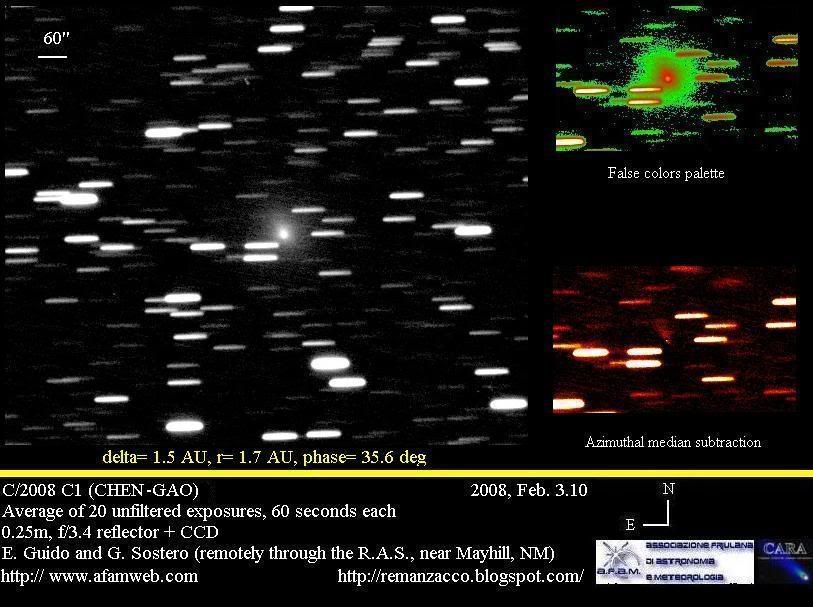
In other news combined meteor video & radio backscatter recordings are now online from one station in New Mexico, e.g. from a fireball last night. And here's another image of Chen-Gao from last night.
Tuesday, February 5, 2008


Asteroid came very close this morning
It approached Earth's center to within 133,000 km (0.000888 AU) at 7 hours UTC this morning: asteroid 2008 CT1 had been discovered only shortly before the encounter when it should have brightened to about 15 mag. and has since faded to below 20th. Another close shave, but nowhere near the record holders for closest approaches to Earth. With an absolute brightness of 27.7 CT1 is only about 10 meters in diameter, so if had been on a collision course with Earth it would have burned up in the atmosphere as a nice fireball.
In other news another fine picture of yesterday's Venus/Jupiter/Moon trio has turned up (this morning the Moon was long 'past' Venus as a view from Oz shows) as have nice views of the ISS that have also made it into SpaceWeather. And visual estimates of comet Chen-Gao hovered around 12.8 mag. last night and 13.5 mag. the night before.
In other news another fine picture of yesterday's Venus/Jupiter/Moon trio has turned up (this morning the Moon was long 'past' Venus as a view from Oz shows) as have nice views of the ISS that have also made it into SpaceWeather. And visual estimates of comet Chen-Gao hovered around 12.8 mag. last night and 13.5 mag. the night before.
Monday, February 4, 2008
NASA budget proposal for FY 2009 promises lots of new science missions
It will be many months before we know what complex Congressional procedures have left over from the bold plans, but the Fiscal 2009 Budget Proposal for NASA - explained in some detail in the Cosmic Mirror #311 with links to all documents - is most exciting. No fewer than five new starts of space science missions are included, from the Joint Dark Energy Mission over a Solar Probe into the corona and preparatory work for a Mars Sample Return in ca. 2020 after an Outer Planets Flagship mission (to a destination in the Jupiter or Saturn systems) to several small lunar missions. Critics already say, though, that the overall strategy won't fly ...
In other news a nice color image of comet Chen-Gao has been taken which might be close to Holmes on March 28. A fine picture of 46P/Wirtanen's tail has been published (but you may have to subscribe to the Comet-Images Yahoo group to access it). And the fate of the asteroid near Mars is unknown - though it certainly did not impact.
In other news a nice color image of comet Chen-Gao has been taken which might be close to Holmes on March 28. A fine picture of 46P/Wirtanen's tail has been published (but you may have to subscribe to the Comet-Images Yahoo group to access it). And the fate of the asteroid near Mars is unknown - though it certainly did not impact.

Tonight's the night: "across the Universe" ...
Tonight at 0:00 UTC (7 p.m. EST, 1 a.m. CET) NASA's Deep Space Network will broadcast a Beatles song towards Polaris - and fans may join in by playing "Across the Universe" simultaneously around the world. You can find it in many incarnations on YouTube, e.g. with space clips, with artwork or in an alternate recording. The reason for this (kind of) 'Active SETI' today are no fewer than five anniversaries:
In other news pictures of this morning's Venus/Jupiter/Moon trio have come in from around the world, with the Moon's quick eastward progress evident e.g. by comparing views from Germany and Australia many hours earlier - or Germany again a full day earlier.
There are new orbital elements for comet Chen-Gao (not much change), a picture from Feb. 3rd - and more details about the discoverers, courtesy of the German Fachgruppe Kometen: the discoverers are true amateur astronomers, 29 and 34 years old. Gao is a physics teacher in Urumqi and owns and operates the 7 cm telescope on nearby Mt. Shanshan, Chen helps analyzing the images. Gao's observatory is named after Xingming Zhou, a deceased fellow amateur who was a proficient SOHO comet hunter.
Finally the report about an asteroid with the shortest period of all was in error and based on an orbital arc way too short: the major axis is much larger (it's object K08C00M: a=1.6 AU) as others had suspected all along.
- 40 years ago (to the day) the song was recorded at Abbey Road studios, although it was released only almost two years later.
- 45 years ago the Deep Space Network was established formally (in a memo from the JPL director dated 24 Dec. 1963) although a forerunner had been around since Jan. 1958 and we thus could also celebrate 50 years of DSN this year.
- 50 years ago the Beatles approached their final lineup when Harrison watched Lennon & McCartney perform on 6 Feb. 1958 and soon joined them (Starr only came to the band in 1962).
- 50 years ago Explorer 1 was launched on 31 Jan. 1958 and the U.S. finally began to catch up in the space race, following the two Soviet Sputniks of 1957.
- 50 years ago NASA was created (legislation signed by Eisenhower on 27 June 1958, actual creation on 1 October 1958) out of NACA.
In other news pictures of this morning's Venus/Jupiter/Moon trio have come in from around the world, with the Moon's quick eastward progress evident e.g. by comparing views from Germany and Australia many hours earlier - or Germany again a full day earlier.
There are new orbital elements for comet Chen-Gao (not much change), a picture from Feb. 3rd - and more details about the discoverers, courtesy of the German Fachgruppe Kometen: the discoverers are true amateur astronomers, 29 and 34 years old. Gao is a physics teacher in Urumqi and owns and operates the 7 cm telescope on nearby Mt. Shanshan, Chen helps analyzing the images. Gao's observatory is named after Xingming Zhou, a deceased fellow amateur who was a proficient SOHO comet hunter.
Finally the report about an asteroid with the shortest period of all was in error and based on an orbital arc way too short: the major axis is much larger (it's object K08C00M: a=1.6 AU) as others had suspected all along.
Sunday, February 3, 2008
Chen-Gao has a little tail, no clear brightness trend
With a remote observatory in New Mexico one of the best images so far of the new comet has been taken. Here is another shot from Arkansas. Meanwhile the Chinese images have been reanalyzed with better software, and no convincing brightness trend between Jan. 30 and Feb. 2 is evident anymore.
In other news comet 46P/Wirtanen also has a tail as also revealed in images of current comets. Yet another 2007 TU24 movie has come to my attention. And on the Sun impressive filaments in H-Alpha images look like wings around an old AR ... (The latter page also shows Venus, Jupiter & the Moon this morning - tomorrow morning the three will be closest together!)

In other news comet 46P/Wirtanen also has a tail as also revealed in images of current comets. Yet another 2007 TU24 movie has come to my attention. And on the Sun impressive filaments in H-Alpha images look like wings around an old AR ... (The latter page also shows Venus, Jupiter & the Moon this morning - tomorrow morning the three will be closest together!)
C/2008 C1 (Chen-Gao): Chinese comet official
According to the first orbit the new comet will reach its perihelion in April at 1.2 AU from the Sun. The current brightness of Chen-Gao is about 13 mag. and could rise to 11th.
The discovery story is described in IAUC #8915 of today: The nova search "XWASS" at Xing Gao's Xingming Observatory on Mt. Nanshan in Xinjiang uses a Canon 350D with a 200 mm f/2.8 lens (7 cm aperture). Tao Chen (in a different Chinese province) found the comet on an image taken Feb. 1 by Gao and then identified it on images from Jan. 30 and 31 as well. Gao then took confirming images on Feb. 2 and Jin Beize sent out the alert. In the Chinese images it looks like the brightness rose from 14 to 12 mag. from Jan. 30 to Feb. 2
In other news a nice Holmes image from yesterday has been published; the comet is increasingly hard to see from many places.
The discovery story is described in IAUC #8915 of today: The nova search "XWASS" at Xing Gao's Xingming Observatory on Mt. Nanshan in Xinjiang uses a Canon 350D with a 200 mm f/2.8 lens (7 cm aperture). Tao Chen (in a different Chinese province) found the comet on an image taken Feb. 1 by Gao and then identified it on images from Jan. 30 and 31 as well. Gao then took confirming images on Feb. 2 and Jin Beize sent out the alert. In the Chinese images it looks like the brightness rose from 14 to 12 mag. from Jan. 30 to Feb. 2
In other news a nice Holmes image from yesterday has been published; the comet is increasingly hard to see from many places.
More pictures of new - yet unnamed - comet
From Italy and Poland come the latest images of the new comet: The latter one was actually the first reported confirmation of the discovery which was overdue statistically (most comets are discovered by professional sky surveys when they are very faint).
In other news a particularly cool movie of NEA 2007 TU24 "running over" a helpless galaxy has come to my attention as has another website with animations and yet another one. Meanwhile an asteroid with a=0.5 (i.e. residing way inside Earth's orbit) has been discovered (HohmannTransfer has such stuff), possibly in a resonance. And the Boston Globe had a detailled portrait of an amateur astrophotographer.

In other news a particularly cool movie of NEA 2007 TU24 "running over" a helpless galaxy has come to my attention as has another website with animations and yet another one. Meanwhile an asteroid with a=0.5 (i.e. residing way inside Earth's orbit) has been discovered (HohmannTransfer has such stuff), possibly in a resonance. And the Boston Globe had a detailled portrait of an amateur astrophotographer.
Saturday, February 2, 2008
Comet discovery confirmed within hours!
The call for observations over an international mailing list for comet specialists has led to the confirmation of the discovery within a few hours: First came a brief report, and now we already have images from a third site!
In other news an observer with dark skies managed to see comet Holmes naked-eye again tonight. Yours truly saw it as well a few hours ago, under less brilliant skies and with binoculars: an ill-defined haze of light. The comet's overall brightness is now around 4 mag.
In other news an observer with dark skies managed to see comet Holmes naked-eye again tonight. Yours truly saw it as well a few hours ago, under less brilliant skies and with binoculars: an ill-defined haze of light. The comet's overall brightness is now around 4 mag.
12 mag. comet discovered in China?
This just in: "Xingming Observation Nova Survey may find a 12 mag new comet, the first iamge back from 30th.Jan Now It needs your help to confirm it. The comet is very bright and move fast, I suggest it is not too far from the earth." So says an announcement on the Comets Mailing List from a few minutes ago.
The NEO Confirmation Page is actually here; the object has the temporary designation XM08AA. And the observatory with the international code C42 is on Mt. Nanshan in the Chinese province Xinjiang. (It's not clear to me yet how Xingming Obs. where the nova search takes place [see also this forum ...] is related to Urumqi Observatory of the Chinese National Astronomical Observatories which is best known for its radio telescope.)
In other news yesterday's Venus/Jupiter conjunction has also been seen in Austria, and only negative reports about the star occultation by Vinata have come in so far. Perhaps observers will have more luck with a star occultation by Lowell (again a small body but a 4th mag. star!) on April 11, visible e.g. in Southern Scandinavia.
The NEO Confirmation Page is actually here; the object has the temporary designation XM08AA. And the observatory with the international code C42 is on Mt. Nanshan in the Chinese province Xinjiang. (It's not clear to me yet how Xingming Obs. where the nova search takes place [see also this forum ...] is related to Urumqi Observatory of the Chinese National Astronomical Observatories which is best known for its radio telescope.)
In other news yesterday's Venus/Jupiter conjunction has also been seen in Austria, and only negative reports about the star occultation by Vinata have come in so far. Perhaps observers will have more luck with a star occultation by Lowell (again a small body but a 4th mag. star!) on April 11, visible e.g. in Southern Scandinavia.
Friday, February 1, 2008
Now a real face on Mars has been found!
Here it is (together with some real Mars news, e.g. on the recent weather) ... sorry, couldn't resist. :-)
In other news the Planetary Society has announced "Target Earth", a focus on NEOs inspired by the upcoming 100-year anniversary of the Tunguska airburst. Good stuff here, but the use of Apophis is seriously misguided: Check at JPL how Earth-based radar has been taking care of his harmless object.
In other news the Planetary Society has announced "Target Earth", a focus on NEOs inspired by the upcoming 100-year anniversary of the Tunguska airburst. Good stuff here, but the use of Apophis is seriously misguided: Check at JPL how Earth-based radar has been taking care of his harmless object.
Astronomical highlights in February 2008
The current close conjunction of Venus and Jupiter at dawn (pictures of this morning have come in from Germany, Australia and many other places) will be followed by (as told in Der Himmel über Berlin 2/2008 and other almanacs):
- Feb. 4: The Moon joins the Venus/Jupiter pair at dawn
- Feb. 7: Annular eclipse of the Sun, visible only from Antarctica; coincides with the Chinese New Year (Year of the Earth Rat)
- Feb. 13: Jupiter occults a 4 mag. star, the brightest since 1971 - visible only in East Asia
- Feb. 20: Final Ring Plane Crossing of Uranus, hardly observable
- Feb. 20/21: Total eclipse of the Moon, in evening in the Americas, in the morning in Europe
- Feb. 21: Diameter of Mars drops below 10 arc sec
- Feb. 24: Saturn in Opposition, celebrated with an Int'l Night of Saturn


Subscribe to:
Posts (Atom)