It hardly hit any solid ground and only in pretty remote spots of the planet - and yet thanks to the WWW and its old and new communications tools you could almost "be there" during the 26 January solar eclipse while frantically switching between various general 'social media' and highly specialized eclipse-related "feeds". In the early hours several true webcasts (with almost video rate) and open image collection sites, esp. Flickr and Twitpic, plus a special chatroom won hands down regarding speed, though the majority of the early images - access the individual screenshots via the "ase" tag - was poor (with a few really good ones scattered among them); the same was true for the early YouTube entries. With the hours passing after the antumbra had left the Earth, key "firsts" came every hour or so: the first clear image of a deep partial phase through clouds, stunning views of the partially eclipsed Sun setting in Manila Bay, then the first closed ring with hardly any clouds interfering. While most of Indonesia in the path of annularity was cloudy as expected, in several places it had been almost clear - while on the Cocos Islands it was raining like hell at the crucial time, smashing the hopes of the 11 eclipse chasers who had made it there.
As I write this, some 36 hours after it was over, high quality material has started to roll in through the "traditional" amateur astronomical channels, but I haven't seen an image of annularity with clearly visible Baily's Beads so far, let alome the chromosphere inbetween them - thus the Grand Prize of Annularity (easily served in 2005, for example) isn't in yet and may have been missed by the lucky few in the clear zones of Indonesia. But there are outstanding images aplenty - for example somewhat fuzzy TV material of the ring closing, seen here (with Spanish commentary), here (German; from second 56) and here (silent). The best still photos of the ring phase are probably these by an amateur (two more in the stream) from Bontang on Kalimantan and these from Reuters on Sumatra. But regarding "stunningness" they have hard competition from these gorgeous pictures (many in the stream!) from Manila - hardly ever has an eclipsed Sun been captured that clearly on the very horizon. The most convincing picture collections to date are probably those from SpaceWeather (starting with a fine animation of the ring closing), Flickr (an extremely huge set) and a South African IYA project (connected to this Flickr tag).
Special reports from the annularity zone have been received only from Indonesia's Anyer so far: Jay Pasachoff shows his results (heavy clouds but ring seen) and all pictures from the trip while Xavier Jubier has a small sampling. One of the webcast projects in Indonesia also has something to show - and report. From the partial zone reports have been found from Zamboanga City in the S. Philippines (pretty 'artsy' pics), Chennai (with more pictures) and Bangalore in India, Malaysia and Australia (another one). Amateur video clips of note come from Indonesia (another and another one), the Philippines and Malaysia. Selected pictures are worth highlighting from Jakarta (another stream and another pic probably from there) and Manila (probably); Manila shots also appear in the news media here (als #35) and here, while a view from Thailand was used here. And eclipse articles were found here, here, here, here, here, here, here (w/slide show), here, here, here, here and here. And while I'm frantically collecting further results, S. Krause is doing the same here.
Tuesday, January 27, 2009

Sunday, January 25, 2009
Annular eclipse less than 24 hours away: How much of it will be online?
The first of 2009's two full-silhouette eclipses is almost upon us: On Monday the shadow of the Moon will sweep across the Indian ocean, and while the antumbra makes little landfall, several countries will experience partial phases. Some eclipse chasers have actually made it into areas of annularity, though, and this being the 21st century they will attempt to webcast the ring of fire or at least e-mail pictures to certain websites shortly after the event. One expedition from India has made it to Indonesia and reports good weather: They are twittering their trip, but their webcast can only be seen by subscribers - or at the planetarium in New Delhi. Free webcasts from Indonesia could appear here and here, however, as several more foreign eclipse chasers are in the country, too (Jay Pasachoff has just sent these pictures from Jakarta). And a few others made it to the Cocos (Keeling) Islands in the Indian Ocean, reporting good and bad weather at eclipse time: Their reports and pictures appear here or on the front page of AstroNation, while in South Africa (which will experience a partial eclipse) pictures from all over the world will be collected here. Some articles on this eclipse appeared also in Australia (which won't see much on its mainland), on AFP and in Space.com - where mysteriously one of my 1992 pictures makes an appearance. The New Moon of 26 January also means the New Year for the traditional Chinese calendar. And talking about the Sun: In 2011 the STEREO s/c will - for the first time in history - see everything when they are 180° apart.
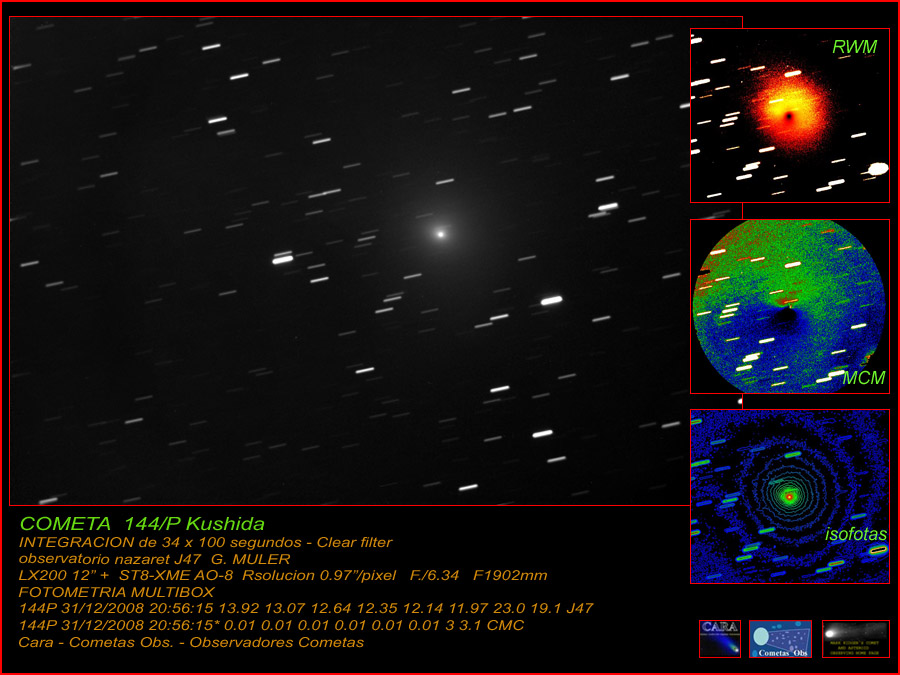
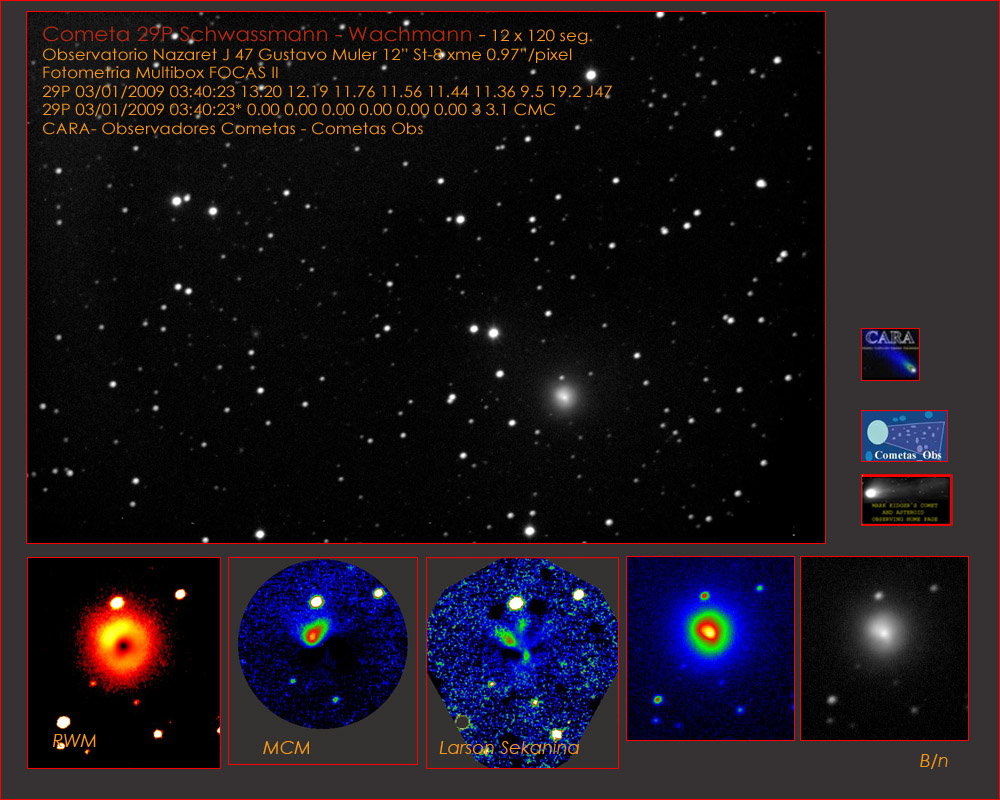
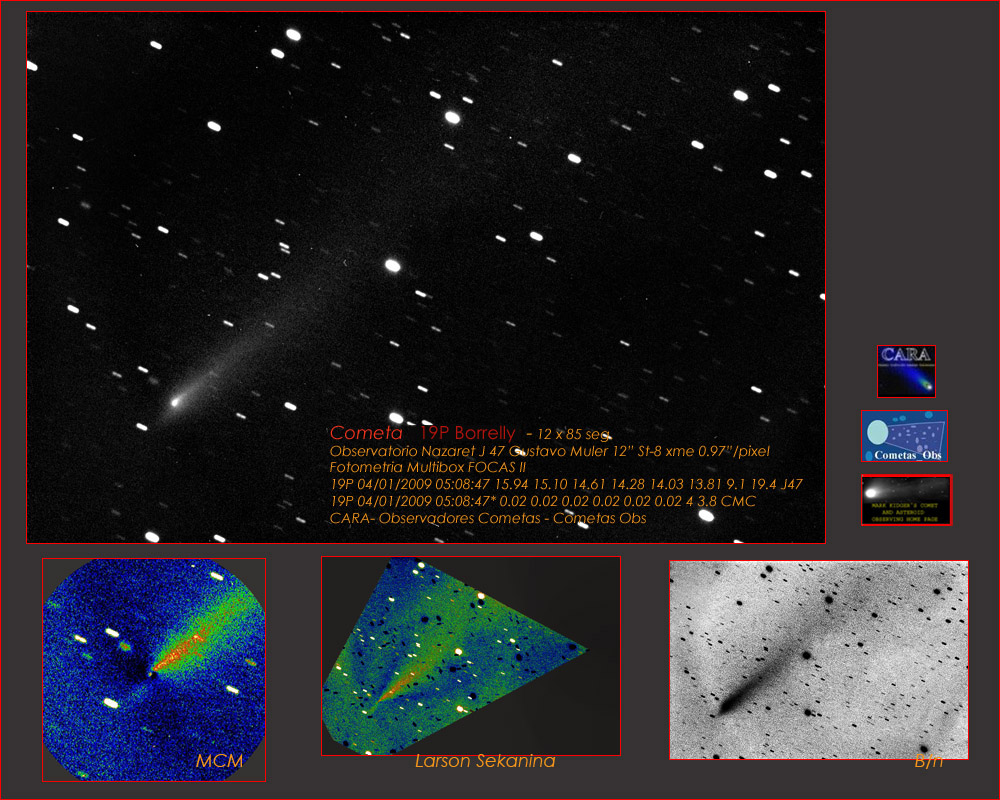
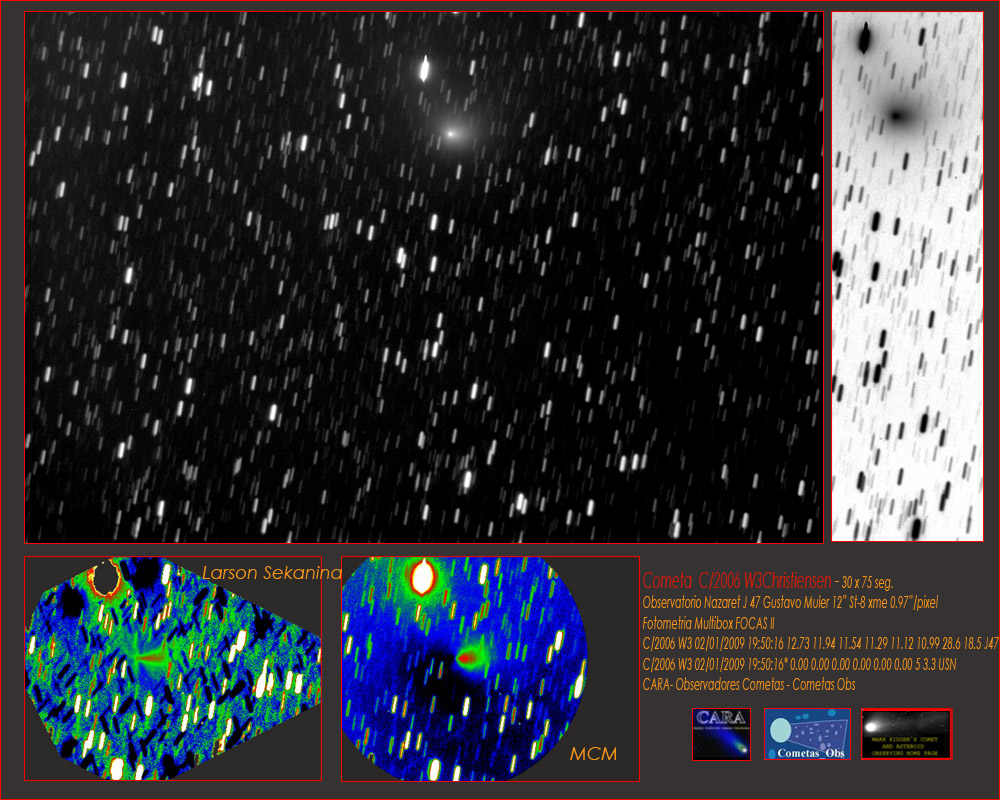
In other news here are Venus & Uranus on 22 January when they were closest together. • There is now an effort to observe occultations by TNOs with vigor, while this paper lists Saturn satellite mutual event successes of a previous season. • On Saturn itself a white spot was discovered and confirmed; also an 18 January picture and the 2009 viewing conditions. Plus - from 2007 but re-published - Jupiter & its moons in action. • Here are nine comets on 23 Jan., the jet in the coma of 29P has intensified (also pics of 21, 20 and 16 Jan.), for Lulin (praise for this page) we have a new analysis and observations of 24, 23 and 21 January, for 17P/Holmes a rare scientific paper about its 2007 outburst and recent pictures of 144P and C/2006 W3.
• Unfortunately there are no good European Network images of the 17 January fireball over Europe (which continues to spawn reports here, here, here, here or here) - so the trajectory of the cosmic body isn't well known. There were other major fireballs in California on 18 January and in Massachussets on 23 January, by the way. • It seems to become a trend to wildly enhance the colors of the full moon as this full-disk and this close-up (of Copernicus) examples show - you can learn something about the Moon's minerals this way. And displaying the full moon in negative also offers new "insights". • There is a major competition going on in the U.K. - but everyone can participate: Astronomy Photographer of the Year 2009. • And finally here's a list of signs you are an astronomer (of the amateur kind, that is).

In other news here are Venus & Uranus on 22 January when they were closest together. • There is now an effort to observe occultations by TNOs with vigor, while this paper lists Saturn satellite mutual event successes of a previous season. • On Saturn itself a white spot was discovered and confirmed; also an 18 January picture and the 2009 viewing conditions. Plus - from 2007 but re-published - Jupiter & its moons in action. • Here are nine comets on 23 Jan., the jet in the coma of 29P has intensified (also pics of 21, 20 and 16 Jan.), for Lulin (praise for this page) we have a new analysis and observations of 24, 23 and 21 January, for 17P/Holmes a rare scientific paper about its 2007 outburst and recent pictures of 144P and C/2006 W3.

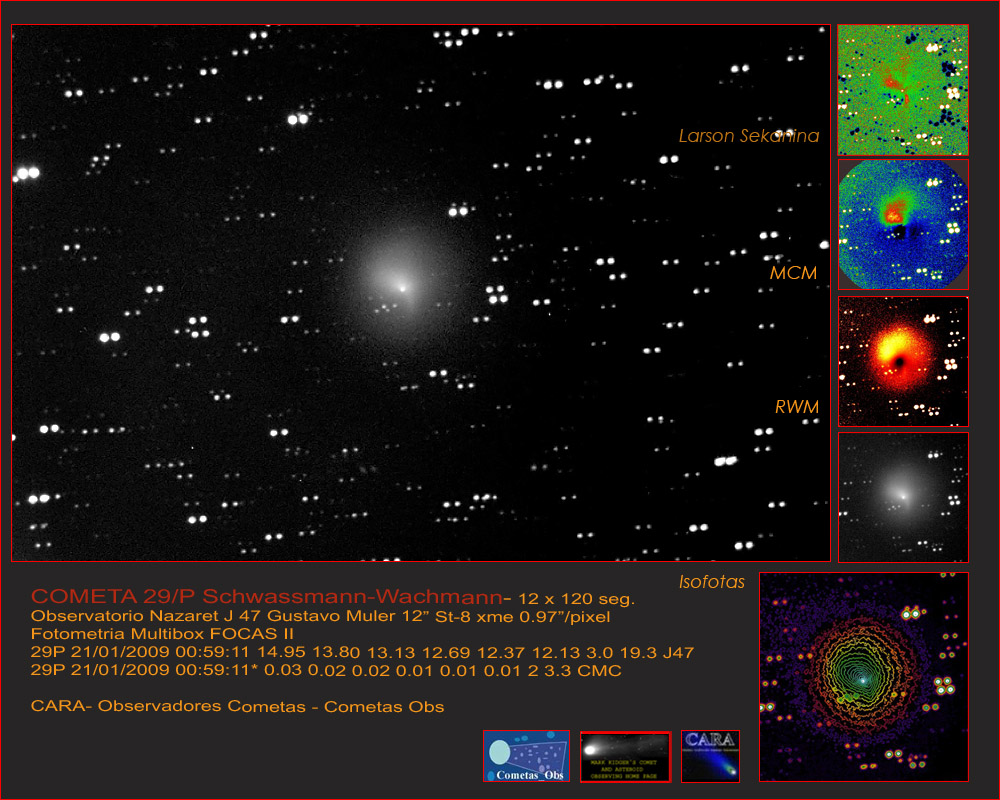
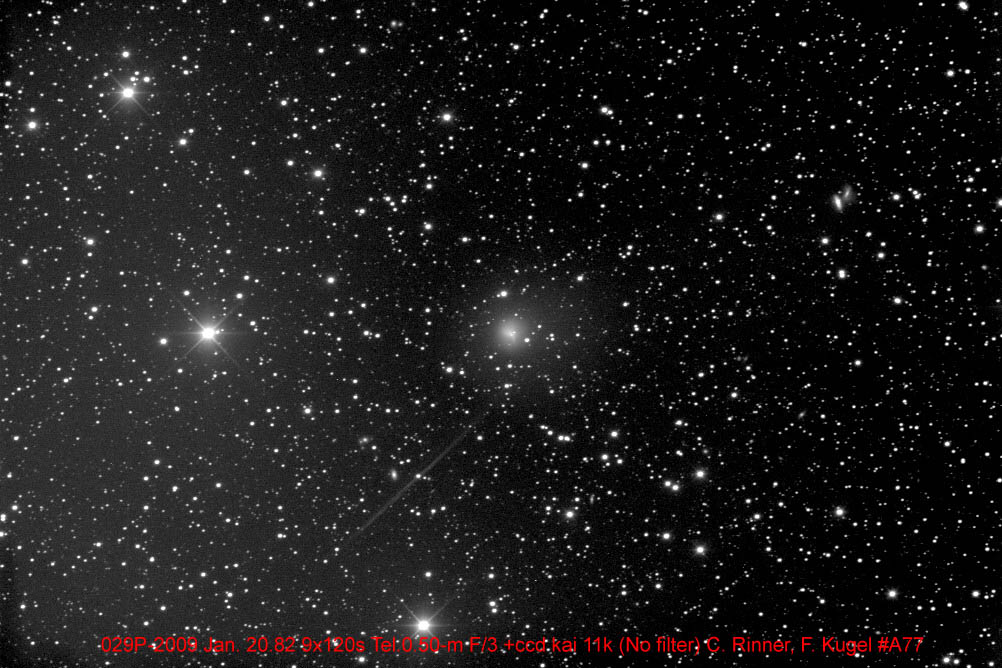


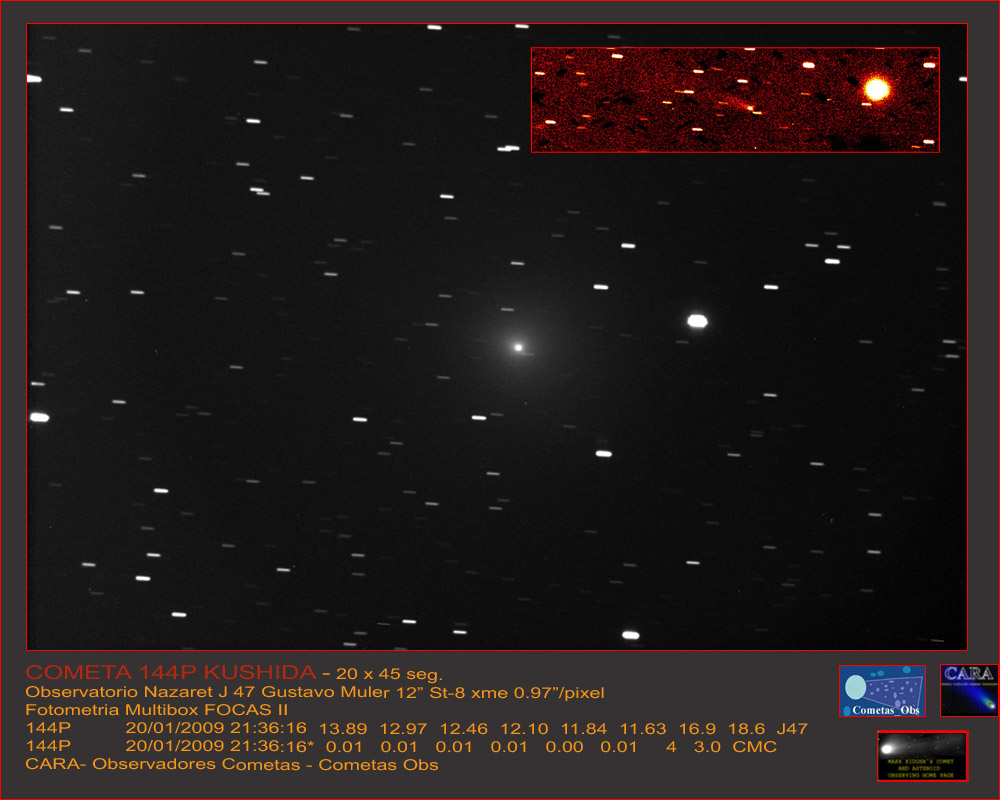
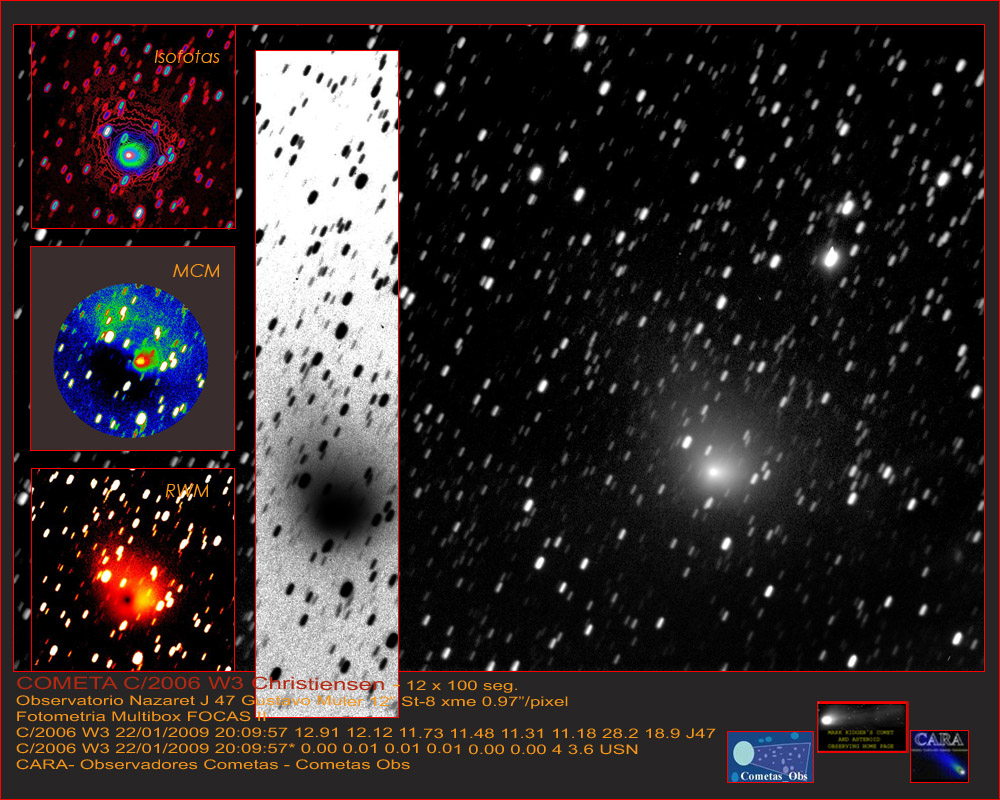
• Unfortunately there are no good European Network images of the 17 January fireball over Europe (which continues to spawn reports here, here, here, here or here) - so the trajectory of the cosmic body isn't well known. There were other major fireballs in California on 18 January and in Massachussets on 23 January, by the way. • It seems to become a trend to wildly enhance the colors of the full moon as this full-disk and this close-up (of Copernicus) examples show - you can learn something about the Moon's minerals this way. And displaying the full moon in negative also offers new "insights". • There is a major competition going on in the U.K. - but everyone can participate: Astronomy Photographer of the Year 2009. • And finally here's a list of signs you are an astronomer (of the amateur kind, that is).
Sunday, January 18, 2009
Fireball over Northern Europe, strange features in comet 29P, and Lulin's next window
A major fireball on 17 January at 19:08 UTC was seen widely over Northern Central Europe, with reports from Sweden, the Netherland, Germany and Poland so far - and as with the Canadian fireball last year, there is at least one detailled video available (alt. source and stills) as are all-sky images (alt. source). Here are early blog reports from the U.S. and Germany (more, earlier, more); notes in observers' forums in Germany are here and here and media stories here and here. • The Earth flyby of the NExT spacecraft has been observed by some.
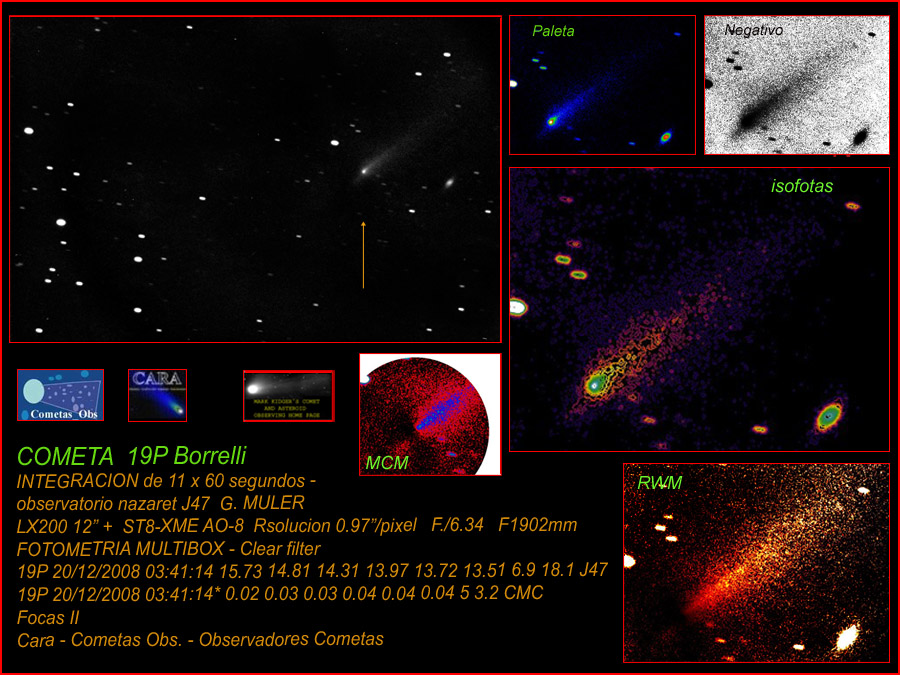
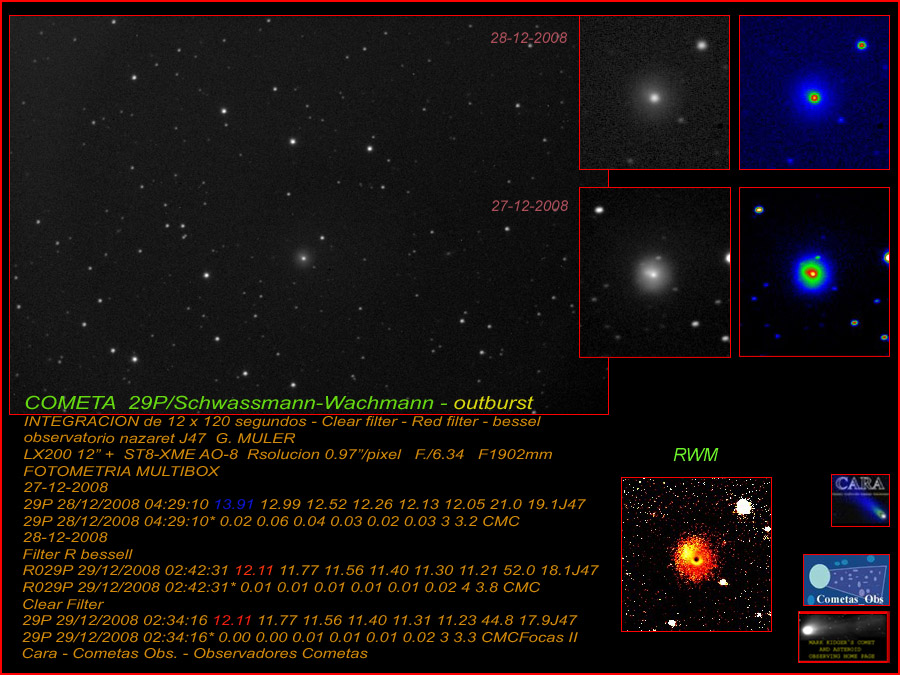
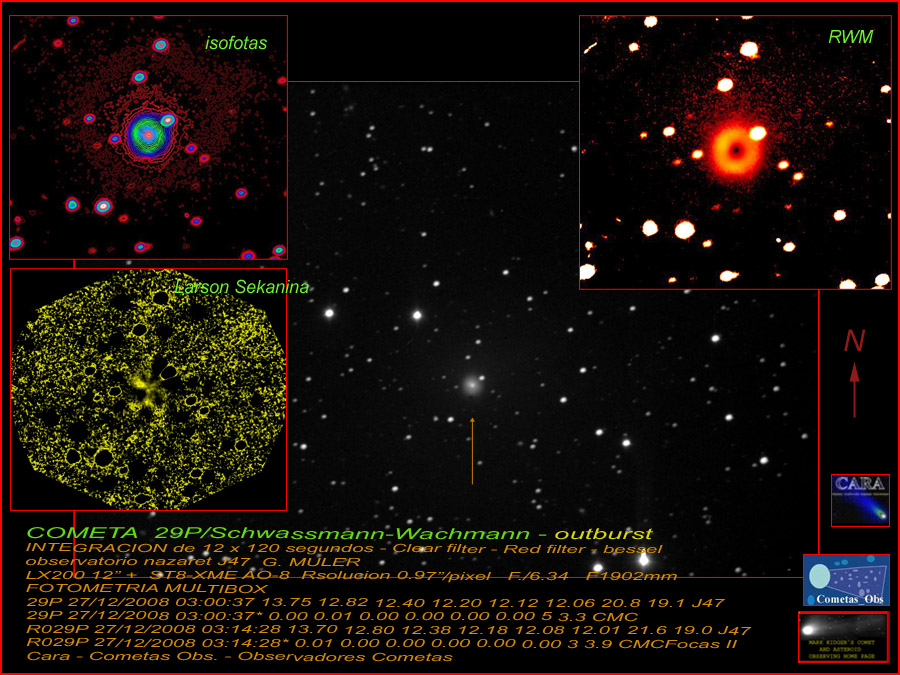
Comets in the News include 29P/Schwassmann-Wachmann which now shows peculiar features in its coma (another report & picture and a Jan. 9 view), 144P/Kushida seen here Jan. 16 and Jan. 14 (also a widefield view with finder chart), C/2006 OF2 on Jan. 14, 67P on Jan. 16 and C/2007 N3 (Lulin) for which we have a growing gallery, info pages and stories here, here, here and here and sparse new observations of Jan. 17 (picture), Jan. 15 and Jan. 12 - but with the Moon about the leave the morning sky, the first good viewing window is opening soon! • Behind all his comets: Meet Boattini - the man!
In other news an amateur has succeeded in detecting Saturn's moon Helene with a 10" telescope, thanks to the near-edge-on rings and recorded his third mutual event of two moons. An Saturn collection from the Philippines contains a video of a Titan transit, and other nice Saturn views are from Jan. 11 (again and with moons) and Jan. 6, with more here. • A nice false-color pic of Venus on Jan. 13 can be found here by scrolling down - and amateurs are invited (follow the links to info in English) to share their Venus views with the Venux Express scientists
• Some constellations: Venus & Uranus on Jan. 17, Venus & the Moon in an Indian panorama on Dec. 31 and the very young Moon - after a dramatic sunset - on Dec. 29 (so under perfect conditions it could be found even from Germany that day already). • Preparations for the annular eclipse on Jan.26 are underway in Indonesia and South Africa where it will be partial but pictures from around the Indian Ocean will be aggregated. Also a very late report from the last total solar eclipse, the Sun on Jan. 9 and more pictures of the large full moon here, here and here, plus the view on Jan. 12 and with the ISS in front of it!
• As the light curve shows, Mira its now past its maximum. • Did an astrophotographer detect a bow shock next to the Veil Nebula? • Some impressive atmospheric optics phenomena were apparently due to the extremely cold conditions in Europe lately. • Marvellous pictures of the Earth from space in high resolution - and a similarly amazing detailled amateur image of a space shuttle orbiter in orbit. • And finally a clip from S. Colbert where he makes numerous astrophysically correct jokes about the Andromeda Galaxy, based on these news from the recent AAS Conference which had had quite a media impact ...

Comets in the News include 29P/Schwassmann-Wachmann which now shows peculiar features in its coma (another report & picture and a Jan. 9 view), 144P/Kushida seen here Jan. 16 and Jan. 14 (also a widefield view with finder chart), C/2006 OF2 on Jan. 14, 67P on Jan. 16 and C/2007 N3 (Lulin) for which we have a growing gallery, info pages and stories here, here, here and here and sparse new observations of Jan. 17 (picture), Jan. 15 and Jan. 12 - but with the Moon about the leave the morning sky, the first good viewing window is opening soon! • Behind all his comets: Meet Boattini - the man!



In other news an amateur has succeeded in detecting Saturn's moon Helene with a 10" telescope, thanks to the near-edge-on rings and recorded his third mutual event of two moons. An Saturn collection from the Philippines contains a video of a Titan transit, and other nice Saturn views are from Jan. 11 (again and with moons) and Jan. 6, with more here. • A nice false-color pic of Venus on Jan. 13 can be found here by scrolling down - and amateurs are invited (follow the links to info in English) to share their Venus views with the Venux Express scientists
• Some constellations: Venus & Uranus on Jan. 17, Venus & the Moon in an Indian panorama on Dec. 31 and the very young Moon - after a dramatic sunset - on Dec. 29 (so under perfect conditions it could be found even from Germany that day already). • Preparations for the annular eclipse on Jan.26 are underway in Indonesia and South Africa where it will be partial but pictures from around the Indian Ocean will be aggregated. Also a very late report from the last total solar eclipse, the Sun on Jan. 9 and more pictures of the large full moon here, here and here, plus the view on Jan. 12 and with the ISS in front of it!
• As the light curve shows, Mira its now past its maximum. • Did an astrophotographer detect a bow shock next to the Veil Nebula? • Some impressive atmospheric optics phenomena were apparently due to the extremely cold conditions in Europe lately. • Marvellous pictures of the Earth from space in high resolution - and a similarly amazing detailled amateur image of a space shuttle orbiter in orbit. • And finally a clip from S. Colbert where he makes numerous astrophysically correct jokes about the Andromeda Galaxy, based on these news from the recent AAS Conference which had had quite a media impact ...
Sunday, January 11, 2009
Full moon fever, Quadrantids high, Lulin promises: good start for the IYA
While the International Year of Astronomy, now 11 days old, isn't rich in unusual sky phenomena, it had a good start - and one sky phenomenon, often dreaded for drowning out most others with its glare, turned out to be enormously popular: the record-close full moon of January 10 or 11 (depending on your time zone). If one takes the flow of messages on Twitter containing "moon" as a measure of general interest in a topic, the sky show inspired people in all walks of life: Several tweets per second came in at time during the night and several per minute even on the day after - expressing great fascination, pointing to news stories and good (and bad) pictures taken. Here then are the big celestial newsmakers of early 2009.
The had been ample announcements that the 2nd full moon in a row would be the closest of the year (2008 and 2009, resp.), and tons of photographs were taken: You can see some here (hi-res!) and here and here and here and here and here and here and here and here and here and here and here and here, see growing collections here or here (this blogger's collecting effort being appreciated!) or moonlit Pelican Lake at midnight or attempts to bring out the subtle colors of the lunar surface (this effort has been met with enthusiasm already). • Another Pleiades occultation by the Moon 3 days earlier was hard to photograph, but some good results are here, here, here and here.
Earlier this month, Jupiter slipped by Mercury and is about to disappear in the solar glow soon, to be followed by Mercury - but Venus (with Uranus nearby) will stay on: pictures and stories from January 10 (Austria and Germany), 8 (Austria; also Venus in a moonlit snowscape), 5 (USA, Germany), 3 (Germany, also with Venus), 2 (Austria and Germany) and 1 (Switzerland) as well as December 31 (USA, again at night and in daytime, Austria, Germany, India and many more) and 30 (Germany and India). From India also a newspaper story mentioning the Dec. 31 constellation. • We have also nice close-up pictures of Saturn - still in the morning skies - of Jan. 11 and Jan. 6 (more), observations of another mutual event of two satellites and a Titan egress as well as of Venus on Jan. 10 in false colors and with lots of cloud detail.
Comet C/2007 N3 (Lulin) is now emerging from the Sun in the morning skies at about 7th magnitude and should reach 5th or 4th in the 2nd half of February, coinciding with perfect viewing geometry and moon-free skies in the Northern hemisphere. General information - and many links - can be found here, here (visibility analysis for 50°N), here and here; the fact that we are in the comet's orbit plane will be important, and there could also be a kind of opposition effect. Here are some particularly good pictures - often with a structured plasma tail in the anti-sunward direction and a dust antitail - from Jan. 8 (more and more), Jan. 7, Jan. 5, Jan. 2/3 (the latter two taken at Lulin Obs. by one of the comet's discoverers), Jan. 3 and Jan. 2 (more and with enhanced contrast) and visual reports of Jan. 9, Jan. 5 and Jan. 2 as well as a picture collection, another one, a wide view and newspaper stories from India and Taiwan. • Some upcoming comet conjunctions with deep sky objects, 144P on Jan. 3 (more) and Dec. 31, C/2006 OF2, 29P, 19P, C/2006 W3 and Christensen (also its dis-/recovery story).
As the visual observing data show, the Quadrantids had a nice, sharp peak - right on time, also! - with a maximum zenithal hourly rate of approx. 150: That's about as good as it gets! There were plenty of videos (more) and pictures (more) taken, and we have exciting observing reports from arctic Canada, Germany and Arizona. • There is now a 2nd "2nd opinion" on the Leonids of 2009, again not confirming a half-storm with 500/hr. • Yet more photographs of the fresh Canadian meteorites. • The first(?) amateur picture of asteroid (3559) Violaumayer; the official citation should make clear why it's close to the heart of German amateurs. Meanwhile the Catalina Sky Survey has received further funding until 2012. • Well equipped amateurs can now try to catch the NExt spacecraft that approaches Earth on Jan. 14.
He is Tom Boles, and in the first week of the new year he caught his supernovae #118 and #119! Even more impressive is the fact that he started not that long ago, works from England - and works alone. Meanwhile a nice supernova appeared in Messier 61 (one more image). • From China comes a nice view of the lunar umbra on Asian soil during the 1 Aug. 2008 TSE. • And on the Sun itself there is now AR 1010 which is not big, but you take what you get when there is so little there - and what will come is notoriously hard to predict ... • From the "just pretty pictures" department, may I recommend SkyPhotographers and pictures from India (more). • An interesting sidenote on light pollution issues: the dangers of polarized light for wildlife (also covered here and here).
More outlooks to the 2009 skies for January, the whole year (more) and from ESA's viewpoint. • Meanwhile here is an actual picture of the recent leap second. • And finally this blogger has seen more "best of 2008" lists of space and related things in the last weeks than ever before; there are even lists of lists here and here and tops of the tops. Some lists now by Discovery, ITV, TPS, New Scientist (more, more and more), Space.com (more), AN, S&T, BAB, Nat'l Geographic, TIME, Universe Today, SciAm, Cosmic Log (more) as well as from the Univ. of AZ, NASA and DLR. And the BBC has 100 things we didn't know 12 months earlier.
Closest full moon of the year widely recognized
The had been ample announcements that the 2nd full moon in a row would be the closest of the year (2008 and 2009, resp.), and tons of photographs were taken: You can see some here (hi-res!) and here and here and here and here and here and here and here and here and here and here and here and here, see growing collections here or here (this blogger's collecting effort being appreciated!) or moonlit Pelican Lake at midnight or attempts to bring out the subtle colors of the lunar surface (this effort has been met with enthusiasm already). • Another Pleiades occultation by the Moon 3 days earlier was hard to photograph, but some good results are here, here, here and here.
The planets are leaving the evening sky, one by one
Earlier this month, Jupiter slipped by Mercury and is about to disappear in the solar glow soon, to be followed by Mercury - but Venus (with Uranus nearby) will stay on: pictures and stories from January 10 (Austria and Germany), 8 (Austria; also Venus in a moonlit snowscape), 5 (USA, Germany), 3 (Germany, also with Venus), 2 (Austria and Germany) and 1 (Switzerland) as well as December 31 (USA, again at night and in daytime, Austria, Germany, India and many more) and 30 (Germany and India). From India also a newspaper story mentioning the Dec. 31 constellation. • We have also nice close-up pictures of Saturn - still in the morning skies - of Jan. 11 and Jan. 6 (more), observations of another mutual event of two satellites and a Titan egress as well as of Venus on Jan. 10 in false colors and with lots of cloud detail.
Comet Lulin on track for a fine February show; fascinating tails already
Comet C/2007 N3 (Lulin) is now emerging from the Sun in the morning skies at about 7th magnitude and should reach 5th or 4th in the 2nd half of February, coinciding with perfect viewing geometry and moon-free skies in the Northern hemisphere. General information - and many links - can be found here, here (visibility analysis for 50°N), here and here; the fact that we are in the comet's orbit plane will be important, and there could also be a kind of opposition effect. Here are some particularly good pictures - often with a structured plasma tail in the anti-sunward direction and a dust antitail - from Jan. 8 (more and more), Jan. 7, Jan. 5, Jan. 2/3 (the latter two taken at Lulin Obs. by one of the comet's discoverers), Jan. 3 and Jan. 2 (more and with enhanced contrast) and visual reports of Jan. 9, Jan. 5 and Jan. 2 as well as a picture collection, another one, a wide view and newspaper stories from India and Taiwan. • Some upcoming comet conjunctions with deep sky objects, 144P on Jan. 3 (more) and Dec. 31, C/2006 OF2, 29P, 19P, C/2006 W3 and Christensen (also its dis-/recovery story).





Quadrantids 2009 as good as they can get, with a max. ZHR of 150
As the visual observing data show, the Quadrantids had a nice, sharp peak - right on time, also! - with a maximum zenithal hourly rate of approx. 150: That's about as good as it gets! There were plenty of videos (more) and pictures (more) taken, and we have exciting observing reports from arctic Canada, Germany and Arizona. • There is now a 2nd "2nd opinion" on the Leonids of 2009, again not confirming a half-storm with 500/hr. • Yet more photographs of the fresh Canadian meteorites. • The first(?) amateur picture of asteroid (3559) Violaumayer; the official citation should make clear why it's close to the heart of German amateurs. Meanwhile the Catalina Sky Survey has received further funding until 2012. • Well equipped amateurs can now try to catch the NExt spacecraft that approaches Earth on Jan. 14.
British amateur already found two supernovae this year!
He is Tom Boles, and in the first week of the new year he caught his supernovae #118 and #119! Even more impressive is the fact that he started not that long ago, works from England - and works alone. Meanwhile a nice supernova appeared in Messier 61 (one more image). • From China comes a nice view of the lunar umbra on Asian soil during the 1 Aug. 2008 TSE. • And on the Sun itself there is now AR 1010 which is not big, but you take what you get when there is so little there - and what will come is notoriously hard to predict ... • From the "just pretty pictures" department, may I recommend SkyPhotographers and pictures from India (more). • An interesting sidenote on light pollution issues: the dangers of polarized light for wildlife (also covered here and here).

More outlooks to the 2009 skies for January, the whole year (more) and from ESA's viewpoint. • Meanwhile here is an actual picture of the recent leap second. • And finally this blogger has seen more "best of 2008" lists of space and related things in the last weeks than ever before; there are even lists of lists here and here and tops of the tops. Some lists now by Discovery, ITV, TPS, New Scientist (more, more and more), Space.com (more), AN, S&T, BAB, Nat'l Geographic, TIME, Universe Today, SciAm, Cosmic Log (more) as well as from the Univ. of AZ, NASA and DLR. And the BBC has 100 things we didn't know 12 months earlier.

Wednesday, December 31, 2008
Evening planets greet the International Year of Astronomy 2009
As I type this, the IYA 2009 has already begun in the Western Pacific while others still have to wait another 24 hours. A parallel blog (in German, but with the majority of links going to websites in English) has covered IYA preparations throughout the year in 70(!) postings; for starters check the latest IAU Press Release - and watch (on TV, maybe) the new year fireworks in Rio which will have an astronomy theme. While there are a few sky highlights in 2009, including some eclipses, there won't probably be that big event uniting humanity looking up. At least the old year ends - and new one begins - with a three-planet (and Moon) line-up in the evening skies.
Pictures of the planets in the evening skies from several evenings, from Dec. 30 in Bavaria and Bonn, Dec. 29 in the U.S. (more), Austria, Würzburg, Hamburg and Japan (more and more pictures) and Dec. 28 from Colorado, Kansas, Arkansas and Europe. • Venus & Neptune on Dec. 28 and Venus close-up in the UV on Dec. 28 and Dec. 23 (more). • A "final numerical report" on Jupiter in 2007. • Meanwhile Saturn - with its rings nearly edge-on - has been imaged a lot: a fantastic collection and selected images of Dec. 28, Dec. 26 (more), Dec. 25, Dec. 24 (more), Dec. 22 and Dec. 20. • Finally some news about a Dark Sky Park in Scotland, a book on the 2008 TSE, nice pics of a green segment of the setting Sun, and pics & poems from the Romanian AstroTournament (and about comet McNaught 2 years ago) - plus splendid Hubble pics in large size. Happy new year!
- Dec. 31: This evening there is even a double conjunction with Venus & the Moon and Jupiter & Mercury pairing up; the latter pair is pretty close to the Sun, though. See below for the view on the past few evenings.
- Dec. 31/Jan. 1: A leap second (some background and more, more, more, more, more, more and more stories) will delay the launch of the IYA ...
- Jan. 1 ... which commences with the "Dawn of the IYA" worldwide solar observing event - everywhere at noon local time. Unfortunately the (white-light) Sun refuses to cooperate, so those having H-Alpha telescopes may be the only ones able to impress ...
- Jan. 3: The Quadrantid meteors should peak around 12:50 UTC; the Moon is in first quarter.
- Jan. 7: At 3:45 UTC the U.S. Opening Ceremony of the IYA begins - and will be webcast (something that's not guaranteed for the international kick-off on Jan. 15/16 or other national kick-offs).
- Jan. 7: Jet another Pleijades occultation by the Moon for Europe, early in the evening.
- Jan. 14: Venus reaches greatest Eastern elongation, 47° (and the Stardust s/c flies by the Earth; EPOXI visited us on Dec. 29).
- Jan. 26: Annular eclipse of the Sun for SE Asia.
- Jan. 30: And again Venus visits the Moon.


Pictures of the planets in the evening skies from several evenings, from Dec. 30 in Bavaria and Bonn, Dec. 29 in the U.S. (more), Austria, Würzburg, Hamburg and Japan (more and more pictures) and Dec. 28 from Colorado, Kansas, Arkansas and Europe. • Venus & Neptune on Dec. 28 and Venus close-up in the UV on Dec. 28 and Dec. 23 (more). • A "final numerical report" on Jupiter in 2007. • Meanwhile Saturn - with its rings nearly edge-on - has been imaged a lot: a fantastic collection and selected images of Dec. 28, Dec. 26 (more), Dec. 25, Dec. 24 (more), Dec. 22 and Dec. 20. • Finally some news about a Dark Sky Park in Scotland, a book on the 2008 TSE, nice pics of a green segment of the setting Sun, and pics & poems from the Romanian AstroTournament (and about comet McNaught 2 years ago) - plus splendid Hubble pics in large size. Happy new year!


Monday, December 22, 2008
Saturn rings as "edgy" now as you will seem them
While the actual ring plane crossing, "RPX" among planetologists, will happen only next September, now is the time to see the rings as narrow as possible - from Earth. On Dec. 27 the opening angle will reach a local minimum, 0.8°, and will then go up again; before it's once again that small, Saturn will be hidden behind the Sun, and when it returns in late 2009 the angle is again bigger. Already in mid-December the rings were a mere line (more and more pics). • With the nearing equinox mutual events of Saturn's satellite have begun: Here's a successful observation of such an event on Dec. 8. • And Titan has been filmed transiting Saturn's disk.
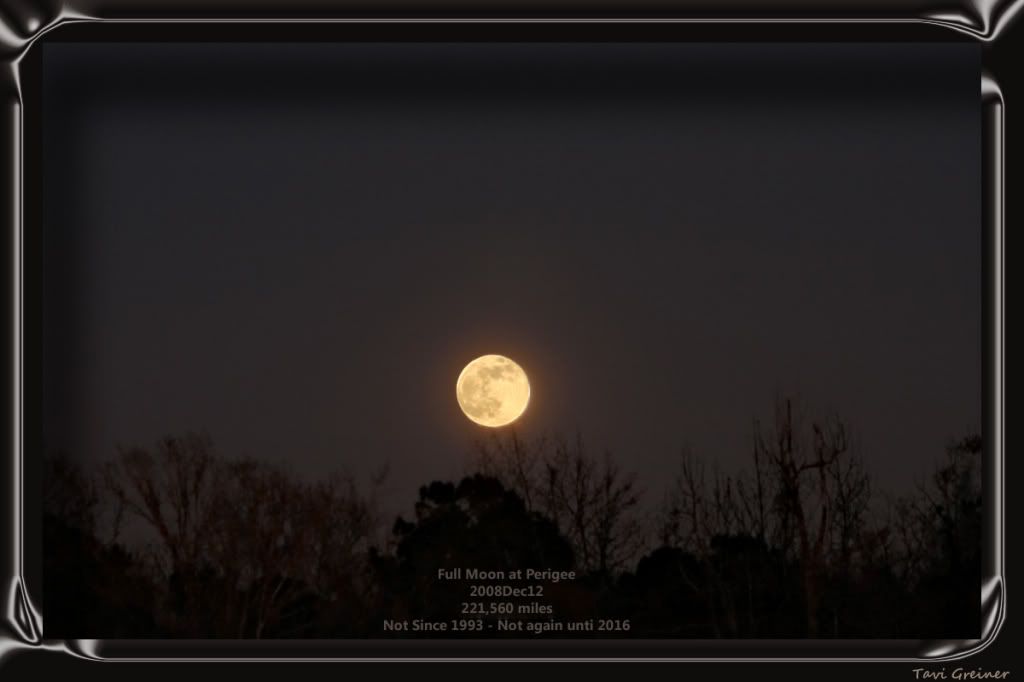
In other news the largest full Moon in 15 years (more, more, more, more and more previews) was observed widely (more and more pics). • The bright Moon hampered (more, more and more previews) visual observations of the Geminids 2008 though some nice pictures were obtained. • Talking about visitors from outer space another nonsensical story about a meteor(ite) setting off a fire in NZ was shot down there as well as here (check also the following message) and here.
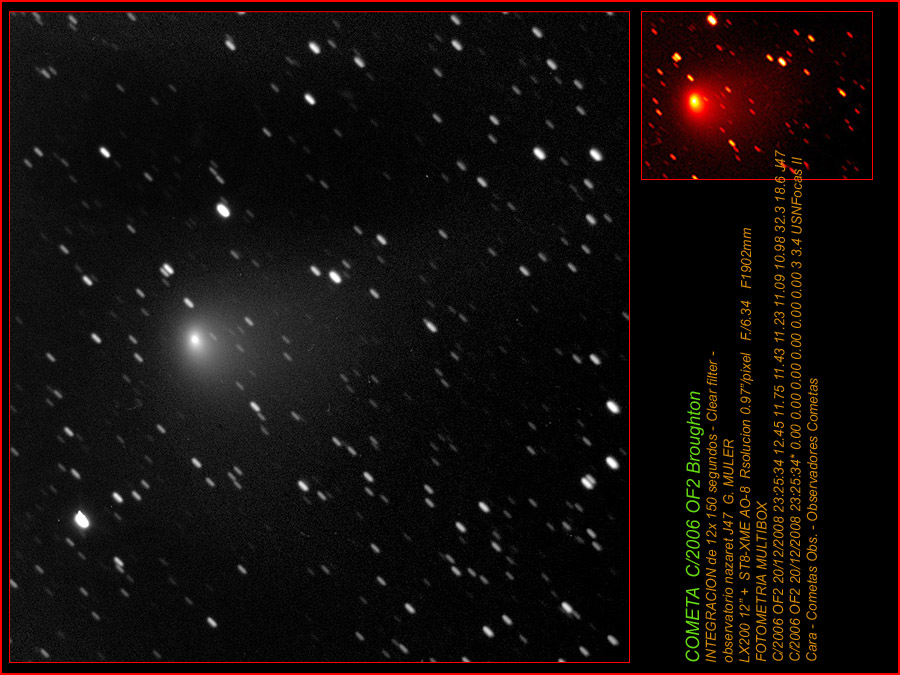
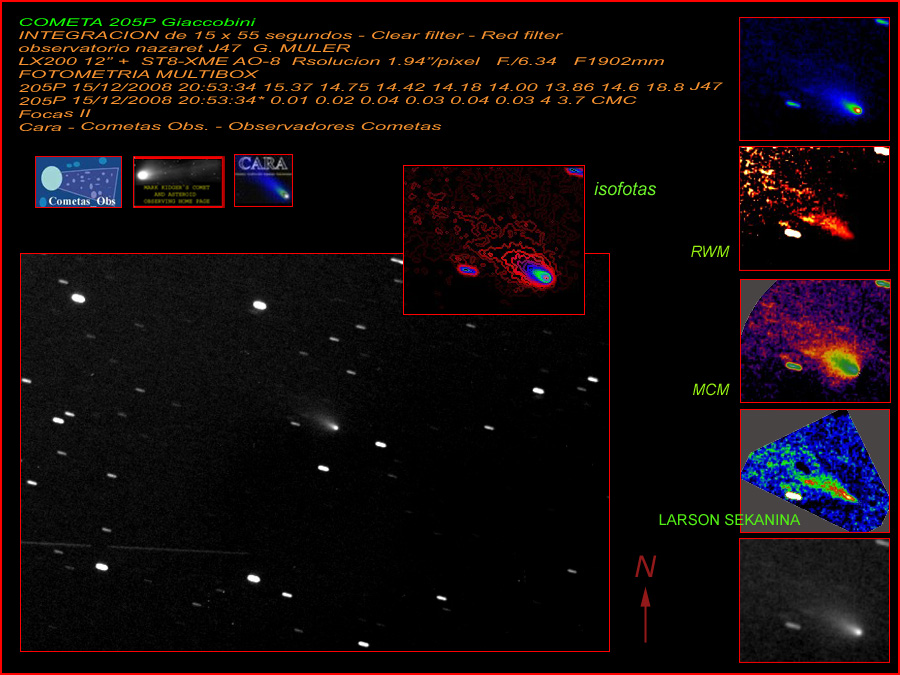
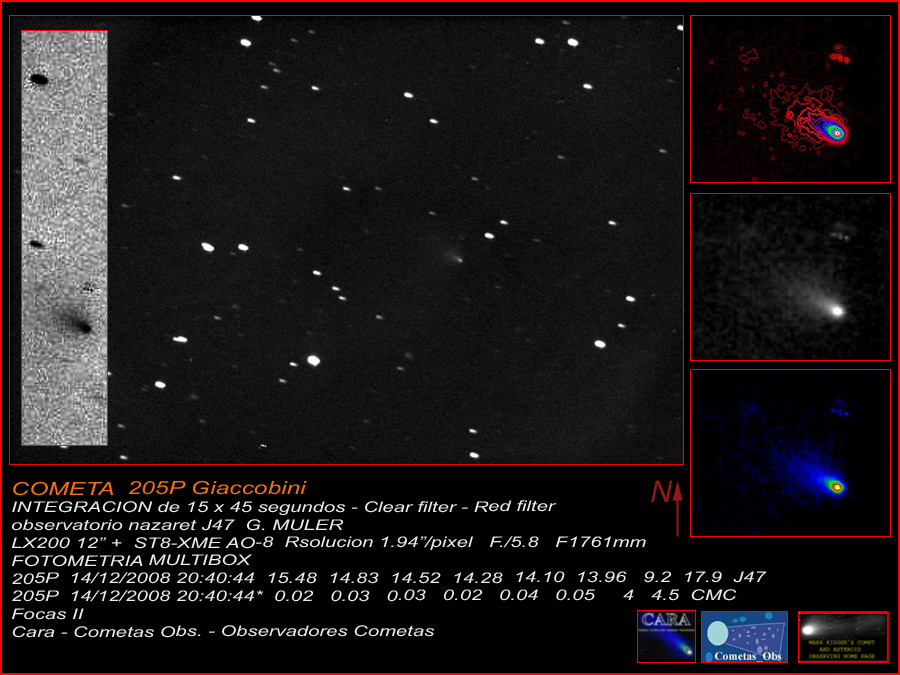
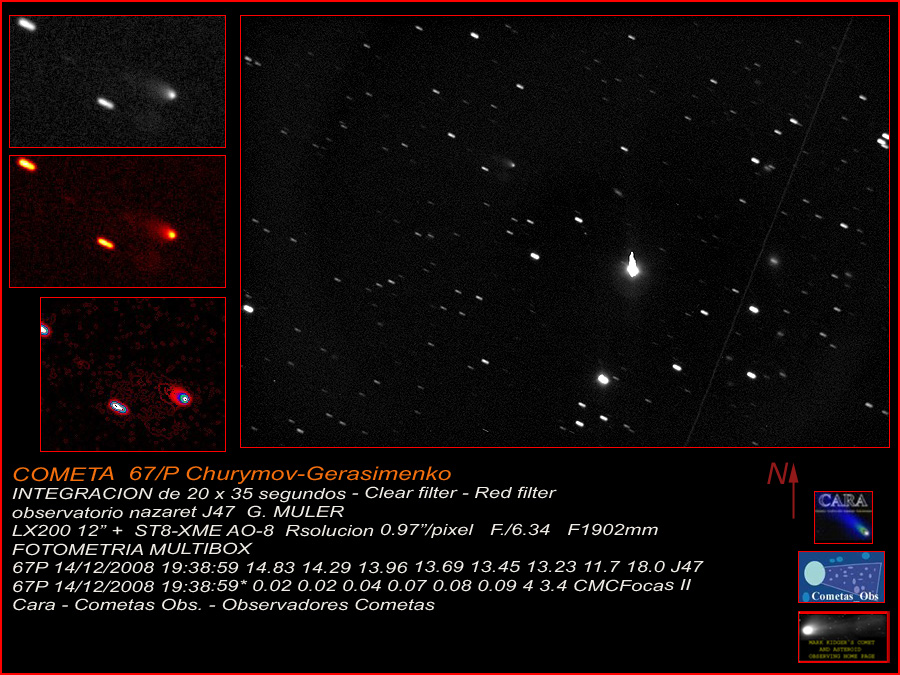
• There is a detailled prediction that one of several recently recovered comets, normally faint, should "light up" tomorrow in the field of view of SOHO's coronagraphs due to extreme forward scattering. The comet is already in the C3 field but difficult to find at 7th mag. • A rendezvous of comets 15P and 17P on Dec. 8. • More pictures of C/2006 OF2, 205P (earlier) and 67P.
• A sky picture with 3 months exposure time, showing Sun trails. • A collection of solar corona pictures from the 1800s. • How the new solar cycle tries to take over. • A reconstructed butterfly diagram for the 18th century. • A solar flare surprise with a stream of perfectly intact hydrogen atoms shooting out of an X-class flare. • Not for the first time aurora watching as an incentive for travel.
• A call for observations for a rare event with EE Cephei. • Amateur variable work can actually lead to real science papers. • The winners of a regional astrophoto contest for South America and India. • And regarding the upcoming International Year of astronomy a new Dark Skies Awareness website with a special trailer, a new website on the Sun and details about the "100 Hours" event in April.
In other news the largest full Moon in 15 years (more, more, more, more and more previews) was observed widely (more and more pics). • The bright Moon hampered (more, more and more previews) visual observations of the Geminids 2008 though some nice pictures were obtained. • Talking about visitors from outer space another nonsensical story about a meteor(ite) setting off a fire in NZ was shot down there as well as here (check also the following message) and here.
• There is a detailled prediction that one of several recently recovered comets, normally faint, should "light up" tomorrow in the field of view of SOHO's coronagraphs due to extreme forward scattering. The comet is already in the C3 field but difficult to find at 7th mag. • A rendezvous of comets 15P and 17P on Dec. 8. • More pictures of C/2006 OF2, 205P (earlier) and 67P.

• A sky picture with 3 months exposure time, showing Sun trails. • A collection of solar corona pictures from the 1800s. • How the new solar cycle tries to take over. • A reconstructed butterfly diagram for the 18th century. • A solar flare surprise with a stream of perfectly intact hydrogen atoms shooting out of an X-class flare. • Not for the first time aurora watching as an incentive for travel.
• A call for observations for a rare event with EE Cephei. • Amateur variable work can actually lead to real science papers. • The winners of a regional astrophoto contest for South America and India. • And regarding the upcoming International Year of astronomy a new Dark Skies Awareness website with a special trailer, a new website on the Sun and details about the "100 Hours" event in April.
Monday, December 8, 2008
PHEMU09 begins tonight: a campaign of observations of the mutual phenomena of the satellites of Saturn
"Tonight (Monday 2008 Dec.08) at 23:50 UT will begin 'the campaign of observations PHEMU09 of the mutual phenomena of the satellites of SATURN in 2008-2010'," advises J.Lecacheux and refers to the PHEMU09 homepage for all details and in particular the interactive software linked there. "While trying it, you will remark that because of the late rise of Saturn tonight, the total occultation of ENCELADE (S II) by TETHYS (S III) will be observable from eastern or central Europe, but not from Great Britain, France or Spain." So what can an amateur do? "The duration of the mutual phenomena, often several minutes, allows some time integration in order to improve the SNR (Signal/Noise ratio), typically between 0.2 and 5 seconds, depending on the diameter of the telescope. Good SNR, good camera linearity and excellent UTC datation of the mid-exposures are the main requirements.
A modern CCD camera mounted at the focus of a large enough mirror is optimal regarding SNR and linearity, but often may induce variable time delay (sometimes more than 1 second) caused by the digital link between the camera and the computer in a multitask environment. In contrast video integration may provide poor linearity and modest SNR." There is a need to hurry: "In reason of the date of the conjunction of Saturn with the Sun (2009 Sep. 18), only a small number of 'phemus' will be observable from a given location during the next 18 months. Even worse : In reason of the Earth-Saturn current geometrical configuration, actually 65 % of the whole set of observable events will occur during the current month of December 2008, and the next one, January 2009!!! So please don't await that better weather condescend to return! If you possess convenient equipment, your immediate cooperation wouldbe very valuable! As early as tonight, if possible!"
In other news there was a -18 mag. fireball over Colorado early on Dec. 6, also observed elsewhere and now analyzed: It is unlikely but not impossible that the event (which was widely reported) has led to meteorites dropping. • Meanwhile the unconfirmed claim of a major (though sub-storm-level) Leonids outburst in 2009 is spreading to the most unlikely places - please refrain from distributing these "news" any further until another dust trail-ologist agrees. He actually got the 2008 Leonids at least as good as the other theorist - and sees only a modest outburst in 2009. • There was a minor panic in the comets community when someone could not find promising Lulin in SOHO images and another one couldn't either - but it is there as was eventually found out, as this image shows.
• Venus is now dominating the evening sky, together with Jupiter and later Mercury as this animation nicely shows. The Moon, which was joining the planet pair on Dec. 2, Dec. 1 and Nov. 30 (as was reported in great detail in the previous two postings) returns to the evening skies only at the month's end. Also enjoy these rare image composites of Venus in the sky (another apparition). • Mira has brightened to 3.9 mag. and is now easy to observe. • As is, apparently the lost astronaut's tool bag now flashing in the sky and discussed here - but not in the official NASA video of STS-126 ... • And finally unusual video of Orion rising.
It is also time for a reminder that this blog is being joined by a Twitter feed since nearly two months: There have already been 1018 "tweets" to date, most of them either linking to all kinds of space news and pictures practically in the moment I found them - or reporting "live" from space events on the web, be it launch broadcasts, press conferences or webinars. The usefulness of Twitter is notoriously hard to explain to the uninitiated (and yours truly had resisted the temptation to join this social network for two years - until personally given the kick by the 'voice of Phoenix' at a conference) - but once you're using the service it becomes clear pretty quickly. There are three levels of engagement possible: just check the Cosmos4U Twitter website occasionally for new tweets ("RT" there means 're-tweeting' someone else's stuff, "@" responds directly to another tweet which is then linked at the bottom), open your own account and subscribe to a few feeds (those which Cosmos4U "follows" are recommended) but stay quiet yourself (as a "twurker" = twitter lurker) - or simply join the party. Since you chose whom to listen to (other than Cosmos4U, of course :-), it's practically spam-free ...
A modern CCD camera mounted at the focus of a large enough mirror is optimal regarding SNR and linearity, but often may induce variable time delay (sometimes more than 1 second) caused by the digital link between the camera and the computer in a multitask environment. In contrast video integration may provide poor linearity and modest SNR." There is a need to hurry: "In reason of the date of the conjunction of Saturn with the Sun (2009 Sep. 18), only a small number of 'phemus' will be observable from a given location during the next 18 months. Even worse : In reason of the Earth-Saturn current geometrical configuration, actually 65 % of the whole set of observable events will occur during the current month of December 2008, and the next one, January 2009!!! So please don't await that better weather condescend to return! If you possess convenient equipment, your immediate cooperation wouldbe very valuable! As early as tonight, if possible!"
In other news there was a -18 mag. fireball over Colorado early on Dec. 6, also observed elsewhere and now analyzed: It is unlikely but not impossible that the event (which was widely reported) has led to meteorites dropping. • Meanwhile the unconfirmed claim of a major (though sub-storm-level) Leonids outburst in 2009 is spreading to the most unlikely places - please refrain from distributing these "news" any further until another dust trail-ologist agrees. He actually got the 2008 Leonids at least as good as the other theorist - and sees only a modest outburst in 2009. • There was a minor panic in the comets community when someone could not find promising Lulin in SOHO images and another one couldn't either - but it is there as was eventually found out, as this image shows.

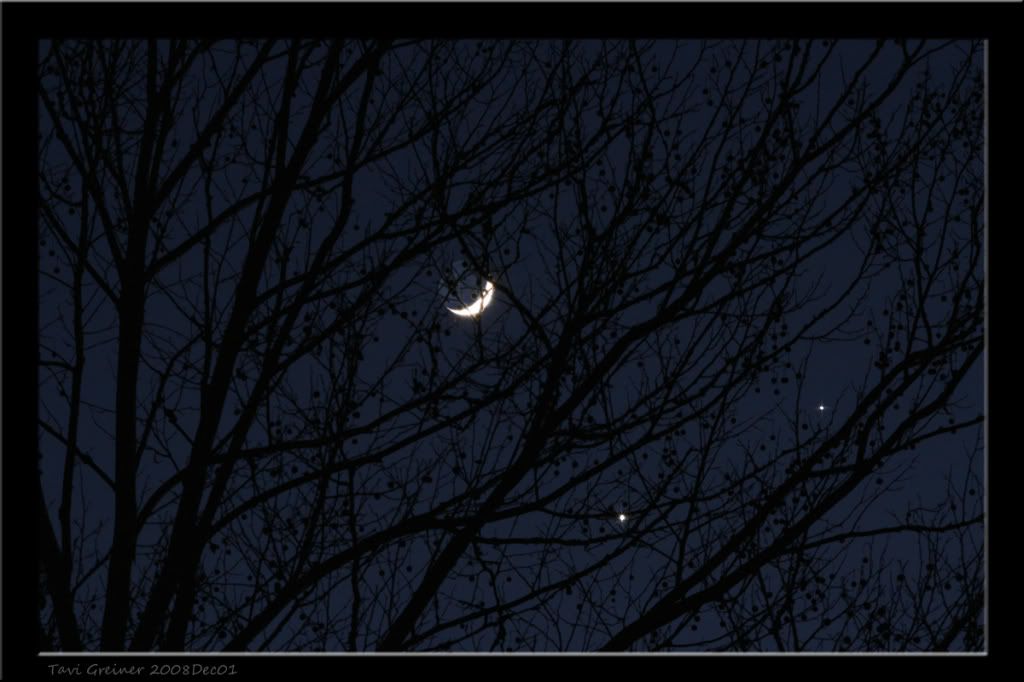
• Venus is now dominating the evening sky, together with Jupiter and later Mercury as this animation nicely shows. The Moon, which was joining the planet pair on Dec. 2, Dec. 1 and Nov. 30 (as was reported in great detail in the previous two postings) returns to the evening skies only at the month's end. Also enjoy these rare image composites of Venus in the sky (another apparition). • Mira has brightened to 3.9 mag. and is now easy to observe. • As is, apparently the lost astronaut's tool bag now flashing in the sky and discussed here - but not in the official NASA video of STS-126 ... • And finally unusual video of Orion rising.
It is also time for a reminder that this blog is being joined by a Twitter feed since nearly two months: There have already been 1018 "tweets" to date, most of them either linking to all kinds of space news and pictures practically in the moment I found them - or reporting "live" from space events on the web, be it launch broadcasts, press conferences or webinars. The usefulness of Twitter is notoriously hard to explain to the uninitiated (and yours truly had resisted the temptation to join this social network for two years - until personally given the kick by the 'voice of Phoenix' at a conference) - but once you're using the service it becomes clear pretty quickly. There are three levels of engagement possible: just check the Cosmos4U Twitter website occasionally for new tweets ("RT" there means 're-tweeting' someone else's stuff, "@" responds directly to another tweet which is then linked at the bottom), open your own account and subscribe to a few feeds (those which Cosmos4U "follows" are recommended) but stay quiet yourself (as a "twurker" = twitter lurker) - or simply join the party. Since you chose whom to listen to (other than Cosmos4U, of course :-), it's practically spam-free ...
Thursday, December 4, 2008
Lots more fine pictures, videos, image collections of the trio & conjunction - and a related detective story ...
have appeared since the first summary appeared here - it was actually linked to in this summary. Picture collections include big ones here, here and here and smaller ones like this and this. Individual pictures published or found since are from Dec. 3 from India and Australia, from Dec. 2 from Germany (scroll down) and Australia and from Dec. 1 from the U.S. (where others just saw it or didn't), Europe (more) with videos from the Netherlands and Austria and pictures from Austria (more, more, more, more and more), Germany (where many saw nothing, though), N. Ireland, Scotland and England, from Morocco and India, namely Mumbai and the Old Fort in Delhi (incl. the next two elements and a multi-day-picture).
And then there was this picture of Nov. 30 from Edwards AFB with the trio over Endeavour (just as it was seen that evening over LA). Originally NASA named this picture "The Setting Sun," and the caption claimed: "The setting sun casts long shadows over space shuttle Endeavour as technicians prepare to move the orbiter from the runway at Edwards Air Force Base where it landed Sunday, Nov. 30" - but how could one unmanipulated shot capture both the Sun and Venus and Jupiter? A big debate ensued on the German amateur astronomy mailing lists Astro and Planetenbeobachter where this blogger had raised questions about the image: First some claimed prematurely that such a picture would easily be possible "if you understood your camera" but the pictures they posted were in fact taken after sunset or poorly documented.
Then others found out that the bright light in the NASA picture could not be the Sun after all: it was in a wrong angle w.r.t. Endeavour's runway, the diverging shadow was evidence for close light source and the "Sun" was too close to the Moon & planets (as someone actually measured from the image). This blogger had already sent a request for details to the Dryden PAO and got a quick response from the actual NASA photographer which included the time the picture was taken: 5:09 PST. It was then easy to calculate that the Sun was 6° below the horizon: The bright light was thus a nearby floodlight and the visibility of Venus and Jupiter was what one would expect at dusk. "Sir, You are indeed correct! Thank you for pointing out that error," the Dryden PAO replied when told of the 'research' result: "I will work to get it corrected." Which has been done - the caption now says: "Floodlights cast long shadows, like a setting sun" ...
In other news here are many more pictures of the fresh Canadian meteorites which include a really big one. • The prognosis of 500 Leonids/hour in 2009 has now also reached NASA where it was apparently confirmed. • There is a Nova Sgr of perhaps 7th magnitude. • The NASA Circular on the two eclipses of 2010 is out as are the individual data for the ASE and the TSE - the weather statistics esp. for the ASE had already caused some debate in October. • Omega Centauri with really many pixels from an 2.2 m groundbased scope (also hailed here and here) - and M 13 from Hubble, also a new release without new science. • Finally another light pollution story in a normal paper - and a kind of sonification of the Arecibo message ...

And then there was this picture of Nov. 30 from Edwards AFB with the trio over Endeavour (just as it was seen that evening over LA). Originally NASA named this picture "The Setting Sun," and the caption claimed: "The setting sun casts long shadows over space shuttle Endeavour as technicians prepare to move the orbiter from the runway at Edwards Air Force Base where it landed Sunday, Nov. 30" - but how could one unmanipulated shot capture both the Sun and Venus and Jupiter? A big debate ensued on the German amateur astronomy mailing lists Astro and Planetenbeobachter where this blogger had raised questions about the image: First some claimed prematurely that such a picture would easily be possible "if you understood your camera" but the pictures they posted were in fact taken after sunset or poorly documented.
Then others found out that the bright light in the NASA picture could not be the Sun after all: it was in a wrong angle w.r.t. Endeavour's runway, the diverging shadow was evidence for close light source and the "Sun" was too close to the Moon & planets (as someone actually measured from the image). This blogger had already sent a request for details to the Dryden PAO and got a quick response from the actual NASA photographer which included the time the picture was taken: 5:09 PST. It was then easy to calculate that the Sun was 6° below the horizon: The bright light was thus a nearby floodlight and the visibility of Venus and Jupiter was what one would expect at dusk. "Sir, You are indeed correct! Thank you for pointing out that error," the Dryden PAO replied when told of the 'research' result: "I will work to get it corrected." Which has been done - the caption now says: "Floodlights cast long shadows, like a setting sun" ...
In other news here are many more pictures of the fresh Canadian meteorites which include a really big one. • The prognosis of 500 Leonids/hour in 2009 has now also reached NASA where it was apparently confirmed. • There is a Nova Sgr of perhaps 7th magnitude. • The NASA Circular on the two eclipses of 2010 is out as are the individual data for the ASE and the TSE - the weather statistics esp. for the ASE had already caused some debate in October. • Omega Centauri with really many pixels from an 2.2 m groundbased scope (also hailed here and here) - and M 13 from Hubble, also a new release without new science. • Finally another light pollution story in a normal paper - and a kind of sonification of the Arecibo message ...
Tuesday, December 2, 2008
Tons of marvellous pictures document cosmic trio, Venus occultation
The triple conjunction of Venus, Jupiter and the Moon, seen in the evening hours around the world yesterday has been observed, photographed and commented on as hardly any such "simple" sky show before. In Australia and Asia the two planets and the lunar crescent formed a "smiley face" as many - even some media - have commented, while half a day later the Moon was on the other side of the planets' line and the smile was gone (though not from the faces of successful observers).
For introduction here are some of the best images from Australia (the smiley over great landscapes), India (over Delhi's Old Fort), Austria (with the Jovian moons visible and - scroll down!!! - a superb video of occultation ingress while this report was online superfast) and the U.S. (with a striking timelapse widefield video). There was also a successful webcast from Cornwall. More images:
For introduction here are some of the best images from Australia (the smiley over great landscapes), India (over Delhi's Old Fort), Austria (with the Jovian moons visible and - scroll down!!! - a superb video of occultation ingress while this report was online superfast) and the U.S. (with a striking timelapse widefield video). There was also a successful webcast from Cornwall. More images:
- The day before a German photographer captured the trio with some roe deer(!); when dusk reached the U.S. the Moon was closer again.
- On December 1st Australia was greeted by above-mentioned smiley face in the sky: a big picture with the Galilean moons, more and more widefield views and experiences.
- In India the smiley was still present over battered Mumbai (from there more pics), a constellation much photographed (more and more scenic views).
- Despite ugly weather predictions, in Germany a number of people were successful (more, more, more, more and more results) as were many in Austria (very scenic shots; here are more, more, more and more results).
- In the U.S. the constellation was imaged even in daylight and then in dark skies (again with the Galilean moons); more, more, more, more and more pictures and impressions.


Sunday, November 30, 2008
"Triple conjunction" just 24 hours away: the highlight of the final month
First Jupiter and Venus crept closer towards each other and since yesterday the crescent Moon is joining the picture: going backwards in time, selected views from Germany, various locations and Australia on Nov. 30, the U.S., Germany, various places, Germany again and Australia on Nov. 29, various sites on Nov. 28, Germany, Austria and Australia on Nov. 27, the U.S. on Nov. 24 and Austria on Nov. 23 - celestial mechanics in action! And the best is to come tomorrow.
In other news the first meteorites that fell after the well-documented Canadian bolide of Nov. 20 have been found and celebrated widely (see here and here and here and here and here and here for coverage and pictures). • Another Canadian bolide - and a rumbling sound in Wales. • According to at least one theorist the Leonids in 2009 could reach a ZHR of 500, i.e. 5 times the typical Perseids. Others haven't confirmed that yet. • Comet Borrelly with a long tail on Nov. 30. • Sometimes here true live images of comets can be seen.
• There is a possible nova in Carina with 7th mag. • And finally the toolbag lost during the 1st EVA of STS-126 has not only been filmed near Eta Psc (which made the videographer kind of famous), it has also been sighted visually, sometimes at 6.5 mag., sometimes even naked-eye, leading the ISS by several minutes already. Predictions are easy to get, and even public events have been proposed - while parodies of the incident abound ...
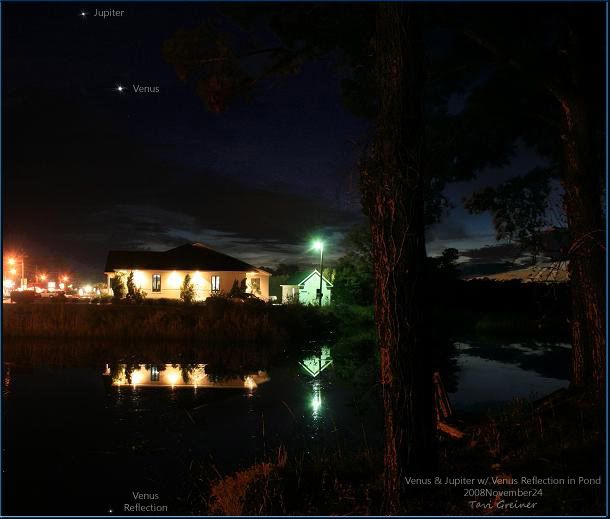
- Dec. 1: Close conjunction of Jupiter, Venus and the Moon, as previewed here (with this, this, this and this preview N-America- and this one Australia-oriented). For Europe there will actually be an occultation of Venus by the Moon as previewed here, here and here!
- Dec. 4/5: Comet C/2008 T2 (Cardinal) approaches the North Pole of the sky to within 7 arc minutes! The comet is at about 13th magnitude.
- Dec. 7: The Trans-Neptunian Object (20,000) Varuna occults a star - with ongoing astrometry the predictions for the ground track have it now pretty stable cutting through the deep South Atlantic.
- Dec. 31: Jupiter will be 1.2° north of Mercury which is experiencing a minor evening visibility. Also Saturn's rings are almost seen from the edge.
- Dec. 31: After a long time there will be once again a leap second, making 2008 one second longer - and thus delaying the beginning of the International Year of Astronomy 2009 ...
In other news the first meteorites that fell after the well-documented Canadian bolide of Nov. 20 have been found and celebrated widely (see here and here and here and here and here and here for coverage and pictures). • Another Canadian bolide - and a rumbling sound in Wales. • According to at least one theorist the Leonids in 2009 could reach a ZHR of 500, i.e. 5 times the typical Perseids. Others haven't confirmed that yet. • Comet Borrelly with a long tail on Nov. 30. • Sometimes here true live images of comets can be seen.

• There is a possible nova in Carina with 7th mag. • And finally the toolbag lost during the 1st EVA of STS-126 has not only been filmed near Eta Psc (which made the videographer kind of famous), it has also been sighted visually, sometimes at 6.5 mag., sometimes even naked-eye, leading the ISS by several minutes already. Predictions are easy to get, and even public events have been proposed - while parodies of the incident abound ...
Monday, November 24, 2008
Major Canadian bolide on Nov. 20 documented by several videos!
A dazzling meteor on the evening of Nov. 20 was "widely seen over a wide portion of the Canadian prairies, resulting not only in hundreds of eye-witness reports [like these] but some wonderful videos" like this one (also here), this and this one - and one shows that "the object broke into pieces. Some may have survived the explosion and have fallen to Earth where, with luck, searchers will find them as charred, blackened rocks sitting on the snow in a farmer’s field. The search is now on, first in narrowing down the fall area, followed by the field work, interviewing eyewitnesses, finding those who saw it fly overhead, and those who may have heard it. Then the real work begins — tramping winter fields looking for dark rocks that don’t belong."
According to early analysis, "the object that entered the atmosphere had a mass of from 1 to 10 tonnes, likely as big as a chair to a desk in size. It fragmented in the large explosion everyone witnessed but reports suggest hundreds of meteorites could be on the ground, in an area near the Alberta-Saskatchewan border north of Provost and Macklin (110°W 52.6°N). At peak brightness, the fireball reached about magnitude -20 — that's 600 times brighter than the Full Moon." Such a thing leaves ample trails on the web: Spaceget and SpaceWeather, e.g., link to the videos, Astroengine has stills, TransientSky, ScienceBlogs, BadAstronomy, UniverseToday, NASA Watch and ROG report as do CBC, MSNBC and SPIEGEL.
The Leonids of 2008 did produce one major peak with a ZHR approaching 100 but not two as was also predicted for these meteors (always good for a headline). Here and here are some images, here, here and here reports. • Many comets on Nov. 22, 17P/Holmes on Nov. 23 and Nov. 6 and 68P/Klemola at Messier 17. • Various links about a stellar occultation by TNO Varuna on Dec. 7, a very rare event: Other than by Pluto no stellar occultation has ever been recorded by a Kuiper Belt Object.
The full Moon at/in front of Messier 45 on Nov. 13, also seen here and here and here - and its waning crescent on Nov. 23. Venus and Jupiter are approaching each other, one week before a tight conjunction also involving the Moon. Views from Nov. 23 (more), Nov. 20 and Nov. 17, plus the view from down under and daily previews. • Rhea's shadow on Saturn. • The aurora from a plane. • A collection of corona images.
And finally some good news out of the bad: The San Fernando Observatory - which this blogger visited last year - survived the big fire of Sylmar (at the Northern periphery of Los Angeles). "The observatory is fine, although we did have fire in the surrounding shrubbery," CSUN's Angie Cookson told this blog on Nov. 17: "None of the buildings sustained damage and we just have to deal with cleaning up ash and soot. The fires have been (and continue to be) just devastating. Driving from home this morning and looking at the burned areas, I was amazed that more homes weren't lost. The firemen truly do an incredible job."
According to early analysis, "the object that entered the atmosphere had a mass of from 1 to 10 tonnes, likely as big as a chair to a desk in size. It fragmented in the large explosion everyone witnessed but reports suggest hundreds of meteorites could be on the ground, in an area near the Alberta-Saskatchewan border north of Provost and Macklin (110°W 52.6°N). At peak brightness, the fireball reached about magnitude -20 — that's 600 times brighter than the Full Moon." Such a thing leaves ample trails on the web: Spaceget and SpaceWeather, e.g., link to the videos, Astroengine has stills, TransientSky, ScienceBlogs, BadAstronomy, UniverseToday, NASA Watch and ROG report as do CBC, MSNBC and SPIEGEL.
The Leonids of 2008 did produce one major peak with a ZHR approaching 100 but not two as was also predicted for these meteors (always good for a headline). Here and here are some images, here, here and here reports. • Many comets on Nov. 22, 17P/Holmes on Nov. 23 and Nov. 6 and 68P/Klemola at Messier 17. • Various links about a stellar occultation by TNO Varuna on Dec. 7, a very rare event: Other than by Pluto no stellar occultation has ever been recorded by a Kuiper Belt Object.

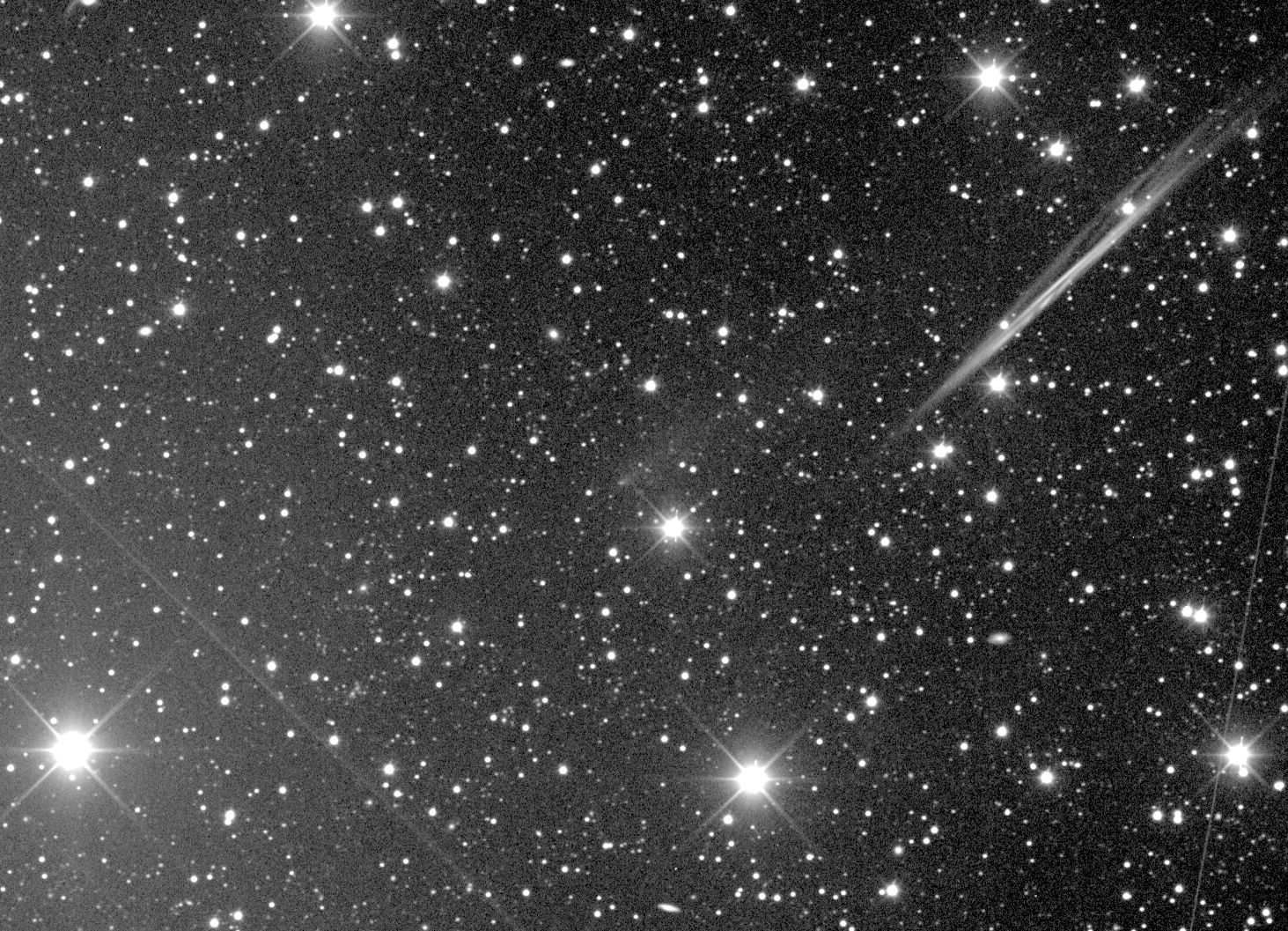
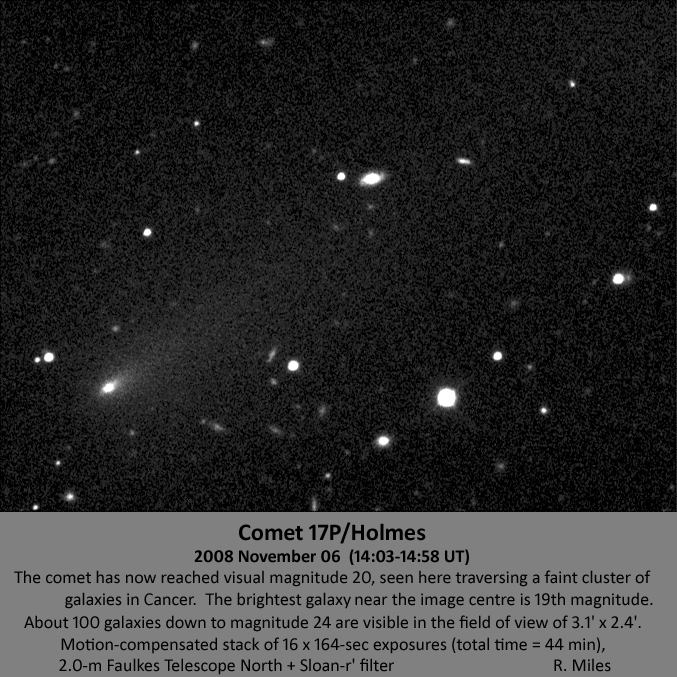
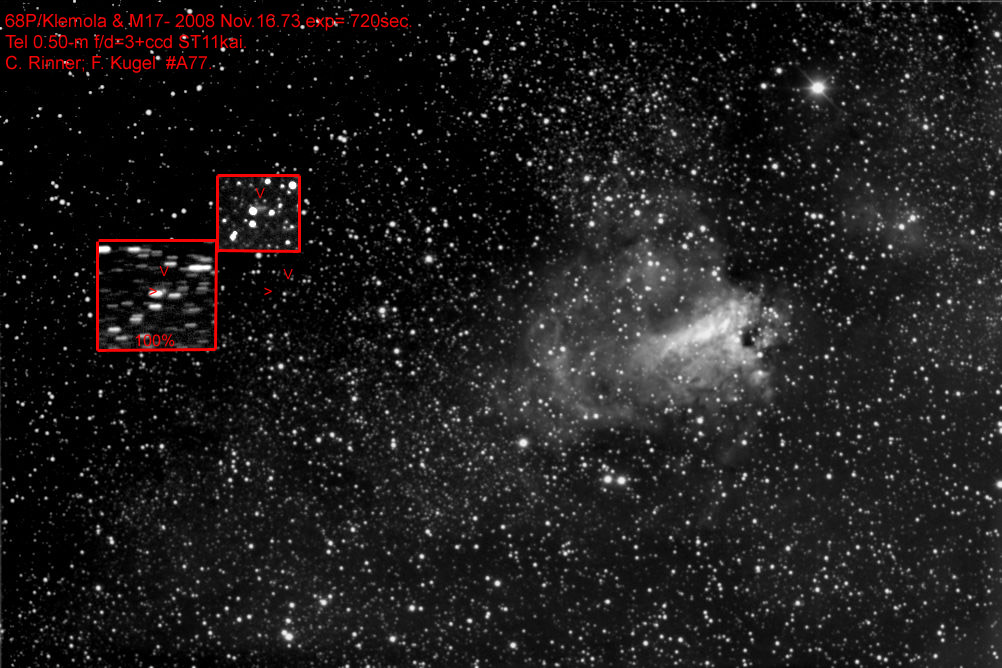
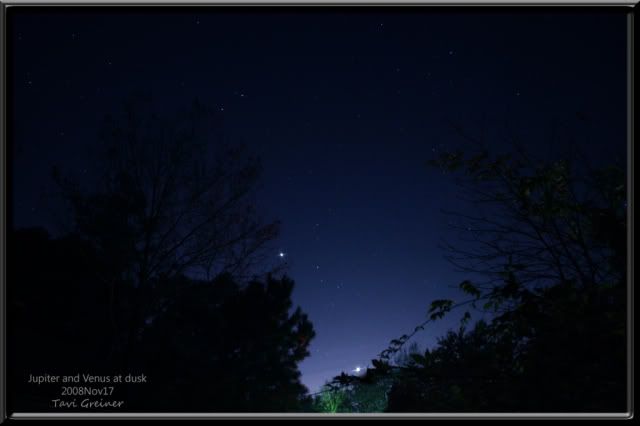
The full Moon at/in front of Messier 45 on Nov. 13, also seen here and here and here - and its waning crescent on Nov. 23. Venus and Jupiter are approaching each other, one week before a tight conjunction also involving the Moon. Views from Nov. 23 (more), Nov. 20 and Nov. 17, plus the view from down under and daily previews. • Rhea's shadow on Saturn. • The aurora from a plane. • A collection of corona images.
And finally some good news out of the bad: The San Fernando Observatory - which this blogger visited last year - survived the big fire of Sylmar (at the Northern periphery of Los Angeles). "The observatory is fine, although we did have fire in the surrounding shrubbery," CSUN's Angie Cookson told this blog on Nov. 17: "None of the buildings sustained damage and we just have to deal with cleaning up ash and soot. The fires have been (and continue to be) just devastating. Driving from home this morning and looking at the burned areas, I was amazed that more homes weren't lost. The firemen truly do an incredible job."
Subscribe to:
Posts (Atom)